
Sports

No Image

Bob Ryan Reflects On Nearly 3 Decades Of ESPN's 'The Sports Reporters'

NPR’s Robert Siegel talks to Bob Ryan what he will do Sunday mornings now that The Sports Reporters roundtable on ESPN is off the schedule.

ROBERT SIEGEL, HOST:

There are several Sunday morning TV roundtables that feature journalists parsing the week’s events and arguing about them – “Meet The Press,” “Face The Nation.” I tend to watch them joylessly as a form of homework, but there has been one Sunday morning roundtable that I’ve watched faithfully and happily, until last weekend when it aired for the last time.

(SOUNDBITE OF TV SHOW, “THE SPORTS REPORTERS”)

SIEGEL: ESPN’s “The Sports Reporters” mixed a kid’s passion for sports with appropriate adult-sized doses of insight, realism and cynicism about the industries that thrive at the expense of gifted athletes. There was a host and a cast of familiar sportswriters, three of them each Sunday. Last week, Mitch Albom, Bill Rhoden and Bob Ryan joined host Mike Lupica for the last go-round.

And as I was wondering what I’m going to be doing without “The Sports Reporters” on Sunday mornings, the question occurred to me – what are they going to be doing? So we’ve called up “Sports Reporters” regular Bob Ryan of The Boston Globe, who joins us from Sarasota, Fla. Hi. Sorry to hear about it.

BOB RYAN: Oh, thank you very much. Well, in the short run, I think we plan on feeling sorry for ourselves.

SIEGEL: (Laughter).

RYAN: That’s – we’ll spend a good portion of Sunday mornings reminiscing and being nostalgic about all the good times we had, and, man, we did have many of them over the course of, in my case, 28 years.

SIEGEL: Twenty-eight. This week you weren’t scheduled to be on the show had there been one, but next Sunday morning?

RYAN: Oh, that is – I’m certain that that is when the withdrawal symptoms will become real.

SIEGEL: This Sunday, they I think would have been talking about perhaps an amazing win by the San Antonio Spurs on the road without their best player playing. Do you miss the chance to hold forth on these things?

RYAN: Positively. We would undoubtedly be marveling at the stunning development in Houston when the Spurs beat them by 39 points on their home court in an epic game 6.

SIEGEL: How different is the beat and the discussion that can be held by, you know, four sportswriters today than it was 30 years ago?

RYAN: So many of the people out there, the public, has access to information that was once our exclusive province, and so it’s easier to misspeak and be called on it than it was 30 years ago.

SIEGEL: (Laughter). And has the range of subjects – has the number of times that you found yourself talking about doping and domestic violence, is it radically different today than it was 30 years ago?

RYAN: Yes. The social issues are a part of the deal, especially in the fall when the National Football League goes about its business, and there is such a disproportionate number of miscreants, people who are unfortunately in the papers for the wrong reasons. I’m not saying that’s the only league where that happens, but I think anyone knows that you don’t get too far away without discussing who’s being suspended in that league.

SIEGEL: The show is unique on ESPN. Do you think it would be harder today to pitch a show where four people talk intelligently and, you know, not always shouting about sports? Is that considered just not an apt idea anymore?

RYAN: What is not considered an apt idea is agreement. What is considered an apt idea is conflict. We weren’t in it to seek conflict. If we had differing opinions, wonderful. It was organic. That was fine. But I have to tell you, and I’m a part of another program on the network, that sometimes we do manufacture issues for the sake of entertainment. And I don’t think for one second we ever thought that way on “The Sports Reporters.”

SIEGEL: By the way, why was “The Sports Reporters” canceled? Was it expensive to bring everybody up to Connecticut every week to do or just low ratings? Or what did they tell you?

RYAN: The only reason we were given – and I am not making this up, and I’m not being hyperbolic, I’m being – quoting verbatim – “we’re going in another direction,” unquote, unquote. So you can take a look at the drift of the nature of some of the programs on the network now, it will tell you what direction that is in. But I don’t see it that I have much of a right to complain about the opportunity that ESPN gave me and as well as the rest of us to have this forum for the last 28 years.

SIEGEL: Well, Bob Ryan, thanks for lots of wonderful Sunday morning half-hours that you and your colleagues and friends provided for me. Good luck, and I’ll be missing you.

RYAN: It’s nice to hear from you. Thank you, Robert.

SIEGEL: Bob Ryan of The Boston Globe was a regular on ESPN’s “The Sports Reporters” which aired for the last time last Sunday.

(SOUNDBITE OF SONG, “PUT ON YOUR SUNDAY CLOTHES”)

UNIDENTIFIED SINGER: (Singing) Put your Sunday clothes. There’s lots of world out there.

Copyright © 2017 NPR. All rights reserved. Visit our website terms of use and permissions pages at www.npr.org for further information.

NPR transcripts are created on a rush deadline by Verb8tm, Inc., an NPR contractor, and produced using a proprietary transcription process developed with NPR. This text may not be in its final form and may be updated or revised in the future. Accuracy and availability may vary. The authoritative record of NPR’s programming is the audio record.

Let’s block ads! (Why?)


No Image

Fenway Incidents Prompt Questions About Hate Speech At The Ballpark

Last week at Boston’s Fenway Park, fans openly used racial slurs, and in one case they were directed at Baltimore Orioles outfielder Adam Jones. NPR explores if the incidents are isolated or part of a larger problem.

KELLY MCEVERS, HOST:

Last week, Baltimore Orioles outfielder Adam Jones said he was the target of racial slurs during a game at Fenway Park in Boston. A day later at Fenway, there was another fan using another racial insult this time directed at a Kenyan woman who sang the national anthem. NPR’s Tom Goldman reports that people are wondering if these incidents are isolated or part of a growing problem.

TOM GOLDMAN, BYLINE: While the furor around Adam Jones has receded, the discussion hasn’t even 3,000 miles west of Fenway Park.

(CHEERING, APPLAUSE)

GOLDMAN: On an otherwise carefree afternoon, baseball fans at Angel Stadium of Anaheim stopped to talk about hate speech. None of those we polled this past weekend said they’d ever witnessed it at a ballgame, but all of them said they wouldn’t stay quiet if they did. Amanda Israel is a first-year dental student at USC.

AMANDA ISRAEL: I would honestly – I wouldn’t even go to the usher. I would go straight to the person. I mean, yeah, some people may be afraid to kind of approach it, but I think if you approach it yourself, you’ll know that it will get taken care of, whereas somebody might just brush it off because they don’t want to engage in conflict.

HARRY EDWARDS: I think it’s a positive thing for us to be talking about it.

GOLDMAN: That’s longtime sociologist and civil rights activist Dr. Harry Edwards. He says a national conversation about hate speech at the ballpark is especially positive because historically, black athletes dealt with racist taunts by themselves, athletes from Jack Johnson to Jackie Robinson to Muhammad Ali to Shaquille O’Neal and so many others who weren’t famous. But Dr. Edwards says with Fenway Park, we need to know what it is we’re talking about, an isolated incident or…

EDWARDS: Are we talking about these individuals as simply the latest manifestation of the much wider problem in American society?

GOLDMAN: Perhaps. Dr. Richard Lapchick directs the Institute for Diversity and Ethics in Sport at the University of Central Florida. He tracks racist incidents in sports. In 2016, he says there were 31 nationwide, mostly affecting pro athletes.

RICHARD LAPCHICK: It was triple the year before.

GOLDMAN: That jump from 11 to 31 came at a time when there was a reported 20 percent increase in hate crimes nationwide. But few, if any, of those crimes had the counterpoint seen last week at Fenway Park when fans showed their support for Adam Jones. Again, here’s Dr. Harry Edwards.

EDWARDS: You can go from a racist incident that goes viral one day and the very next day have a standing ovation for that same athlete by 35,000 people. That carries a message with it.

GOLDMAN: Dr. Edwards says over the last 50 years, he’s witnessed the power of sports as a lever for social change. It’s a stretch to expect baseball to provide a roadmap for dealing with this country’s intractable issue of race relations. Still, MLB wants to send a message within its world. For at least the last decade, all 30 teams have been required to give fans the opportunity to report hate speech by alerting an usher or by sending a text to club officials. Late last week, baseball commissioner Rob Manfred said MLB is surveying each team’s policies, what they do to handle Adam Jones-like incidents.

(SOUNDBITE OF ARCHIVED RECORDING)

ROB MANFRED: As a prelude to giving consideration to some more industry-wide guidelines in this area.

GOLDMAN: At a minimum, baseball hopes to deliver what fans want from a day at the park – a day away from the world outside. Tom Goldman, NPR News.

Copyright © 2017 NPR. All rights reserved. Visit our website terms of use and permissions pages at www.npr.org for further information.

NPR transcripts are created on a rush deadline by Verb8tm, Inc., an NPR contractor, and produced using a proprietary transcription process developed with NPR. This text may not be in its final form and may be updated or revised in the future. Accuracy and availability may vary. The authoritative record of NPR’s programming is the audio record.

Let’s block ads! (Why?)


No Image

I'll Pass On The $495 Sneakers, Pablo Torre Says

Did you pay a little extra for a sports star’s name on your latest pair of sneakers? Well, a budding NBA player’s dad is relentlessly promoting the chance to pay even more for potential star power.

STEVE INSKEEP, HOST:

Did you pay a little bit extra for that last pair of sneakers – maybe even a lot more so that some sports star’s name could grace your ankles? Well, sports commentator Pablo Torre says you can now pay an even bigger premium for the mere potential of star power cache.

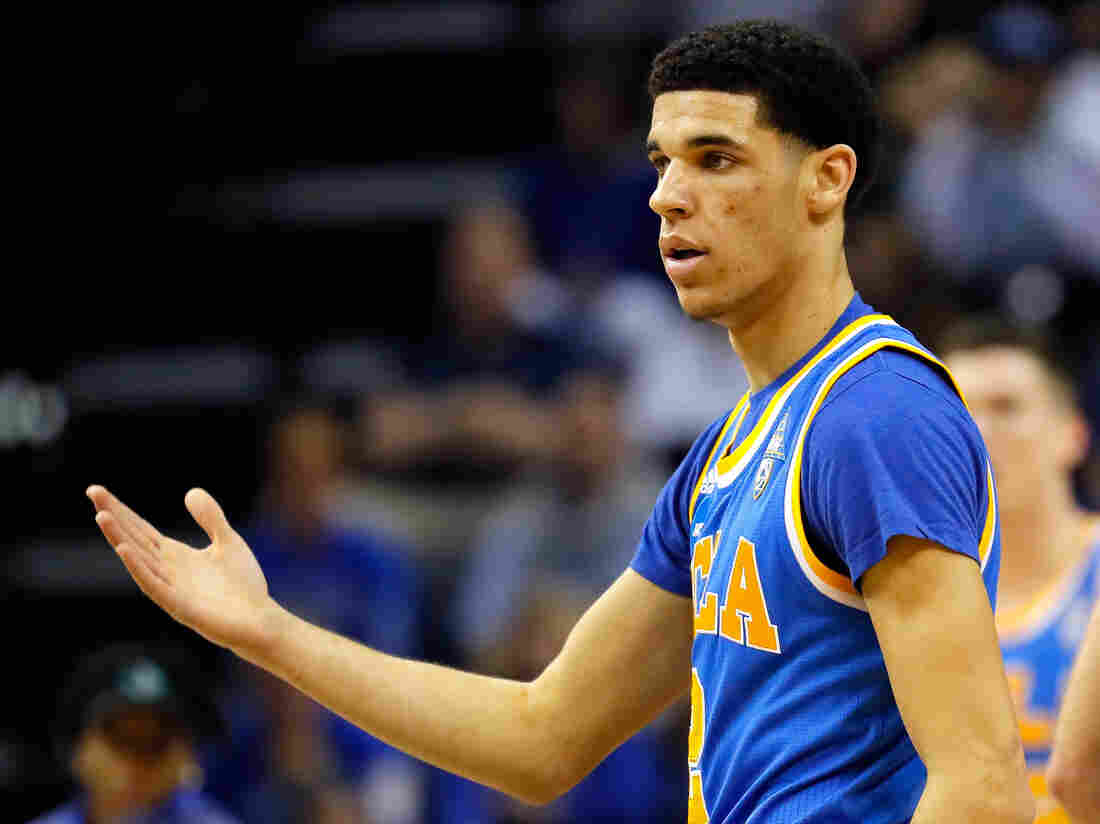
PABLO TORRE: If you haven’t heard of a man named LaVar Ball, consider yourself an endangered species. LaVar’s son, Lonzo Ball, is a relatively quiet kid, a point guard out of UCLA and a surefire top pick in June’s NBA draft.

But Lonzo has very little to do with why his dad is dominating the sports news cycle or why LaVar was called the worst thing to happen to basketball in the last hundred years by an executive at Nike, which passed on signing his son to a shoe contract, as did Adidas and Under Armour. All of that is happening because LaVar says stuff like this, from an ESPN segment.

(SOUNDBITE OF ARCHIVED RECORDING)

LAVAR BALL: We going to get a billion dollars. Trust and believe that. I’ve told my boys this. Somebody got to be better than Michael Jordan. Why not you?

TORRE: He also says stuff like this.

(SOUNDBITE OF ARCHIVED RECORDING)

BALL: I have the utmost confidence in what my boy’s doing. I’m going to tell you right now, he better than Steph Curry to me. Here, put Steph Curry on UCLA’s team right now. And put my boy on Golden State, and watch what happens.

TORRE: …And also stuff like this.

(SOUNDBITE OF ARCHIVED RECORDING)

BALL: I don’t care if I’m viewed off the rails ’cause guess what? I am off the rails. So it don’t matter what y’all say.

TORRE: In that aforementioned quest for a billion dollars, notably, the Ball family had been seeking a business partner for Big Baller Brand, the family’s apparel company, instead of the typical endorsements for Lonzo. But with none of those giant corporations interested, Big Baller Brand was left to set its own retail price, which is why Lonzo’s custom-designed sneaker can now be had for a mere $495, which is more than twice as expensive as any Nikes endorsed by LeBron James. When this was announced last week, NBA coaches like Golden State’s Mike Brown had roughly the reaction you’d expect in response to a reporter’s question.

(SOUNDBITE OF ARCHIVED RECORDING)

UNIDENTIFIED REPORTER: Would you buy your kids a pair of shoes for $500…

MIKE BROWN: (Laughter).

UNIDENTIFIED REPORTER: From an unproven NBA player?

BROWN: No.

TORRE: But while LaVar may be a delusional huckster, we should also be clear about something. He isn’t the downfall of basketball culture. In fact, the guy is just playing by the rules of the game. Yes, demanding a business partnership sounds ludicrous, until you realize that LeBron, who preaches seeking equity over endorsements, is pioneering that very model himself. And yes, $495 sounds like an arbitrarily exorbitant price point for a basketball sneaker, until you realize that $200, objectively, is too.

And yes, unabashed self-promotion sounds like a self-defeating tactic, until you realize that the most precious resource in the Internet age is attention, which LaVar generates nearly as easily as the president of the United States. So no, you don’t have to buy his son’s sneakers. But in sports, as in politics, you should never underestimate the upside of going off the rails.

INSKEEP: Commentator Pablo Torre is a senior writer for ESPN The Magazine.

Copyright © 2017 NPR. All rights reserved. Visit our website terms of use and permissions pages at www.npr.org for further information.

NPR transcripts are created on a rush deadline by Verb8tm, Inc., an NPR contractor, and produced using a proprietary transcription process developed with NPR. This text may not be in its final form and may be updated or revised in the future. Accuracy and availability may vary. The authoritative record of NPR’s programming is the audio record.

Let’s block ads! (Why?)


No Image

Yankees Defeat Cubs In 18-Inning Game That Broke Combined Strikeouts Record

The Yankees beat the Cubs last night in an 18-inning game that lasted six hours and five minutes, and broke the record for the most combined strikeouts in any game.

KELLY MCEVERS, HOST:

The New York Yankees played the Chicago Cubs last night at Wrigley Field – and played and played and played.

ROBERT SIEGEL, HOST:

They played into the morning, in fact. They tied in the bottom of the ninth and played to the 18th inning. For those of you who are math or baseball-challenged, that is nine more innings than usual.

MCEVERS: Six hours and five minutes of baseball, the longest major league game this season.

SIEGEL: There were many challenges.

(SOUNDBITE OF ARCHIVED RECORDING)

DAN SHULMAN: You need some new baseballs. Four hundred and seventy-two pitches, 41 strikeouts, just shy of tying the major league record. We need a new supply of baseballs.

AARON BOONE: Rub ’em (ph) up. Rub ’em up.

SIEGEL: That’s ESPN’s Aaron Boone and Dan Shulman, used with permission of Major League Baseball.

MCEVERS: Another challenge for this marathon of a game was keeping the fans awake. One stretch at the seventh inning wasn’t enough, so they stretched again in the 14th.

SIEGEL: A few innings later, their fortitude paid off.

(SOUNDBITE OF ARCHIVED RECORDING)

SHULMAN: New major league record, 44th strikeout in a game.

MCEVERS: And yet that record did not stand. When the Yankees finally won in the 18th inning, the number of strikeouts was up to 48.

SIEGEL: They were thrown by 15 different pitchers for a total of 583 pitches in this very long baseball game.

MCEVERS: Not just long for players and fans. ESPN’s Buster Olney set his own record.

BUSTER OLNEY: As a sideline reporter, you know, I have to remain in place basically from the first pitch to the end of the game. So I stopped drinking liquids at about 2 o’clock in the afternoon because I can’t go to the bathroom during the course of the game. So the game started at 7:08. And we get to 1 o’clock, we get to the 18th inning, and I have a crisis developing.

MCEVERS: Happy to say crisis averted.

SIEGEL: A final note. This is not the longest major league baseball game ever. That honor belongs to the White Sox and the Brewers. In 1984, they played for eight hours and six minutes, 25 innings, before Chicago won.

(SOUNDBITE OF GEORGE BENSON’S “BENSON’S RIDER”)

Copyright © 2017 NPR. All rights reserved. Visit our website terms of use and permissions pages at www.npr.org for further information.

NPR transcripts are created on a rush deadline by Verb8tm, Inc., an NPR contractor, and produced using a proprietary transcription process developed with NPR. This text may not be in its final form and may be updated or revised in the future. Accuracy and availability may vary. The authoritative record of NPR’s programming is the audio record.

Let’s block ads! (Why?)


No Image

World-Renowned Rock Climber On Constantly Pushing The Limits

NPR’s Lakshmi Singh talks to Tommy Caldwell, the first to free climb a 3,000 foot “Dawn Wall” granite cliff, about his book The Push: A Climber’s Journey of Endurance, Risk and Going Beyond Limits.

LAKSHMI SINGH, HOST:

For professional musicians, the instrument on which they play is more than just a tool of the trade. It can also be a muse, a partner and a voice. A new book titled “Gone: A Girl, A Violin, A Life Unstrung” shares one artist’s story of finding her inspiration only to have it stolen away. We’ll let the author take it from here.

MIN KYM: My name’s Min Kym, and I play the violin.

(SOUNDBITE OF MUSIC)

KYM: I started playing at the age of 6 and a half. I won my first competition when I was 11. And, yeah, I’ll start it from there.

(SOUNDBITE OF MUSIC)

KYM: It took me until adulthood to be able to say the word child prodigy. Like, when I was a child and people used to sort of, you know, talk about me in that way, I was so mortified. I mean, it was just, you know, you just don’t want to be. I just wanted to have fun.

(SOUNDBITE OF MUSIC)

KYM: From a very young age, I was aware that the most important thing as a violinist and as a musician is to find your voice through the right instrument.

(SOUNDBITE OF MUSIC)

SINGH: And for a professional soloist, that means a top shelf violin worth hundreds of thousands of dollars. And for Kym, that meant a Stradivarius. She had saved all of her competition winnings for this purpose. Now she just needed to find the right one.

KYM: The dealer who I was talking to came to my parents’ house. I was 21. And he had a double case with him and two violins. And everybody was sort of pointing towards one of the violins which had a incredibly sonorous and powerful sound, everything that as a soloist you would be looking for. So I picked it up and I drew my bow across it, and, yeah, of course, it sounded magnificent.

But it was like I was wearing an incredibly beautiful gown that didn’t suit me. And so I put it down, and I picked up the other one. And it was smaller. It had been repaired. It got through the walls, and I could see that. However, when I played that first note – just, oh, my goodness – the vibrations of it. I knew this was my voice.

(SOUNDBITE OF MUSIC)

KYM: It had an incredible soprano. It was very bell-like. It had this what I like to call space around the notes.

(SOUNDBITE OF MUSIC)

KYM: You could almost hear (laughter) – this is really going to make me sound like a fruitcake actually, but you could hear an orbit around the note.

(SOUNDBITE OF MUSIC)

KYM: The real true partnership I felt was with this Strad. And I had my violin for 10 years, and I was still getting to know it. Even after 10 years, it was still showing me new things. It was teaching me new ways of playing.

(SOUNDBITE OF MUSIC)

KYM: But that was short lived. Unfortunately, it’s real life. It isn’t a fairytale.

SINGH: What happened next made headlines.

KYM: I remember it like it was just, you know, moments ago. It was a cold November evening. I’d had an asthma attack earlier. So I wasn’t feeling very well, and I had a argument with my boyfriend at the time who was going to look after my violin. And there were only two other people in my life that I’ve ever entrusted my violin. So I was very reluctant not to have it in my possession, but I did agree to let him look after the violin. And one minute it was there, and the next minute it was gone.

(SOUNDBITE OF MUSIC)

SINGH: While Kym and her boyfriend sat in a train station cafe, three thieves snagged her Stradivarius out from under the table.

KYM: I’ve relived that moment – I sort of think if this hadn’t happened, then that wouldn’t have happened. You know, if we hadn’t made this decision, if I hadn’t made that decision, you know, and I went through it, I went through it with such a fine-toothed comb with the detectives. And he just reminded me that he’s a professional. I’m a professional. And they were professional thieves. It’s one of those things that I still find so horribly painful to talk about.

I didn’t know who I was anymore, and I didn’t know what to do with myself. I felt as though I was just sort of a shell of a person. You know, when it’s a human relationship, it’s something that everybody can relate to and understand. But I think as a violinist, as a musician, as an artist when, you know, the relationship you have with your particular art, it’s something that lives inside you. And it’s – it has a life of its own. And that’s very difficult to explain or describe. And so, you know, after three years, it was recovered. I was on the train, and I – and the phone rang. And it was Detective Rose (ph), and he said, Min, I have good news for you. So I thought, well, he’s never said that before.

(SOUNDBITE OF MUSIC)

KYM: For three years, my spirits were just on the floor. And in that nanosecond, they just completely lifted again, and I felt human again. I felt like me.

(SOUNDBITE OF MUSIC)

SINGH: Kym wishes her story would have ended with her being reunited with her violin, but unfortunately it didn’t. By the time the Stradivarius was found, Kym had already spent the money she received from the insurance claim on a new violin, so she could continue with her career.

KYM: Too much time had passed, so for financial reasons, I wasn’t able to buy my violin back. One of the most important things that I learned throughout this whole process is that we have such little control over anything, but one thing that we do have control is how you deal with the next steps forward. Writing actually finding this new voice, it helped unblock my musical life. And, you know, for the first time in seven years or so, I felt hopeful again.

SINGH: That was violinist and author Min Kym. Her book “Gone: A Girl, A Violin, A Life Unstrung” is out now.

Copyright © 2017 NPR. All rights reserved. Visit our website terms of use and permissions pages at www.npr.org for further information.

NPR transcripts are created on a rush deadline by Verb8tm, Inc., an NPR contractor, and produced using a proprietary transcription process developed with NPR. This text may not be in its final form and may be updated or revised in the future. Accuracy and availability may vary. The authoritative record of NPR’s programming is the audio record.
Let’s block ads! (Why?)


No Image

Always Dreaming Wins The 143rd Kentucky Derby

Jockey John Velazquez sprays the winning connections with champagne as he celebrates his victory aboard Always Dreaming in the 143rd running of The Kentucky Derby at Churchill Downs on Saturday.
  • Jockey John Velazquez sprays the winning connections with champagne as he celebrates his victory aboard Always Dreaming in the 143rd running of The Kentucky Derby at Churchill Downs on Saturday.

    Matt Sayles/Invision for G.H. MUMM Champagne

  • John Velazquez rides Always Dreaming to victory.

    John Velazquez rides Always Dreaming to victory.

    Morry Gash/AP

  • John Velazquez pulled through the slop Always Dreaming to win his second Derby, following his 2011 victory riding Animal Kingdom.

    John Velazquez pulled through the slop Always Dreaming to win his second Derby, following his 2011 victory riding Animal Kingdom.

    John Minchillo/AP

  • Jockeys walk through the paddock in a race before the 143rd running of the Kentucky Derby horse race at Churchill Downs Saturday.

    Jockeys walk through the paddock in a race before the 143rd running of the Kentucky Derby horse race at Churchill Downs Saturday.

    John Minchillo/AP

1 of 4

The skies cleared just in time for Derby fans to trade out their ponchos for flamboyant hats when the jockeys assumed their posts. But intermittent rains posed a muddy challenge for the 20-horse field at Churchill Downs racetrack on Saturday.

In the end though, Always Dreaming, ridden by jockey John Velazquez, was able to pull ahead of Lookin at Lucky in the slop, to win the 143rd Kentucky Derby. The Battle of Midway finished third.

The win lands the thoroughbred’s owners a $1,635,800 first-place prize from a $2 million total purse. It’s the second Derby victory for both trainer Todd Pletcher, who won with Super Saver in 2010, and for Velazquez, who won atop Animal Kingdom in 2011.

Starting from the No. 5 post position and favored at 9-2 odds, Always Dreaming broke from the pack near the far turn. The 3-year-old colt finished by a clean two and three-quarters lengths ahead of long shot Lookin At Lee, who drew the unlucky first post. In 2010, his sire, Lookin at Lucky, hadn’t been so fortunate, and was pinned to the rail, finishing sixth that day.

Always Dreaming will have to defeat enormous odds in the next couple of races to snatch the coveted Triple Crown. Next stop is the Preakness Stakes, on May 20, before the final Belmont Stakes run on June 10. In the long history of horse racing — the Derby is America’s “oldest continuously held sporting event” — only 12 horses have been able to pull off the feat. Just in 2015, American Pharoah became the most recent Triple Crown champion.

Let’s block ads! (Why?)


No Image

Would You Wear Lonzo Ball's $495 Shoes? 'Nah,' Twitter Says Politely

The soul behind the soles: former UCLA star — and potential NBA star — Lonzo Ball.

Kevin C. Cox/Getty Images

hide caption

toggle caption

Kevin C. Cox/Getty Images

Surely you’ve heard by now: Sports as we know it has changed forever.

Go on, take a second if you need it. We’ll wait here — but while we’re at it, we’ll leave this little reminder for the laggards who haven’t heard what struck the decisive blow.

The Sports World is Forever Changed. Introducing Lonzo’s 1st Signature Shoe: The ZO2 Prime. pic.twitter.com/5JN1OLxlZS

— Big Baller Brand (@bigballerbrand) May 4, 2017

Yup: a pair of shoes. A $495 pair of shoes. Fronted by a college freshman who helped lead his team to the Sweet 16 in the 2017 NCAA tournament.

Or, if you’d prefer, you can select the $995 pair and get Lonzo Ball’s John Hancock scrawled in gold right there on the shoe — though be forewarned, it remains unclear how much that pair changed the sports world, or for how long.

Independence is Beautiful. We are proud to present the ZO2 Wet.
.
.
.
Signed By Lonzo | LED Box Included pic.twitter.com/OnaUCLlLZQ

— Big Baller Brand (@bigballerbrand) May 4, 2017

The premium-priced footwear dropped Thursday afternoon, unveiled by his father LaVar Ball’s punningly named Big Baller Brand just about a month and a half before the NBA Draft, where the younger Ball is widely hyped to be one of the top selections.

It follows, then, that Ball also enjoys his fair share of hype as one of the NBA’s top rookies-to-be. His future at the professional level is so bright, it practically shines like polished hardwood. In fact, it’s possible he could very well be the next Lebron James or Stephen Curry (whose signature sneakers, by the way, top out at about $175 and $100, respectively).

When balanced against that future, $495 seems like a steal … right?

Right?

Guys?

Mike Brown says he won’t be buying LaVar Ball’s $500 signature LO2’s…or his $200 pair of flip flops pic.twitter.com/HZwhGchwBA

— KNBR (@KNBR) May 5, 2017

OK, well, sure — Mike Brown coaches the Golden State Warriors, a championship contender that’s not going to get the lofty draft position needed to nab Ball for its roster. Perhaps he’s just jealous.

What does everyone else have to say?

Hey @Lavarbigballer real big baller brands don’t over charge kids for shoes. pic.twitter.com/N2U0VPXXyt

— SHAQ (@SHAQ) May 4, 2017

Lonzo Ball’s shoes r $495/if he plays in the @NBA like he did vs BBN De’Aaron Fox they’ll go for $4.95 @darrenrovellhttps://t.co/hz6em0rqu1

— Dick Vitale (@DickieV) May 5, 2017

Lonzo Ball’s shoes in 6 months: pic.twitter.com/3WPDabYfuN

— Just Me. (@NoThoughtsHere) May 5, 2017

Lonzo Ball reveals his new shoe for $500 pic.twitter.com/0TH5o6j8YL

— Tom Brazy ?? (@Chuck__Says) May 4, 2017

Asked Friday why the shoe costs what it does, LaVar told ESPN Radio’s The Dan Le Batard Show the matter was simple: “I figure that’s what the shoe is worth,” he said. “When you are your own owner you can come up with any price you want.”

ESPN reports that the Balls, who marketed the shoes themselves, were turned down by Nike, Adidas and Under Armour after the elder Ball declined standard endorsement deals.

Still, they remain confident the shoes will earn a respectable return — and they’re not alone in thinking the prices aren’t as bad an idea as some on social media would have you believe. After all, if we discarded everything Twitter showered with snark, it’s tough to tell what in the world we’d even have left.

Probably not these $220 sandals, at least.

& Lastly, The ZO2 Slide. pic.twitter.com/gyzHscfA3w

— Big Baller Brand (@bigballerbrand) May 4, 2017

Let’s block ads! (Why?)


No Image

'Is That Your New Pink Leg?!': A Girl Is Embraced As She Shows Off Her Prosthesis

Schoolmates give Anu, 7, hugs after she wore her new prosthetic sports blade on the playground at her school in Birmingham, England.

BBC Midlands

hide caption

toggle caption

BBC Midlands

Anu is seven and goes to school in Birmingham. Look what happened when she showed her friends her new sports blade. It’s just gorgeous!???? pic.twitter.com/Aa1UlnhlQy

— BBC Midlands Today (@bbcmtd) May 3, 2017

Video of a little girl running onto the playground to show off her new sports blade prosthesis has gone viral — and we’ll warn you that the video may induce effects ranging from involuntary “Awwws” to spontaneous tears.

Anu, a cute and plucky 7-year-old, is at the heart of the video from BBC Midlands, which posted footage of the girl wearing her new prosthetic leg at her school in Birmingham, England, for the first time, in a version of show-and-tell on the playground.

“Look what happened when she showed her friends her new sports blade,” BBC Midlands said in a tweet that was liked thousands of times. “It’s just gorgeous!”

“Is that your new pink leg?” one girl can be heard asking Anu in the video, as kids gather around her. Anu’s friends give the girl hugs, and she’s the center of attention. But within seconds, she’s off and running with her schoolmates.

“I’m not crying, it’s just allergies,” reads the most popular reply to the posting.

“It makes me run faster and do my street dancing faster,” Anu tells BBC Midlands, describing the prosthetic blade that was customized for her.

“My favorite color’s pink,” Anu told the network — and because a child is allowed more than one opinion, she added, “but violet is my favorite color, too.”

[embedded content]

Anu has grown up using a regular prosthetic leg — her right leg had to be amputated shortly after she was born because her umbilical cord had wrapped tightly around her leg and cut off blood circulation, according to the Birmingham health foundation that worked with her.

But Anu — short for Anupurba — has survived and thrived, going from being on a respirator to help her heart and lungs to dancing and running with her school friends.

“We’ve never had such a wonderful reaction to something we’ve filmed,” BBC Midlands said in an update via Facebook, adding that it has received hundreds of messages about Anu.

One of those reactions came from Rozanne Brown, who wrote, “Kids give me hope!! This is beautiful.” She added, “We could really learn from them.”

The BBC spent time with Anu and her family as it reported on Britain’s program to aid children who need prosthetic limbs to pursue sports. The National Health Service got a grant of some $2 million for that effort after last summer’s Paralympics, but the money was split between research efforts and the “active limbs” program, and further funding is in doubt.

The cost of a new prosthetic leg can range from around $5,000 to tens of thousands of dollars, according to the Hospital for Special Surgery in New York, which specializes in orthopedic surgery.

While some prostheses can last 2-5 years or longer when worn by adults, children “need a change of socket every year to accord with their growing bodies,” according to the Comprehensive Prosthetics and Orthotics group in Illinois.

Let’s block ads! (Why?)


No Image

WATCH: Orioles' Adam Jones Receives Ovation At Fenway After Alleged Epithets

Adam Jones walks off the field during Tuesday night’s game at Fenway Park.

Tim Bradbury/Getty Images

hide caption

toggle caption

Tim Bradbury/Getty Images

Baltimore Orioles player Adam Jones received an extended ovation from fans at Boston’s Fenway Park on Tuesday night, one day after he says he heard racists taunts from fans at the same park.

Jones, who is African-American, also said someone in the stands threw a bag of peanuts at him Monday night.

At Tuesday’s game, many fans applauded and stood up as Jones went to bat in the first inning. Boston pitcher Chris Sale stepped off the mound to let Jones relish the moment and some Red Sox players also applauded.

Adam Jones was given a standing ovation before his first at bat on Tuesday at Fenway. ??? pic.twitter.com/LsGr71JzYz

— TotalProSports (@TotalProSports) May 3, 2017

Before the game, Red Sox player Mookie Betts encouraged fans to stand up for Jones with a tweet. “Fact: I’m Black too,” he tweeted.

Fact: I’m Black too ??Literally stand up for @SimplyAJ10 tonight and say no to racism. We as @RedSox and @MLB fans are better than this.

— Mookie Betts (@mookiebetts) May 2, 2017

“I just appreciate what they did,” Jones told reporters just outside the visitor’s clubhouse after the game. “I’ve never on the road gotten any ovations or anything like that, so it just caught me off guard a little bit. … I just wanted to get in the box and get on with the game.”

Jones called the heckling one of the worst experiences of his 12-year major league career. It was an unusually raucous night at the game — 34 fans, including the one who allegedly threw peanuts at Jones, were ejected from the park.

The incidents prompted the Red Sox to quickly apologize. “We take Adam Jones at his word,” team president Sam Kennedy said. “That is unacceptable what happened and we’re going to take steps to address it.” It’s unclear exactly what steps the Red Sox will take, but the team is considering a possible lifetime ban for anyone caught making racist remarks at the ballpark.

“It just shows that people live in their own world,” Jones said. “They still have their own views, obviously, and some people like to express hatred toward another person.”

Jones is not the first black professional athlete to experience racism in Boston. Even professional athletes who have called Boston home have dealt with racism during their careers. And despite efforts to change that reputation, it persists.

Gov. Charlie Baker said he didn’t think the incidents reflect a wider issue in the state. “I’ve lived here my whole life,” he said. “I take tremendous pride in the fact that Massachusetts is a state and a community that welcomes diversity.”

But Boston NAACP President Tanisha Sullivan said what Jones experienced was “a reflection of the worst of the city of Boston.”

“It illuminates this subculture that exists here in and around the city of Boston, where someone would believe that they could go to Fenway park in a crowded stadium and use this racially charged language and not be held accountable,” she said.

Let’s block ads! (Why?)


No Image

WATCH: Surfer Rescued After 32 Hours Adrift And Alone Off Scotland's Coast

[embedded content]

After Matthew Bryce is spotted, footage rolls as a rescue worker is lowered from a helicopter to pull the surfer to safety.

YouTube

When Matthew Bryce paddled out into the cold surf off the west coast of Scotland, he was clad in a thick, neoprene wetsuit — gear that would stand him in good stead for a solid surf session Sunday. But at less than an inch thick, that material may not have seemed the most important bit of equipment the 22-year-old surfer brought with him.

As it turns out, that wetsuit helped save his life.

Bryce’s Sunday-morning surf spiraled into a life-threatening ordeal that lasted a day and a half in cold, choppy surf. By midday Monday, local coast guard teams had learned of his disappearance, and it was only after an hours-long search — involving a helicopter and roughly a half-dozen local coast guard teams — that Bryce was finally spotted and plucked from the sea.

“Hope was fading of finding the surfer safe and well after such a long period in the water and with nightfall approaching we were gravely concerned,” Dawn Petrie of the Belfast Coastguard Operations Centre said in a statement, “but at 7.30pm [Monday], the crew on the Coastguard rescue helicopter were delighted when they located the man still with his surf board and 13 miles off the coast.”

Rescue workers say they found Bryce when the surfer, who had miraculously remained conscious, slipped into the water and began waving the tip of his white board in the air. It was that movement and contrast of colors that caught the helicopter crew’s eyes — but at first they feared it was simply debris.

“We went around, dropped down the height a bit, came in and then that moment, when you go, ‘Oh! it is actually a surfboard and there is actually someone on it waving,’ ” Capt. Andy Pilliner, who had been piloting the helicopter, told NBC News. “It’s just a great feeling, it’s just what you’re hoping for, but daren’t.”

The team recorded the moment of the rescue as it happened. You can watch that footage from the Maritime and Coastguard Agency at the top of this page.

Even better news awaited when they found that after about 32 hours alone in the Irish Sea, Bryce was suffering from hypothermia but appeared no worse. Now hospitalized in stable condition, he celebrated his rescuers in a brief statement.

“I am so grateful that I am now receiving treatment in hospital. I can’t thank those enough who rescued and cared for me — they are all heroes,” Bryce said. “For now, I am not facilitating any interviews as I am exhausted. Please respect the privacy of myself and my family at this time as I recover.”

“The past 48 hours have been an absolute rollercoaster of emotions for our family and we are so grateful that Matthew has been found safe and well,” his father, John, told The Guardian. Bryce’s family had been the first to report him missing.

John Bryce added:

“To get that call from the police last night to say that he was alive was unbelievable. It was better than a lottery win — you just can’t describe it. Matthew means the world to us; he is such a strong character both mentally and physically, and we are looking forward to being reunited with him.”

What’s one other thing Bryce owes a debt of thanks? Why, that wetsuit, Petrie says. “He was kitted out with all the right clothing including a thick neoprene suit and this must have helped him to survive for so long at sea.”

Let’s block ads! (Why?)