
Sports

No Image

LeBron James' Return To Cleveland Illustrates Remarkable Economic Experiment

Professional sports generate a tremendous amount of money, but it’s tricky to know exactly what part of sports generates that money. LeBron James unintentionally ran a nearly perfect economic experiment by unexpectedly leaving Cleveland and then, three years later, returning with almost no warning. A pair of economists have now used James’ prodigal son data to look at the financial impact a single superstar can have on a local economy.

ARI SHAPIRO, HOST:

The Cleveland Cavaliers and Boston Celtics tip off tonight. If the Cavs win they’ll go to the NBA finals for the third time in a row. Some economists are among the people watching. They say star player LeBron James has let them run a remarkable experiment. Here’s Kenny Malone from our Planet Money podcast.

KENNY MALONE, BYLINE: Daniel Shoag is a Harvard economist, but also a diehard Cleveland Cavaliers fan.

DANIEL SHOAG: There were some great days and some pretty dark days (laughter).

MALONE: You may recall the heartbreaking career path of LeBron James – started in Cleveland, left Cleveland.

(SOUNDBITE OF ARCHIVED RECORDING)

LEBRON JAMES: And this fall I’m going to take my talents to South Beach.

MALONE: And then four years later came back to Cleveland.

(SOUNDBITE OF ARCHIVED RECORDING)

UNIDENTIFIED ANNOUNCER: Cleveland is a city of champions once again.

MALONE: Economists have spent decades studying the business of sports. Is a new stadium worth the cost? Does a championship create jobs? But LeBron James allowed them to test something new – the economic impact of a single player, or as the working paper calls it, local externalities from a superstar athlete because here was the same guy in the same city – there, then gone, then there again.

SHOAG: Because he’s returning to the same place – you know, the correct place – there’s one less thing to worry about econometrically.

MALONE: Now, to show you the LeBron effect that Shoag and his co-author found, I visited one of the many, many bars and restaurants in their study.

MIKE MILLER: See how – up here?

MALONE: This is Mike Miller, the owner of a bar called Wilbert’s. It’s about 500 feet from the Cavs arena. And Miller is looking up at the ceiling, squinting at some brownish splatter stains.

MILLER: I would think it looks like beer.

MALONE: It’s a dark beer, though.

MILLER: Yeah.

MALONE: Booze on the ceiling, it turns out, a leading indicator of the LeBron effect. The study found that bars and restaurants like this, right next to the stadium, they got crushed when LeBron James left.

MILLER: And I think it ended up cutting close to 80.

MALONE: Eighty percent?

MILLER: Yeah. Yeah. Yeah, it was bad.

MALONE: Miller was writing resumes, looking for a new job, but then LeBron James came home.

(SOUNDBITE OF ARCHIVED RECORDING)

UNIDENTIFIED ANNOUNCER: As we come up on a minute remaining…

MALONE: The first time that booze ceiling thing happened at Wilbert’s it was a Sunday when the bar typically would have been closed. But it was packed with Cavs fans watching LeBron win the team’s first championship.

(SOUNDBITE OF ARCHIVED RECORDING)

UNIDENTIFIED ANNOUNCER: It’s over. It’s over.

MILLER: Oh, my God, there was alcohol flying everywhere. I couldn’t believe it.

MALONE: I mean, how high up is that, 10 feet?

MILLER: Yeah, that’s got to be 10 feet. Yeah.

MALONE: Sign of success.

MILLER: I guess so.

MALONE: The LeBron study found a nearly 25 percent increase in employment for businesses like Wilbert’s near the stadium. And the LeBron economists give the credit to LeBron coming back. They know this because of the natural experiment of leaving and coming back. And it takes something like this to really study the economic impact of sports because unfortunately, they don’t just hand billion-dollar sports franchises over to academics.

BRAD HUMPHREYS: Now, we – I mean, ideally they would put me in charge as the sports czar of the country and I would just randomly move teams around.

MALONE: You would be a cruel czar.

HUMPHREYS: Well, fans would hate me, right.

MALONE: Brad Humphreys is a sports economist at West Virginia University and says LeBron is a great example of one of these naturally occurring experiments. Another is from 2004 and 2005, when the National Hockey League had a lockout. Because of a labor dispute, there suddenly was no professional hockey for people to spend their money on.

HUMPHREYS: But those people who would’ve gone to NHL games went to minor league baseball games. They went to the movies. They went to a bowling alley. They went to an art gallery.

MALONE: In other words, hockey wasn’t creating new spending. It was attracting money people were already going to spend. Humphreys says that’s almost certainly the case with the LeBron effect as well. Daniel Shoag, the co-author of that LeBron paper, says that one of the lessons here is that we tend to focus a lot on the financial impact of a stadium, but it really does matter who’s playing in that stadium. That’s his lesson, at least, as an economist. His lesson as a Cavaliers fan…

SHOAG: I guess this just shows that LeBron should never leave again.

MALONE: Is that your conclusion?

SHOAG: I think that’s a pretty reasonable conclusion, yeah (laughter). I’m not sure I needed the data to show me that.

MALONE: Kenny Malone, NPR News.

(SOUNDBITE OF HOT 8 BRASS BAND’S “IT’S REAL – LACK OF AFRO REMIX”)

Copyright © 2017 NPR. All rights reserved. Visit our website terms of use and permissions pages at www.npr.org for further information.

NPR transcripts are created on a rush deadline by Verb8tm, Inc., an NPR contractor, and produced using a proprietary transcription process developed with NPR. This text may not be in its final form and may be updated or revised in the future. Accuracy and availability may vary. The authoritative record of NPR’s programming is the audio record.

Let’s block ads! (Why?)


No Image

NBA Says 2019 All-Star Game Will Be In N.C. After Partial 'Bathroom Bill' Repeal

The Charlotte Hornets, who play in the city’s Time Warner Cable Arena, will host the 2019 NBA All-Star game.

Streeter Lecka/Getty Images

hide caption

toggle caption

Streeter Lecka/Getty Images

The NBA has announced that Charlotte, N.C., will host the 2019 All-Star Game, after the state partially repealed its controversial law that limited civil rights protections for LGBT people.

The professional basketball league moved last year’s All-Star game from Charlotte, where it was originally scheduled, to protest the state’s HB2 law.

“While we understand the concerns of those who say the repeal of HB2 did not go far enough, we believe the recent legislation eliminates the most egregious aspects of the prior law,” NBA Commissioner Adam Silver said in a statement.

Today’s decision has drawn criticism from some transgender advocates, who say the state is still not providing adequate protections. “This is a disgrace from the NBA but not surprising,” Chase Strangio, a staff attorney at the ACLU working on LGBT issues, wrote on Twitter. “Lessons in why you should never trust corporations as your allies.”

HB2 is also known as the “bathroom bill” because it said that in public institutions, transgender people must use the bathroom corresponding to the sex on their birth certificate, rather than their gender identity.

The law created an intense backlash, ultimately costing the state an estimated $3.7 billion after businesses pulled out and events moved elsewhere.

In March, lawmakers came up with a compromise to partially repeal the measure – but “the deal prohibits local communities from passing anti-discrimination ordinances for at least three years,” as NPR’s Camila Domonoske reported. “That will block cities from imposing their own protections for LGBT people.”

The NBA commissioner said that the league would work with the Charlotte Hornets to “apply a set of equality principles” so that the game and other associated events “will proceed with open access and anti-discrimination policies.”

North Carolina Gov. Roy Cooper, a Democrat, applauded the decision: “Hosting the All-Star Game will pump millions of dollars into our economy and provide an incredible showcase for our state, but it will also remind us of the work that remains to ensure equal rights and protections for all North Carolinians.”

Michael Jordan, the legendary basketball player and Charlotte Hornets chairman, said he was “thrilled” about the announcement and emphasized that it would have a “tremendous economic impact to our community.”

Charlotte has been the focus of the state’s debate over the HB2 law. As Camila reported, “the city passed a measure protecting gay, lesbian, bisexual and transgender people from being discriminated against by businesses. It included a provision allowing trans people to use bathrooms corresponding to their gender.”

State lawmakers then convened and rapidly passed the HB2 law, ultimately overriding the Charlotte city measure.

Other events that fled during the controversy are slowly coming back to the state; last month, the NCAA announced that it will bring back college sports events, though it said it was doing so “reluctantly,” as Camila reported.

Let’s block ads! (Why?)


No Image

Nicky Hayden, Champion Motorcyclist, Killed In Italy

Motorcycle champion Nicky Hayden on May 12 in Misano Adriatico, Italy. Hayden died Monday after being hit by a car while bicycling.

Mirco Lazzari/Getty Images

hide caption

toggle caption

Mirco Lazzari/Getty Images

Nicky Hayden, a champion motorcycle racer, died at an Italian hospital Monday, five days after being struck by a car while bicycling as part of his training on the Rimini coast.

The 35-year-old had suffered trauma to his head, chest and abdomen after colliding with the car’s windshield, leaving him in critical condition at Maurizio Bufalino Hospital in Cesena.

The hospital confirmed Monday that he died “following a very serious polytrauma.”

At the time of his death, Hayden’s mother and fiancee were by his side, according to a statement by the Red Bull Honda World Superbike Team.

“Although this is obviously a sad time, we would like everyone to remember Nicky at his happiest – riding a motorcycle,” his brother Tommy Hayden — also a motorcycle racer — said in the statement.

Nicky Hayden was in Italy after competing in the Superbike World Championship races at Imola on May 14.

Judicial authorities have opened an investigation into the crash and have questioned the 30-year-old driver of the black Peugot that hit Hayden, reports The Associated Press.

Born in Owensboro, Ky., to parents who both raced dirt track, Hayden, dubbed the Kentucky Kid, began racing professionally at age 16 — as soon as he became eligible.

He began MotoGP racing in 2003 and was crowned the MotoGP World Champion three years later. This season, he was ranked 13th in Superbike, racing for the Red Bull Honda team.

The Washington Post reports, Hayden’s is the latest in a series of high-profile collisions between cars and bicycles in Europe. Last month an Italian pro bicyclist was killed during training after a van crashed into him in Italy.

And on May 9, Tour de France winner Chris Froome tweeted that he was “rammed on purpose,” while cycling in France. Froome said his bike wound up crumpled, but he was okay.

Hayden’s brother says the family hopes to have the body returned home soon.

Let’s block ads! (Why?)


No Image

Kareem Abdul-Jabbar Writes About His Friendship With Coach Wooden

NPR’s Lulu Garcia-Navarro talks to writer and sports legend Kareem Abdul-Jabbar about his book, Coach Wooden and Me, about his 50-year relationship with his UCLA basketball coach John Wooden.

LULU GARCIA-NAVARRO, HOST:

Kareem Abdul-Jabbar is a basketball legend…

(SOUNDBITE OF ARCHIVED RECORDING)

UNIDENTIFIED SPORTSCASTER #1: Three NCAA championships at UCLA. Six NBA titles with Milwaukee and Los Angeles.

Here’s Kareem, the sky hook.

UNIDENTIFIED SPORTSCASTER #2: He has scored well over 37,000 points, well over 3,000 blocked shots.

UNIDENTIFIED SPORTSCASTER #3: Kareem – swing left, right hand 12-footer good.

UNIDENTIFIED SPORTSCASTER #4: And you can just tell the way the big fellow was laughing, he thinks that’s it.

GARCIA-NAVARRO: …But his new book is a tribute to another legend, his coach at UCLA, John Wooden. Their 50-year-long friendship started on the court at Pauley Pavilion and grew over lunch at VIP’s Cafe in Tarzana and long afternoons of easy conversation in coach Wooden’s den. This week on Out of Bounds, Kareem Abdul-Jabbar, author of “Coach Wooden And Me.” He joins me now from NPR West. Welcome so much to the program.

KAREEM ABDUL-JABBAR: Thank you very much, nice to talk to you.

GARCIA-NAVARRO: At the beginning of the book, you write about how you and coach Wooden when you first met were an odd couple sitcom waiting to happen. Tell us about who you were then.

ABDUL-JABBAR: Well, you know, I was this cocky kid from New York City who felt that I would go to UCLA and do very well playing basketball, and that’s what it would be all about. And coach Wooden was able to make me become aware of so much more.

GARCIA-NAVARRO: You write in the book that you thought he was some white dude from the Midwest who might be close-minded, who just thought about farms, and you had some preconceptions about him as well.

ABDUL-JABBAR: Yeah. You know, when you’re – spent all your time in one section of the country, you get the little snippets and stereotypes of it and that’s all you know. So for me to come all this way across the country and go to Los Angeles, it was a brave new world a little bit.

And, you know, that’s really what I was trying to explain in writing “Coach Wooden And Me.” I wanted people to get an idea of just how out of place this was to put two people like this together and have them become lifelong friends.

GARCIA-NAVARRO: Yeah. This is a book about a 50-year-long friendship and mentorship, he mentored you. You credit coach Wooden with instilling some key values in you. There are a lot of anecdotes in this book, so I’m going to ask you to just sort of relay one of them. When was the moment that you really came to understand the impact he was having on your life?

ABDUL-JABBAR: The moment that I understood the impact that he had had on my life was after I became a parent and I had to deal with my kids, and I used his tactics. And I would think about it and laugh to myself.

So in putting everything together in writing “Coach Wooden And Me,” I really had to go back and think about these things. And it took me some time. You know, I had to really digest what he had meant to me, and then I had to figure out if I wanted to share it.

GARCIA-NAVARRO: But it feels more than a tribute to a great man. It’s more about the nature of friendship and how you navigate fundamental differences with people that you care about.

ABDUL-JABBAR: Yeah. What we had that we loved together so much, you know, the things that we shared, the loves that we shared, you know, for literature and for sports other than basketball. But, you know, he was an English teacher. I was an English major. So we had that, and that was a tremendous bond. And it enabled him to reach into my life and for me to have insight into his life.

GARCIA-NAVARRO: You write in this book though – and I’m quoting here – “he didn’t quite understand that when you are black in America, everything is about race.” You got to know him at a time when the civil rights movement was underway. You were finding your voice on race, but he disappointed you on that issue along the way at times.

ABDUL-JABBAR: Well, I don’t think coach disappointed me so much as sometimes he didn’t understand how race could affect somebody. And he didn’t see that until he was with me, and we went through incidents where he saw that geez, he wouldn’t like to have experienced that.

And he didn’t think that other Americans were that mean-spirited and cruel at times, the way that black people experience those emotions and sentiments from their fellow Americans. And he said he learned so much from what he saw me go through as his star player.

GARCIA-NAVARRO: Race is so divisive. What can we learn from your relationship with a white man from a different generation?

ABDUL-JABBAR: That’s what “Coach Wooden And Me” is about. It’s about the fact that despite all the differences here in America, we come together on so much that we agree on, you know, our love for sport. Basketball fans across all ethnicities and socioeconomic lines, everybody loves hoops. And that’s where we come together, within our country and with other countries of the world.

GARCIA-NAVARRO: When you talk about your friendship with coach Wooden in the book, you use the word accomplishment. Why that word? Is having an enduring friendship and accomplishment?

ABDUL-JABBAR: Yeah, I think so because it’s something that you have to work at. It just doesn’t come. Building up trust and love and affection with someone else, you’ve got to take some risks. You could fail. It is an accomplishment, you know, because it tests your judgment and, what is your commitment?

GARCIA-NAVARRO: You have to show your vulnerability to that person.

ABDUL-JABBAR: Yeah. It’s not just about I’m wonderful, here I am.

GARCIA-NAVARRO: That’s Kareem Abdul-Jabbar, the legend, the author, the mentor, the friend. His book out now is “Coach Wooden And Me.” Thank you so much.

ABDUL-JABBAR: Great talking to you. Thanks.

(SOUNDBITE OF TRIBECA’S “GET LARGE”)

Copyright © 2017 NPR. All rights reserved. Visit our website terms of use and permissions pages at www.npr.org for further information.

NPR transcripts are created on a rush deadline by Verb8tm, Inc., an NPR contractor, and produced using a proprietary transcription process developed with NPR. This text may not be in its final form and may be updated or revised in the future. Accuracy and availability may vary. The authoritative record of NPR’s programming is the audio record.

Let’s block ads! (Why?)


No Image

Cloud Computing Pulls Upset Win At Preakness, Ending Triple Crown Hopes

Cloud Computing (2), ridden by Javier Castellano, gallops out after winning the 142nd Preakness Stakes horse race at Pimlico race course as Classic Empire (5) with Julien Leparoux aboard finishes for second, Saturday, in Baltimore.

Patrick Semansky/AP

hide caption

toggle caption

Patrick Semansky/AP

Cloud Computing pulled a surprise win in the final strides of the 142nd run of the Preakness Stakes, shutting out any chances for a Triple Crown winner this year.

The clear favorite, Always Dreaming, who took the first jewel in Kentucky, wound up finishing eighth this run, despite sharing a strong lead with Classic Empire — who finished second — for the first half of the race. Senior Investment placed third.

In a final, fierce charge, Cloud Computing, ridden by Javier Castellano, nosed ahead of Classic Empire. Castellano finished the mile and three-sixteenth race in 1 minute 59.98 seconds at Pimlico Race Course in Baltimore, Md. It’s the jockey’s second Preakness win, following his 2006 victory aboard Bernardini.

The next stop is New York’s Belmont Stakes on June 10, where the final jewel is up for grabs.

Let’s block ads! (Why?)


No Image

Nashville Goes Nuts For Hockey And The Predators

A decade ago, the NHL’s experiment with hockey in Nashville, Tenn., was in trouble. Now “Smashville” fans are in love with the Predators, who are playing in their first Western Conference finals.

RACHEL MARTIN, HOST:

The biggest shock during this year’s Stanley Cup playoffs hasn’t come from a traditional hockey powerhouse. It’s been the Nashville Predators. Heading into last night’s game against the Anaheim Ducks, the Predators had won 10 consecutive playoff games at home. The Ducks managed to break their streak, winning 3-2, but a lot of credit for the Predators’ amazing run is going to the team’s fans and the electric atmosphere on the team’s home ice. Here’s Chas Sisk with member station WPLN.

CHAS SISK, BYLINE: Two hours before a playoff game against the Anaheim Ducks, and the party is already underway on the plaza outside Nashville’s Bridgestone Arena.

(SOUNDBITE OF BANGING, CHEERING)

SISK: This is Smashville, and Predators fans are kicking things off by taking a sledgehammer to a junk automobile, painted over with the Ducks logo and color scheme.

(SOUNDBITE OF BANGING, CHEERING)

SISK: Jay Mayfield is one of the people working out his aggression. He lives two hours away in Chattanooga and says he’s been a Preds fan since the team’s inception in the late 1990s.

JAY MAYFIELD: When I tell friends who are from up north that I’m a big hockey fan and I live in Tennessee, none of them really believe me or process that it’s true.

SISK: They have good reason. In Tennessee, winter ice is considered a crisis, and playing the game – well, let’s just say that’s not required.

Can you skate?

MAYFIELD: I can’t skate to save my life.

SISK: But this is hockey with Nashville flair, and Mayfield loves it, the fans spewing out of the country music bars just across the street, Grammy winners like Keith Urban and Carrie Underwood singing the national anthem, pro wrestlers leading the cheers.

MAYFIELD: The entire experience is very distinctly Tennessee. It’s not something you’re going to see, and it’s not something you’re really going to see in D.C. or Pittsburgh or Cleveland or anywhere else.

SISK: This spectacle is a major reason why the Predators sold out all 41 of their home games this season, which is a big deal. A decade ago, attendance here was so poor, the team stood on the verge of relocating, either to Canada or Kansas City. Now, some experts say the Preds are the best show in the NHL. Its fans are among the loudest. And at home, the team is practically unbeatable.

TERRY CRISP: They thoroughly believe that when they make that noise and that chant and what they do, it boosts them, and they’re dead on right.

SISK: Terry Crisp is a former NHL player and coach. He’s been a broadcaster for the Predators since their inaugural season in 1998. Back then, Crisp had to tutor fans on the rules of hockey. Now, he says, they’re as engaged as followers up north.

CRISP: But when you’re sitting on the bench and you just finished a shift or you’re just going to go on for a shift and they start that uproar and they start that noise coming, the hair in the back of your neck rises. You get goosebumps everywhere. And they definitely pick you up.

SISK: Like other Sun Belt teams, the Predators have worked to spread the game through youth hockey teams and building rinks. Team officials say they now have a generation of fans who grew up on the team. But the Preds’ real age is location. The team plays in the heart of Nashville’s honky-tonk district, a place where people have come for decades to cut loose. Danny Shaklan is the Predators’ VP of marketing.

DANNY SHAKLAN: The party doesn’t start when the puck drops. The party starts, like, three hours earlier.

SISK: For Game 3 against the Ducks, the Predators brought in players from the city’s pro football team, the Tennessee Titans, to get the crowd riled up. As fans watched on the video monitors, a lineman stripped his shirt and shotgunned a beer. The game itself was tight, with the score tied late in the third period. Then the Predators amped up the pressure. Play-by-play man Pete Weber with ESPN 102.5 The Game in Nashville made the call.

(SOUNDBITE OF ARCHIVED RECORDING)

PETE WEBER: Fifty seconds left, and the puck is knocked down. Josi scores.

SISK: Another home victory in the books, for the Nashville Predators and their growing cadre of fans. For NPR News, I’m Chas Sisk in Nashville.

(SOUNDBITE OF BRONTIDE’S “SANS SOUCI”)

Copyright © 2017 NPR. All rights reserved. Visit our website terms of use and permissions pages at www.npr.org for further information.

NPR transcripts are created on a rush deadline by Verb8tm, Inc., an NPR contractor, and produced using a proprietary transcription process developed with NPR. This text may not be in its final form and may be updated or revised in the future. Accuracy and availability may vary. The authoritative record of NPR’s programming is the audio record.
Let’s block ads! (Why?)


No Image

Star Player's Injury Prompts Calls To Tighten NBA Rules

An injury to a star player following an aggressive defensive play has changed the tenor of the NBA playoffs. An uproar has ensued over whether the move was intentional and whether the league should tighten its rules.

ARI SHAPIRO, HOST:

Kawhi Leonard is one of the best players in the NBA, and last night it showed. Without Leonard, the San Antonio Spurs lost a playoff game to the Golden State Warriors by 36 points. Leonard was out because of a previous injury caused by a Warriors player. The injury has prompted talk of dirty play and possible changes to league rules. NPR’s Tom Goldman has more.

TOM GOLDMAN, BYLINE: Last night’s game two of the Western Conference finals on ESPN basically was over by halftime.

(SOUNDBITE OF ARCHIVED RECORDING)

UNIDENTIFIED ANNOUNCER #1: An unbelievable first half performance from the Warriors.

GOLDMAN: Golden State led by 28, and the only potential drama left was what might San Antonio head coach Gregg Popovich say post-game. He had gone off the day before talking about whether the Warriors’ Zaza Pachulia meant to injure Kawhi Leonard this past Sunday.

(SOUNDBITE OF ARCHIVED RECORDING)

GREGG POPOVICH: Who gives a damn about what his intent was? You ever hear of manslaughter?

GOLDMAN: But after last night’s shellacking Popovich sounded much more philosophical.

(SOUNDBITE OF ARCHIVED RECORDING)

POPOVICH: I think we’ve maybe felt it too much, Kawhi being gone, in the sense that I don’t think they believed. And you have to believe.

GOLDMAN: Sunday, midway through game one, the Spurs were dominating the favored Warriors, largely due to Leonard’s offense, 26 points, and his defense. But in the third quarter he rose for a jump shot and landed on Pachulia’s foot. Replays show Pachulia took an extra step and slid his foot directly under Leonard. Leonard turned at an already gimpy ankle and left the game with his team up 23. The Warriors came back and won.

DAVID THORPE: I’ve studied that play, you know, 40, 50 times. At the very least it was an extremely reckless or sloppy play by Pachulia.

GOLDMAN: David Thorpe is a longtime basketball coach, analyst and author.

THORPE: You have to give him that room so we can land without fear of being hurt.

GOLDMAN: Pachulia denies claims that he’s a dirty player. He was charged with a foul on the play. Many howled he should have received a flagrant foul and been ejected from the game. The NBA is standing by the official’s call. Joe Borgia is the NBA’s senior vice president of replay and referee operation.

JOE BORGIA: It was almost a normal basketball play. Maybe he took an extra step too far.

GOLDMAN: But, Borgia says, Pachulia didn’t extend his leg unnaturally or make a kicking motion, which, he says, would warrant a flagrant foul. Beyond Pachulia, the closeout move on jump shooters has become more of an issue. With the long-range three-point shot an important part of today’s NBA, more defenders, says coach David Thorpe, are trying to disrupt and distract.

THORPE: You want to make that player think of you as you’re shooting the ball, not focus on his form, without any risk for a fouling.

GOLDMAN: But the fouls are happening. In the 2011-2012 season the NBA made what it calls a point of emphasis. Officials were told to watch more closely for defenders taking away shooters’ landing areas. Of course, shooters aren’t always innocent. They often jump into defenders to try to draw a foul. The question now – with such a prominent player as Leonard going down at a critical time, will the league do more like baseball did?

(SOUNDBITE OF ARCHIVED RECORDING)

UNIDENTIFIED ANNOUNCER #2: It is 2-2 and Tejada’s hurt. It was a hard, hard fly to second base by…

GOLDMAN: In the 2015 playoffs, this play helped prompt baseball’s adoption of the slide rule to protect infielders from hard-charging baserunners. The NBA’s Joe Borgia doesn’t know if the Leonard incident alone will prompt a similar change, although it may lead to more discussion about the issue. For now, the time off until Saturday’s game three should help Kawhi Leonard heal, but it won’t end debate about what the NBA should do to ensure jump shooters have happy landings. Tom Goldman, NPR News.

(SOUNDBITE OF SABZI’S “DRIVING THE WET PAVEMENT”)

Copyright © 2017 NPR. All rights reserved. Visit our website terms of use and permissions pages at www.npr.org for further information.

NPR transcripts are created on a rush deadline by Verb8tm, Inc., an NPR contractor, and produced using a proprietary transcription process developed with NPR. This text may not be in its final form and may be updated or revised in the future. Accuracy and availability may vary. The authoritative record of NPR’s programming is the audio record.

Let’s block ads! (Why?)


No Image

Female Broadcaster Set To Make NFL History

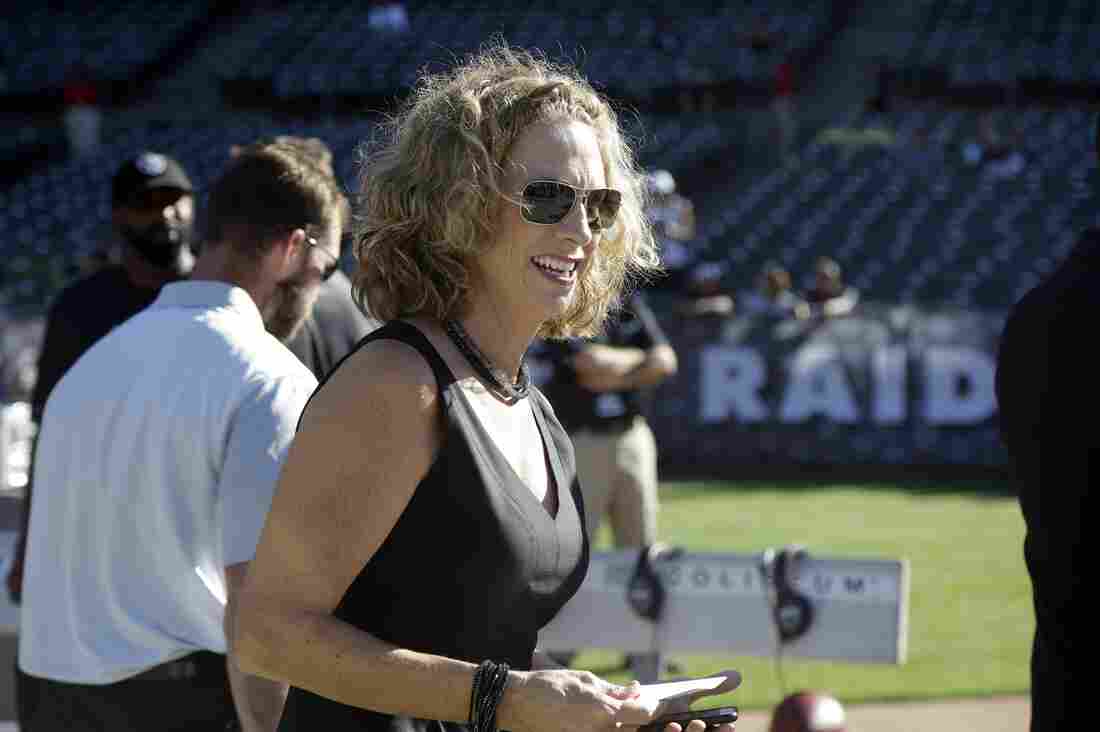
Announcer Beth Mowins walks on the field before a 2015 NFL preseason football game between the Oakland Raiders and the St. Louis Rams in Oakland, Calif.

Ben Margot/AP

hide caption

toggle caption

Ben Margot/AP

Play-by-play announcer Beth Mowins is set to become the first-ever female broadcaster to call an NFL game televised nationally.

A commentator for ESPN since 1994, she’ll call the Los Angeles Chargers vs. Denver Broncos game in ESPN’s opening Monday Night Football doubleheader on Sept. 11. Former Buffalo Bills and New York Jets head coach Rex Ryan will join her.

“Beth has been an important voice in our college sports coverage and she has experience calling NFL preseason games. She deserves this opportunity,” Stephanie Druley, ESPN events and studio production senior vice president, said in a statement. “ESPN is committed to putting talented women in high-profile positions and we look forward to Beth and Rex’s call of this game on our MNF opening night.”

Mowins “typically does play-by-play at the college level for women’s sports, but has plenty of experience calling college football games,” writes SBNation. She has also called Oakland Raiders preseason games since 2015, and recently signed a multiyear extension with ESPN.

“This is an amazing opportunity and I look forward to working with Rex and our entire ESPN team. As lifelong fans of the NFL Monday Night Football franchise, we want to bring the same passion to the broadcast as our predecessors have all done,” Mowins said in a statement.

She is not the first woman to call an NFL regular season game. That was Gayle Sierens, who in 1987 called a regional NBC broadcast of a Seahawks-Chiefs game.

Sierens received “generally good reviews” and was offered a six-game contract for the following season, according to The New York Times.

But she told the newspaper that “the management at her local NBC station did not want her to call more games the next season. They made it clear that she had a choice: work for NBC, essentially part time, or continue as a full-time news anchor.” Sierens chose the latter, and had a long and successful career as a news anchor at WFLA-TV in Tampa.

Thirty years then passed before ESPN announced Mowins’ assignment.

Why did it take three decades? As Sports Illustrated wrote last year:

“Between all of the NFL rightsholders—CBS, ESPN, Fox, NBC, and the NFL Network—there are around 20 spots for play-by-play broadcasters every year. Given a woman has never ascended to even one of the lower-level teams on the networks with multiple broadcast teams (such as CBS and Fox), the implicit message to women who want to enter sports broadcasting is that this job is not for you.”

49ers radio announcer Kate Scott told the magazine that there’s “no pipeline” for women who want to be play-by-play announcers, because there have been so few examples, despite a larger number of women working as sideline reporters.

Sierens called Mowins the “perfect person to carry the torch” in an interview with the New York Daily News. Here’s more:

“This is a woman who is as prepared as anyone, so much more prepared than I was to wear that crown as the first. She is the real deal. There’s no publicity stunt, this is not something somebody’s doing for ratings. They’re doing this because she knows her stuff inside out, and she will be fabulous when she does this game.”

Let’s block ads! (Why?)


No Image

Pentagon Disrupts Path For College Athletes Hoping To Be Drafted By The Pros

NPR’s Lulu Garcia-Navarro asks the Denver Post’s Nicki Jhabvala about a change in policy that will no longer waive the active duty requirement for students drafted into professional sports leagues.

LULU GARCIA-NAVARRO, HOST:

For college students who are also top-level athletes, it’s the dream path – graduate straight from college to the likes of the NBA and the NFL. And until recently, that included students at American service academies – the Army’s West Point, the Naval Academy in Annapolis and the Air Force Academy in Colorado Springs. Jalen Robinette, a wide receiver for the Air Force, had a shot at the dream in 2017.

(SOUNDBITE OF ARCHIVED RECORDING)

UNIDENTIFIED ANNOUNCER: End zone, it’s caught, touchdown, Robinette.

UNIDENTIFIED REPORTER: So don’t be surprised if Robinette becomes the first Falcon drafted in almost 20 years.

JALEN ROBINETTE: This could be something that happens. And if it doesn’t, then I have a pretty good plan B, which is being an officer in the greatest air force there is in the world.

GARCIA-NAVARRO: That plan B became a bit more likely when the Pentagon reversed a policy that allowed players drafted into the pros to substitute two years of reserve duty for the normal two years of active service. In this edition of Out of Bounds, graduating to the pros instead of military service. Nicki Jhabvala reports for The Denver Post, and she’s been following this story.

Welcome to the program.

NICKI JHABVALA: Hi. Thank you for having me.

GARCIA-NAVARRO: How important was this waiver to these students?

JHABVALA: Very important. This is part of a 2016 policy. It didn’t create any guarantees for them. But, you know, once guys like Jalen Robinette realized they had a shot at the pros, they spent a lot of time, money, energy preparing for life as both an Air Force grad and a potential NFL player.

GARCIA-NAVARRO: Do we know the reason for the Pentagon changing course?

JHABVALA: They say they’re in the business of developing service members. This affects really only about three athletes across all sports at all service academies. So to take that away from those three athletes, there had to be a good reason. But right now, they’re just saying it’s because they’re more focused on developing service members than professional athletes.

GARCIA-NAVARRO: Let’s take a little bit of a look at the history here. This isn’t the first time a policy like this has been rescinded. Do we know their thinking on this?

JHABVALA: Well, I think that’s a question these athletes want answered, too. From the players I talk to, they don’t have an issue with the policy. It’s certainly the Department of Defense’s right to enact any policy it feels is best for these service members. And they knew when they committed to one of these service academies that they would be required to fulfill some sort of active duty. But the timing has become the big issue, the timing after these athletes were told they would have a chance to possibly go pro – to have it taken from them is concerning in many ways because of the time and the money they put forward. But they don’t have any clear answers right now other than the fact that the DOD simply can change the policy whenever it feels it’s necessary.

GARCIA-NAVARRO: So let’s talk about Jalen Robinette. He’s the reason this is in the news. Tell us about him and where his NFL future is at right now.

JHABVALA: So Jalen Robinette was projected to be a mid-round pick before they reversed course. He’s the Air Force’s all-time leading receiver and was one of the most sought-after prospects in the area really. But no team has signed him yet. And if they do – if this policy is still in place, he will have to be put on a reserve military list for a couple years while he serves his active duty, and then he might have a chance to return. But it’s a big risk for an NFL team, and it really puts his future in the NFL in a very, very tough spot right now.

GARCIA-NAVARRO: Why is it a big risk for an NFL team to do that?

JHABVALA: Because if they were to draft a guy that they couldn’t use for two years, in their mind it would be somewhat of a waste of a draft pick. He is in his prime right now. Two years down the road, when he’s been out of the game, it’s not guaranteed that he will be.

GARCIA-NAVARRO: Could this have effectively ended his career, his hopes of joining the NFL?

JHABVALA: He says it hasn’t ended his hopes. But being away from the game for two years – if that’s, you know, what ends up happening, it certainly reduces his chances. But it’s not impossible. Players have done it before. Many players in the past, like Ben Garland, an offensive lineman who is now with the Atlanta Falcons, did it. So it’s certainly not impossible, but it is much tougher.

GARCIA-NAVARRO: What next? I mean, are we waiting for a review? Do we think that there’ll be a reversal of the decision?

JHABVALA: It’s a very hard fight going against the Department of Defense, as you can imagine. But Jalen Robinette’s agent, as well as those of some other players who, you know, are dealing with this now, they’re continuing to fight it. They’re asking for their clients to be grandfathered into the old policies since, you know, the timing was just so brutal really. They’re still very hopeful that something can be done, but it is a uphill battle, and there’s no guarantee.

GARCIA-NAVARRO: Nicki Jhabvala reports for The Denver Post. Thanks so much for being with us.

JHABVALA: Thanks for having me.

Copyright © 2017 NPR. All rights reserved. Visit our website terms of use and permissions pages at www.npr.org for further information.

NPR transcripts are created on a rush deadline by Verb8tm, Inc., an NPR contractor, and produced using a proprietary transcription process developed with NPR. This text may not be in its final form and may be updated or revised in the future. Accuracy and availability may vary. The authoritative record of NPR’s programming is the audio record.

Let’s block ads! (Why?)


No Image

Not My Job: We Quiz Olympic Skier Hannah Kearney On Business Moguls

Hannah Kearney competes in the women’s freestyle skiing aerials qualification at the Vancouver Winter Olympics in 2010.

Streeter Lecka/Getty Images

hide caption

toggle caption

Streeter Lecka/Getty Images

Hannah Kearney is one of the greatest mogul skiers of all time. She’s won 43 World Cup mogul medals, three U.S. Championship medals and two Olympic medals.

Kearney is obviously really good at one kind of moguls, so we’ll ask her three questions about another kind: business moguls.

PETER SAGAL, HOST:

And now the game where people who’ve won everything important try to win at something trivial. Hannah Kearney is one of the greatest mogul skiers of all time. She’s won 43 World Cup mogul medals…

(APPLAUSE)

SAGAL: …Three U.S. Championship medals and two Olympic medals, including a gold. Frankly, we are amazed that with all those medals around her neck she can even lift her head. Hannah Kearney, welcome to WAIT WAIT… DON’T TELL ME.

(APPLAUSE)

HANNAH KEARNEY: Thank you so much.

SAGAL: So you live here in Salt Lake City, which, of course, is a winter sports mecca. But you did not grow up here.

KEARNEY: I did not. I grew up skiing on ice in Vermont.

SAGAL: Right.

(APPLAUSE)

SAGAL: And is that why you became a mogul skier, ’cause you couldn’t find a decent groomed run anywhere in Vermont?

KEARNEY: It certainly built character, and it honed my turns. It made skiing in Utah much easier.

SAGAL: Wow. Yeah. I should probably explain because…

MO ROCCA: Yeah, what moguls are.

SAGAL: …Not everybody knows that mogul skiing is. So you’re – basically you’re skiing, you’re going around these many, many, many bumps in the course. And then every now and then you hit a jump, you go flying in the air, you do a somersault or something impressive, you land, you keep going.

KEARNEY: Yep. And then it’s also timed.

SAGAL: Right. So how did you – well, first of all, how old were you when you started skiing?

KEARNEY: I was 2 years old when my parents put my 2-year-old body inside of a horse halter and let me go down the slopes. And I don’t remember learning how to ski.

SAGAL: Really? So, like, you have no memory of yourself before you knew how to ski?

KEARNEY: Correct.

SAGAL: Wow.

ROCCA: You were in the horse halter? Were they riding you?

(LAUGHTER)

KEARNEY: The whip. That’s why I became a good skier. Just kidding, mom and dad.

(LAUGHTER)

ROCCA: So when you get in a car, do you love streets with a lot of potholes when you’re driving? Because they’re sort of the same thing, right?

KEARNEY: Yeah. Those you’d be dodging, moguls you’re going straight over them, but similar.

SAGAL: Yeah. Yeah. Now…

KEARNEY: No backflips in the car.

SAGAL: This is a relatively new competitive sport – right? – because ski racing classically was just downhill and slalom and giant slalom. And when did they start adding these sort of crazy new types of skiing to the international circuit?

KEARNEY: At the Olympic level it was 1992 for our sport. And they’ve been, as you’ve seen, adding more crazier sports year after year. In my sport alone, I was, I think, 16 years old when I had to just start learning backflips because someone – his name was Jonny Moseley – decided he was going to push the sport and make it so that all future generations were going to have to learn crazy flips and maneuvers. They’re not as dangerous as they sound, but I don’t think that’s what my parents thought when they first heard. And certainly nothing I was interested in doing when I signed up for mogul skiing, meeting my dad at Tower Eight (ph) and skiing bumps. I wanted to keep my feet on the ground.

ALONZO BODDEN: Can I ask you something? You keep talking about you didn’t want to do the acrobatics and so on. Was there a point when you realized, like, wow I’m really good at this? I mean, you were the best in the world and you didn’t want to do it. What if you had focused?

(LAUGHTER)

KEARNEY: We might never know.

SAGAL: We might never know.

KEARNEY: I tricked myself into thinking I liked them. I put little Post-its in my room at the Olympic Training Center that said, I love jumping.

SAGAL: Really? That was your…

(LAUGHTER)

KEARNEY: And it’s only now that I would admit that I didn’t really like it, that it’s all over.

SAGAL: That was your self-motivation program?

KEARNEY: It worked.

SAGAL: I thought you guys had, like, you know, multi-thousand-dollar sports psychologists. You know, like…

KEARNEY: Nothing’s better than a Post-it.

SAGAL: Post-it, OK.

ROCCA: It’s like the world’s shortest TED talk.

SAGAL: Exactly.

(LAUGHTER)

SAGAL: Now, you’ve skied in two Olympics, 2010 and – excuse me…

KEARNEY: The first one was so unsuccessful that it would be better off if we just…

SAGAL: Where was that?

KEARNEY: Torino, Italy, in 2006.

SAGAL: Yeah. And then you came back in 2010 and you won gold. Yeah, that was where exactly? That was…

KEARNEY: Vancouver.

SAGAL: Vancouver. That was a final that you were in, right?

(APPLAUSE)

SAGAL: I have heard – we have all heard that the Olympic Village is like an absolute decadent Roman orgy all the time.

(LAUGHTER)

SAGAL: That is what they tell us. And they say, well, you know, young athletes, they’re away from home…

ROCCA: They’re going at it like sled dogs.

SAGAL: Exactly.

(LAUGHTER)

SAGAL: What comment can you make about that, shall we say, stereotype of Olympic villages?

KEARNEY: I can make a couple comments.

SAGAL: All right.

(LAUGHTER)

KEARNEY: I will start with the rumor, which was there’s a bowl of condoms at, like, the health center…

SAGAL: Yes, that’s what we hear about.

KEARNEY: …At the – in the Athlete Village.

SAGAL: Yeah.

KEARNEY: And they disappear quickly, so it’s like, oh, my goodness, these are being put to use. But let me ask you this – if you were at the Olympics and there were Olympic condoms, wouldn’t you take one?

ROCCA: Oh, my God.

(LAUGHTER)

SAGAL: Wait a minute.

(APPLAUSE)

SAGAL: So – (laughter) so they’re Olympic-branded – little five rings on the condoms?

KEARNEY: I never opened it, so I’m not positive.

SAGAL: All right.

(LAUGHTER)

KEARNEY: They come in all the colors of the Olympic rings.

SAGAL: Of course they do.

ROCCA: And there’s a – and they work so well there’s a flame at the tip.

SAGAL: I know.

KEARNEY: You might be on to something.

(LAUGHTER, APPLAUSE)

SAGAL: Hannah Kearney, it is a pleasure to talk to you. We have asked you here to play a game we’re calling…

BILL KURTIS: I am the master of all I survey.

SAGAL: You ski mogul, so we thought we would ask you about the other kind of moguls – business moguls. Answer two out of these three questions correctly, you’ll win our prize for one of our listeners. Bill, who is Hannah playing for?

KURTIS: Kyle Trotter of Salt Lake City, Utah.

SAGAL: All right.

(APPLAUSE)

SAGAL: First question. Ready to do this?

KEARNEY: Ready.

SAGAL: All right. Samuel Goldwyn was one of the great movie moguls. And he was famous for his odd turns of phrase known around Hollywood as Goldwynisms, including, at least allegedly, which of these – A, when told he couldn’t make a movie from a book because it was about lesbians, he said, it’s OK, we’ll make them Hungarians instead?

(LAUGHTER)

SAGAL: Or B, quote, “my own personal theory is that the pyramids were built to store grain”; or C, quote, “people are not as stupid as the media think they are. Many of them are stupid, but I’m talking about overall”?

KEARNEY: C.

SAGAL: You’re going to go for C?

KEARNEY: Yep.

SAGAL: No, that was actually said by Ben Carson, the department…

(LAUGHTER)

SAGAL: The secretary of Housing and Urban Development. The real answer was A, the one about the lesbians.

KEARNEY: Oh, second choice.

SAGAL: Yeah.

ROCCA: So what was it?

SAGAL: No, the – so the first one about Hungarians was – that was Samuel Goldwyn. The other two about the pyramids storing grain and people are often, in fact, stupid, that’s Ben Carson, the secretary of Housing and Urban Development.

BODDEN: He would recognize stupid.

(LAUGHTER)

SAGAL: OK, Hannah, you’ve got two more chances. Here’s your next question. Working for a mogul can be pretty dangerous, as in which of these cases – A, cosmetics mogul Vidal Sassoon required that his employees never wear bike helmets which might cover their silky, lustrous hair; B, in the early days at Ben and Jerry’s, ice cream mogul Ben Cohen used to make employees eat new flavors as fast as possible to test brain freeze; or C, in order to test the quality of his wares, bulletproof clothing mogul Miguel Caballero shoots all of his employees in the chest?

UNIDENTIFIED CROWD: C.

KEARNEY: Well, Ben and Jerry’s is a Vermont company and I’m a Vermonter, and their motto is if it’s not fun, why do it? And that didn’t sound fun. A.

SAGAL: You’re going to go for A, which is that Vidal Sassoon told people they could never wear bike helmets no matter what they were doing?

UNIDENTIFIED CROWD: C.

ROCCA: Ooh, I don’t…

KEARNEY: Can I poll the audience? Is that an option?

SAGAL: You can do whatever the hell you want.

KEARNEY: I already heard – so C.

SAGAL: C it is. Very good.

(SOUNDBITE OF BELL)

SAGAL: Did you know that? It was great.

(APPLAUSE)

SAGAL: All right, last question. You get this right you win. One of the most famous moguls we have today is, of course, Rupert Murdoch. He made his first fortune in Australia, and then he moved to the U.K. in the 1960s, buying the then-struggling tabloid The Sun. He turned its fortunes around by telling its editor what – A, quote, focus on football, footballers’ girlfriends and things that look like footballs; B, if you use a word longer than three syllables you’re fired; or C, I want a paper with lots of boobs in it?

ROCCA: How could you prove he didn’t say any of those things?

(LAUGHTER)

SAGAL: Well…

ROCCA: Like, she could – she’s going to be right whatever she answers.

KEARNEY: I do – I like that option.

SAGAL: I like your thinking.

KEARNEY: They all sound possible, yeah.

SAGAL: They do. But according to…

ROCCA: I mean, is there, like, a transcript of everything he’s ever said?

SAGAL: According to his biography, he said one of those things.

ROCCA: Oh, OK. OK.

KEARNEY: Oh, had I read his biography. Has anyone read his biography?

UNIDENTIFIED CROWD: C.

KEARNEY: Really? That would be absolutely not my choice.

SAGAL: It’s funny. You don’t have to read his biography. You just have to read an issue of The Sun.

(LAUGHTER)

KEARNEY: OK, the audience in my ear is saying C.

SAGAL: And it is C.

(SOUNDBITE OF BELL, APPLAUSE)

KEARNEY: Thank you. Well done.

SAGAL: Bill, how did Hannah Kearney do on our quiz?

KURTIS: Well, of course she won, two out of three.

(APPLAUSE)

KEARNEY: Thanks for the help.

SAGAL: Congratulations. Hannah Kearney is an Olympic gold medal-winning skier who just finished her junior year at Westminster College here in Salt Lake City. Hannah, thank you so much for talking to us on WAIT WAIT… DON’T TELL ME. Give it up for Hannah Kearney.

(SOUNDBITE OF JOHN WILLIAMS’ “BUGLER’S DREAM AND OLYMPIC FANFARE MEDLEY”)

SAGAL: In just a minute, we’ll tell you the hip way to prevent a broken hip in our Listener Limerick Challenge. Call 1-888-WAITWAIT to join us on the air. We’ll be back in a minute with more of WAIT WAIT… DON’T TELL ME from NPR.

Copyright © 2017 NPR. All rights reserved. Visit our website terms of use and permissions pages at www.npr.org for further information.

NPR transcripts are created on a rush deadline by Verb8tm, Inc., an NPR contractor, and produced using a proprietary transcription process developed with NPR. This text may not be in its final form and may be updated or revised in the future. Accuracy and availability may vary. The authoritative record of NPR’s programming is the audio record.

Let’s block ads! (Why?)