
Trump Embroiled In 2 Controversies About Professional Sports, Race And Culture

San Francisco 49ers quarterback Colin Kaepernick and outside linebacker Eli Harold kneel during the playing of the national anthem before an NFL game in 2016.
John Bazemore/AP
hide caption
toggle caption
John Bazemore/AP
In the span of less than 24 hours, President Trump catapulted himself into the center of two racially-charged controversies involving professional sports, reigniting criticism that he is divisive and insensitive — a month after Trump struggled with criticism of his multiple remarks in response to violence in Charlottesville, Va.
The president was stumping for Sen. Luther Strange, R-Ala., at a campaign rally Friday night, when he used a segue in his speech that was supposed to convince voters that continuing to have Strange in the Senate would make all Alabamans winners — an argument with emotional appeal in a state known for its fierce love of football.
And, while he was on the subject of football, Trump took the opportunity to expound on his thoughts regarding NFL players, like Colin Kaepernick, who last year began kneeling during the national anthem in protest over perceived social injustices against African-Americans. Trump’s take: It’s unpatriotic and NFL team owners should fire those refusing to stand.
“Wouldn’t you love to see one of these NFL owners, when somebody disrespects our flag, to say, ‘Get that son of a bitch off the field right now,’ ” he said to roaring applause.
“He’s fired!” Trump said, paraphrasing his popular reality TV catchphrase.
Then Trump took on Stephen Curry of the NBA champion Golden State Warriors in a tweet Saturday morning. The president rescinded an offer for what has become a traditional celebratory visit to the White House for any championship team of a major professional sport.
He wrote: “Going to the White House is considered a great honor for a championship team. Stephen Curry is hesitating, therefore invitation is withdrawn!”
Going to the White House is considered a great honor for a championship team.Stephen Curry is hesitating,therefore invitation is withdrawn!
— Donald J. Trump (@realDonaldTrump) September 23, 2017
The president was reacting to Curry’s statement Friday that the popular star player didn’t want to visit the White House and meet with Trump because Curry believed passing on the traditional event sent the message that “we won’t stand for” some of Trump’s past remarks. “This is my opportunity to voice that,” Curry also said, of the possibility of not going to the White House as expected.
Saturday afternoon, Trump was back online attacking the NFL.
If a player wants the privilege of making millions of dollars in the NFL,or other leagues, he or she should not be allowed to disrespect….
— Donald J. Trump (@realDonaldTrump) September 23, 2017
…our Great American Flag (or Country) and should stand for the National Anthem. If not, YOU’RE FIRED. Find something else to do!
— Donald J. Trump (@realDonaldTrump) September 23, 2017
“If a player wants the privilege of making millions of dollars in the NFL, or other leagues, he or she should not be allowed to disrespect our Great American Flag (or Country) and should stand for the National Anthem. If not, YOU’RE FIRED. Find something else to do!” Trump tweeted.
While none of Trump’s tweets or remarks were explicitly about race, they led to an escalating war of words between the president and black athletes, activists and celebrities on social media. And the president, who was almost immediately cast as being divisive, took a serious pummeling from NFL team owners and notable black public figures.
NFL Commissioner Roger Goodell said in a statement Saturday morning, “Divisive comments like these demonstrate an unfortunate lack of respect for the NFL, our great game and all of our players.”
Late Friday night, before Trump had sparked controversy involving Curry, Max Garcia of the Denver Broncos couldn’t help comparing Trump’s comments about kneeling in the NFL during the campaign rally with how he responded to events in Charlottesville, Va., last month that left one counterprotester dead.
“What an emphatic response, where was this passion in response to Charlottesville…” Garcia wrote on Twitter with a video of Trump.
What an emphatic response, where was this passion in response to Charlottesville…? https://t.co/OkVZTdloXx
— Max Garcia (@MGarcia_76) September 23, 2017
Individual NFL teams, including the New York Giants, Miami Dolphins, Green Bay Packers and San Francisco 49ers all issued statements Saturday condemning Trump’s remarks.
Jed York of the San Francisco 49ers, for whom Kaepernick played last year when he began the kneeling protest, issued this statement:
“The callous and offensive comments made by the President are contradictory to what this great country stands for. Our players have exercised their rights as United States citizens in order to spark conversation and action to address social injustice.”
Dolphins owner Stephen Ross said, “Our country needs unifying leadership right now, not more divisiveness. We need to seek to understand each other and have civil discourse instead of condemnation and sound bites.”
Meanwhile, current and former luminaries in the NBA weighed in online Saturday expressing support for Curry and criticizing Trump.
Basketball megastar LeBron James, who has nearly as many followers on Twitter (38.4 million) as Trump does on his personal account (39 million), defended Curry, his sometimes rival on the court.
James wrote, “U bum @StephenCurry30 already said he ain’t going! So therefore ain’t no invite. Going to White House was a great honor until you showed up!”
U bum @StephenCurry30 already said he ain’t going! So therefore ain’t no invite. Going to White House was a great honor until you showed up!
— LeBron James (@KingJames) September 23, 2017
James’ tweet has been liked more than a 1.1 million times and retweeted more than a half million times. According to Twitter, the message is James’ most retweeted post to date.
James later recorded and posted a two-minute video to Twitter in which he said, “It’s not about dividing. We as American people need to come together even stronger.”
“It’s not about dividing. We as American people need to come together even stronger.” — @KingJames responds to @realDonaldTrump‘s comments. pic.twitter.com/UHpzXpb42K
— UNINTERRUPTED (@uninterrupted) September 23, 2017
Chris Paul, who plays for the Houston Rockets and is president of the NBA Players Association, questioned the president’s attention to the issue in the first place. “With everything that’s going on in our country, why are YOU focused on who’s kneeling and visiting the White House??? #StayInYoLane,” Paul wrote on Twitter.
Retired longtime Los Angeles Laker Kobe Bryant contributed this to the online conversation, suggesting Trump was not living up to his ubiquitous campaign slogan: “A #POTUS whose name alone creates division and anger. Whose words inspire dissension and hatred can’t possibly ‘Make America Great Again.’ “
A #POTUS whose name alone creates division and anger. Whose words inspire dissension and hatred can’t possibly “Make America Great Again”
— Kobe Bryant (@kobebryant) September 23, 2017
By Saturday afternoon, the Warriors formally announced they were not visiting the White House — or Trump. “We accept that President Trump has made it clear that we are not invited,” the team said in a statement. “In lieu of a visit to the White House,” the NBA champions added, “we have decided that we’ll constructively use our trip to the nation’s capital in February to celebrate equality, diversity and inclusion — the values we embrace as an organization.”
NBA Commissioner Adam Silver said he was “disappointed” the team would not be visiting the White House. Curry, for his part, suggested Trump’s effort to target him was beneath the dignity of the presidency.

Cleveland Cavaliers forward LeBron James and Golden State Warriors guard Stephen Curry during the first half of Game 5 of basketball’s NBA Finals in Oakland, Calif., in June.
Ben Margot/AP
hide caption
toggle caption
Ben Margot/AP
The dual controversies also elicited reaction Saturday from black celebrities including musician John Legend, actor Jesse Williams and filmmaker Ava DuVernay, among others.
Some politicians also joined the fray on Twitter.
Rep. Adam Schiff, D-Calif., took a jab at Trump for comments he has made in the past ridiculing Sen. John McCain, R-Ariz., for being of prisoner of war. “And if a person wants the privilege of serving as President, they shouldn’t be allowed to disrespect military heroes who were taken prisoner,” Schiff tweeted.
And if a person wants the privilege of serving as President, they shouldn’t be allowed to disrespect military heroes who were taken prisoner https://t.co/mvuijIyXBc
— Adam Schiff (@RepAdamSchiff) September 23, 2017
California’s lieutenant governor and former San Francisco Mayor Gavin Newsom, a Democrat, congratulated the Warriors for the stance. “Couldn’t be more proud of the @warriors. Thank you for speaking truth to power and standing up for our fundamental California values,” he wrote.
Sen. Ben Sasse, R-Neb., a frequent critic of the country’s growing divisiveness, suggested that if the kneeling protest spread, NFL players would be playing into Trump’s hands: “btw, Trump wants you to kneel—because it divides the nation, with him and the flag on the same side. Don’t give him the attention he wants,” Sasse tweeted.
btw, Trump wants you to kneel–because it divides the nation, with him and the flag on the same side. Don’t give him the attention he wants. https://t.co/ic5Vc9oGyB
— Ben Sasse (@BenSasse) September 23, 2017
Seemingly answering Sasse, Trump backers argued the president’s comments have nothing to do with race and are purely about patriotism and respect for the flag.
“Has our world turned upside down! Our President criticized for believing our flag & anthem shoud be respected & honored #StandForTheFlag,” Ronna Romney, chairwoman of the Republican National Committee, wrote on Twitter.
Former Trump campaign aide Corey Lewandowski expressed similar sentiments on Fox News Saturday.
Some in the Washington press corps wrote Saturday that the president is deliberately using coded language to appeal to his base of white voters who see themselves as part of an aggrieved group in America, rapidly losing power and influence relative to ethnic and racial minorities.
“To addressa largely white crowd as ‘people like yourselves,’ and refer to protesting athletes, often African American, as ‘those people,’ does nothing to heal the wounds of Charlottesville,” political journalist Mike Allen wrote on Axios.com Saturday morning.
Ron Brownstein, another seasoned political journalist in D.C., spent most of the day on Twitter putting forth the argument that exploiting racial and economic anxieties and divisions was one of Trump’s key political strategies.
“Point of this fight is not very hard to find- more signaling to white racial resentment, which has been central to Trump message from day 1,” Brownstein tweeted.
Brownstein reaffirmed his point in a later tweet when another journalist questioned whether Trump was utilizing any strategy at all. “Yes, pretty clearly from day 1: to appeal to parts of older, blue-collar, non-urban white America most uneasy about demographic & eco change,” Brownstein wrote.
Another journalist was more blunt. “There is an unmistakable racial element at play, since he is targeting prominent black players,” CNN media reporter Brian Stelter wrote Saturday afternoon about Trump’s NFL comments.
And Stelter’s CNN colleague Chris Cillizza saw something similar, writing Saturday that the context of Trump’s criticisms was inherently racial given that both the NBA and NFL have mostly white team owners and mostly black players. Cillizza went on to point out that Trump’s comments Friday and Saturday bore two rhetorical hallmarks that went back to his presidential campaign: using racially coded language and espousing a seemingly simplistic view of the black community.
Meanwhile, throughout most of Saturday the hashtag #TakeAKnee trended on Twitter across the U.S., as people sympathetic to Kaepernick wondered about what NFL players would do Sunday and as they talked about posting photos of themselves kneeling in solidarity.
Saturday night the Kaepernick-style protest spread to professional baseball.
Catcher Bruce Maxwell of the Oakland A’s took a knee during the national anthem before a game Saturday night in California. Like the rest of his team, Maxwell had his hand on his heart and was facing the flag; as Maxwell knelt, a teammate is shown in photos with a comforting hand on Maxwell’s shoulder.

Oakland Athletics catcher Bruce Maxwell kneels during the national anthem Saturday in Oakland. Maxwell is the first Major League Baseball player to kneel during the national anthem.
Eric Risberg/AP
hide caption
toggle caption
Eric Risberg/AP
“This now has gone from just a BlackLives Matter topic to just complete inequality of any man or woman that wants to stand for Their rights!” Maxwell posted on Twitter Saturday.
Major League Baseball Teams Look To Add Extra Netting After Yankee Stadium Accident

After a foul ball hit a young girl at Yankee Stadium this week, some Major League Baseball teams will be adding extra netting along the baselines to protect fans.
AILSA CHANG, HOST:
This week the big story in baseball is pretty sobering. It’s about the safety of fans at the ballpark.
KELLY MCEVERS, HOST:
On Wednesday, in the fifth inning of the game between the New York Yankees and the Minnesota Twins…
(SOUNDBITE OF ARCHIVED RECORDING)
UNIDENTIFIED ANNOUNCER: Look out. Oh, my goodness.
MCEVERS: …New York’s Todd Frazier hit a line drive foul ball into the stands behind the third base dugout.
(SOUNDBITE OF ARCHIVED RECORDING)
UNIDENTIFIED ANNOUNCER: That is scary. It was absolutely laced.
CHANG: The ESPN announcers reacted as the ball hit a young girl in the face.
(SOUNDBITE OF ARCHIVED RECORDING)
UNIDENTIFIED ANNOUNCER: A little too graphic for us to show you. And that…
CHANG: The game stopped. Some players cried. Frazier knelt down at home plate. And then medics evacuated the girl.
MCEVERS: The game did eventually continue. And after it was over, Frazier talked to reporters.
(SOUNDBITE OF ARCHIVED RECORDING)
TODD FRAZIER: It was terrible. Shaken up a little bit and, you know, I don’t know really what happened. I hope she’s all right. But it was just something that I wish never happened. It was – it was tough. It was tough to watch and tough to be a part of, to be honest.
MCEVERS: One of the girl’s relatives told the New York Post earlier today she’s in the hospital in stable condition. But the relative said it’s going to be a long process.
CHANG: Since Wednesday’s game, many people are saying teams need to extend the protective netting along the baselines where foul balls and broken bats can fly into the stands. Twins second baseman Brian Dozier was on the field Wednesday. He wants to see that.
(SOUNDBITE OF ARCHIVED RECORDING)
BRIAN DOZIER: Every stadium needs to have nets. That’s it. I don’t care about the damn view of a fan or what. It’s all about safety. I still have a knot in my stomach.
MCEVERS: Major League Baseball said back in 2015 that teams should extend the netting from behind home plate all the way to the dugouts. But it was a recommendation, not a requirement. And at the time, Commissioner Rob Manfred admitted some people wouldn’t like it.
(SOUNDBITE OF ARCHIVED RECORDING)
ROB MANFRED: We want our fans to be safe in the ballpark. But we also have lots of fans who are very vocal about the fact that they don’t like to sit behind nets.
CHANG: So far, only 11 ballparks have extended the nets. Yankee Stadium is not one of them. But after what happened this week, more teams are doing it. In the last two days, the Cincinnati Reds, San Diego Padres and Seattle Mariners announced that next season they will extend their netting.
(SOUNDBITE OF BOYISH SONG, “OBVIOUS”)
Copyright © 2017 NPR. All rights reserved. Visit our website terms of use and permissions pages at www.npr.org for further information.
NPR transcripts are created on a rush deadline by Verb8tm, Inc., an NPR contractor, and produced using a proprietary transcription process developed with NPR. This text may not be in its final form and may be updated or revised in the future. Accuracy and availability may vary. The authoritative record of NPR’s programming is the audio record.
Aaron Hernandez's Brain Reveals Signs Of CTE, Says Lawyer

Former New England Patriots NFL football player Aaron Hernandez listens to testimony during his murder trial in February 2015.
Brian Snyder/AP
hide caption
toggle caption
Brian Snyder/AP
The brain of former New England Patriots star Aaron Hernandez showed severe signs of the degenerative brain disease chronic traumatic encephalopathy, referred to as CTE, according to doctors who conducted tests after he committed suicide in April while imprisoned for murder.
“We’re told it was the most severe case they had ever seen of someone of Aaron’s age,” said Hernandez’s attorney, Jose Baez, in a news conference announcing the filing of a lawsuit against the National Football League and the New England Patriots. Hernandez was 27 when he hanged himself in his prison cell.
The lawsuit was filed in federal court in Boston on behalf of his daughter, Avielle Hernandez, citing loss of companionship. It argues that the league and team knew of the damage caused by repetitive impact injuries to the brain, but that they “failed to disclose, treat or protect him from the dangers of such damage.”
The New England Patriots said the team had no comment on the suit.
A statement issued by the Boston University CTE Center says Dr. Ann McKee, chief of neuropathology at the VA Boston Healthcare System and director of the Center, examined Hernandez’s brain and found that “Mr. Hernandez had chronic traumatic encephalopathy (CTE), Stage 3 out of 4, (Stage 4 being the most severe). This diagnosis was confirmed by a second VABHS neuropathologist. In addition, Mr. Hernandez had early brain atrophy and large perforations in the septum pellucidum, a central membrane.”
McKee said, “CTE is associated with aggressiveness, explosiveness, impulsivity, depression, memory loss and other cognitive changes.”
In 2015, Hernandez was sentenced to life-without-parole for the 2013 murder of his friend, Odin L. Lloyd. He was acquitted earlier this year of two other murder charges stemming from a 2012 incident. He hanged himself five days after the acquittal.
His death brought to an end the controversial saga of a talented young player who couldn’t seem to escape trouble off the field.
Hernandez, raised in the hardscrabble town of Bristol, Conn., was a star at the University of Florida where his team won a national championship. But a failed drug test and his involvement in a bar fight caused many teams to pass him over until the fourth round of the NFL draft.
He played three seasons with the Patriots, earning a $40 million contract. About a year after signing it, he was implicated in the murder of Lloyd.
Hernandez stopped playing football at the age of 23. His lawyer, Jose Baez, said that his brain damage was indicative of a player with a median age of 67 years.
The Hernandez lawsuit and brain test results are likely to reignite the debate over contact sports, such as football, and potential brain injury.
In a separate study published earlier this year in the Journal of the American Medical Association, McKee found that 110 of 111 brains of deceased NFL players showed evidence of CTE.
Former Boxing World Champion 'Raging Bull,' Jake LaMotta Dies At 95
Former boxing world champion Jake LaMotta has died at 95. His colorful life was the subject of a book and an Academy Award winning movie, Raging Bull.
ARI SHAPIRO, HOST:
The boxer whose life was immortalized in the film “Raging Bull” has died. Jake LaMotta died yesterday in a Florida hospital. NPR’s Tom Goldman remembers the former middleweight champion and his complicated life.
TOM GOLDMAN, BYLINE: You know, the 1980 movie was aptly titled, because this guy was, you know, by all accounts raging in and out of the ring.
(SOUNDBITE OF ARCHIVED RECORDING)
DON DUNPHY: Both men blaze away at the (unintelligible). But LaMotta, rallying from the brink of defeat, knocks Dauthuille down and almost through the ropes.
GOLDMAN: He was known for being able to take a punch. In fact out of his 100-plus fights, he was only knocked down once. Matter of fact, in his last fight against Sugar Ray Robinson that was stopped because it was just so bloody and he was just being pummeled, he said to Ray, you know, I didn’t go down. That line was immortalized in the movie.
(SOUNDBITE OF FILM, “RAGING BULL”)
ROBERT DE NIRO: (As Jake LaMotta) Hey, Ray, I never went down, Ray. You never got me down, Ray.
GOLDMAN: He wore that as a badge of honor – his toughness. But you know, he had to be a good boxer as well to do what he did. He held the middleweight title from 1949 to 1951. He was a great boxer.
It would take a psychologist to kind of identify exactly what the root cause was for his rage, but you know, there were stories of him growing up – a very tough childhood. There were reports that his father, an immigrant, would beat Jake LaMotta’s mother and siblings, so he grew up around physical violence.
There was also a really interesting part of his personality that Nigel Collins told me – Nigel Collins being a Hall of Fame boxing writer. He said he had a conversation with LaMotta, and LaMotta said when he was a teenager, he attacked a person with a lead pipe wrapped in newspaper and definitely hurt the guy. But Jake LaMotta always thought that he had killed him, and he apparently was guilt ridden for that. And that guilt kind of transferred into this feeling of, I’m not worthy of living. And so there was that that was kind of motivating his rage and his ability to just take punch after punch after punch. According Nigel Collins, Jake LaMotta in a sense felt he deserved those kinds of beatings.
You know, so Jake LaMotta retired from boxing in the mid-1950s, but you know, a troubled life continued. In 1960, he appeared before a Senate subcommittee on antitrust and monopoly that was investigating boxing’s connection to the Mob, and he admitted then that he took a dive in a famous fight against a fighter named Billy Fox. And the way Jake LaMotta described it was he needed to take that dive in order to get a title shot, which he did.
And then in later years, he had an association with an underage prostitute. He owned some bars. So you know, his rough-and-tumble life continued. But as is also characterized in the movie, you know, he had such a personality that he displayed on TV. He was kind of a staple on the late-night talk shows.
(SOUNDBITE OF TV SHOW, “LATE NIGHT WITH DAVID LETTERMAN”)
JAKE LAMOTTA: That guy you had on before, that Shakespearian guy – what’s his name?
DAVID LETTERMAN: John Houseman.
LAMOTTA: He talks kind of funny.
LETTERMAN: Yeah, he does.
GOLDMAN: The 1980 movie “Raging Bull” kind of put LaMotta back into the public eye for a new generation at that time. And after watching the movie, LaMotta said – and I’m quoting here – he said, “when I saw the film, I was upset. I kind of look bad in it. Then I realized it was true. That’s the way it was. I was a no-good bastard. I realize it now. It’s not the way I am now but the way I was then.”
SHAPIRO: That’s NPR’s Tom Goldman on boxer Jake LaMotta, who died yesterday at the age of 95.
Copyright © 2017 NPR. All rights reserved. Visit our website terms of use and permissions pages at www.npr.org for further information.
NPR transcripts are created on a rush deadline by Verb8tm, Inc., an NPR contractor, and produced using a proprietary transcription process developed with NPR. This text may not be in its final form and may be updated or revised in the future. Accuracy and availability may vary. The authoritative record of NPR’s programming is the audio record.
NFL Fans Are Divided Over How Players Express Themselves Politically
Players protesting during the national anthem has exposed deep racial and political divides among the NFL’s fans. David Greene talks to Jesse Washington, senior writer for Theundefeated.com.
DAVID GREENE, HOST:
NFL fans right now are deeply divided, and it’s not about which team is better.
MARY LOUISE KELLY, HOST:
Oh, no. This is about how players express themselves on the field politically. It goes back to Colin Kaepernick, the quarterback who last year took a knee during the national anthem to protest police violence against people of color.
(SOUNDBITE OF ARCHIVED RECORDING)
COLIN KAEPERNICK: There are a lot of things that are going on that are unjust – people aren’t being held accountable for – and that’s something that needs to change.
KELLY: This season, Kaepernick is out of a job. His supporters say he’s plenty good enough to make a roster. He’s just being blackballed.
GREENE: And meanwhile, the kneeling protests have spread. Every weekend, players emulate Kaepernick. And many critics have a problem with these anthem protests for a variety of reasons, which means some fans on both sides are angry, and they have been boycotting the league altogether.
JESSE WASHINGTON: So now the NFL is squeezed between these dividing protests, these protests from both sides.
GREENE: Jesse Washington is a senior writer for theundefeated.com.
WASHINGTON: On the one hand, you’ve got people who say, I’m not going to watch the NFL until Colin Kaepernick gets signed. And on the other side, you have people saying, I’m not going to watch the NFL until they stop all these players from kneeling.
GREENE: Yeah, these anthem protests have been rattling the NFL, a league that tries to steer clear of politics. TV ratings, long on the rise, actually took a dip last year. And some teams have really gotten worried about this polarized atmosphere. Take the Cleveland Browns. Before their opening kickoff, the team played this video on the big screen.
(SOUNDBITE OF ARCHIVED RECORDING)
UNIDENTIFIED MAN: No matter your race or no matter your gender, we are all created equally.
WASHINGTON: In the video, it was players of all different backgrounds – white, black, brown – talking about unity, talking about human rights.
(SOUNDBITE OF ARCHIVED RECORDING)
DESHONE KIZER: Together, we can make our country a better place.
WASHINGTON: A real “Kumbaya” type of moment…
(SOUNDBITE OF ARCHIVED RECORDING)
RANDALL TELFER: …Love for what it stands for.
WASHINGTON: And I found it hugely ironic that the people who are boycotting did not see it.
GREENE: …The voice there of senior writer Jesse Washington. Now, he spent time with some of these boycotting fans, and he told me about a group he met outside Cleveland. They are Veterans of Foreign Wars, and they are strongly opposed to Kaepernick and other anthem protesters.
WASHINGTON: So they’ve got 1,300 members of this VFW post, and the flag is nonnegotiable. The anthem is nonnegotiable for these folks. And when you start raising issues, and using the flag and the anthem to discuss these topics, they’re not going to hear you.
The interesting thing about my discussion with people inside that post is that a lot of the people who are upset with the flag protests do not believe that African-Americans are still treated unfairly in this country, that are still subject to oppression. They think that there is a level playing field. And so if you go inside that VFW post, you will find the belief that, hey, man, it’s a bunch of black millionaires out here playing ball. They should be grateful for this opportunity. That’s really the essence of the dispute that is hurting the NFL right now.
GREENE: But this is a really important thing to drill down on. I mean, you’re saying it is not just people saying, look, you NFL athletes are millionaires. You don’t have anything to complain about. It goes beyond that. It’s a belief that African-Americans in this country don’t really have a reason to be angry and to protest anything.
WASHINGTON: One hundred percent, that’s the root of it. And, you know, I’ve spent many years reporting around this topic. I’ve spoken to people all across the country. And there is no mutual set of facts that we can agree upon when it comes to this topic. However, the NFL is a business, and having a conversation about race is almost a no-win situation for them. No matter what they do, they’re going to have people upset.
GREENE: You wrote that sports is often a place where America puts aside its differences to enjoy the spirit of competition and community and that the NFL is really threatened in what you call an extraordinary moment. I mean, I just think to the ’60s, and you had Muhammad Ali refusing to fight in Vietnam. You had two black athletes, Tommie Smith and John Carlos, on the medal podium in the ’68 Olympics making a black power salute. I think of, you know, tennis star Billie Jean King fighting for women’s rights. Is there something that new about this moment?
WASHINGTON: No. There’s something that unresolved about this moment. And this is one of the things that we’ve really been grappling with over at The Undefeated. One of my colleagues raised a good point today. She said, all of the athletes that have raised this issue over the years paid a heavy price for their activism. Ali was banned from his sport at the peak of his abilities. John Carlos and Tommie Smith were kicked out of the Olympics for daring to make this gesture. And so you can tell that a lot of the country is profoundly uncomfortable with these athletes/gladiators actually voicing opinion on racial issues, and we’re seeing that play out right now in front of us on Sundays.
GREENE: Well, is there something about the NFL that makes it a natural venue for these kinds of strong emotions to be unleashed?
WASHINGTON: Yes. It’s one of the integrated places in America. We’re largely still segregated. Call it what you will – self-segregated or structurally segregated. But it’s a rare opportunity to just get a lot of people from a lot of different racial backgrounds in the same room watching the same show.
GREENE: Because you’ve covered politics before, we should say, and I wonder if something feels the same about this moment in sports or different in some way because it’s sports.
WASHINGTON: It feels different to me. It feels new because the athletes are making more money than ever before. They have a bigger platform than ever before because of social media and because of the amount of attention. One thing I think that should be noted is that African-Americans, many of us in fortunate positions who have, quote, unquote, “succeeded” feel a strong necessity, drive to speak out on behalf of those who are voiceless.
So Michael Bennett and Colin Kaepernick feel a responsibility to speak for those who are not heard because we’ve made it to this point through the sacrifices and struggles of those who came before us. And we would be remiss if we did not try to help the black community because even though we have, quote, unquote, “made it,” at the end of the day, you know, Kanye said it. You’re still a N-word in a coupe even if you’re in a Benz. That’s part of the dynamic that’s playing out in sports here. They’re making more money than ever before, but by many empirical measures, the black community is suffering still, as it always has. What am I supposed to do? We see it playing out on the field right now.
GREENE: Jesse Washington, a pleasure talking to you. We really appreciate it. Thank you.
WASHINGTON: Thank you for having me.
GREENE: Jesse is a senior writer at theundefeated.com.
Copyright © 2017 NPR. All rights reserved. Visit our website terms of use and permissions pages at www.npr.org for further information.
NPR transcripts are created on a rush deadline by Verb8tm, Inc., an NPR contractor, and produced using a proprietary transcription process developed with NPR. This text may not be in its final form and may be updated or revised in the future. Accuracy and availability may vary. The authoritative record of NPR’s programming is the audio record.
Around The World In Not Quite 80 Days, Cyclist Smashes Record

Mark Beaumont poses with his Guinness World Records in Paris Monday after cycling for 79 days around the world.
Aurelien Meunier/Getty Images
hide caption
toggle caption
Aurelien Meunier/Getty Images
Seventy-eight days, 14 hours and 40 minutes of pure pedaling around the globe gave Mark Beaumont a new world record Monday, besting the former record of 123 days.
“This has been, without doubt, the most punishing challenge I have ever put my body and mind through,” Beaumont said upon completing the journey in Paris, reports the BBC. “The experience has been incredible, and I’m excited to share this journey for years to come.”
He also won a second Guinness title for the most ground covered in a month on a bike, from Paris to Perth at 7,031 miles, says the BBC.
The 34-year-old Scotsman began in Paris on July 2, cycling over 18,000 miles of diverse terrain, across Europe to Mongolia, over China, traversing Australia, across North America and back through Western Europe (hopping flights over the ocean portions, of course). See the map of his route here.
Sometimes the conditions and the climate were punishing. Beaumont breathed in smoke from North American forest fires and powered through freezing temperatures in the Southern Hemisphere, ice forming on his jacket.
He covered 240 miles a day in about 16 hours.
Beaumont burned 9,000 calories each day of the trek. He told VisitScotland.com that gels and sports bars wouldn’t cut it and he tried to refuel with around 40 grams of protein per meal, along with sufficient carbohydrates and fat. Moroccan lamb, spaghetti bolognese and smoothies were all on the menu.
Still, Beaumont’s body was feeling the burn from all that exercise. “As you can imagine the legs and backside and neck and all the bits which have been abused were grumbling,” Beaumont told British newspaper The Daily Telegraph toward the end of the journey.
Officially made it around the world in 78 days,14hrs & 40 mins. Thx to all the supporters and support teams. https://t.co/fp8LxjnSCQ#80days
— Mark Beaumont (@MrMarkBeaumont) September 18, 2017
But Beaumont was lucky to have evaded major injury. “To pull off something like this requires a huge amount of suffering and hurting but I am not injured and that is the important part,” he told the Telegraph.
That is not to say Beaumont completed the challenge unscathed. While in Russia, a pothole sent him flying, resulting in a broken tooth and a fractured elbow.
“It was a pretty awful moment and it is one of the only times during my ride when I thought: is this it? Is this over?” Beaumont told the newspaper.
Luckily his performance manager, Laura Penhaul, was able to do some “DIY dentistry,” Beaumont said, and he pedaled on.
In addition to Penhaul, Beaumont’s support crew included a navigator, a bike mechanic, and his mother, Una Beaumont, who would take care of the details at base camp. A camera team also stuck with him, filming the journey for online review as well as a documentary.
An incredible achievement and two well earned @GWR titles!
Congratulations to Mark and his team#OfficiallyAmazinghttps://t.co/Hj9c8ql4o8— Mark McKinley (@markgmckinley) September 18, 2017
Smashing records on his bicycle is well-worn ground for Beaumont. He had already set a world record of 194 days for pedaling around the planet in 2008.
This time, Beaumont was inspired by Jules Verne’s classic 19th century novel Around The World In 80 Days and had made it his own mission to circumnavigate the globe in 80 days, putting his Monday arrival in Paris one day ahead of schedule.
Now that he can finally put his feet up, Beaumont told the Telegraph he is looking forward to simple pleasures. “I don’t want anything big or grand,” he said. “So I look forward to walking the dog and sleeping in a normal bed and eating a nice meal without getting pummeled with a massage at the same time.”
Saturday Sports: Cleveland's Winning Streak Ends
Howard Bryant of ESPN and ESPN the Magazine joins NPR’s Scott Simon to talk about the Cleveland Indians’ winning streak and the imbroglio between ESPN and the White House.
SCOTT SIMON, HOST:
And time now for sports.
(SOUNDBITE OF MUSIC)
SIMON: The Cleveland Indians lost last night, 4-3, to the Kansas City Royals to end their win streak at 22 games, the longest in 101 years. Cleveland came out to the field, and they gave their fans a standing ovation. We’re joined now by Howard Bryant of ESPN and ESPN the Magazine. Howard, thanks so much for being with us.
HOWARD BRYANT: Good morning, Scott.
SIMON: That standing O for the fans is one of the classiest things I’ve ever seen on a baseball field. In a way, are the Indians relieved not to have the streak on their shoulders as they go into the playoffs?
BRYANT: No, I just think all of this is great. I don’t think there’s anything bad about losing this game. I don’t think there’s anything bad about them continuing to win. I think that – the thing that I like most about what Cleveland’s been doing is that they’ve just proven that last year was no fluke. They had – played a great World Series against the Cubs. They came very, very close to winning. And it looks like they are on their way to taking another shot at that championship. If you’re in Cleveland, you’re extremely excited about what this team can do.
SIMON: Giancarlo Stanton of the Miami Marlins has 54 home runs this season. Barry Bonds ostensibly holds the title of 73 – you know, but that’s a steroid record. So Giancarlo Stanton is drawing close to the – Roger Maris’ 61 home runs from 1961.
BRYANT: And with absolutely no fanfare on this, Scott. I think it’s fascinating. One of the things that we’ve talked about is the price for the steroid era. We talked about what was going to happen in terms of how we viewed sports after this or how he viewed baseball specifically after all of the drugs and the suspensions and everything. And I think what you’re finding is, as much as we talk about the Hall of Fame paying a price, you’re also paying a price now because when somebody was going after that record, people cared. And right now, I don’t feel any of the buzz that you felt, whether it was 1961 or whether it was – or 1998. It just isn’t there. It’s nowhere near what it was. And that’s the price. When you mess with the record books in that sport, that’s what matters the most to people.
SIMON: Yeah. I have to ask – your colleague Jemele Hill of “SportsCenter” called President Trump a white supremacist in a series of tweets, so ESPN has been dragged into the news. The White House press secretary called that a fireable offense. President Trump went out after it. And last night, ESPN’s public editor called Jemele Hill’s tweets an error in judgment.
Do you have anything to say you can share with us?
BRYANT: Well, we are not really talking very much about this. But I feel – to me, the – this is the most divided time I’ve ever been in in terms of the country. This is a divided country. And I think that we’re – as sports people, we’re all finding out – for all the terms about the flag and protests and the president and Kaepernick and Jemele and everything else, we’re going to find out right now if these institutions about the flag and the Constitution, whether they mean something or whether it’s just all talk until it’s challenged.
SIMON: Howard Bryant of ESPN, thanks very much for being with us, my friend.
BRYANT: Thank you.
Copyright © 2017 NPR. All rights reserved. Visit our website terms of use and permissions pages at www.npr.org for further information.
NPR transcripts are created on a rush deadline by Verb8tm, Inc., an NPR contractor, and produced using a proprietary transcription process developed with NPR. This text may not be in its final form and may be updated or revised in the future. Accuracy and availability may vary. The authoritative record of NPR’s programming is the audio record.
Royals Snap Indians' Winning Streak At 22 Games, Four Short Of Record
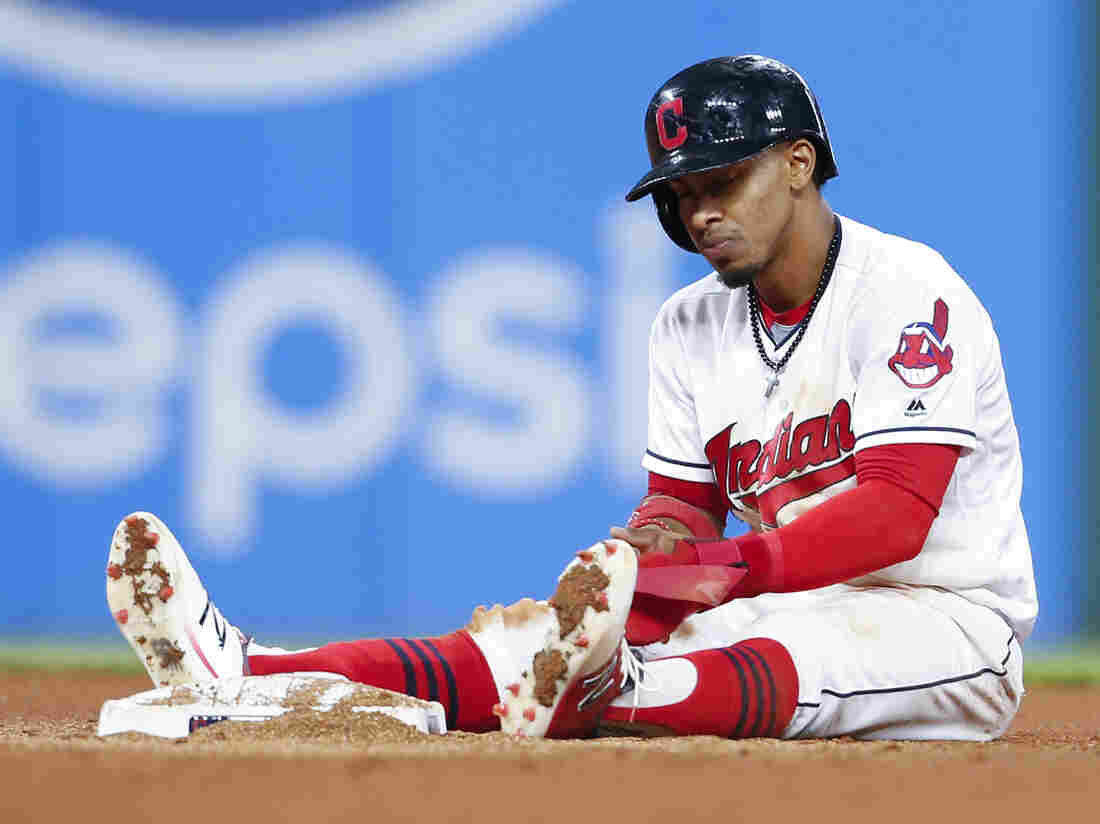
Cheer up, Francisco Lindor — there will be other 22-game winning streaks, right? The Cleveland Indians shortstop was forced out at second base in seventh inning Friday night at Progressive Field in Cleveland.
Ron Schwane/Getty Images
hide caption
toggle caption
Ron Schwane/Getty Images
The Cleveland Indians had mostly breezed through their record-setting 22-game winning streak, needing extra innings for the first time during it when they played the Kansas City Royals on Thursday. But they struggled against the Royals again on Friday and this time couldn’t pull off the comeback, falling 4-3.
The loss leaves them four wins shy of the all-time Major League Baseball record, a 26-game steak by the 1916 New York Giants. The Indians do now hold the record for the longest streak in American League history — and the second-longest streak the MLB ever has seen.
The run of wins also saw Cleveland rise to the top of the American League, with a guaranteed spot in the playoffs, all but clinching their division.
The win represents a surprising turnaround from when Kansas City played Cleveland during the streak in August, getting swept while being outscored 20-0. The biggest difference for the Royals tonight was that the bullpen held, giving up one hit and three walks in four innings.
Outfielder Lorenzo Cain led Kansas City at the plate, going 3-for-4 with a run scored and a run batted in, but every starter outside of catcher Drew Butera got at least one hit — including solo home runs by shortstop Alcides Escobar and designated hitter Brandon Moss.
With 15 games left to play, the Royals remain four games out of the final AL wild card spot.
Close Call, But Indians Pass Cubs, Set Sights On Longest MLB Winning Streak

Jay Bruce of the Cleveland Indians celebrates with teammates after hitting a game-winning double off Brandon Maurer of the Kansas City Royals during the 10th inning Thursday at Progressive Field in Cleveland.
Ron Schwane/Getty Images
hide caption
toggle caption
Ron Schwane/Getty Images
After three weeks of domination, the Cleveland Indians had begun to seem almost invulnerable. The Kansas City Royals exposed some weakness Thursday night but couldn’t finish the job, as the Indians got consecutive win No. 22 with runs in the ninth and 10th innings.
A double by Royals first baseman Eric Hosmer got outfielder Melky Cabrera across home plate for a 2-1 lead in the sixth, but Indians shortstop Francisco Lindor’s two-out double in the ninth scored pinch runner Erik Gonzalez.
Outfielder Jay Bruce, whose midseason acquisition from the New York Mets has powered much of the streak, hit a double in the 10th inning to drive in second baseman Jose Ramirez for the winning run for Cleveland.
The win gave Cleveland sole possession of the second-longest winning streak in Major League Baseball history, passing the Chicago Cubs. The record is held by the 1916 New York Giants with 26; if the Indians manage three more wins against the Royals, they could tie the record at 10 p.m. ET on Tuesday against the Los Angeles Angels.
The streak, which began with a win Aug. 24 against the Boston Red Sox and includes series sweeps of the Baltimore Orioles, Chicago White Sox, New York Yankees, Detroit Tigers (twice!) and these same Royals, has rocketed the Indians to the top of the American League and leave them three wins shy of clinching a playoff spot.
Thursday night’s game was the first time during the streak that the Indians trailed entering the ninth inning and the first game that went to extra innings, and was only the fourth one-run win of the stretch.
The loss for Kansas City was at least an improvement over the three-game sweep in August, in which the Indians outscored them 20-0. But moral victories don’t count for much with a team barely hanging onto hopes of a wild card berth.
Dual Olympic Bids Approved For Paris And Los Angeles

Paris and Los Angeles have been awarded the honor of hosting the 2024 and 2028 Olympic games, respectively. Pictured above: IOC President Thomas Bach (center), Paris Mayor Anne Hidalgo (left), and Los Angeles Mayor Eric Garrett.
Martin Mejia/AP
hide caption
toggle caption
Martin Mejia/AP
It’s official, the 2024 Olympics are coming to Paris – and four years later they’ll be in Los Angeles in the first “double allocation” of the Olympic contests in modern history.
The International Olympic Committee announced it had approved the allocations — the result of a three-way deal — by vote Wednesday.
“This historic double allocation is a’win-win-win’ situation for the city of Paris, the city of Los Angeles and the IOC,” said IOC President Thomas Bach following the vote to approve the decision.
IOC makes historic decision by simultaneously awarding Olympic Games 2024 to Paris and 2028 to Los Angeles https://t.co/NSXWbFCo6Upic.twitter.com/vuEMesyclD
— IOC MEDIA (@iocmedia) September 13, 2017
The Associated Press reports that Bach declared the vote unanimous after a “show of hands” count raised no objections.
The vote, in addition to setting the Olympic schedule for 11 years, breaks the IOC’s tradition of selecting host cities one at a time. Initially agreed to over the summer, the three-way deal followed an exodus of other bidders for the 2024 games, reported Ben Bergen, of member station KPCC, in June.
“Few governments want to risk the billions in cost overruns that have become synonymous with recent Olympics. That’s why the IOC is considering awarding dual bids,” said Bergen at time.
And once the IOC was looking at just two bidders, as NPR’s Tom Goldman reported, it was down to a matter “of who’d get what.”
“Paris said it didn’t want to host in 2028. 2024 will be the 100th anniversary of the 1924 Paris summer games. … LA sent signals that it was open to going second, ” Tom told Morning Edition last month.
Los Angeles, host city to the 1932 and 1984 summer games, conceded the 2024 Olympics to Paris, Tom goes on, and has been promised $180 million by the IOC for doing that.
The AP adds this will be the third Olympics for both cities, and the Los Angeles games will be the first Summer Olympiad in the U.S. since 1996.
