
Sports

No Image

Many Black Families Watching As 'Take A Knee' NFL Protests Continue

For a week, black NFL players have been under an even brighter spotlight than on any given Sunday and while some families are turning away from the game, others are watching closely.

ROBERT SIEGEL, HOST:

For almost two weeks, black players in the National Football League have been under an intense spotlight during the national anthem, some standing, some kneeling and many of them locking arms with their teammates. The silent protests or demonstrations of solidarity have turned off some fans. But as Tonya Mosley of member station KQED in San Francisco reports, many black families are watching closely.

TONYA MOSLEY, BYLINE: There’s one thing you should know about Rob Hughes. He’s hopelessly devoted to NFL football. His wife, Jwana, jokes it’s his first love.

JWANA HUGHES: Eagles. Since I met him, diehard Eagle fan.

MOSLEY: He has the Comcast RedZone deluxe cable package. It gives him access to every game in the country. On a 60-inch television from the comfort of his living room couch, Hughes even checks his fantasy football online during commercial breaks.

ROB HUGHES: If I could have a TV in my bathroom so I wouldn’t have to actually miss a second, I would (laughter).

MOSLEY: But things have been a little different this season. Hughes pays more attention to the top of the game, the national anthem, what players are kneeling and what players aren’t. As we jump in the car to grab some snacks before his beloved Philly Eagles play the Los Angeles Chargers, Hughes explains how he sometimes puts himself in the players’ shoes.

R. HUGHES: Would I kneel? Would I stand? Would I do the patriotic thing, as I was taught?

MOSLEY: He’s not sure. He supports a player’s right to protest – no question. And he supports that the protest is against police brutality. Last year, he took his 13-year-old son to Colin Kaepernick’s Know Your Rights Camp in Oakland. At the time, Kaepernick was a quarterback for the 49ers, and he was scrutinized for taking the knee throughout the season during the national anthem.

R. HUGHES: It took a whole lot of heart for that dude to do that. I also think to myself, like, I wonder if he thought that all this would come from just that one act.

MOSLEY: Hughes’ son Kelby says Kaepernick’s camp was life-changing. He learned stuff like how to talk to and deal with law enforcement. But most of all, Kelby says he learned that he has the right to know his rights. Now when he sits to watch football with his dad, he’s thinking about a lot more than a touchdown.

KELBY: Every time I see a game, that reminds me of people who have knelt and people who have at least tried to solve our problems in our country.

MOSLEY: Some of the family’s friends are boycotting the NFL by not watching the games. They feel Kaepernick hasn’t been hired for political reasons. But Hughes doesn’t want to do that.

R. HUGHES: You have to also – what? – boycott everybody that supports them. So I’ve got to boycott Visa. I’ve got to boycott Pepsi. I’ve got to boycott all these corporate entities that also do that.

MOSLEY: Other people are boycotting the NFL for allowing the players to protest during the anthem. This frustrates Hughes’s wife, Jwana.

J. HUGHES: It’s not about the flag. It’s about police brutality. That’s the way I take it as.

R. HUGHES: Touchdown. Touchdown.

MOSLEY: This week, the Eagles beat the Chargers. Hughes took note during the anthem as the camera focused on Eagles safety Malcolm Jenkins raising his fist. For NPR News, I’m Tonya Mosley in San Leandro, Calif.

(SOUNDBITE OF PETE ROCK’S “A LITTLE SOUL”)

Copyright © 2017 NPR. All rights reserved. Visit our website terms of use and permissions pages at www.npr.org for further information.

NPR transcripts are created on a rush deadline by Verb8tm, Inc., an NPR contractor, and produced using a proprietary transcription process developed with NPR. This text may not be in its final form and may be updated or revised in the future. Accuracy and availability may vary. The authoritative record of NPR’s programming is the audio record.

Let’s block ads! (Why?)


No Image

Judge In Canada Intervenes In Custody Battle

Beverly and Donald McLeod divorced after 35 years. The big question: Who would keep the hockey tickets. The couple owns two season tickets to the Edmonton Oilers NHL games.

DAVID GREENE, HOST:

Good morning. I’m David Greene. A judge had to intervene in a custody battle in Canada. Beverly and Donald MacLeod divorced after 35 years. The big question was who would keep the hockey tickets? The couple owns two season tickets to Edmonton Oilers games. Beverley wanted joint custody of the seats, and she won. The judge laid out this plan for how the couple will divvy-up games. They do not have to actually sit together watching hockey. That would have been a stick-ing point. It’s MORNING EDITION.

Copyright © 2017 NPR. All rights reserved. Visit our website terms of use and permissions pages at www.npr.org for further information.

NPR transcripts are created on a rush deadline by Verb8tm, Inc., an NPR contractor, and produced using a proprietary transcription process developed with NPR. This text may not be in its final form and may be updated or revised in the future. Accuracy and availability may vary. The authoritative record of NPR’s programming is the audio record.

Let’s block ads! (Why?)


No Image

The Call-In: Kids' Sports

Kids’ sports is now a $15 billion industry. Lulu Garcia-Navarro explores the pressure this puts on families with parent Amanda Nissim and former president of Washington Youth Soccer, Doug Andreassen.

Let’s block ads! (Why?)


No Image

40 Years Of Athletic Support: Happy Anniversary To The Sports Bra

Brandi Chastain celebrates after scoring the winning goal of the 1999 World Cup.

Hector Mata/AFP/Getty Images

hide caption

toggle caption

Hector Mata/AFP/Getty Images

Title IX is often credited with getting more girls involved in sports, but there’s another, more intimate milestone in the women-in-sports story that deserves some recognition: This year, the Jogbra turns 40.

In 1977, Hinda Miller had just started working at the University of Vermont and had taken up jogging. But she found she had a problem: What to do with her breasts? “I used two bras,” she says. “You know, everyone has their stories of what they did.”

Across campus, Lisa Lindahl was in the same predicament. She reached out to a friend — Polly Smith, who made costumes for the university’s theater department, where Miller also worked — and the three of them got together to build a better bra.

“We bought some bras, tore them apart,” Miller remembers. “I was taking notes; Lisa was running. ‘Does that feel good? Does that feel good?’ “

None of it felt good. See, breasts move — a lot. Up and down, side to side, even back to front. And they can be really heavy. Try as they might, the women couldn’t figure out how to make a bra that could stop the painful bounce. At one point, Lindahl’s then-husband came downstairs with two jockstraps slung over his chest. He was teasing them, but it led to an idea. Miller remembers thinking, “That’s what we want to do — we want to pull everything close to the body.”

Hinda Miller stands by a bronze plaque at the University of Vermont that commemorates the Jogbra.

Jane Lindholm/VPR

hide caption

toggle caption

Jane Lindholm/VPR

She ran to the store, bought two jockstraps and brought them back to the costume shop. “The waist band became our rib band,” Miller says. “We crossed the straps in the back because we didn’t want them to fall, and it went over our head. And that was it.”

They thought about calling their creation the Jockbra, but decided Jogbra was a better fit. The design caught on, and Miller and Lindahl made Jogbra into a national brand.

Two decades later, at the 1999 World Cup, the sports bra got its moment in the sun. U.S. women’s national team star Brandi Chastain scored the winning penalty kick of the championship game. Then, filled with emotion, Chastain pulled off her shirt in celebration, revealing a simple black sports bra. Images of that moment were featured on the covers of Newsweek and Sports Illustrated, and on the front pages of countless newspapers.

These days, women have all kinds of options when it comes to their sports bras: There are sports bras as outerwear and sports bras that are glittery, patterned or have crisscrossing straps that peek out prettily when you’re doing yoga. They’re big business: Global sales topped $7 billion in 2014. But the foundational truth remains: The best sports bra is the kind that allows girls and women to move the way they want to move, without worrying about their anatomy.

Chastain says sports bras are more than clothing — they’re an essential piece of equipment. “I couldn’t play without my cleats, and I wouldn’t and couldn’t play without my sports bra.”

The sports bra may be the unsung hero in the rise of women in sports, quietly claiming its place under a T-shirt. And it all comes back to two jockstraps sewn together in 1977.

Jane Lindholm (@JaneLindholm) hosts Vermont Public Radio‘sVermont Edition.

Let’s block ads! (Why?)


No Image

MLB Players Just Shy Of 6,000 Home Runs In Record Season

The long ball is back. Major League Baseball players broke the single season record for home runs. But, how did this happen? And do we have to start wondering about steroids again?

ROBERT SIEGEL, HOST:

The long ball is back. Major League Baseball players have hit just shy of 6,000 home runs this year, and that’s a record. Miami’s Giancarlo Stanton and the Yankees’ Aaron Judge are the star sluggers of this season, going into tonight’s games with 57 and 50 home runs respectively. But more than a hundred major leaguers have hit more than 20 home runs this year. That’s a record number. And 20 home runs used to be a respectable sum. We should note this is also a record-breaking season for strikeouts. And joining me to talk about this is Jonah Keri of CBS Sports. Welcome back to the program.

JONAH KERI: Thank you for having me, Robert.

SIEGEL: How did we get here? Has it been a gradual climb up in the number of home runs each season?

KERI: It has, but it’s accelerated over the last couple years. And there’s nothing too mysterious about it. There have been studies done by Ben Lindbergh at The Ringer as well as Rob Arthur at FiveThirtyEight that determined the ball is juiced. You’ve got an ability to manipulate how lively the ball can be. And right now those tests have shown that the ball is flying about seven feet further on average than in the past. Now, it’s seven, you say to yourself. Well, 400, hit the ball out into centerfield and so forth.

But seven could make a difference. A lot of what you call wall-scraper home runs are going out this season in addition to some colossal blasts. So now you’re in a situation where a lot of people are hitting home runs. Not just the big strong sluggers that you would expect, but some fellows who’ve never hit home runs before in their lives are suddenly hitting 15, 20, 25 home runs.

SIEGEL: And you’re saying that it’s because of, say, how tightly wound or stitched the baseball is?

KERI: So there’s two things going on. Number one is what you would call the center of restitution, which is referred to as core. So that basically is how lively the ball is, one. And then two, the seams are lower – so as you said, more tightly stitched. And that creates a couple of issues. There’s less drag on the ball as it goes through the air. And even more so – and in my mind maybe even more nefarious, honestly – is that some pitchers have complained that they are getting blister problems for the first time in their career as a result of these lower seams because the grip is very different. Now, that part has not been proven, but if it’s true that is a pretty big turn in terms of baseball.

SIEGEL: But given the number of strikeouts and given all the talk about the launch angle of the baseball as it leaves the bat, it seems that more baseball players are going up to the plate trying to hit a home run.

KERI: Well, that’s certainly true. But it has to do with incentives. You know, if you hit a bunch of home runs and you strike out, there’s nothing that’s going to get you fired from your job for that. And Aaron Judge is a classic example of this. Aaron Judge has more than 50 home runs. He’s going to win the AL Rookie of the Year, maybe MVP. He struck out more than 200 times this year. Only six players ever in the history of baseball, including Judge, have done that. And we don’t say, Aaron Judge, tisk-tisk (ph), all those strikeouts. We say, Aaron Judge, what an exciting player.

SIEGEL: The idea that this is caused by baseballs that are juiced is a less disturbing explanation than that it’s caused by players who are juiced. Is there any suggestion that perhaps performance-enhancing drugs are back in the game?

KERI: One thing I try to do is deal in evidence. We know based on these studies that the baseball is juiced, so we can say that with confidence. Whether or not players are taking performance-enhancing drugs is just difficult to ascertain. We don’t have recent failed tests or anything like that to prove it. It doesn’t necessarily mean that an absence of evidence suggests that nothing is going on. It’s just that we don’t know. And so for me to cast aspersions in that way would just be irresponsible.

SIEGEL: Is all of the interest in the long ball unfair to a player like Jose Altuve of Houston who’s going to win a batting title? He’s all of 5’6″. He’s hit over 20 home runs this year. But he’s a great player, but not a player who’s ever going to hit 50 home runs.

KERI: Well, I think Altuve’s going to get attention. He might win the AL MVP award despite him not hitting 50 home runs. That great-all-around game does play. And I’ll tell you something. This could show up in terms of contracts because you’re going to get a bunch of power hitters who are going to go out on the open market this year and might not get as much money as they expected. A lot of these big, strong sluggers who don’t have a complete game necessarily – they’re not fast, they don’t necessarily hit for a high average, they’re basically just sluggers – are not getting their just due.

And I would submit to you that if Jose Altuve went out on the open market right now he would get an unbelievable amount of money because he’s athletic, he steals bases, he plays good defense, he hits for a high average and, yes, he has some power. Whereas if you look at some other sluggers that have gone out on the open market and will this offseason, it’s a supply and demand issue. If everybody’s hitting home runs, why bother spending a lot for home runs?

SIEGEL: Jonah Keri of CBS Sports, thanks for talking with us.

KERI: Thank you, Robert.

Copyright © 2017 NPR. All rights reserved. Visit our website terms of use and permissions pages at www.npr.org for further information.

NPR transcripts are created on a rush deadline by Verb8tm, Inc., an NPR contractor, and produced using a proprietary transcription process developed with NPR. This text may not be in its final form and may be updated or revised in the future. Accuracy and availability may vary. The authoritative record of NPR’s programming is the audio record.
Let’s block ads! (Why?)


No Image

Rick Pitino Is Put On Unpaid Leave As University Of Louisville Reacts To Scandal

The University Of Louisville has put men’s head basketball coach Rick Pitino on unpaid leave, after the program was mentioned in a wide-ranging federal fraud investigation.

Joe Robbins/Getty Images

hide caption

toggle caption

Joe Robbins/Getty Images

The University Of Louisville has placed men’s head basketball coach Rick Pitino on unpaid administrative leave, with his employment to be reviewed. The school’s interim president, Gregory Postel, called it “a dark day” for the university.

The move comes after Pitino’s program was implicated in a wide-ranging federal fraud investigation that was unveiled on Tuesday. The FBI says it caught coaches, Adidas employees and players in a network of bribes.

Postel said Louisville athletic director Tom Jurich is being placed on paid administrative leave.

Member station WFPL reports about the allegations that touch on Louisville in the FBI’s bribery case:

“In one instance, an Adidas employee arranged for $100,000 and ongoing monthly payments allegedly funneled through a third-party company for a high school player, who is currently a freshman athlete at the school. That athlete is widely believed to be star recruit Brian Bowen.”

Announcing Pitino’s reduced status Tuesday, Postel also said that one athlete on the basketball team won’t be allowed to practice or play with the team — an apparent reference to Bowen.

Pitino was put on leave after intense speculation that the coach would be fired Wednesday, after federal officials said bribes were paid to steer top high school recruits toward certain schools — and by extension, toward Adidas, the sports apparel company that sponsors those schools’ teams.

None of the four assistant coaches who were arrested over the federal charges work under Pitino at Louisville. But in addition to being implicated through court documents, the school’s athletics teams are sponsored by Adidas — whose director of global sports marketing for basketball, James Gatto, was among 10 people who were arrested in the federal investigation.

As member station WFPL — which is based in Louisville but is not affiliated with the university — reports, “Adidas paid Pitino $2.25 million in 2015 in athletically related income.”

The school will name an interim head basketball coach and interim athletic director, Postel said.

In court documents, investigators alleged universities had agreed to “provide athletic scholarships to student-athletes who, in truth and in fact, were ineligible to compete as a result of the bribe payments.”

Charges in the case range from wire fraud and bribery to money-laundering, conspiracy and other offenses.

After news of Louisville’s implication in the case emerged Tuesday, the school’s interim leader, Postel, issued a statement reading in part, “U of L is committed to ethical behavior and adherence to NCAA rules; any violations will not be tolerated. We will cooperate fully with any law enforcement or NCAA investigation into the matter.”

Pitino, 65, has coached at Louisville since 2001. He has won two national titles — one at Louisville in 2013 and another at the University of Kentucky in 1996.

In his own statement, Pitino said on Tuesday:

“These allegations come as a complete shock to me. If true, I agree with the U.S. Attorneys Office that these third-party schemes, initiated by a few bad actors, operated to commit a fraud on the impacted universities and their basketball programs, including the University of Louisville.”

The announcement of the university’s response comes as Louisville and other colleges are preparing for the upcoming new season. Many schools have resumed practice this week.

Let’s block ads! (Why?)


No Image

4 College Basketball Coaches, Adidas Executive, Charged In Bribery Case

The Department of Justice announced fraud and corruption charges for a scheme allegedly involving four college basketball coaches and the head of global sports marketing for Adidas, plus five other defendants. NPR’s Robert Siegel talks to Mike DeCourcy of Sporting News about the case.

ROBERT SIEGEL, HOST:

The Department of Justice has brought charges in a wide-ranging college basketball bribery and fraud case. Here’s how U.S. Attorney Joon Kim laid it out at a news conference today.

(SOUNDBITE OF PRESS CONFERENCE)

JOON KIM: Coaches at some of the nation’s top programs soliciting and accepting cash bribes, managers and financial advisers circling blue-chip prospects like coyotes and employees of one of the world’s largest sportswear companies secretly funneling cash to the families of high school recruits.

SIEGEL: Ten people have been charged, including four assistant college basketball coaches and an executive at Adidas. All have been arrested. Mike DeCourcy is a college basketball columnist with The Sporting News, and he’s been covering this case. Welcome to the program.

MIKE DECOURCY: Thank you, Robert.

SIEGEL: The U.S. attorney for the Southern District of New York described two separate schemes. Let’s talk about the first one. This involved the assistant coaches being bribed. What was the alleged scheme, and who did they say was involved?

DECOURCY: Well, there are four assistant coaches, including a coach at Auburn, associate head coach Chuck Person, as well as assistant coaches at Oklahoma State, Southern California and Arizona. They are charged with accepting bribes for delivering particular players who had gone through their programs to a particular financial management firm. And then of course the financial management firm would profit from their association with those players as they turned professional.

SIEGEL: It’s alleged that the coaches took money in order to direct the players to those companies. And the second scheme – what’s charged there?

DECOURCY: The second case involves a scheme to direct particular players to particular schools who were affiliated with one of the conspirator’s apparel company.

SIEGEL: And we should say the apparel company isn’t named I guess in this. But the – it’s Adidas obviously from reading between the lines.

DECOURCY: The – one of the indicted people was an executive at Adidas.

SIEGEL: Bill Sweeney of the FBI New York field office said at the news conference today that this investigation is ongoing. And he said to others conducting business this way in college sports, we have your playbook. Do you assume they’re going to be more indictments in this case?

DECOURCY: I would not rule that out. But I think the point that was made by the FBI agent was more like, don’t do this stuff because we’ll catch you. And before, the problem had always been if you get caught, well, you might lose your job at school, or your school might go on probation or lose a post-season tournament or something like that. Now there’s a lot more at stake. I think there was a cavalier attitude when it was only the NCAA. They had to be worried about – those three letters, the FBI, are a lot more intimidating than the four in the NCAA.

SIEGEL: Yeah. Of the people indicted, only one name rings a bell with me, and that’s Chuck Person, an assistant coach at Auburn but also a former star basketball player there and a longtime NBA player.

DECOURCY: What’s interesting about that is Chuck Person, according to statistical websites, made over $22 million in his NBA career and is making over a quarter of a million dollars a year as the associate head coach at Auburn. So why would he need the money that he was alleged to have accepted as a bribe? And I think that’s the question that people in basketball are asking and that they wonder if the federal authorities will ask as well.

SIEGEL: Mike DeCourcy, college basketball columnist for The Sporting News, thanks for talking with us.

DECOURCY: Thank you very much.

Copyright © 2017 NPR. All rights reserved. Visit our website terms of use and permissions pages at www.npr.org for further information.

NPR transcripts are created on a rush deadline by Verb8tm, Inc., an NPR contractor, and produced using a proprietary transcription process developed with NPR. This text may not be in its final form and may be updated or revised in the future. Accuracy and availability may vary. The authoritative record of NPR’s programming is the audio record.

Let’s block ads! (Why?)


No Image

Athletes On The Track And The Slopes Are Pulled Into Trump Controversy

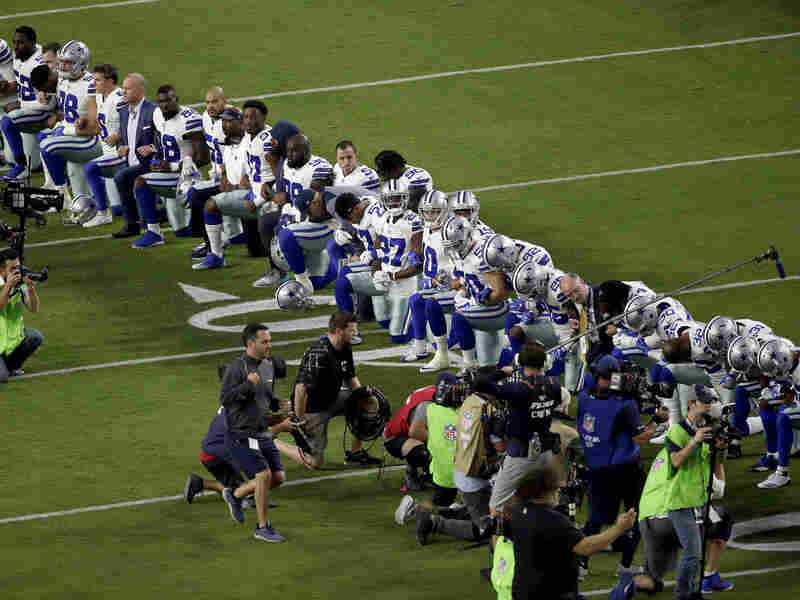
The Dallas Cowboys, led by owner Jerry Jones have their picture taken making a protest gesture during the national anthem before their game against the Arizona Cardinals Monday.

Matt York/AP

hide caption

toggle caption

Matt York/AP

The tumult in the sports world continued Monday after President Trump’s incendiary remarks criticizing NFL players who have protested racial inequality during the playing of the national anthem. While the Dallas Cowboys and Arizona Cardinals showed solidarity with the protesters before their Monday night football game, NASCAR figures and Olympic athletes also weighed in.

The president had targeted the NFL and, to a lesser extent, the NBA but on Monday he praised professional racing, saying, “So proud of NASCAR and its supporters and fans. They won’t put up with disrespecting our Country or our Flag — they said it loud and clear!”

Trump was responding to support from legendary racer Richard Petty and Hall of Fame team owner Richard Childress during the weekend. It served as a coda to a remarkable few days — a series of events that seemed to put to rest for good the idea that sports and politics don’t mix.

“Anybody that don’t stand up for that [the anthem] ought to be out of the country, period,” Petty said. “If they don’t appreciate where they’re at, what got them where they’re at? The United States.”

Although Yahoo Sports notes it wasn’t long ago that NASCAR drivers sat in their cars during the national anthem.

NBC Sports reported this is what Childress said if one of his team members protested: “Get you a ride on a Greyhound bus when the national anthem is over. … Anybody that works for me should respect the country we live in. So many people gave their lives for it. This is America.”

Since most of the anthem protests have been conducted by African-American athletes, Trump’s critics have said the president’s use of the term “S.O.B.” last Friday to describe protestors was racially insensitive. Critics say Trump’s endorsement of NASCAR, a sport with, historically, an overwhelming number of white drivers, inflamed the racial component of the controversy.

Trump said several times Monday his comments had nothing to do with race.

NASCAR released a statement saying “Sports are a unifying influence in our society, bringing people of differing backgrounds and beliefs together. Our respect for the national anthem has always been a hallmark of our pre-race events. Thanks to the sacrifices of many, we live in a country of unparalleled freedoms and countless liberties, including the right to peacefully express one’s opinion.”

And then NASCAR’s most popular driver, Dale Earnhardt, Jr. tweeted this message, quoting former President John F. Kennedy: “All Americans R granted rights 2 peaceful protests. Those who make peaceful revolution impossible will make violent revolution inevitable.”

The flag and the anthem arguably are most significant in Olympic sport. Carrying the flag during opening and closing ceremonies is considered a high honor; winning a gold medal is followed by an emotional playing of the anthem while the flag rises.

Park City, Utah, is a long way from the pro football fields of America. But it’s where many of this country’s Winter Olympians are gathered for several days of media interviews in advance of next February’s game in South Korea.

And like everywhere else in the sports world, talk in Park City turned to the president, NFL players and anthem protests.

“I think the president of the United States has a very important job,” says U.S. figure skater Adam Rippon. “I think there are so many things going on in the world that we should be focused on. President Trump speaking up and against freedom of speech is dangerous and divisive.”

“Some people think that we should just shut up and ski or shut up and play,” says Alpine ski racer Laurenne Ross. “But the fact that the Internet exists and there’s all this social media and news spreads so fast, is actually a really wonderful thing for us and it helps us have a voice.”

Gold medal winning skier Mikaela Shiffrin says it’s “cool” to see sports play a bigger role than it has in the past.

“It gives us all a really great opportunity to share our values with the world,” says Shiffrin, adding, “I think the Olympics will be the same thing. We have to be careful not to offend anyone when we’re there because we’re not just talking about the U.S., we’re talking about the entire world. But it has been interesting to see how sports has taken a stronger role these past few months.”

Figure skater Ashley Wagner says she absolutely respects the different ways Americans express their freedom of speech. But Wagner, a self-described army brat, also respects how special a flag and an anthem are in an Olympic Games.

“I think for me going into South Korea, when I hear the anthem, I hear it when I’m standing on top of the podium,” she says. “So for me it’s a huge moment of pride and it’s a moment I really hope to experience for myself in Korea.”

As far as a possible anthem protest at the games, the most famous of which took place in Mexico City in 1968, International Olympic Committee rules strictly forbid what we’ve seen over the past weekend on NFL fields.

According to Rule 50 of the Olympic Charter, “No kind of demonstration or political, religious or racial propaganda is permitted in any Olympic sites, venues or other areas.”

Still, USOC CEO Scott Blackmun said in Park City he and other officials support the right of athletes to speak their minds.

“[NFL] athletes are protesting because they love their country, not because they don’t.”

Let’s block ads! (Why?)


No Image

Trump Renews Debate Over National Anthem Protest, NFL Players Respond

New Orleans Saints players sit on the bench during the national anthem before Sunday’s NFL football game against the Carolina Panthers in Charlotte, N.C.

Bob Leverone/AP

hide caption

toggle caption

Bob Leverone/AP

It seemed like the controversy involving NFL players kneeling during the national anthem had died down a bit — that is until President Trump stirred up a hornet’s nest Friday night during a campaign trip to Alabama.

Trump unleashed a tirade of strong comments against NFL players who don’t stand during the playing of “The Star Spangled Banner.”

Kneeling during the national anthem in protest over perceived social injustices against African-Americans began last year.

A handful of white players didn’t stand Sunday, but the vast majority of those actively protesting were black, The Associated Press reports.

Trump’s take: It’s unpatriotic and NFL team owners should fire those refusing to stand.

Trump’s comments festered over the weekend and by the various game times on Sunday, roughly 200 players sat, knelt or raised their fists in defiance during the anthem.

Most of the players locked arms with their teammates — some coaches and team owners also joined in.

Other teams, such as the Pittsburgh Steelers, stayed off the field until the anthem was finished. One Steeler, Army veteran Alejandro Villanueva, ventured out of the tunnel and placed his hand over his heart during the singing of the anthem.

A week ago, less then 10 players protested.

Great solidarity for our National Anthem and for our Country. Standing with locked arms is good, kneeling is not acceptable. Bad ratings!

— Donald J. Trump (@realDonaldTrump) September 24, 2017

The last NFL game of the day, Washington hosted Oakland, was played in Landover, Md. — not far from the White House.

Most of Oakland’s team sat on their bench during the anthem while most of Washington’s team stood arm-in-arm along with owner Dan Snyder and president Bruce Allen.

Trump tweeted earlier on Sunday: “Standing with locked arms is good, kneeling is not acceptable. Bad ratings!”

The Associated Press reports that among the strongest criticisms of the president was from New Orleans Saints coach Sean Payton:

“I’m disappointed in the comments that were made. I think we need a little bit more wisdom in that office,” he said of the White House. “I want that guy to be one of the smarter guys in the room and it seems like every time he’s opening up his mouth it’s something that is dividing our country and not pulling us together.’ “

Kneeling during the national anthem began as a protest more than a year ago when former San Francisco 49ers quarterback Colin Kaepernick refused to stand during the song as a protest of police treatment of minorities.

This season, no team has signed him, and some supporters believe NFL owners are avoiding him because of the controversy.

Trump’s comments may have helped to publicize a cause that not all NFL fans were aware of.

Let’s block ads! (Why?)