
Alabama Clinches NCAA Championship 26-23 In Overtime Against Georgia

Alabama’s Tua Tagovailoa holds up the championship trophy after overtime of the NCAA college football playoff championship game against Georgia, on Monday in Atlanta.
David J. Phillip/AP
hide caption
toggle caption
David J. Phillip/AP
Updated at 12:15 a.m. ET Tuesday
The Georgia Bulldogs got into the college football title game with an unexpected comeback for an overtime win against the Oklahoma Sooners. On Monday night, they had their championship hopes yanked away the same way.
In the fourth quarter, the Alabama Crimson Tide made up lost ground, bringing the score with Georgia’s Bulldogs to 20-20 with less than four minutes left in the College Football Playoff National Championship game in Atlanta.
Down to what might have been their last down, freshman quarterback Tua Tagovailoa flung the ball to the endzone on fourth down and found wide receiver Calvin Ridley. Georgia had been leading Alabama 20-7 in the the third quarter.
Alabama got the ball back, but kicker Andy Pappanastos pulled a 36-yard field goal wide, and the game went to overtime.
Georgia went first and managed a field goal of their own, and looked to be in good shape after a 16-yard sack of Tagovailoa on Alabama’s first play. But Tagovailoa found wide receiver DeVonta Smith streaking down the left sideline for a touchdown, and Alabama’s fifth national championship in nine seasons.
The Bulldogs had scored their second touchdown of the game on a 80-yard reception by receiver Mecole Hardman. Rodrigo Blankenship kicked the point-after.
After being held scoreless in the first half, Alabama got on the board with a 6-yard touchdown pass by freshman quarterback Tua Tagovailoa to Henry Riggs III.
Tagovailoa started the second half for Alabama after a lackluster performance by starting quarterback Jalen Hurts.
Late in the second quarter, Georgia scored a touchdown on a one-yard run by Mecole Hardman. That capped off a 69-yard drive.
Blankenship earlier had kicked two field goals of 41 and 27 yards.
Georgia’s freshman quarterback Jake Fromm has paced his team with a mix of medium-length passes which have set up the Bulldogs a potent running attack.
Georgia’s offense dominated the game early with twice as many offensive plays as Alabama which hadn’t managed to sustain a drive throughout the contest.
The game pitted Georgia’s potent running game against Alabama’s stout rushing defense.
Alabama is led by arguably the best college football coach in the game, Nick Saban, while Georgia is led by Kirby Smart, who spent nine years as a Saban assistant coach and was looking to best the master by bringing the Peach State its first title since 1980. No former assistant coach has ever beaten Saban.
President Trump, who once, as a football mogul, tried to break the National Football League’s hold on pro football and failed, was there for the first half.
The Atlanta chapter of the NAACP encouraged people to stage a “snowflake” protest by waving small white towels at any mention of Trump. But apparently that didn’t happen.
Chapter president Richard Rose told USA Today that his group would also protest on social media, but their planned action would be limited.
“Rose said the Atlanta chapter of the NAACP will not officially participate in any physical gathering before or during the game due to weather and security concerns,” reported the national daily.
It was likely that Trump would be on safe ground at a game between competitors of two deep-red states.
But as the New Yorker pointed out:
“While it’s true that Alabama and Georgia went for Trump in the 2016 presidential election, he’s not exactly beloved in either state. Clarke County, Georgia, home to the UGA, went for Hillary Clinton in 2016 by a nearly 40 percent margin. And Alabama recently dealt Trump a double whammy in the special election to fill the seat left vacant by his Attorney General Jeff Sessions. Republicans in the state first rejected Trump-endorsed Luther Strange in the GOP primary and then dealt a loss to Roy Moore in last month’s special election.”
And in case you’re wondering how popular Nick Saban is in Alabama, consider this: more than 400 voters cast their ballot during that recent special election for the 66-year-old coach as a write-in candidate. Not that Saban ever did anything to encourage that support. As Al.com reports, Saban said bluntly, “I don’t get involved in politics.”
Adam Rippon Is U.S.'s First Openly Gay Man To Qualify For Winter Olympics

Adam Rippon, the first openly gay man to qualify for the U.S. Winter Olympics team, competes during the 2018 Prudential U.S. Figure Skating Championships in San Jose, Calif.
Matthew Stockman/Getty Images
hide caption
toggle caption
Matthew Stockman/Getty Images
As of Sunday morning, 28-year-old figure skater Adam Rippon will be the first openly gay man to compete for the United States in the Winter Olympics.
Despite a disappointing fourth-place performance at the U.S. figure skating championships Saturday night, Rippon was selected to join Nathan Chen and Vincent Zhou in Pyeongchang next month.
“I’m really grateful that the selection committee looked at my body of work over the last two seasons,” Rippon told reporters on Sunday.
The committee’s decision wasn’t without controversy. Rippon’s selection edged out Ross Miner, who placed second in the national championship. U.S. Figure Skating President Sam Auxier said the athletes’ track records in international competitions were a deciding factor.
But for Rippon, who was the U.S. national champion in 2016, the road to PyeongChang has been a long one. This year will be the 28-year-old’s Olympic debut — more than 80 years since an American man his age competed as a rookie, according to The Washington Post.
“I don’t really care what other people think of me. I’m able to go out there and I’m really able to be unabashedly myself,” he said. “I want somebody who’s young, who’s struggling, who’s not sure if it’s OK if they are themselves to know that it’s OK.”
And depending on how the roster for the U.S. ski team shapes up, Rippon may end up sharing his historic moment.
U.S. freestyle skier Gus Kenworthy came out publicly in 2015, a year after he took silver in the 2014 Sochi Olympics. Kenworthy will find out later this month whether he heads to Pyeongchang.
A third gay athlete, luger John Fennell, had also been vying for a spot on Team USA, but a sled malfunction slashed his chance at qualifying in December.
Figure skater Johnny Weir faced speculation about his sexuality while competing in 2006 and 2010, but he avoided questions on the matter. In 2011, he publicly confirmed that he was gay in his memoir, Welcome to My World.
Despite the gain in LGBTQ representation this winter, the Olympics contend with a dearth of openly queer athletes. The U.S. hasn’t sent an openly gay man to the Summer Olympics in 14 years — since equestrians Robert Dover and Guenter Seidel competed in 2004.
But come February, a global audience will get the chance to know Rippon, who’s built a reputation as an unapologetic, highly entertaining skater.
“A few weeks ago, I was asked in an interview … what was it like being a gay athlete in sports. And I said it’s exactly like being a straight athlete. Only with better eyebrows,” Rippon said.
Saturday Sports: NFL Playoffs

NPR’s Scott Simon talks with Howard Bryant of ESPN about the NFL playoffs — which games to watch and which teams to watch out for.
SCOTT SIMON, HOST:
Talk about fire and fury. It’s time for sports.
(SOUNDBITE OF MUSIC)
SIMON: Much of the country is huddled inside against the cold, but the NFL playoffs are just heating up. Howard Bryant of ESPN joins us. Howard, thanks so much for being with us.
HOWARD BRYANT: Good morning, Scott. How are you doing?
SIMON: I’m fine. Thank you, my friend. Most of the NFL talk we’ve had this this year has been about demonstrations of conscience on the field, been about the dropping ratings of the games. There are four big games this weekend. You’ve got the Tennessee Titans playing the Kansas City Chiefs and the Panthers against the New Orleans Saints. Where’d you like to start?
BRYANT: Well, actually, I’d like to start with Buffalo – and Buffalo and Jacksonville. You’ve got two teams that haven’t made the playoffs in forever. Jacksonville hadn’t made the playoffs since 2007. And they were a laughingstock for years. And the Buffalo Bills, the once proud Buffalo Bills, hadn’t made the playoffs since 1999. They play each other this weekend.
And you’re right, Scott. This has been a very difficult year, whether you’re talking about CTE and concussions, and we’re talking about the ratings and protests for and against Colin Kaepernick and against police brutality. And so this is the period now where the league needs this, where I think football fans are going to try to settle in and salvage this season. It’s go time for the players in terms of trying to win a championship.
And then, also, of course, you’re looking at the Atlanta Falcons. You’ve got a team there that had a 28-3 lead in the Super Bowl against the Patriots a year ago. And now they’re in the playoffs again one more time. And a team that lost the Super Bowl hasn’t gone back to the Super Bowl since 1993, when Buffalo did it. So maybe…
SIMON: And this was a team that was two minutes away from – or four minutes away from winning the Super Bowl.
BRYANT: From winning the Super Bowl. It goes back to what John Madden always said – I love that – that the greatest gap in sports is between the winner and loser of the Super Bowl. And it really is true.
SIMON: Yeah. Teams that had a rough regular season – can they put that all behind them when it gets to the playoffs? Do you wipe the slate clean?
BRYANT: Well, I think you have to. And I think that one of the teams that you’re really concerned about in that regard is the Kansas City Chiefs. There’s a team that – they went out on opening day, and they demolished the defending champion Patriots in Foxborough. You looked at them, and you said, here’s a team that’s really going to put it together.
And they’ve got Andy Reid back there, who’d been to the Super Bowl with the Philadelphia Eagles. And then, of course, they had their troubles during the season. And then they turned it around, and so now they’re in the playoffs. And so, this is one of the – they’re going to be one of those teams that is definitely saying, look. We’re in the tournament now, so everything that happened in the past isn’t going to matter. Let’s see if we can turn this around.
And, of course, the team that everyone’s looking out – there are two teams that everyone’s looking out for. One in the NFC is the Philadelphia Eagles – great team, 13 win team. But they lost their quarterback, Carson Wentz. So now you’re looking at the Eagles to see, can they win the Super Bowl with Nick Foles, with a backup? And then, of course, the defending champion Patriots, who are always there. And can 40-year-old Tom Brady do what no one’s ever done before, which is to win the Super Bowl at that age?
SIMON: Yeah. You didn’t ask. But I’ll say, yeah. I think he can.
BRYANT: (Laughter) I think he can too.
SIMON: And let me ask about the Australian Open because it is such a testament to the eminence of Serena Williams that she can dominate a news cycle about the Australian Open by making a personal decision – let me put it that way.
BRYANT: No question. Well, Serena Williams hasn’t played a professional match since she beat her sister in the Australian Open last year. She was eight weeks pregnant at the time and then announced that she was pregnant. And then she had her baby. And yet, for much of that time, she had told people that she was going to come back and make the Open, announced that she didn’t reach her goal and that she’s not going to play in the Open.
Serena Williams is the greatest athlete we’ve got going in the country right now. She does not, however, have an S on her chest. It was a great ask. But because it was Serena, everybody assumed that, hey, you’re not going to bet against her. But she said she’s not quite there yet. Kind of a shame but not really a surprise. You’re asking a lot even of the great Serena Williams to not play a match in a year and then come back and compete for a championship.
SIMON: Yeah. Well…
BRYANT: But she’ll be back.
SIMON: …Let me just say, no male champion’s ever come back after giving birth, has he?
BRYANT: (Laughter) Asking a lot, even of Serena.
SIMON: Howard Bryant, thanks so much for being with us.
BRYANT: Thank you.
Copyright © 2018 NPR. All rights reserved. Visit our website terms of use and permissions pages at www.npr.org for further information.
NPR transcripts are created on a rush deadline by Verb8tm, Inc., an NPR contractor, and produced using a proprietary transcription process developed with NPR. This text may not be in its final form and may be updated or revised in the future. Accuracy and availability may vary. The authoritative record of NPR’s programming is the audio record.
U.S. Figure Skaters Preparing For PyeongChang Winter Olympics
The best figure skaters in the United States are squaring off this week and will learn who will compete at next month’s Winter Olympics in South Korea. Already, there have been some surprises.
ROBERT SIEGEL, HOST:
Figure skating is always a fan favorite at the Olympic Games, a combination of athleticism, sequined costumes and often melodrama. U.S. figure skaters are gathered in San Jose, Calif., this week for the national championships and a chance to qualify for the Olympics, which begin next month. NPR’s Tom Goldman reports there has been drama, more real-world than soap opera.
TOM GOLDMAN, BYLINE: The U.S. Figure Skating Championships in an Olympic year are a stressful event. Performances in the short program and longer free skate don’t solely determine whether a skater makes the Olympic team, but they count a lot. So the stumbles during routines are more frequent, the on-ice smiles sometimes appear strained. 2016 U.S. champion Adam Rippon was feeling it before his short program last night.
ADAM RIPPON: When I made a little mistake in the six-minute warm-up, I said, girl, you tight. So…
(LAUGHTER)
GOLDMAN: But the 28-year-old veteran told himself to bend his knees, take things one at a time. And it worked.
(SOUNDBITE OF MUSIC)
GOLDMAN: Rippon flowed and jumped with ease. Although he’s had success in his career, he’s battled injury and illness and never qualified for an Olympics. But last night’s second-place finish was what he calls a first step toward that elusive Olympic gold.
(APPLAUSE)
GOLDMAN: And if Adam Rippon makes the trip to South Korea next month, a much bigger audience will get to know a top-notch and highly entertaining skater.
RIPPON: A few weeks ago, I was asked in an interview – and I tweeted about it – that they asked me, what was it like being a gay athlete in sports? And I said, it’s exactly like being a straight athlete, only with better eyebrows.
(LAUGHTER)
GOLDMAN: Rippon came out in 2015, and he could be one of the first openly gay figure skaters to compete in an Olympic Games.
RIPPON: Growing up, I really didn’t have a lot of role models. And I said, if I was ever given the chance and the platform, I would share my story.
GOLDMAN: He says sharing that story has made him a better competitor.
RIPPON: Because I don’t really care what other people think of me. I’m able to go out there and I’m really able to be, like, unabashedly myself. And I want somebody who’s young, who’s struggling, who’s not sure if it’s OK if they are themselves to know that it’s OK.
GOLDMAN: Adam Rippon isn’t the only member of the figure skating world to put a dramatic stamp on these championships. Sports federation leaders traditionally don’t wade into controversy, certainly geopolitics, but not this week. After North Korea floated the idea that its athletes might participate in the Olympics, Senator Lindsey Graham said the U.S. should boycott the games. In San Jose, U.S. Figure Skating President Sam Auxier willingly waded into the fray.
SAM AUXIER: These athletes have worked so hard to get here. I mean, their whole lives are focused on getting to the Olympics. It would be devastating if we were to pull out just for this kind of posturing.
GOLDMAN: There’s a direct connection to his sport. The only North Koreans who’ve qualified for Olympic competition are a pairs skating team. With talks now scheduled next week between North and South Korea dealing in part with the Olympics, Auxier hopes this country’s leaders can see the games as one way to help move the Korean Peninsula away from crisis.
At least, he says, the U.S. should go to the games and win medals. He’ll get no argument from Adam Rippon, Nathan Chen and Bradie Tennell, the men’s and women’s leaders after the short programs, and the rest of a bunch of hungry and slightly anxious skaters in San Jose. Tom Goldman, NPR News.
(SOUNDBITE OF TARO UMEBAYASHI’S “YURI ON ICE”)
Copyright © 2018 NPR. All rights reserved. Visit our website terms of use and permissions pages at www.npr.org for further information.
NPR transcripts are created on a rush deadline by Verb8tm, Inc., an NPR contractor, and produced using a proprietary transcription process developed with NPR. This text may not be in its final form and may be updated or revised in the future. Accuracy and availability may vary. The authoritative record of NPR’s programming is the audio record.
Training For The Olympics Is Hard Enough. Try Doing That While Earning A Degree
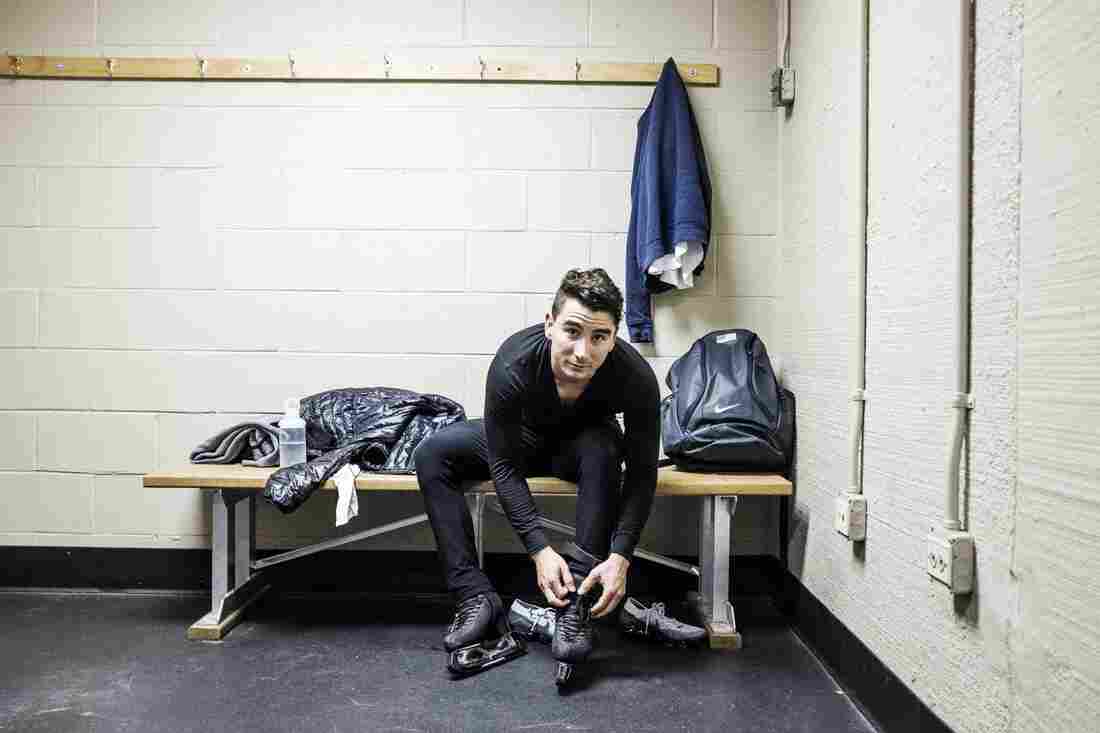
2013 Figure skating national champion and Olympic hopeful Max Aaron trains at the World Arena Ice Hall in Colorado Springs. Aaron recently graduated with a degree in finance.
Matt Nager for NPR
hide caption
toggle caption
Matt Nager for NPR
Max Aaron may have been the 2011 men’s junior figure-skating champion, 2013 U.S. national champion and 2015 Skate America champion. And sure, he’s a top contender for a spot on the U.S. team in next month’s Winter Olympic Games in PyeongChang, South Korea.
But all his grandfather wants to know is when he’s going to machan a leibedik—Yiddish for “make a living.”
Before he can do that, though, Aaron and many other elite athletes face a big hurdle: Finding time, between all that training — hours in the gym or pool or on the ice — to earn a college degree.
Aaron, who is 25, has been working on it — for years — balancing his grueling training schedule with classes in finance at the University of Colorado Colorado Springs.
A onetime hockey player who switched to figure skating after breaking his back in high school, Aaron took his competitive nature with him to the university, where he was determined to outdo his classmates.
This story was reported for radio by Elissa Nadworny and for the web by Jon Marcus of the Hechinger Report.
“I look at, they got a 99 — I’m going to get 100,” he says during a break from the rink in the World Arena Ice Hall, where aspiring and elite Olympic skaters train.
That doesn’t mean it was easy. Because of his skating career, he hadn’t ever taken the SAT or ACT, so he had to start at community college. He worked as a a waiter on the weekends to help pay the tuition. To accommodate his three hours a day at the rink, plus warmup time, strength conditioning, physical therapy and dance, he typically took his finance classes from 8 to 10:40 a.m. and 7:30 to 10:05 p.m.
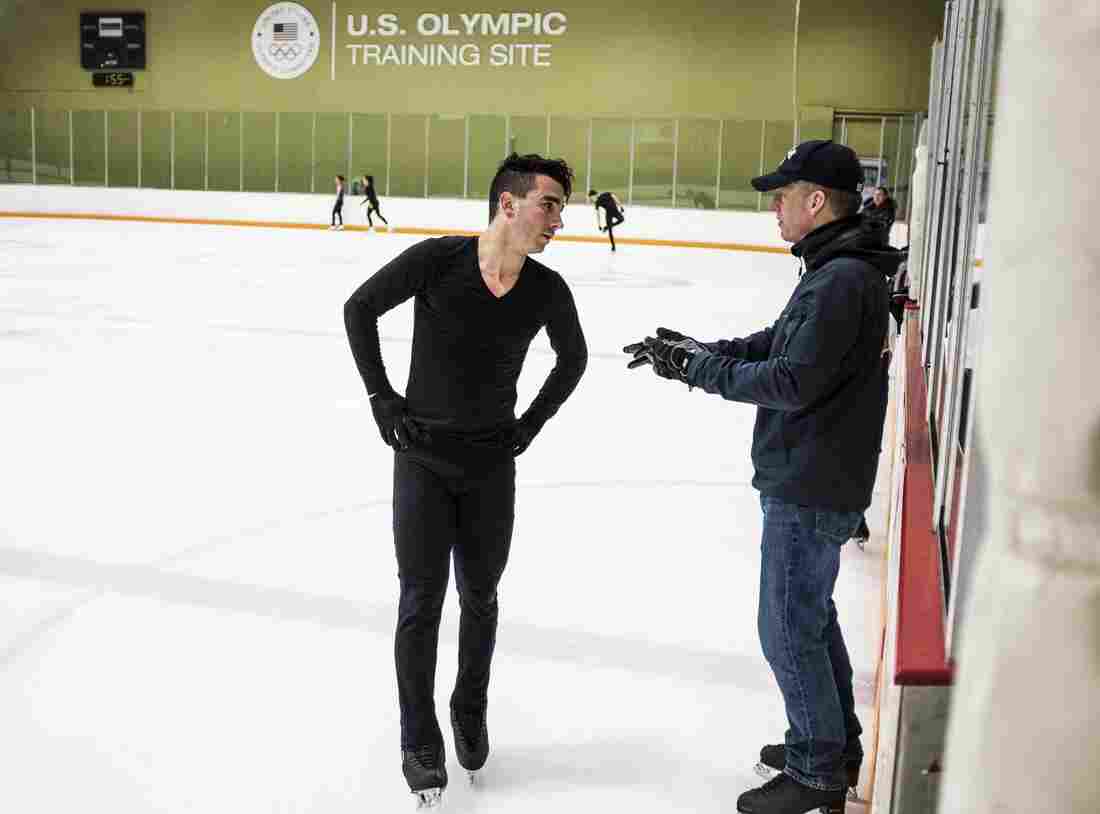
Max Aaron talks with his coach, Tom Zakrajsek, during practice at the World Arena Ice Hall in Colorado Springs.
Matt Nager for NPR
hide caption
toggle caption
Matt Nager for NPR
“I laid out my entire schedule,” he says. ” ‘And these are my breaks and this is when the courses meet and where I can fit them in.’ ” Universities “don’t work around you,” he says, “you work around them.”
Meeting the needs of older students
Olympic athletes and hopefuls comprise only a tiny handful of the older students trying to get higher educations. But their struggles with finding the money and time to do it, among other problems, illustrate the problems legions of adults are facing.
American higher education long ago stopped being primarily for the 18-year-old undergraduate, tossing a Frisbee on a manicured quadrangle.
Sixty percent of undergraduates today are over 25, working full time, financially independent of their parents, or connected with the military, according to the American Council on Education. That’s nearly 16 million people.
As the number of 18-year-olds declines, colleges and, eventually, employers, are becoming more dependent on this older group to fill classrooms and jobs. And the supply of them is vast. One in five American adults has earned some college credit, but never finished a degree, the American Academy of Arts & Sciences reports.
Yet exactly at the time when more nontraditional-aged adults are needed to go to college, institutional and government policies make that harder than trying to skate uphill.
Compared with most of these older students, Olympic athletes and hopefuls have some help. In August, Colorado made them eligible for lower in-state tuition at community colleges and public universities; 56 athletes are already taking advantage of that. There are 500 athletes in residence at the U.S. Olympic Training Center, chosen by the governing bodies of their sports.
In 2014, the U.S. Olympic Committee began offering college scholarships, using money it receives from donors. And athletes can take online courses for free from the for-profit DeVry University, a USOC sponsor.
Thirty-seven student-athletes have graduated, and there are another 118 enrolled. (About 1,600 paying students at DeVry have filed claims for loan forgiveness, saying the school defrauded or misled them, according to the Century Foundation, a nonpartisan think tank, and its parent company has reached a tentative deal to sell it.)
“The athletes are a little bit at the forefront of this,” says Leslie Klein, the USOC’s director of athlete career and education. She’s a former two-time Olympian who competed in kayaking and canoeing. Veteran athletes with multiple trips to the Olympics, she says, “are just trying to chisel away at their educations [and] we’re trying to make it a little easier for them.”
In many ways, it’s still tough. The USOC last year awarded $236,000 in tuition scholarships, for instance, but the amount requested was four times that much. Only 80 athletes got them out of 120 who applied.
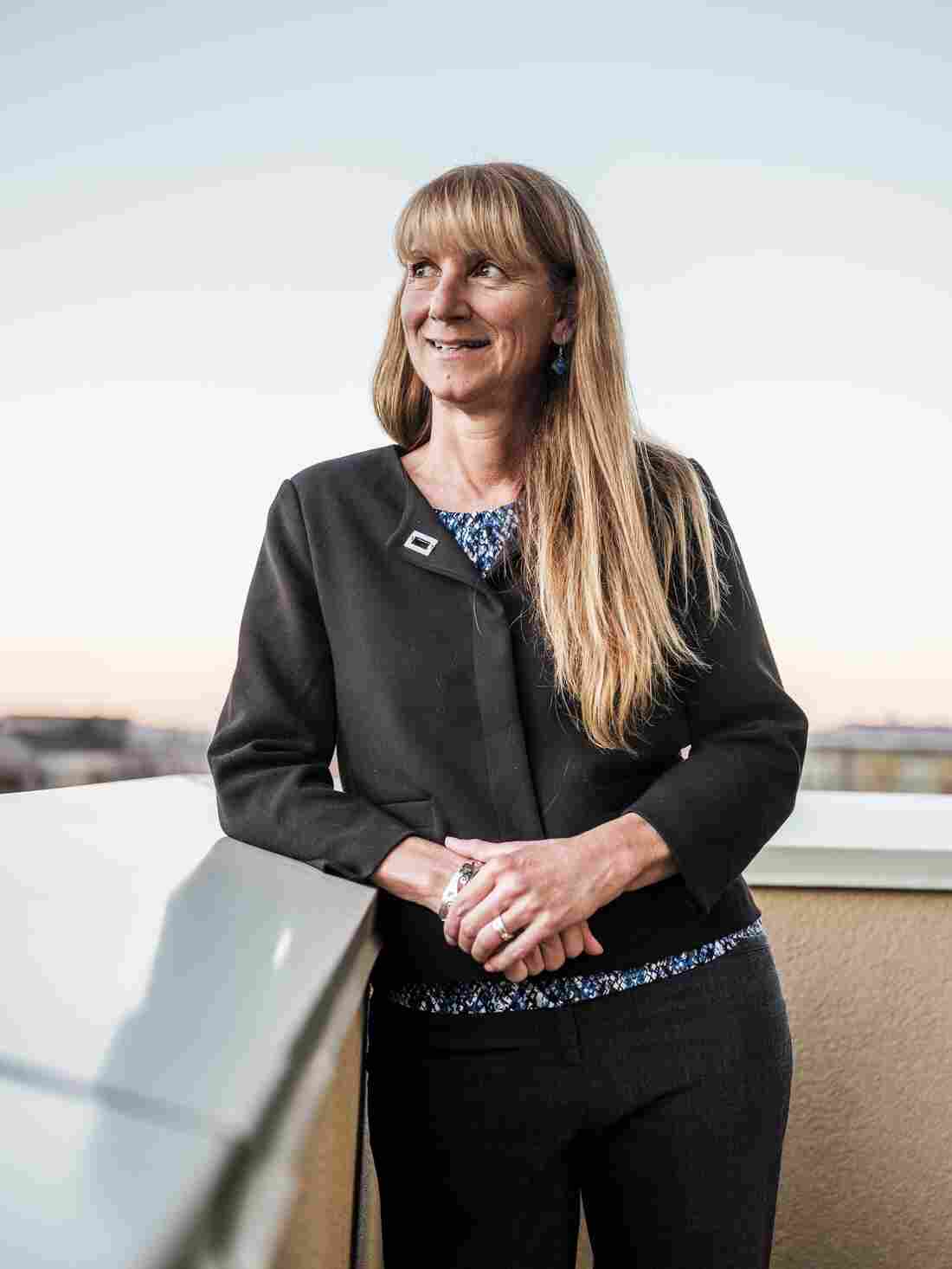
Leslie Klein, director of the athlete career and education program the U.S. Olympic Committee.
Matt Nager for NPR
hide caption
toggle caption
Matt Nager for NPR
Then there are the time constraints. Olympic hopefuls train so incessantly that their training is often the equivalent of a full-time job. On top of that, they travel often to compete. And many older athletes juggle families and jobs on top of all that.
Elana Meyers Taylor is a bobsledder with two Olympic medals: bronze in Vancouver and silver in Sochi. It took her four years to get her master’s in sports administration, and then she started studying online for an MBA.
Bobsled competitions are often held in tiny ski towns around the world, which made studying hard in places without reliable wireless service.
“You can imagine getting an online degree is pretty difficult,” she says.
She’d work on her academics during travel time and at night. “I’d get a couple of hours in and study here and there,” Meyers Taylor says. She got her MBA in finance in 2015.
“It’s not easy,” she says of combining work, study and international competition. “I’m not going to say … I wanted to sit down and read about the stock market” after every race. “It’s about setting a goal and keeping that long-term perspective.”
Jennifer Page, a 2020 Olympic hopeful in women’s wrestling, just finished an undergraduate degree in health sciences and strength and conditioning at the University of Colorado Colorado Springs, or UCCS.
“I would wake up, I’d have class at 8 a.m., I had practice at 10. I’d eat, shower, go back to school from 1 to around 3:30 and then have practice again from 4 to 6 p.m. and I’d go home and eat, shower, do homework and go to bed. And that was my day.”
Page earned some credits at Oklahoma City University, where she spent a year on a wrestling scholarship but quit to train for London with the Olympic team. It took her six years to earn her bachelor’s degree.
Page was amused to hear her younger classmates complain about how hard college was.
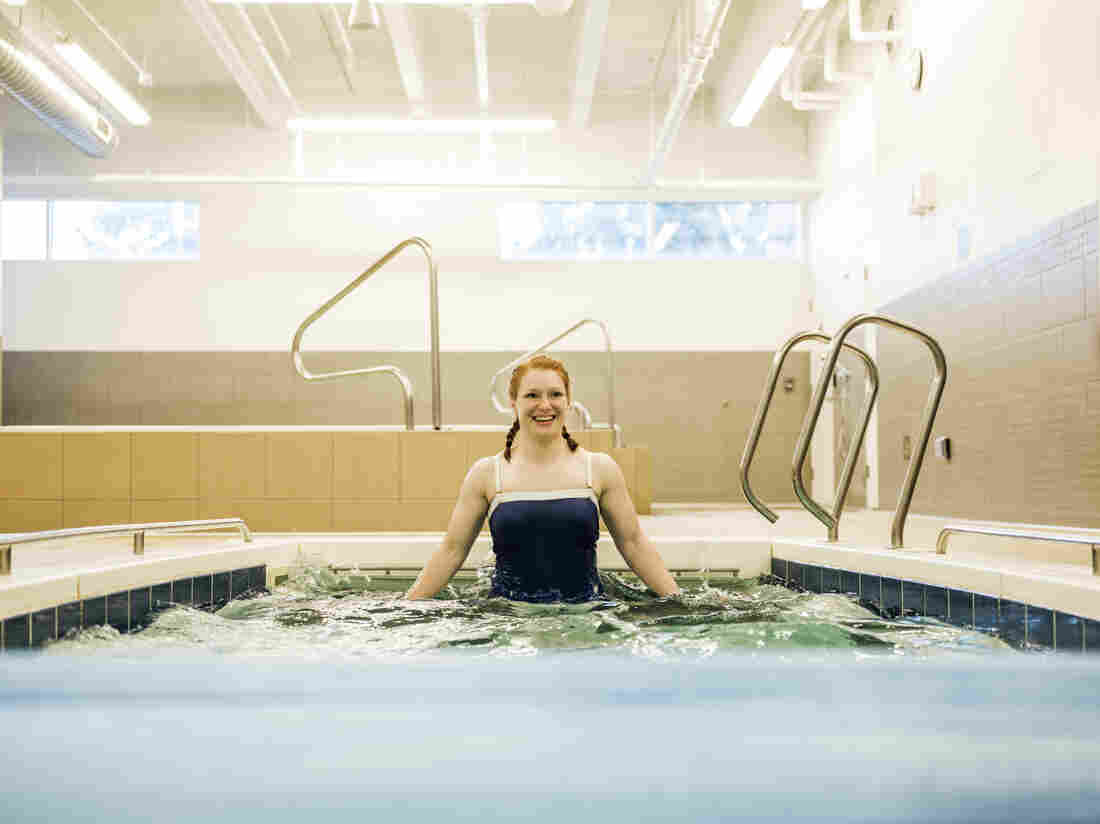
Team USA wrestler Jennifer Page trains in a pool at the Colorado Springs Olympic Training Center. She is recovering from an ACL surgery.
Matt Nager for NPR
hide caption
toggle caption
Matt Nager for NPR
“I think how easy it would be if all I had to do was go to school,” she says. “Life seems so simple when all you have to do is show up for school and do your homework.”
Figure skater Mirai Nagasu also hopes to return to the Olympics — she came in fourth in Vancouver in 2010, when she was just 16.
“Whenever I have a break, I’m back on my computer and studying,” says Nagasu, now 24. She’s in the equivalent of her junior year, on her way to a bachelor’s degree in international business at UCCS. “It is so beyond difficult to balance it all. During finals week I don’t get a lot of sleep and I tell myself, ‘I can’t do this anymore.'”
But she and other Olympic athletes do, because they know their competitive years will someday end.
“An athlete ends up at the pinnacle of a career sometimes as early as their late 20s and they’ve never known a life outside of sport,” says Leslie Klein, who interrupted her own education to compete before later earning undergraduate and graduate degrees. “If they haven’t gone to school, they have nothing to lean on in terms of a career outside of sport.”
That’s what keeps Max Aaron focused on fulfilling his grandfather’s wishes.
“I have met a lot of athletes who were on the top of their sport, and then sat around and did nothing. They just didn’t know what to do,” he says. “It eventually ends, and that’s what I think a lot of athletes forget. It’s 10 years after the Olympics and you won the Olympics and that’s great, but no one cares.”
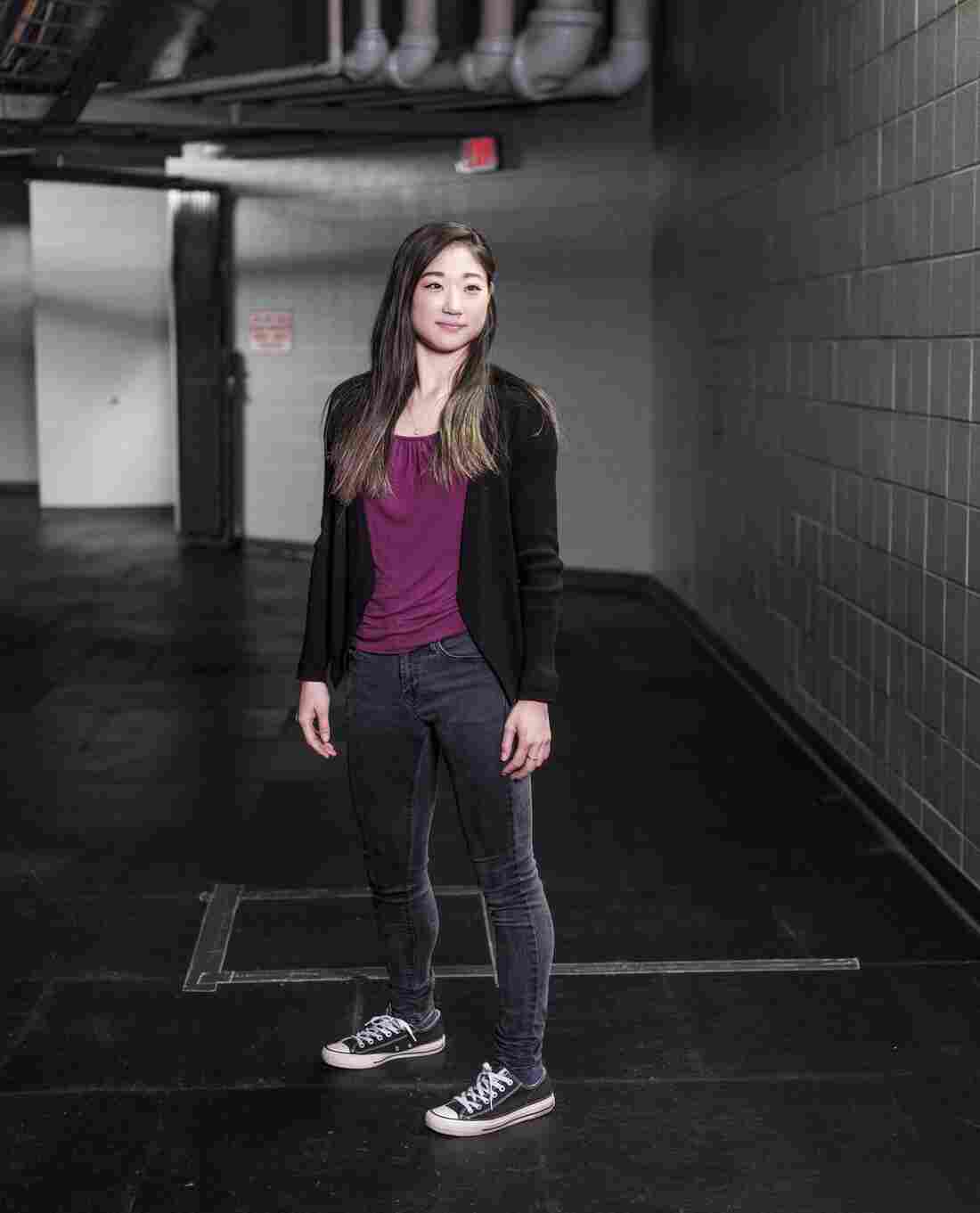
Figure skater Mirai Nagasu at the World Arena Ice Hall in Colorado Springs.
Matt Nager for NPR
hide caption
toggle caption
Matt Nager for NPR
His graduation ceremony last month was held in the arena next to the rink where he trained. His grandfather couldn’t make it, but his parents did.
After he received his degree, he went back to the locker room, changed clothes, and got back on the ice to train some more.
This story was produced with The Hechinger Report, a nonprofit, independent news organization focused on inequality and innovation in education.
Terrell's World Marathon Challenge Raises Money For Mental Health
David Greene talks to Jonathan Terrell, founder of the consulting firm KCIC, about running seven marathons on seven continents in seven days to raise money for pediatric mental health.
AILSA CHANG, HOST:
Here’s a question for you – would you run a marathon? Maybe. But what about seven marathons? What about seven marathons in seven days on seven different continents? Well, that’s exactly what Jonathan Terrell is planning to do this month. It’s called The World Marathon Challenge. And he’s running to raise money for pediatric mental health. Terrell lives in Washington, D.C. And when he stopped by our studio, our co-host David Greene asked him, why are you doing this to yourself?
JONATHAN TERRELL: I think I might be a little crazy. And that’s why I took it on because it is so crazy. And if I was running a 5K, I don’t think anyone would care.
DAVID GREENE, HOST:
Have you been a marathon runner for a long time?
TERRELL: Well, not really. I’m 55 now. And I ran my first marathon when I was 49.
GREENE: Wow. OK.
TERRELL: And I’ve – did the JFK 50-mile Ultra Marathon, and that was my 25th marathon. So I’ve been packing them in.
GREENE: And so what is the training regimen beyond what you’re describing? I mean, are you on a special diet? Do you have to kind of get your head in the right place to get ready for something like this?
TERRELL: There’s the actual physical training. And I train about 20 to 25 hours a week. I do triathlon training – so a lot of running but also swimming and biking and strength training. Secondly, I’m very particular about my diet. And then, as you say, the mental game is really huge. And, you know, exercises in belief and gratitude and meditation are all part of how I get myself ready for this.
GREENE: So what is your exercise? Belief – is that what you said?
TERRELL: So, you know, I start off with gratitude. Grateful to be in this physical shape. Grateful for the people in my life who are supporting me. But I also have to visualize and believe that I can achieve this. And once you start thinking that defeatist way, pretty soon you’re dropping out. But I do consciously exercise a sense of belief that I will get to the finish line in each of these seven marathons.
GREENE: I keep going back to you saying you’re 55 years old. I mean…
TERRELL: But I’m spry.
GREENE: A spry 55. I mean, is there something different in your experience, do you think, compared to someone who has been running marathons since they were, you know, like, 14?
TERRELL: Well, I come from a place of having health problems in my mid-40s. And I had kids late in life. And I think when you start having children in your 40s, it makes you attitudinally stay a little bit younger, perhaps, because I want to be physical and present and involved in my children’s lives.
GREENE: I just want to get kind of a picture of what your week is going to be like. Where’s the first marathon?
TERRELL: Well, we’re going to be meeting up in Cape Town.
GREENE: OK. South Africa, right?
TERRELL: South Africa, yes. And then we’ll fly down to Nuvo, Antarctica. And then two hours later, we’ll run the first marathon. After that, we’ll all get back to Cape Town and run the second. And then on to Perth, Australia – from there to Dubai, from there to Lisbon, Portugal, from there to Barranquilla, Colombia and finishing, finally, in Miami in Florida.
GREENE: And you’re traveling with a group. Are you’re also running with other people, or is this a very solitary thing for you?
TERRELL: No. It’s an organized event. The first two years, there were 12 runners. There was about 30 last year. And this year, it’s much bigger. It will be 60. And there’s a very great camaraderie between runners when you’re on these kinds of events and a lot of high-fives and encouragement and all that. So I think there will be, you know, a good energy and a good group dynamic.
GREENE: Well, congratulations for improving your health. It sounds like this is just such an important cause that you’re working for. And best of luck to you in these seven marathons.
TERRELL: Thank you.
CHANG: That was runner Jonathon Terrell. He plans to run seven marathons in seven days on seven continents in January.
Copyright © 2018 NPR. All rights reserved. Visit our website terms of use and permissions pages at www.npr.org for further information.
NPR transcripts are created on a rush deadline by Verb8tm, Inc., an NPR contractor, and produced using a proprietary transcription process developed with NPR. This text may not be in its final form and may be updated or revised in the future. Accuracy and availability may vary. The authoritative record of NPR’s programming is the audio record.
WATCH: Hockey Player Tells Dad He Made The Olympic Team

Bobby Butler during hockey training camp when he played for the Florida Panthers in 2014.
Lynne Sladky/AP
hide caption
toggle caption
Lynne Sladky/AP
The U.S. unveiled its roster for the men’s Olympic hockey team on Monday.
And the joyful, emotional moment when forward Bobby Butler told his dad that he made the team was caught on video.
It shows Butler skating up to the side of the rink as his father walks in. The two men shake hands, then Butler breaks the news. His dad immediately throws his arms around him as his teammates cheer.
Watch, it will probably brighten your day:
TFW you tell your dad that you’ve made the US Olympic Team ??#TeamUSA ?? pic.twitter.com/ASoOYYXS4Z
— Milwaukee Admirals (@mkeadmirals) January 1, 2018
The 30-year-old Butler, who hails from Marlborough, Mass., skates for the American Hockey League’s Milwaukee Admirals.
Like 14 of his Olympic teammates, Butler has played on NHL teams. But this is the first Olympics in two decades that no U.S. team members are currently playing for the NHL.
That’s because the NHL announced last April that it wouldn’t pause its regular season to accommodate players who want to compete at the games in Pyeongchang, South Korea. The NHL stated that the “overwhelming majority of our clubs are adamantly opposed to disrupting the 2017-2018 NHL season.”
The decision was also about money, as NPR’s Camila Domonoske reported: “The International Olympic Committee has previously paid for players to travel to the Olympics and covered their insurance costs. But the IOC wasn’t planning to foot the bill for 2018.”
The players on the men’s final roster came from colleges, from Americans playing in Europe and from the American Hockey League. And, as SB Nation wrote, NHL stars are out and “in their place are a bunch of guys you’ve probably never heard of.”
In previous years, “USA Hockey got all its Olympic players from one league: the NHL,” according to SB Nation. “Without that option, management turned to a wide variety of sources, plucking players from leagues around the world to piece together a roster for Pyeongchang.”
The NHL’s decision created a unique opportunity for players who would not have been able to make the team otherwise. Just one member of the team, captain Brian Gionta, has played in the Olympics before.
“We really like our roster,” team general manager Jim Johannson said in a statement. “It’s a group that brings versatility and experience and includes players with a lot of passion about representing our country.”
The roster is perplexing to some hockey observers, such as Deadspin’s Barry Petchesky, who calls it “weird as hell” with little name recognition.
But it may be that the lack of prior fame makes moments like Butler’s all the more poignant.
“I know we’re a little down on the Olympics without the NHL, but these are the kinds of moments that make me so happy for the players selected,” writes ESPN hockey analyst Chris Peters. “You know they’ll battle every day for the crest on that jersey.”
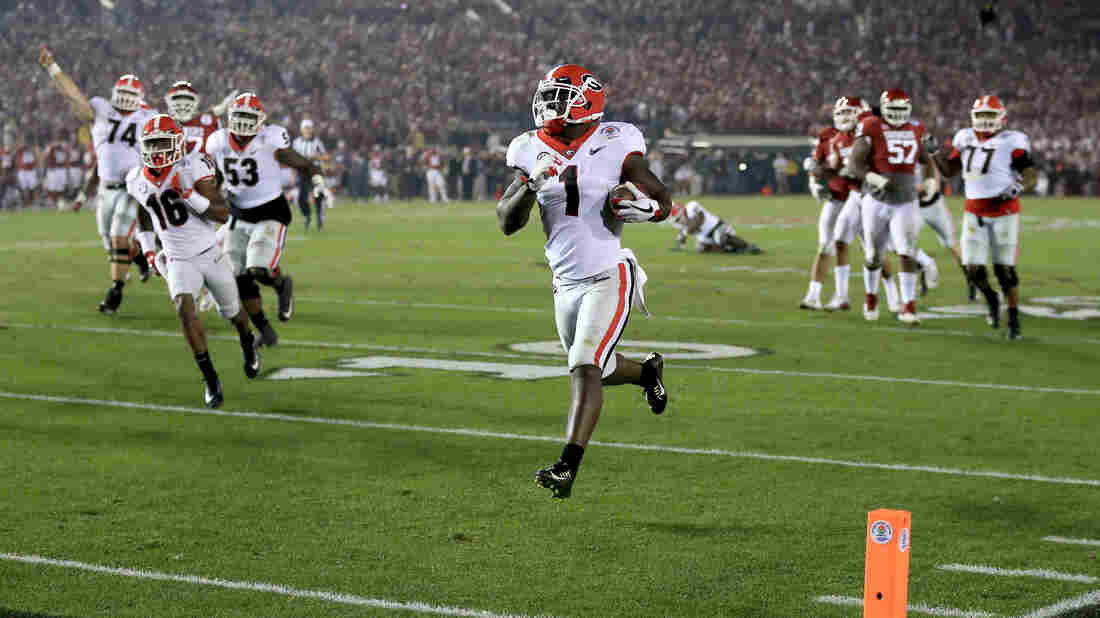
Alabama Bulldozes Into 3rd Straight Title Game; Georgia Runs By Oklahoma

Saturday Sports: Expect More Politics In The New Year
Politics is expected to dominate sports in the new year much as it did in 2017, from the NFL playoffs and Super Bowl to the Olympics and World Cup.
LINDA WERTHEIMER, HOST:
And now it’s time for sports.
(SOUNDBITE OF MUSIC)
WERTHEIMER: It seems like our sports coverage this past year was as much about politics as it was about touchdowns or home runs. And heading into 2018, we’re likely in for more of the same. We have NPR’s Tom Goldman to give us a preview.
Good morning, Tom.
TOM GOLDMAN, BYLINE: Happy new year – almost.
WERTHEIMER: Yeah. The NFL taking the knee protests were front page, headline news for weeks and months. Politicians and ordinary Americans had strong opinions about this and voiced them loudly. What are you expecting to see in the playoffs and in the Super Bowl?
GOLDMAN: Probably more. The protests have continued up through last weekend, and there’s a good chance they’ll keep going through the postseason, Linda – although some players stopped after they reached a tentative agreement with the NFL about a month ago, where the league will contribute about $90 million to social causes important to the players, an owners vote on that expected in March. Some of the more outspoken players this season are on the Philadelphia Eagles. And the Eagles will be a No. 1 seed as the playoffs start.
And if they make it to the Super Bowl, we may very well hear about the issues these players have been talking about, especially considering the big game’s in Minnesota. That, of course, is where a policeman shot and killed Philando Castile last year, one of the prominent police shootings that prompted the NFL protests in the first place.
WERTHEIMER: Then, less than a week after the Super Bowl, the Winter Olympics open in South Korea. We know of at least one prominent Olympian who is not shying away from politics, alpine ski champion Lindsey Vonn.
GOLDMAN: Yeah, she has said she’ll be competing at the Olympics for the American people and not for the president. She’s also said she won’t visit the White House if she’s invited. It’s not clear what she’ll say or do in South Korea. The Olympic rules strictly forbid political protests. But, you know, she’s one of the most famous Olympians, and she’ll certainly be asked a lot about it.
WERTHEIMER: The Olympics are always political, Tom. But this year…
GOLDMAN: Oh, really?
(LAUGHTER)
WERTHEIMER: …With the IOC picking the Russian team out of the Winter Games in South Korea, that’s created an extra layer of controversy.
GOLDMAN: Yeah, it sure has. I mean, the International Olympic Committee kicked out the Russian team because of Russia’s widespread doping scandal, which Russian officials continued to deny. But supposedly, clean Russian athletes who passed the screening process going on right now will be in Pyeongchang. Technically, they’ll be neutral competitors with no official Russian uniforms or anthem or flags. But in a compromise by the IOC because Russia is such a power player in the Olympics, Russian athletes will wear uniforms that say Olympic athlete from Russia. So we’ll know who’s who.
It will be an uncomfortable Russian presence at the games. And, you know, it’s bound to create some tension. Will fans wave Russian flags? Will winning Russian athletes sing their national anthem while the Olympic anthem plays over the loudspeakers? So all of this is layered on top of the tension already on the Korean peninsula. It’s going to be a very political games.
WERTHEIMER: And Russia’s state-sponsored doping scandal will hang over the World Cup as well. The soccer tournament kicks off in June, hosted by Russia.
GOLDMAN: Yeah. And this week, a prominent Russian sports official, Vitaly Mutko, resigned as head of the World Cup organizing committee. He’d become a PR liability after he was banned from the Olympics because of the doping scandal. Russia is hoping, with him gone, it’ll smooth this approach to the World Cup in the summer. But already, there’ve been allegations about doping by members of the Russian men’s national soccer team, allegations about bribery in the awarding of the World Cup to Russia. And by June, who knows where the story will be about Russian interference in the 2016 U.S. election?
WERTHEIMER: Now, the U.S. soccer team will not be at the World Cup. The USA is not a soccer superpower. But there were some unexpected results from the qualifying matches.
GOLDMAN: Yeah – no USA, no Netherlands, no Italy – that’s a big absence. Soccer fans in the U.S. still will be interested. There will be a lot of great action. But casual fans who’d normally be drawn to the tournament because the U.S. is playing – they won’t be as interested. TV ratings in this country will take a hit. That’s important because the promise of those ratings bring in big advertisers and sponsors. And hopefully, U.S. soccer will figure out what it takes to bolster the men’s program in order to get the Yanks back in the next World Cup.
WERTHEIMER: That’s NPR’s Tom Goldman. Tom, thank you.
GOLDMAN: You’re welcome, Linda.
(SOUNDBITE OF TOE’S “VANISHING POINT AND WHISTLE”)
Copyright © 2017 NPR. All rights reserved. Visit our website terms of use and permissions pages at www.npr.org for further information.
NPR transcripts are created on a rush deadline by Verb8tm, Inc., an NPR contractor, and produced using a proprietary transcription process developed with NPR. This text may not be in its final form and may be updated or revised in the future. Accuracy and availability may vary. The authoritative record of NPR’s programming is the audio record.
Go Jump In A Lake
Last season, the Cleveland Browns were 1-15. Coach Hue Jackson vowed they’d be better this year or he’d swim in Lake Erie. Now that the Browns have lost 15 games already he said he’s “got to” jump in.
DAVID GREENE, HOST:
Good morning. I’m David Greene. Last season, the Cleveland Browns were 1-15. Their coach, Hue Jackson, vowed they’d be better this year or, he promised, he’d swim in the lake over there. He was talking about frigid Lake Erie. Well, the Browns have lost 15 games already, so Jackson was asked…
(SOUNDBITE OF ARCHIVED RECORDING)
UNIDENTIFIED JOURNALIST: Are you really going to jump in the lake?
HUE JACKSON: Heck yeah, I got to. Well, how? You just jump in.
GREENE: He is turning it into a positive, using it to raise money to fight human trafficking. It’s MORNING EDITION.
Copyright © 2017 NPR. All rights reserved. Visit our website terms of use and permissions pages at www.npr.org for further information.
NPR transcripts are created on a rush deadline by Verb8tm, Inc., an NPR contractor, and produced using a proprietary transcription process developed with NPR. This text may not be in its final form and may be updated or revised in the future. Accuracy and availability may vary. The authoritative record of NPR’s programming is the audio record.
