Business

No Image

Researchers Analyze Economic Impact Of Climate Change In The U.S.

A team of scientists and economists claims they’ve come up with the most thorough analysis of the cost of climate change in the U.S. Most of the country will suffer economic loss in addition to higher mortality from heat waves and loss of agriculture productivity by 2100. But like all predictions far into the future, this one has a wide range of outcomes and could be overshadowed by new technology still to be invented.

ARI SHAPIRO, HOST:

Climate scientists agree that the 21st century will be warmer. That warming will likely bring economic pain to the U.S., though economists aren’t sure how much. Now, a research team says they can at least tell which parts of the country are likely to suffer the most. NPR’s Christopher Joyce reports on their new study.

CHRISTOPHER JOYCE, BYLINE: The team started with history. How have heat waves and drought affected the economy in the past? Then they applied that metric to various warming scenarios for the future, county by county. They found that if warming continues at recent rates it could shave several percentage points off the country’s gross domestic product by century’s end. But lead researcher Solomon Hsiang says that’s not really the bottom line.

SOLOMON HSIANG: I think the takeaway message that is most striking is that the effects of climate change on the U.S. are not the same everywhere. Where you are in the country really matters.

JOYCE: Colder places like New England might see an economic upturn – lower heating bills, for example. But hot places like the South and Midwest could see huge damage to their local economies – enormous electric bills or dying crops. Maybe that’s not so surprising. But Hsiang, an economist at the University of California, Berkeley, takes it a step further. Climate change will redistribute wealth away from hard-hit regions and mostly toward the North and West. Exactly how much is hard to predict. Hsiang acknowledges that his numbers are uncertain. But he says that’s actually part of the message.

HSIANG: When you start changing the climate, it starts affecting all these aspects of the economy. And it makes the future world harder to predict.

JOYCE: Things like new technologies to help people adapt, for example. With so many uncertainties, why do this kind of exercise? Economist Billy Pizer at Duke University says research like this at least brings a distant threat into focus.

BILLY PIZER: It’s important to figure out – are we talking about something the size of a bread box or the size of an elephant, you know, or the size of a mouse? And I think getting those sorts of magnitudes right is really important. And I think that that’s what this paper does.

JOYCE: And it continues a 10-year effort to determine something called the social cost of carbon, carbon dioxide being the major greenhouse gas. What’s a ton of carbon pollution going to do to the economy? And should polluters pay that cost now? The Trump administration says it’s not interested in the cost of carbon or moving away from carbon-based fuels. Economist Chris Field at Stanford University says, yes, that would be expensive. But he compares it to the space program in the 1960s.

CHRIS FIELD: It cost a lot. But it also unleashed a huge amount of creativity and innovation and really launched the United States on the trajectory to being ready for the 21st century.

JOYCE: The research appears in the journal Science. Christopher Joyce, NPR News.

Copyright © 2017 NPR. All rights reserved. Visit our website terms of use and permissions pages at www.npr.org for further information.

NPR transcripts are created on a rush deadline by Verb8tm, Inc., an NPR contractor, and produced using a proprietary transcription process developed with NPR. This text may not be in its final form and may be updated or revised in the future. Accuracy and availability may vary. The authoritative record of NPR’s programming is the audio record.

Let’s block ads! (Why?)


No Image

Former Trump Campaign Manager Paul Manafort Registers As A Foreign Agent

Former Trump campaign chairman Paul Manafort had resigned his position last August after his work for Ukrainian interests came under scrutiny.

Matt Rourke/AP

hide caption

toggle caption

Matt Rourke/AP

A firm headed by Paul Manafort, who served as President Trump’s campaign manager last year, made more than $17 million in two years working for the pro-Russia political party that controlled Ukraine’s government, according to documents filed late Tuesday.

Manafort, who resigned from Trump’s campaign last August after his work for Ukrainian interests came under scrutiny, has registered as a foreign agent with the U.S. Justice Department, as did his deputy, Rick Gates.

Manafort spokesman Jason Maloni said Manafort had started the registration process under the Foreign Agents Registration Act in September of last year, before the November 2016 election.

“Paul’s primary focus was always directed at domestic Ukrainian political campaign work and that is reflected in yesterday’s filing. Paul has appreciated the professionalism and guidance of the FARA unit throughout this process,” Maloni said.

Manafort did domestic political consulting for the Party of Regions, headed by former Ukrainian President Viktor Yanukovych, who fled to Russia after an uprising in 2014. Much of Manafort’s work was aimed at “advancing the goal of greater political and economic integration between Ukraine and the West,” the documents say.

“Manafort was representing a political party, a very strong pro-Russian political party in … Ukraine from 2012 to 2014, pulling in a whopping $17 million by the way,” says Craig Holman, government affairs lobbyist at Public Citizen, a progressive public interest group.

Holman says Manafort should have filed the disclosure forms right after he began working for Ukraine’s government.

Manafort’s work in Ukraine ended in 2014, after Yanukovych stepped down and well before Manafort worked for Trump’s campaign.

Manafort is one of several current and former Trump associates whose ties to the former Soviet Union have attracted attention. He is said to be a focus of interest in the investigation headed by Department of Justice special counsel Robert Mueller into Russia’s interference in the U.S. presidential election.

Manafort is the second Trump associate to register retroactively as a foreign agent. Former national security adviser Michael Flynn has acknowledged lobbying for the government of Turkey in the months leading up to last year’s election.

Let’s block ads! (Why?)


No Image

Sarah Palin Sues 'New York Times,' Says Editorial Defamed Her

Sarah Palin seen at Politicon 2016 at The Pasadena Convention Center on June 26, 2016, in Pasadena, Calif.

Colin Young-Wolff/Colin Young-Wolff/Invision/AP

hide caption

toggle caption

Colin Young-Wolff/Colin Young-Wolff/Invision/AP

Former Alaska Gov. Sarah Palin filed a defamation lawsuit against The New York Times Tuesday in a federal court in Manhattan.

Palin, a former vice presidential nominee, says the newspaper published a statement about her in an editorial earlier this month that it “knew to be false.”

The editorial, which was corrected the next day, linked one of Palin’s political action committee ads to the mass shooting in January 2011 that severely wounded then-Arizona Rep. Gabby Giffords.

Lawyers for Palin say The Times “violated the law and its own policies” when it accused her of inciting the 2011 attack that killed six people.

The New York Times reports:

“The editorial was published online on June 14, the day a gunman opened fire at a baseball field where Republican lawmakers were practicing for an annual charity game. The editorial said there was a link between political incitement and the mass shooting in Arizona that severely wounded Representative Gabby Giffords and said that Ms. Palin’s “political action committee circulated a map of targeted electoral districts that put Ms. Giffords and 19 other Democrats under stylized cross hairs.”

The Times later issued a correction, saying that there was no established link between political statements and the shooting and that the map circulated by Ms. Palin’s PAC had depicted electoral districts, not individual Democratic lawmakers, beneath the stylized cross hairs. The NYT Opinion Twitter account also sent out the correction about the lack of a link, apologizing and saying that it appreciated that readers had pointed out the mistake.”

The suit charges the newspaper’s correction and apology to readers were “devoid of any reference to Mrs. Palin” and were “woefully insufficient.”

Palin is seeking damages to be determine by a jury, according to The Associated Press.

In a statement, a spokeswoman for The Times said, “We have not reviewed the claim yet but will defend against any claim vigorously.”

In the June 14 shooting at the ball field in Virginia, Rep. Steve Scalise was critically wounded. The House majority whip has since been released from the intensive care unit but remains at a Washington, D.C., hospital.

Let’s block ads! (Why?)


No Image

Facial Recognition May Boost Airport Security But Raises Privacy Worries

Charles Camiel looks into the camera for a facial recognition test before boarding his JetBlue flight to Aruba at Logan International Airport in Boston.

Robin Lubbock/WBUR

hide caption

toggle caption

Robin Lubbock/WBUR

Passengers at Boston’s Logan International Airport were surfing their phones and drinking coffee, waiting to board a flight to Aruba recently when a JetBlue agent came on the loudspeaker, announcing: “Today, we do have a unique way of boarding.”

On flights to the Caribbean island, JetBlue is experimenting with facial recognition software that acts as a boarding pass. The airline says it’s about convenience. For the federal government, it’s also about national security. But for privacy activists, it’s an intrusive form of surveillance.

This is the first trial between an airline and Customs and Border Protection to use facial recognition in place of boarding passes.

“The practical side of that is you will not need to show a boarding pass and you will not need to take your passport out because your face will be essentially your boarding pass,” says Joanna Geraghty, JetBlue’s executive vice president of customer experience.

Michelle Moynihan, who was flying to Aruba for a wedding, says facial recognition would make her life easier.

“Typically when I travel I have my three kids with me and I travel alone with them,” she says. “They’re all under age 10, so flipping through multiple boarding passes on my phone, making sure I have all the kids, all the backpacks, all the suitcases can be cumbersome and frustrating.”

Moynihan gets in line and right before she gets to the jet bridge, there’s a camera that’s about the size of a shoebox. It takes her photo and she gets a checkmark, saying she’s good to go.

The whole process takes about 5 to 6 seconds.

“We’re basically capturing that picture at the boarding gate and then providing it to U.S. Customs and Border protection,” says Sean Farrell, who works for SITA, the company running this technology. SITA provides a lot of the IT infrastructure you see at airports.

“It’s actually the U.S. government that’s implementing the biometric matching system,” he says.

The government uses existing databases to compare a traveler’s face against all the other passengers on the flight manifest.

JetBlue is pitching this idea of facial recognition as convenience for customers. It’s voluntary. But it’s also part of a broader push by Customs and Border Protection to create a biometric exit system to track non-U.S. citizens leaving the country.

After the Sept. 11 attacks, there was a lot of talk about the necessity of a biometric exit system, but the tech and computing power just wasn’t good enough. Now, facial recognition experts say it’s more accurate.

And Farrell sees a future — not too far off — where our faces could be our IDs.

“The end game is that in a few years’ time you’ll be able to go through the airport basically just using your face,” he says. “If you have bags to drop off, you’ll be able to use the self-service system and just have your face captured and matched. You’ll then go to security, the same thing. … And then you go to the boarding gate, and again just use your biometric.”

But that worries people like Adam Schwartz, a lawyer with the Electronic Frontier Foundation, a nonprofit digital rights group. He says facial recognition is a uniquely invasive form of surveillance.

“We can change our bank account numbers, we even can change our names, but we cannot change our faces,” Schwartz says. “And once the information is out there, it could be misused.”

Kade Crockford, director of the Technology for Liberty Program at the ACLU of Massachusetts, says she’s particularly concerned by the JetBlue program because of the government’s role.

“The biometric databases that the government is amassing are simply another tool, and a very powerful tool of government control,” she says.

Customs and Border Protection insists it will discard facial recognition photos taken of U.S. citizens at the airport, and only keep a database of non-U.S. citizens.

Back at Logan Airport, passenger Yeimy Quezada feels totally comfortable sharing her face instead of a barcode.

“Even your cellphone recognizes selfies and recognize faces, so I’m used to that technology already,” she says. “And, I’m not concerned about privacy because I’m a firm believer that if you’re not hiding anything, you shouldn’t be afraid of anything.”

Customs is running similar biometric tests at airports in Atlanta, New York and the Washington, D.C., area. The goal is to deploy facial recognition tech widely by early next year.

Asma Khalid leadsWBUR’s BostonomiX team, which covers the people, startups and companies driving the innovation economy. You can follow them@BostonomiX.

Let’s block ads! (Why?)


No Image

Overwhelmed By Air Bag Troubles, Takata Files For Bankruptcy Protection

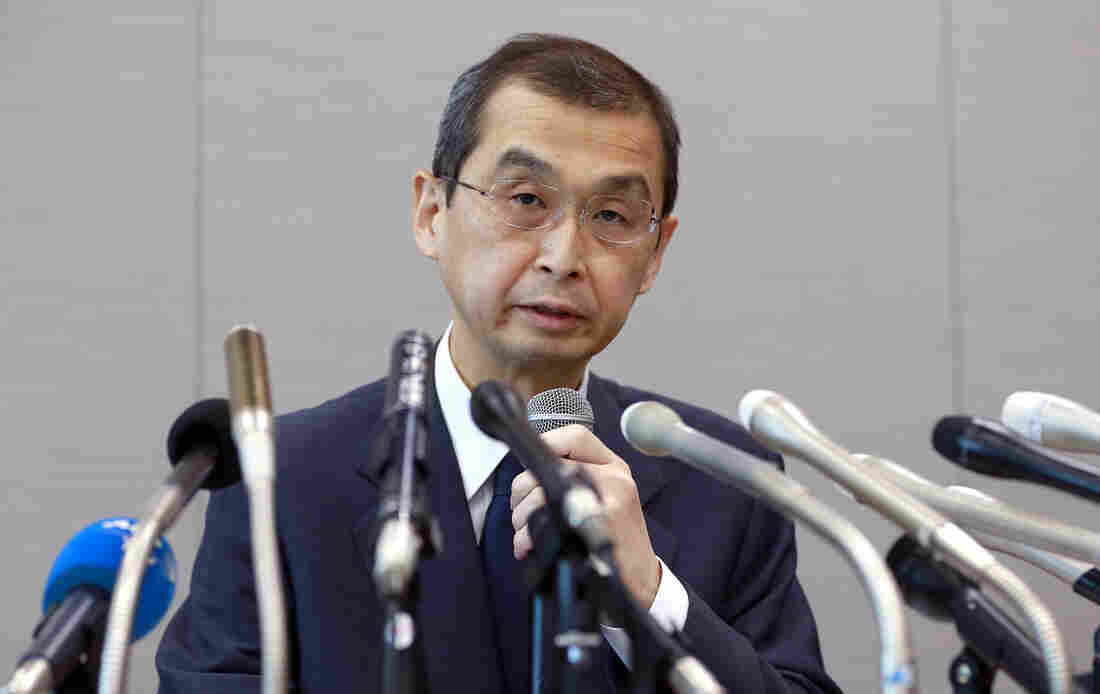
Takata Corp. CEO Shigehisa Takada speaks during a press conference in Tokyo, Monday, as the Japanese air bag maker announces filing for bankruptcy protection in Tokyo and the U.S., The company has been under financial pressure from lawsuits and recall costs related to its of defective air bag inflators.

Shizuo Kambayashi/AP

hide caption

toggle caption

Shizuo Kambayashi/AP

Long crippled by lawsuits and recall costs over its faulty air bags, Takata, the Japanese auto parts maker, filed for bankruptcy protection in Japan and the U.S. on Sunday.

Takata is on the hook for billions of dollars to banks and automakers, which have been covering the replacement costs of tens of millions of the recalled air bag inflators.

The company plans to sell what’s rest of its operations to the rival U.S. auto parts supplier, Key Safety Systems, for $1.588 billion.

Automakers will be able to recover some costs from Takata’s remaining assets, but “experts say the companies still must fund a significant portion of the recalls themselves,” reports The Associated Press.

It’s the largest safety recall in automotive history. Worldwide, 100 million inflators have been recalled, 69 million of them in the U.S., affecting 42 million vehicles by 19 different automakers, according to the wire service.

Takata’s air bag inflators are blamed for rupturing and spewing dangerous debris into a vehicle’s cabin, as NPR’s Sonari Glinton reported.

In January, the auto parts maker pleaded guilty to concealing the defect in millions of its air bags as the Two-Way reported earlier this year.

In that settlement, as NPR’s Bill Chappell noted,

“Takata agreed to pay $1 billion over air bag fraud; three of the company’s executives were also criminally charged. That total included $125 million that’s earmarked as restitution to people who are physically injured by defective air bag systems.”

At the time, the defective air bags were linked to at least 16 deaths, including 11 in the U.S.

And U.S. lawmakers have criticized Takata’s slow pace of addressing the recalls. As Bill reported last month, “As of late April, they say, all of the auto makers in today’s settlement had completed less than a third of their air-bag related recalls.”

“There are not very many airbag makers,” Autotrader analyst Michelle Krebs tells NPR. “So a lot of these recalled vehicles have not been fixed, the airbags don’t exist for them to be fixed yet.”

Let’s block ads! (Why?)


No Image

Some U.S. States Relax Restrictions On Cladding Suspected In Grenfell Tower Fire

The cladding used in a 2016 refurbishing of Grenfell Tower in London helped last week’s fatal fire spread. The combustible material is permitted in some parts of the U.S.

Niklas Halle’n /AFP/Getty Images

hide caption

toggle caption

Niklas Halle’n /AFP/Getty Images

The type of siding or “cladding” used on the Grenfell Tower in London — and suspected of feeding the massive fire that killed dozens of residents — is not allowed on the exterior of tall buildings across most of the U.S.

But a few states and the District of Columbia have relaxed their building codes in recent years and have started to permit the material’s use.

The cladding installed on Grenfell Tower as part of a 2016 refurbishing project has become a focus for investigators. NPR’s Frank Langfitt has confirmed that the cladding had a combustible polyethylene core rather than a more fire-resistant mineral core.

At least 79 people died last week when the fire spread quickly through the 24-story public housing tower. Investigators say a refrigerator started the fire, which then spread to the cladding outside.

Prime Minister Theresa May told Parliament this week that similar cladding on other buildings has been found to be combustible. Reuters reports that at least 600 buildings in England use the same type of cladding and that authorities are testing the material to determine whether other buildings are at risk of fire.

In the United States, most jurisdictions don’t allow this type of cladding for buildings higher than 40 feet. That is because they’ve adopted the International Building Code, which requires cladding for tall buildings to pass a rigorous test developed by the National Fire Protection Association called “NFPA 285.” The purpose of the test is to ensure that installed cladding will be noncombustible.

In recent years, a few U.S. jurisdictions have eliminated this testing requirement. They now permit cladding similar to what was believed to be used on the Grenfell Tower, as long as the building has other fire safety measures in place, such as a working sprinkler system. (The Grenfell Tower reportedly did not have sprinklers.)

This softening of some U.S. building codes upsets Tulsa, Okla.-based fire protection engineer John Valiulis. He says D.C. and three states — Minnesota, Indiana and Massachusetts — have exempted cladding from NFPA 285 testing.

Valiulis wrote a report about the topic for the Fire Safe North America group. In it, he details a series of cladding fires around the world that were similar to the Grenfell Tower fire. None were in the U.S., and he says there is a good reason for that.

“The fire protection engineering profession in the U.S. is quite active and is often very proactive,” says Valiulis.

Thirty years ago, when it became clear builders would start using more of this type of cladding, he says, the NFPA test was developed to determine whether combustible materials used within cladding might pose a fire danger.

But that test can be expensive — potentially costing $30,000 or more. And usually a new test must be conducted for each building because the cladding specifications change.

A panel of external cladding was removed from the Dorney tower block in north London. Tower blocks across England are being tested to check whether their outer coverings pose a serious fire risk following the Grenfell Tower disaster.

Niklas Halle’n/AFP/Getty Images

hide caption

toggle caption

Niklas Halle’n/AFP/Getty Images

Cost is a primary reason the D.C. Construction Codes Coordinating Board, which is under the Department of Consumer and Regulatory Affairs, removed the testing requirement. DCRA spokesman Matt Orlins says that during a 2012 code review process, building designers said they were concerned about the difficulty of finding cladding that passed the NFPA 285 test.

“The board agreed that the concerns were valid and that other portions of the codes did provide safeguards,” says Orlins. So the board eliminated the requirement.

Advocates for eliminating the NFPA 285 testing requirement have said it’s a prudent cost-saving change, given the lack of dramatic fires in the United States like the Grenfell Tower fire. And they point out that most fires start inside a building, where required sprinklers are likely to keep a fire from spreading to the cladding outside.

NPR contacted firms that have pushed for code changes in the District and Minnesota, but those businesses either did not respond or declined to comment.

Valiulis doesn’t accept their argument. Like most fire protection engineers, he wants multiple safety systems in place in case one fails.

“When a code is well-written and properly anticipates problems, people observe a lack of incidents, and often assume that the code must be asking for overkill,” says Valiulis. But he says that also can be a sign that “the code got it exactly right.”

Now, at least one of the jurisdictions that relaxed its building codes may reverse course.

As more cladding options that comply with NFPA 285 have come onto the market in recent years, Orlins with the DCRA says the agency plans to put the testing requirement back into the next revision of the District’s building code.

And Orlins says, “The District is also evaluating whether the change ought to be adopted as an amendment to the current code.”

Let’s block ads! (Why?)


No Image

Arkansas Tries To Stop An Epidemic Of Herbicide Damage

Soybean leaves showing evidence of damage from dicamba. Thousands of acres of soybean fields have shown this kind of damage this spring.

Courtesy of the University of Arkansas

hide caption

toggle caption

Courtesy of the University of Arkansas

Arkansas’s pesticide regulators have stepped into the middle of an epic battle between weeds and chemicals, which has now morphed into a battle between farmers. Hundreds of farmers say their crops have been damaged by a weedkiller that was sprayed on neighboring fields. Today, the Arkansas Plant Board voted to impose an unprecedented ban on that chemical.

“It’s fracturing the agricultural community. You either have to choose to be on the side of using the product, or on the side of being damaged by the product,” says David Hundley, who manages grain production for Ozark Mountain Poultry in Bay, Arkansas.

The tension — which even led to a farmer’s murder — is over a weedkiller called dicamba. The chemical only became a practical option for farmers a few years ago, when Monsanto created soybean and cotton plants that were genetically modified to survive it. Farmers who planted these new seeds could use dicamba to kill weeds without harming their crops.

Farmers, especially in the South, have been desperate for new weapons against a devastating weed called pigweed, or Palmer amaranth. And some farmers even jumped the gun and started spraying dicamba on their crops before they were legally allowed to do so. (Dicamba has long been used in other ways, such as for clearing vegetation from fields before planting.)

A map showing the number of complaints filed by county. According to the Arkansas Agriculture Department, the investigations into these complaints have yet to be completed.

Courtesy of Arkansas Agriculture Department

hide caption

toggle caption

Courtesy of Arkansas Agriculture Department

The problem is, dicamba is a menace to other crops nearby. It drifts easily in the wind, and traditional soybeans are incredibly sensitive to it. “Nobody was quite prepared, despite extensive training, for just how sensitive beans were to dicamba,” says Bob Scott, a specialist on weeds with the University of Arkansas’s agricultural extension service.

As soon as spraying started this spring, the complaints began arriving. By June 23, state regulators had received 242 complaints from farmers who say their crops have been damaged. “This has far eclipsed any previous number of complaints that we’ve gotten, and unfortunately, this number seems to just keep growing,” says Scott. “Every day we get an update with eight or ten more complaints.”

In his area, Hundley says, “any soybean that’s not [resistant to dicamba] is exhibiting damage. I can name 15 farmers within three or four miles who have damage, and I can only name 3-4 farmers who have used the technology.”

On June 20, the Arkansas Plant Board met to consider an emergency ban on further spraying of dicamba, and farmers crowded into the meeting to argue both sides.

“The individuals who were damaged were quite passionate. The growers who had invested money in the technology also were quite passionate,” says Jason Norsworthy, a weed specialist at the University of Arkansas, who attended the meeting.

At that first meeting, a procedural mix-up prevented the board from holding a valid vote. On June 23, it reconvened and voted, 9-5, to ban any spraying of dicamba on any crops except for pasture land for 120 days. The ban will take effect immediately if the governor of Arkansas signs it.

The decision, assuming it goes into effect, is a hard blow for farmers who paid extra for dicamba-resistant seeds. They now won’t be able to spray dicamba, which they were counting on doing. “A lot of those growers will not have a good option for pigweed,” Scott says.

Even Hundley, who was in favor of banning dicamba, doesn’t feel that it’s an optimal solution. “It’s pitting Arkansas farmers against Arkansas farmers, and that’s never good,” he says.

Looking toward the future, Scott isn’t sure whether dicamba ever will be a good tool for farmers, because it appears to be so difficult to control. “I have walked a lot of fields that leave you scratching your head, how did this happen? Because it seemed like they did everything right,” he says.

He also doesn’t think the problem will be limited to Arkansas. His state just happened to hit this problem first, because Arkansas’s farmers adopted dicamba earlier than those in other states. “Arkansas may be ahead of the curve, but I anticipate other states also having this problem,” he says.

Let’s block ads! (Why?)


No Image

Man Accused Of Making Millions Of Robocalls Faces Biggest-Ever FCC Fine

Telemarketers are prohibited from making prerecorded phone calls to people without prior consent. It’s also illegal to deliberately falsify caller ID with the intent to harm or defraud consumers.

PeopleImages/Getty Images/iStock

hide caption

toggle caption

PeopleImages/Getty Images/iStock

Federal regulators on Thursday said they’ve identified “the perpetrator of one of the largest … illegal robocalling campaigns” they have ever investigated.

The Federal Communications Commission has proposed a $120 million fine for a Miami resident said to be single-handedly responsible for almost 97 million robocalls over just the last three months of 2016.

Officials say Adrian Abramovich auto-dialed hundreds of millions of phone calls to landlines and cellphones in the U.S. and Canada and at one point even overwhelmed an emergency medical paging service.

Making prerecorded telemarketing phone calls to people without their prior consent is prohibited. So is making telemarketing calls to emergency phone lines and deliberately falsifying caller ID to disguise identity with the intent to harm or defraud consumers.

According to the FCC, the robocalls made by Abramovich through his ambiguously named companies (Marketing Strategy Leaders or Marketing Leaders) would show up “spoofed” as if they came from a phone number with the same area code and the same first three digits of the recipient’s number.

If the recipients answered, they’d get a recording offering an “exclusive” vacation deal from prominent travel companies such as Expedia, Marriott, Hilton or TripAdvisor — instructing them to “Press 1” to learn more. But pressing 1 would instead land people on a line with a call center hawking “discounted” vacation packages and time-shares unaffiliated with any of those brands.

According to FCC documents, TripAdvisor investigated some of the robocalls that purported to offer that company’s deals and found call centers that it said were based in Mexico.

Abramovich now faces the largest penalty ever proposed by the FCC, according to FCC Commissioner Mignon Clyburn. The fine is for Abramovich’s unlawful caller ID spoofing, the FCC says. The agency’s Enforcement Bureau has also issued a citation to Abramovich, and the documents say his “mass robocalling campaigns violate the Communications Act, and his misrepresentations in the prerecorded messages constitute criminal wire fraud.”

Abramovich now has 30 days to respond to the FCC, which is expected to finalize the investigation and penalties in the following months.

Let’s block ads! (Why?)


No Image

After CEO Resignation, Is Uber Kalanick-less Or Kalanick-free?

Uber co-founder Travis Kalanick, pictured here at a Vanity Fair summit in October 2016, resigned abruptly this week as the company’s CEO after weeks of scandals about workplace culture.

Mike Windle/Getty Images for Vanity Fair

hide caption

toggle caption

Mike Windle/Getty Images for Vanity Fair

If you think of a company as a sports team — let’s say, basketball — then Uber is at a point where the players are still on the court, but the coaches and general manager are gone, the arena is filled with jeers and the owner’s hair is on fire.

The resignation of co-founder Travis Kalanick as CEO under pressure from investors (instead of the originally announced leave of absence) is only the most dramatic of various dramatic turning points in the disorderly narrative arc of Uber. And though business annals are rife with powerful founders who were forced to leave their companies, such stories typically hinge on poor financial results or wrong business decisions.

Few companies have had such a rapid fallout from such a vast number of crises stemming from the workplace culture perpetuated from the top, while appearing to be at the peak of their success. (Uber is one of the largest privately held companies, valued at nearly $70 billion.)

How long will Kalanick’s shadow be over Uber’s future?

Leadership void

In a statement, Uber’s board of directors said the departure of Kalanick — who was at the helm for more than six years — will give the company “room to fully embrace this new chapter in Uber’s history.”

And the slate is remarkably clean thanks to an exodus of executives in recent weeks as the company shed employees amid the very public airing of stories involving sexist HR practices, sexual harassment of female employees, rampant bro culture and immaturity, shady skirting of regulations, lawsuits by drivers and allegations of intellectual-property theft.

What does history teach about turning around a company in turmoil with an empty executive bench?

“I think that the people who are now in charge — and the question is who is really in charge … — that better get sorted out pretty quickly,” says Rosabeth Moss Kanter, a professor at Harvard Business School and expert on corporate leadership. “That’s the real historic lesson, that you need to move quickly or you’re highly vulnerable. … It’s a perfect time for competitors to start poaching the best executives, for morale to go down, because even staff who have great ideas aren’t sure they can implement them.”

The Uber board had already been searching for a chief operating officer — a more seasoned executive who might tone down the volcanic Kalanick as CEO. This call followed a pledge from Kalanick to “grow up” after a leaked video showed him berating an Uber driver, who complained to him about pay. According to Recode, the board had considered former Disney Chief Operating Officer Tom Staggs, Helena Foulkes from CVS and various executives of media and transportation companies.

Investors are also calling on Uber to hurry up and hire a chief financial officer — a position that’s been vacant since 2015. Uber has also lost executives from its product, engineering, mapping, communications, business, finance and self-driving units.

“Clearly there was a terrible workplace culture … terrible enough for a lot of these people who are highly competent individuals to want to go,” says Valerie Demont, a lawyer at Pepper Hamilton who represents companies undergoing restructuring. In other words, the exodus is also a reflection on Kalanick’s ability to pick and retain talent.

But is he really leaving?

Kalanick is a polarizing figure. He’s come to personify both Uber’s toxic cowboy culture, but also its phenomenal business growth. On Friday, before his abrupt resignation, NPR asked an early Uber investor Jason Calacanis what he thought of the CEO.

“Indefatigable, phenomenal, unlimited upside,” Calacanis said. “I think he has another 20, 30 years ahead of him as founder, and I think the company can grow 10x from here, 20x from here. I think he’s going to wind up being one of the top 10 CEOs that Silicon Valley has ever seen.”

Kalanick’s resignation comes as a surprise to employees and people close to the company. Notably, he and his close allies have majority voting shares in Uber, which means he could have fought it. He’s known for not caving. But here he did cave, under tremendous pressure from large, powerful Silicon Valley investors.

One tricky thing is that technically, Kalanick isn’t leaving for good. His large stake in the company keeps him on Uber’s board of directors — the same board that will search for his and his team’s successors.

“I would like to know who’s heading the search and how much independence they’ll have and how much veto power Travis will have,” Harvard’s Kanter says.

She predicts Kalanick’s successor might be someone unexpected, someone seasoned and, notably, someone with a “calming presence” — again, because Uber’s turnaround will be not financial, but cultural.

Stories of other ousted CEOs include the famous departures of Steve Jobs from Apple or Jack Dorsey from Twitter — both of whom later returned to the companies they helped found. This has spurred speculation of Kalanick doing the same.

But Kanter argues, Uber as a company is not closely tied to its founder at all — in fact, he has come to be the face of Uber’s problems, not of Uber as a company.

“What Uber is to its consumers is … whatever driver they get, Uber is the app on their smartphone,” she says. “Uber is not Travis. In fact, most people can’t even pronounce his name, let alone know who he is.”

Let’s block ads! (Why?)


No Image

Uber Founder Resigns Under Pressure As CEO, Published Report Says

Uber co-founder Travis Kalanick has resigned as CEO of the ride-hailing service, according to The New York Times. The paper reported that Uber’s major investors demanded Kalanick resign immediately.

Evan Agostini/Evan Agostini/Invision/AP

hide caption

toggle caption

Evan Agostini/Evan Agostini/Invision/AP

Travis Kalanick, who co-founded Uber in 2009, has been on a leave of absence from the ride-hailing service. When Uber announced Kalanick’s sabbatical last week, the company said he needed time to grieve the recent death of his mother.

At the same time, Uber officials also announced that the company was adopting new policies to improve its workplace environment — including ones meant to help it fight sexual harassment and to change a corporate culture blamed for allowing workplace misconduct to flourish.

Kalanick said there was much to be improved at the company and that he would be working on a team that could lead “Uber 2.0.”

But Uber’s five major investors apparently were working on their own plan to lead the company forward. On Tuesday, they demanded that Kalanick resign immediately, according to the Times:

“Mr. Kalanick’s exit came under pressure after hours of drama involving Uber’s investors, according to two people with knowledge of the situation, who asked to remain anonymous because the details are confidential.

“In the letter, titled “Moving Uber Forward” and obtained by The New York Times, the investors wrote to Mr. Kalanick that he must immediately leave and that the company needed a change in leadership. Mr. Kalanick, 40, consulted with at least one Uber board member and after hours of discussions with some of the investors, he agreed to step down. He will remain on Uber’s board of directors.”

The Times also published a statement from Kalanick:

“I love Uber more than anything in the world and at this difficult moment in my personal life I have accepted the investors request to step aside so that Uber can go back to building rather than be distracted with another fight.”

With no clear successor to Kalanick, Uber’s focus now is the search for a new leader. In March, President Jeff Jones quit after less than six months on the job.

The new CEO will have a full plate. Valued at around $70 billion, Uber is one of the largest private companies in the world.

But its reputation has suffered over the harassment reports, and the company has also faced challenges to its labor and competition practices, as well as a lawsuit from Google’s parent company over its self-driving vehicle program.

Let’s block ads! (Why?)