
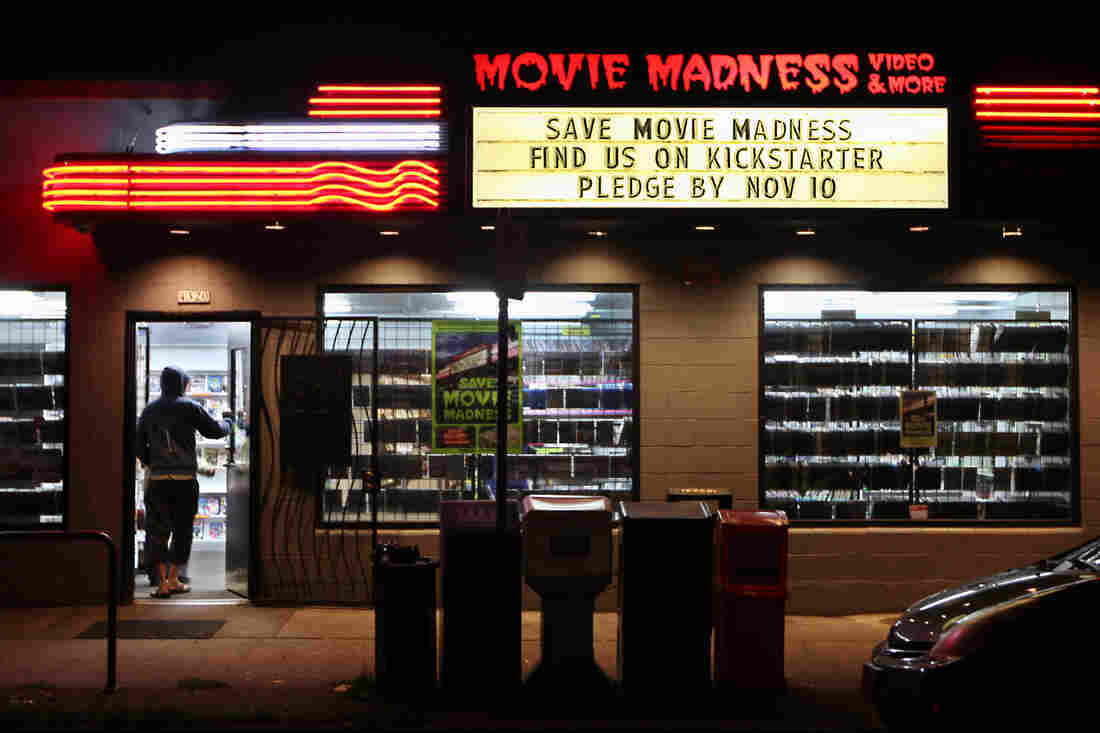
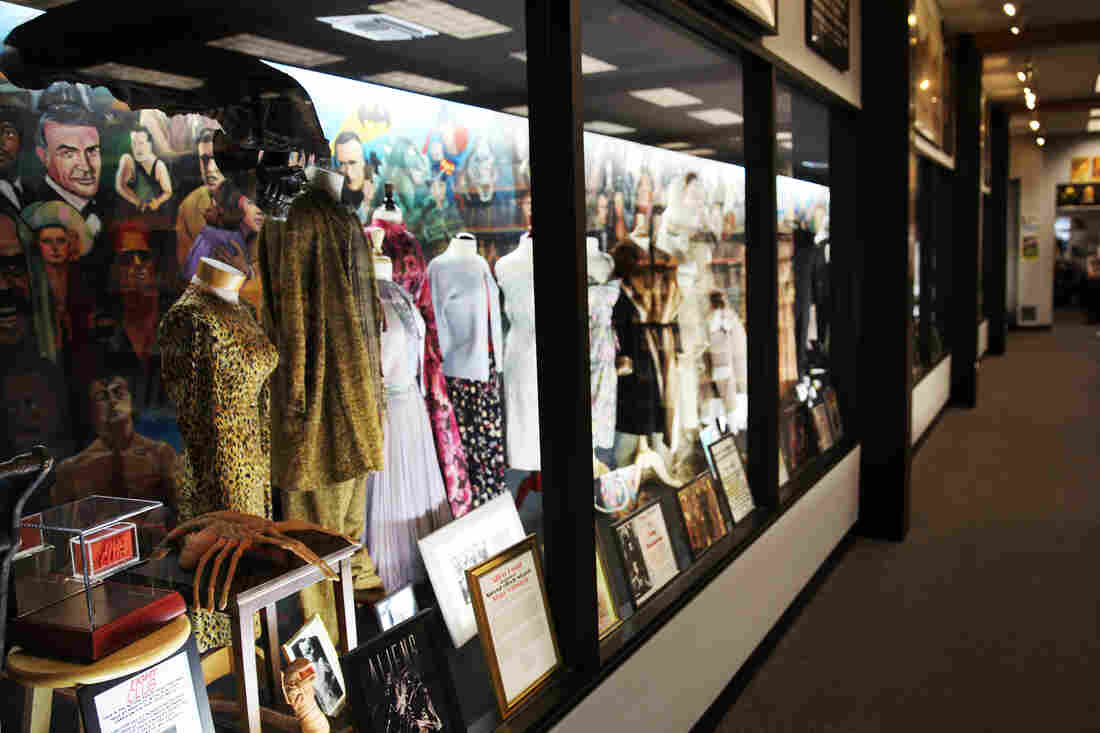
A Portland Video Store Goes Nonprofit To Save Itself
Reporter Pulls Blanket Off Cozy Ties Between Mattress Companies And Reviewers

Shoppers go online for reviews of the products they want to buy — like mattresses. But one reporter found out that reviewers often have cozy business deals with the companies they’re reviewing.
ARI SHAPIRO, HOST:
Now to the shadowy underworld of online mattress reviews. When you’re getting ready to spend hundreds or even thousands of dollars on a new mattress you want to be smart about it, so you start Googling and reading reviews. And writer David Zax says there are some things you need to know about those reviews. He discovered a kind of Wild West of memory foam where people writing about mattresses have cozy business deals with the companies they’re reviewing. Zax described this in a piece for Fast Company magazine and joins us now. Welcome.
DAVID ZAX: Thank you for having me.
SHAPIRO: Your discovery started in the spring of 2016 when you met a guy named Kenny who gave you a free mattress. Who is this dude?
ZAX: Kenny’s a nice guy. Let me begin by saying that. He’s my neighbor. He’s a friend of a friend. And I heard that he had mattresses to spare. So I actually just walked over one day with a bottle of wine under my arm and traded him a bottle of wine for a free mattress. And I sort of asked him, what’s going on here? I hear you’re handing out free mattresses left and right. And it emerged that he reviewed mattresses online and that he actually got paid a commission from companies when he managed to persuade the people reading his reviews to buy a given mattress.
SHAPIRO: We actually have a clip here from one of his YouTube videos. This one’s from 2015.
(SOUNDBITE OF ARCHIVED RECORDING)
KENNY KLINE: Hey, I’m Kenny with Slumber Sage. Today I’m reviewing the Leesa mattress. I’ve been sleeping on the Leesa about three weeks now. It’s been a great experience.
SHAPIRO: So he goes on to rate the firmness of the mattress. And right under the review is a link for a coupon, $60 off the mattress. This has more than 60,000 views. What does Kenny get for doing this?
ZAX: So I did interview the CEO of Leesa, David Wolfe. And with his affiliate marketing partners, as they’re called, these reviewers who are also paid commissions on sales they generate, he pays $50 per mattress.
SHAPIRO: You report that some of these mattress reviewers are making more than a million dollars a year from mattress companies just for doing these reviews and doing referrals.
ZAX: It’s pretty incredible. But when you think about it – so a mattress is a – it’s a big-ticket item. It’s a thousand bucks on average, right about. And 5 percent of that, which is a standard commission for salespeople, is $50. So that adds up.
SHAPIRO: We’re not going to reveal all the twists and turns of your magazine story, including the surprise ending. But ultimately, the moral seems to be that you can’t necessarily trust the reviews you read online, at least of mattresses. How true is this of other review sites?
ZAX: Yeah, well, I wanted my story to be a way into understanding this giant industry called affiliate marketing. $4.5 billion were exchanged – changed hands last year in affiliate marketing. Affiliate marketing basically means, you know, often review sites where a product is reviewed. And on a deep level, the reviewers are incentivized by the very companies that they are reviewing.
SHAPIRO: Because on the review site you can click to buy. And if you click to buy on, say, Amazon, Amazon will give you a cut.
ZAX: Exactly. Or there’s a tracking code embedded in a link that goes straight to casper.com or leesa.com. There’s no obligation to disclose a case where you’re reviewing two competitors and one competitor’s paying you $250 per mattress and another competitor is paying you $50 for mattress or $0 per mattress. So it’s very difficult to know which sites are honest and which might be less so.
SHAPIRO: What advice do you have for people going online to buy things, wondering if reviewers are getting paid to give positive reviews?
ZAX: You know, definitely snoop around on the website. Check out the disclosures page. Be skeptical of language that says, you know, we may earn a small affiliate commission. Sometimes I tend to think that these disclosures that use the word affiliates, it’s almost as though that word is sort of almost boring enough that I think it causes consumers to – eyes glaze over. But that means in some cases that – especially if this is a highly trafficked website – that the people behind that website are making an awful lot of money. That doesn’t mean that the review is inaccurate. It’s just something consumers should be aware of.
SHAPIRO: That’s David Zax, contributing writer for Fast Company magazine. His latest story is called “The War To Sell You A Mattress Is An Internet Nightmare.” Thanks a lot.
ZAX: Thank you.
Copyright © 2017 NPR. All rights reserved. Visit our website terms of use and permissions pages at www.npr.org for further information.
NPR transcripts are created on a rush deadline by Verb8tm, Inc., an NPR contractor, and produced using a proprietary transcription process developed with NPR. This text may not be in its final form and may be updated or revised in the future. Accuracy and availability may vary. The authoritative record of NPR’s programming is the audio record.
After Ikea Dresser Recall, Another Toddler Reportedly Died In Tip-Over

Two recalled Ikea dressers are displayed during a Consumer Product Safety Commission news conference in 2016. Since the recall was announced, at least one more toddler has been crushed to death by a falling dresser.
Carolyn Kaster/AP
hide caption
toggle caption
Carolyn Kaster/AP
Another toddler has reportedly been crushed to death by an unsecured Ikea dresser, after the furniture giant recalled millions of chests and dressers over the risk of deadly tip-over accidents.
Jozef Dudek, 2, died in May, according to lawyers for his family, when he was crushed by an Ikea Malm dresser in his parents’ room after he was put down for a nap.
In the recall, which began last June, Ikea offers full or partial refunds as well as providing free wall-anchoring kits to make the furniture safe to use. The move came after multiple toddlers were killed in similar tip-over accidents.
But Jozef’s parents weren’t aware that their Malm dresser had been recalled, Daniel Mann, who is representing the family, tells NPR.
In a statement, Mann’s colleague Alan Feldman called Jozef’s death “completely avoidable” and criticized Ikea’s recall effort as “poorly publicized … and ineffective.”
In a statement, Ikea said it is aware of the accident and extends its “sincere condolences” to the family. The company says it went to “great lengths to get the word out” about the recall, including a national advertising campaign, millions of emails to consumers and information “posted prominently” in stores.
Last June, Ikea said that 29 million dressers in the U.S. were covered by the recall. The company has not identified how many dressers have since been returned or how many wall-mounting kits have been claimed.
The Philadelphia Inquirer, which has extensively investigated tip-over deaths, reports that in the first six months of the recall about 882,500 dressers were returned or “repaired” — representing 3 percent of the recalled items. More recent numbers are not available, the paper says.
Ikea challenges the accuracy of any percentages, saying that the affected dressers have been sold “going back decades,” that “it’s impossible to know how many of those units are still in use” and that some users might have attached the unit to the wall without participating in the recall.
As NPR previously reported, the recalled chests and dressers — as well as similar items of furniture — can be pulled over by a child, with potentially fatal consequences:
“When multiple drawers are opened, or if a child opens drawers and attempts to climb on them, even dressers that seem too heavy for a child to move can become vulnerable to tipping. (Seemingly stable televisions can pose a similar hazard.)
“In 2014, two children, both around 2 years old, died in tip-over accidents involving Ikea’s Malm dressers. The next year, the company launched a program offering free wall-mounting kits to consumers and encouraging them to attach dressers to the wall.
“But in February [2016], a third child, a 22-month-old boy in Minnesota, died after a Malm chest fell on top of him.
“His family was renting its apartment, the Star Tribune reports, and was not allowed to put holes in the walls, as Ikea’s wall-mounting kits require.”
“IKEA urges all consumers to securely attach chests to the wall with the hardware included in every IKEA chest of drawers package,” the company says in its newest statement. “Wall attachment is a necessary part of the assembly instructions, which must not be overlooked. If it is impossible for units to be attached to the wall, consumers should choose a different storage solution.”
The Consumer Product Safety Commission says it is investigating the death of Jozef Dudek. He would be the eight toddler known to have died in an Ikea dresser tip-over, according to the CPSC and the Inquirer.
“We urge people who have IKEA dressers covered by the recall to take advantage of the remedies provided,” the agency says.
Meanwhile, a group of consumer safety advocacy groups — including the American Academy of Pediatrics and the Consumer Federation of America — have issued a joint statement criticizing Ikea for promoting wall-mounting instead of urging owners to return their dressers.
“Unfortunately, the communication efforts focused on anchoring a deadly dresser to the wall are not enough on their own. Anchoring devices are meant as a second layer of protection for stable dressers — not as a replacement for making stable dressers in the first place,” the groups write.
Safety standards for dressers are currently voluntary. Last year, some lawmakers introduced a bill to call for mandatory safety standards, which failed in committee.
Emoluments Hearing Hints At What May Be At Stake: Trump's Tax Returns

Officers Fired After Forcible Removal Of United Airlines Passenger

A United Airlines jet taxis to a gate at O’Hare International Airport in Chicago in June.
Kiichiro Sato/AP
hide caption
toggle caption
Kiichiro Sato/AP
Two security officers who were caught on video in April forcibly removing a passenger from a United Airlines flight in Chicago were fired following the incident that sparked widespread public outrage.
In a report, Chicago’s Office of the Inspector General found that three Chicago Department of Aviation security officers “improperly escalated the incident” and that a sergeant “made misleading statements and deliberately removed material facts from their reports” on the April 9 incident aboard United Express Flight 3411 from Chicago to Louisville, Ky., according to The Associated Press.
Several fellow passengers used their mobile phones to film the incident. Those videos were widely shared on social media and turned into a major public relations debacle for the airline. In them, officers are seen grabbing the passenger — Dr. David Dao — who was selected apparently at random to be removed from the overbooked flight.
As NPR’s Camila Domonoske reported at the time, Dao, 69:
“… was told he had to give up his ticket so a United crew member could take his seat. The man refused: He’s a doctor and said he had patients he had to see.”
“United called security officers, who violently wrenched the man from his seat,bloodying his face, and dragged his limp body down the aisle. The passenger, David Dao, is at a hospital in Chicago recovering from his injuries, member station WFPL reports.”
Dao’s attorney, Thomas Demetrio, said his client sustained a broken nose and lost teeth as he was dragged off the flight. United apologized for the incident and later reached an undisclosed settlement with Dao for his injuries.
Besides the two officers who were fired, two others received short-term suspensions and one of them subsequently resigned, the report says. The names of the four were not released.
Demetrio told the AP on Tuesday that he and his client were not expecting the dismissal of the security officer who is not a sergeant, but said it may resonate with others.
“In firing him, perhaps it will send a clear message to police and airline personnel all over the world that unnecessary violence is not the way to handle passenger matters,” Demetrio told the news agency.
Florida Man Awarded $37,500 After Cops Mistake Glazed Doughnut Crumbs For Meth

A Krispy Kreme doughnut was to blame for a white substance that led to an Orlando man being jailed on drug charges. Results from roadside drug test kits conducted by law enforcement officers can be unreliable.
Joe Raedle/Getty Images
hide caption
toggle caption
Joe Raedle/Getty Images
It sounds like a joke, but, well — keep reading.
In December 2015, 64-year-old Daniel Rushing had just dropped off a friend at chemotherapy and was driving home an older woman from his church who worked at the 7-Eleven and would otherwise walk the 2 miles home.
As Rushing drove away from the convenience store, police pulled him over. The officer said he had been driving 42 miles an hour in a 30 zone and had failed to come to a complete stop before entering the roadway. When Rushing handed over his driver’s license, Officer Shelby Riggs-Hopkins noticed his concealed-weapons permit. Rushing confirmed he had a pistol, and she asked him to step out of the car for her safety.
The officer then asked if police could search his car, and Rushing said sure — if it meant he wouldn’t be ticketed. Rushing watched as the officers, who now numbered four, conducted a very thorough inspection of his car.
Finally, Riggs-Hopkins said to him, “You want to tell me about what we found?”
“There’s nothing to find,” he said, confused.
But Riggs-Hopkins had noticed some crystals on the floorboard of the car, and when officers used a field testing kit, the white substance tested positive for methamphetamine.
Rushing said that was impossible: “I’ve never even smoked a cigarette,” he protested.
The officer showed him the substance in question, and Rushing was aghast.
“That’s glaze from a Krispy Kreme doughnut!” he explained. “I get one every other Wednesday.”
But officers weren’t buying it. Rushing was booked on charges of possessing methamphetamine while armed with a weapon.
As he sat in jail, he asked himself, “Lord, what am I doing here?”
“It was funny,” Rushing says, “because I called my wife to tell her what happened, and the guy next to me waiting for the phone started to laugh. He said, ‘This is crazy. I think you got a real good lawsuit here.’ “
He spent more than 10 hours in jail before being released on bail.
Orlando police sent the evidence it had collected from Rushing’s car to the Florida Department of Law Enforcement for further testing — which determined that just as he’d said, the white crystals were not a controlled substance. (Results did not indicate whether the substance was sweet and delicious.)
All charges against Rushing were dropped.
It would be a funnier story if it hadn’t been so closely replicated in Oviedo, a Florida city northeast of Orlando.
Karlos Cashe was pulled over in March for driving without headlights and arrested by Oviedo police when court records showed that he was out past his court-ordered curfew. Those records were later shown to be out of date and inaccurate, ABC affiliate WFTV reported.
Police saw white dust on the floorboards of Cashe’s car and tested it with a field kit. The substance showed positive for cocaine.
Cashe went to jail for 90 days – 90 days in which he knew that the white substance in his car was simply drywall dust.
“I know for a fact it’s drywall because I’m a handyman,” Cashe told WFTV. “I said that continuously during the arrest stop.”
Police in Orlando and Oviedo, like many other law enforcement agencies, use inexpensive field kits to test for drugs. Orlando’s police use NIK brand narcotic testing kits. A NIK general screening kit, which tests for opiates, meth and other drugs, costs just $18 for a box of 10.
But such roadside test kits are far from foolproof.
A 2016 investigation by ProPublica and The New York Times found that tens of thousands of people are sent to jail each year based on the kits’ results, which often generate false positives:
“Some tests … use a single tube of a chemical called cobalt thiocyanate, which turns blue when it is exposed to cocaine. But cobalt thiocyanate also turns blue when it is exposed to more than 80 other compounds, including methadone, certain acne medications and several common household cleaners. Other tests use three tubes, which the officer can break in a specific order to rule out everything but the drug in question — but if the officer breaks the tubes in the wrong order, that, too, can invalidate the results. The environment can also present problems. Cold weather slows the color development; heat speeds it up, or sometimes prevents a color reaction from taking place at all.”
Data from the state law enforcement lab in Florida found that 21 percent of the evidence recorded by police as methamphetamine was not in fact methamphetamine, and of that, half was not illegal drugs at all, according to the ProPublica investigation: “When we examined the department’s records, they showed that officers, faced with somewhat ambiguous directions on the pouches, had simply misunderstood which colors indicated a positive result.”
Those findings are part of what spurred Rushing to file a lawsuit against the city of Orlando after the charges against him were dropped. Two weeks ago, Rushing says he reached a settlement with the city for $37,500.
“I thought [the lawsuit] was the right thing to do, for what they did to me,” he tells NPR.
An Orlando police spokeswoman says that after the Rushing incident, the department conducted an internal investigation and officers received additional training in using the field kits — but it’s still using the same NIK narcotic test kits.
The Safariland Group, which makes the NIK tests, told ProPublica that it provides all law enforcement agencies with comprehensive field test training manuals, in addition to its instructions, and says its products are not intended for use other than directed.
“These training materials, which outline protocols for use, clearly state that the tests are presumptive aids that serve only as confirmation of probable cause and are not a substitute for laboratory testing,” the company wrote in a statement.
For his part, Rushing bears no ill will toward the city’s police department and says that the arresting officer was “very polite and nice.” He worked alongside the police as a parks department employee for more than 25 years, and his brother is a former Orlando cop.
He says the issue is that the department keeps using the kits, despite the well-documented problems with using them.
“These kits give a false positive 1 out of every 5 times,” he says. “I’m thinking about running for statehouse next year. And if I do, I’d like to get something done about these kits.”
With the lawsuit behind him, Rushing’s next step is getting his record expunged. He says he would like to find more work in security — but it’s been hard to get business with a record showing an arrest for possession of meth while armed.
After the glaze incident, Rushing stopped by his local Krispy Kreme to let the people there know they might be in for a little publicity.
Sometimes they give him a free doughnut.
“But I don’t eat them in the car,” he says, laughing.
As Trump Moves To Renegotiate NAFTA, U.S. Farmers Are Hopeful But Nervous


What Affordable Care Act Rollback Means For The Health Care Insurance Industry
Health insurance providers have already raised rates in anticipation of reduced government subsidies. NPR’s Michel Martin talks with health policy analyst Robert Laszewski about how the industry might fare.
MICHEL MARTIN, HOST:
We have one more conversation about healthcare. As we just heard, health insurers are trying to figure out what to do without the reimbursement from the government that the Trump administration says will no longer be paid. The question is, will insurers raise their rates or withdraw from the health exchanges created by the Affordable Care Act? For perspective on this, we called Robert Laszewski. He’s a former insurance executive who’s now a health policy consultant. Mr. Laszewski, thanks so much for speaking with us.
ROBERT LASZEWSKI: You’re welcome.
MARTIN: So based on your knowledge of the industry, what are the options that insurers are considering to deal with the lack of these subsidies?
LASZEWSKI: Well, actually, many of them have already raised the rates. They had to have their 2018 rates into the regulators and approved a couple of weeks ago, so most of them have already made some pretty significant rate increases – between 10 and 20 percent – assuming that Trump would cut off the subsidies. A few insurance companies and a few regulators did not do that. They did not allow for it. I think now what’s going to have to happen is these insurance companies today are having some pretty tense conversations with the regulators, saying, if you want us to stay in the market, you’re going to have to let us raise those rates 10 to 20 percent.
MARTIN: Is it possible or likely that some of these companies will just pull out? And can they do that even if they’ve already offered plans for the coming year?
LASZEWSKI: It is still possible for insurance companies to pull out. The contracts they have with the government have an out clause if there’s a major material change. So it’s possible. More likely, I think you’re going to see some regulators make some accommodations and allow for the higher rates to happen pretty quickly. I don’t think we’re going to see many, if any, pull-outs. Now we’ve got dozens of insurance companies involved, so I wouldn’t be shocked to see one do it. But generally speaking. The carriers have known this is coming, they know what kind of environment they’re in, and they’re pretty much pricing for it.
MARTIN: Let’s say for the sake of argument that companies do pull out of the exchange. Is there a tipping point at which the Affordable Care Act no longer effectively exists?
LASZEWSKI: Well, that’s possible if you had substantial carriers pull out in some of the larger markets – with any markets of any consequence with no insurance company. But I think we’re actually entering a strange period here. The insurance companies are figuring out how to make money in the Obamacare insurance exchanges. They just raise the rates. So the carriers – the insurance companies – are backing into a survivable market here. Run the rates up as high as you have to. They can at least break even. It becomes sustainable for the insurance company, but it’s a terrible situation for people who don’t get subsidies and have to pay the full cost.
MARTIN: So finally, before we let you go, are there other options on the table? Could Congress theoretically, anyway, pass some sort of a patch to fund these cost savings reimbursement?
LASZEWSKI: Absolutely. The Congress could pass legislation not only to fix the cost-sharing subsidy problem that Trump created but to fix a lot of other problems. Obamacare has some very serious architectural problems when it comes to the insurance exchanges. It needs an overhaul minimally. So the Congress could fix it, but here’s the problem – Trump would veto it.
So I think we’re stuck in a really bizarre period right now, one where people getting subsidies are going to be OK. Even though we cut the funding to the insurance companies, they’re going to get their subsidies to help pay for it. But 43 percent of those in the individual market didn’t get a subsidy last year because they made too much money, and those people are really getting hurt.
MARTIN: That’s Robert Laszewski. He’s a health policy consultant, a former insurance executive. He was kind enough to speak to us by phone just outside Washington, D.C. Mr. Laszewski, thanks so much for speaking with us.
LASZEWSKI: You’re welcome.
Copyright © 2017 NPR. All rights reserved. Visit our website terms of use and permissions pages at www.npr.org for further information.
NPR transcripts are created on a rush deadline by Verb8tm, Inc., an NPR contractor, and produced using a proprietary transcription process developed with NPR. This text may not be in its final form and may be updated or revised in the future. Accuracy and availability may vary. The authoritative record of NPR’s programming is the audio record.
New York District Attorney On The Defense Over Handling Of Weinstein Allegations

Manhattan District Attorney Cyrus Vance Jr. faces criticism of his handling of sexual assault allegations against Harvey Weinstein and a case involving the Trump SoHo development in New York City.
Pacific Press/LightRocket via Getty Images
hide caption
toggle caption
Pacific Press/LightRocket via Getty Images
If only because of its venue, the office of New York district attorney has long been among the highest-profile prosecutorial jobs in the country. The men who have served in it, legal legends such as Thomas Dewey, Frank Hogan and Robert Morgenthau, have often held the job for years, gaining enormous stature and political capital along the way.
Until recently, it seemed the current DA, 63-year-old Cyrus Vance Jr., might enjoy the same long tenure.
But controversies over the Trump SoHo development and the sexual assault allegations against Harvey Weinstein have raised new questions about Vance’s prosecutorial discretion and even his ethics. Both cases involved wealthy, powerful individuals who had contributed to his election campaigns.
This week, as numerous actresses stepped forward to say they had been assaulted by Weinstein, Vance had to explain why he declined to prosecute the movie mogul, despite graphic audiotape of Weinstein harassing an Italian model in a Manhattan hotel. The tape was collected in 2015 as part of an undercover sting operation by New York police.
Despite the audiotape, Vance said prosecutors in his office had determined the evidence against Weinstein wasn’t strong enough to pursue a case.
“I understand that folks are outraged by his behavior,” Vance told reporters. “I understand that there are many other allegations that have surfaced, but in our case, we really did what I think the law obligates us to do.”
“If we could have prosecuted Harvey Weinstein for the conduct that occurred in 2015, we would have,” said Karen Friedman Agnifilo, chief assistant district attorney.
But criminal attorney Matthew Galluzzo, who once worked in the DA’s sex crimes unit, told The Associated Press he believed the audiotape, in which Weinstein acknowledges touching Gutierrez on the breast, could have been used to pursue a case.
“She can testify about what happened, and you’ve got him acknowledging he did something wrong,” Galluzzo said.
Before this week, questions were also being raised about Vance’s handling of a fraud investigation involving the Trump SoHo, a condo hotel built by the Bayrock Group. Some early buyers of units at the hotel sued Bayrock, arguing that they had been misled about the hotel’s sales records.
The Manhattan DA’s office had considered pursuing fraud charges against Ivanka Trump and Donald Trump Jr., who played a big role in promoting the hotel. An investigation by The New Yorker, WNYC and ProPublica said prosecutors wanted to pursue a criminal case, but Vance said evidence to do so was lacking.
The report also noted that Vance had received a $32,000 campaign contribution from one of Trump’s lawyers shortly after dropping the case. Vance had also received an earlier donation, which he had returned.
“It was improper for him to accept it in the first place. He responded by returning those donations and then apparently accepted them again after the fact,” noted Jim Cohen, a professor at Fordham University School of Law.
Before these controversies, Vance, who was first elected in 2009, enjoyed a solid if somewhat low-profile reputation in the New York legal world.
“He is in general viewed with great respect. He’s considered to be a straight shooter. But recent news events may ultimately end up changing that,” Cohen says.
The son of Cyrus Vance, secretary of state in the Carter administration, Vance attended Georgetown University Law Center before taking a job in the Manhattan DA’s office.
Although he moved to Seattle to work in private practice, he later returned to New York, where he was long seen as a potential successor to Morgenthau.
After Morgenthau chose not to run for re-election, Vance was elected as a Democrat to replace him. He was re-elected in 2013.
While Vance hasn’t yet achieved the prominence of his predecessors, his office has handled major investigations such as the sexual assault case against former International Monetary Fund head Dominique Strauss-Kahn.
The Weinstein case has exploded just as Vance is preparing to run for a third term. He is running unopposed, which makes his re-election almost inevitable, says longtime Democratic consultant Jerry Skurnik.
But the controversies have definitely hurt Vance’s reputation and make him more vulnerable should he choose to run again in 2021, Skurnik says.
“His name recognition has probably gone up. But most of this new name recognition is not positive,” he says.
Top Exec At Amazon Studios Put On Leave After Harassment Allegations

Roy Price, head of Amazon Studios, participates in the “Hand of God” panel at the Amazon Summer TCA Tour at the Beverly Hilton Hotel in Beverly Hills, Calif., in Aug. 2015.
Richard Shotwell/Richard Shotwell/Invision/AP
hide caption
toggle caption
Richard Shotwell/Richard Shotwell/Invision/AP
Updated at 2:30 a.m. ET
Roy Price, the head of Amazon Studios, has been put on leave following allegations published in The Hollywood Reporter that he sexually harassed a female producer for the series The Man in the High Castle.

Producer Isa Hackett attends “The Man in the High Castle” photo call at the Amazon Summer TCA Tour at the Beverly Hilton Hotel in Beverly Hills, Calif. Hackett says she was sexually harassed in 2015 by Amazon Studios executive Roy Price.
Richard Shotwell/Richard Shotwell/Invision/AP
hide caption
toggle caption
Richard Shotwell/Richard Shotwell/Invision/AP
The incident allegedly occurred in July 2015 at a Comic-Con in San Diego, according to the trade paper, which says that in a taxi, Price “repeatedly and insistently propositioned” producer Isa Hackett using explicit language.
In a brief statement, Amazon confirmed late Thursday that: “Roy Price is on leave of absence effective immediately.”
Hackett, who is the daughter of Philip K. Dick, the author of the book The Man in the High Castle says that Michael Paull, then-Amazon executive and now CEO of the digital media company BAMTech, was also in the taxi with Hackett and Price at the time of the incident.
According to Hollywood Reporter:
“Hackett says she reported the incident to Amazon executives immediately. An outside investigator, Christine Farrell of Public Interest Investigations Inc., was brought in and spoke to Hackett and executives at Amazon. Hackett says she was never told the outcome of that inquiry, but notes that she hasn’t seen Price at any events involving her shows.”
The allegation against Price follows a series of similar ones directed at film executive Harvey Weinstein. On Sunday, The Weinstein Co., which Weinstein co-founded, fired him after dozens of women, including actors Angelina Jolie and Gwyneth Paltrow, went public with allegations of sexual misconduct and assault.
In Thursday’s statement from Amazon, the company said it was also reviewing its options for projects with The Weinstein Co. Those projects include The Romanoffs and an untitled drama from filmmaker David O. Russell starring Robert De Niro and Julianne Moore, according to The Associated Press.
That review also follows a series of tweets by actor, director and producer Rose McGowan on Thursday in which she confirmed that Weinstein is the Hollywood executive she claims raped her. In the tweets, directed at Amazon CEO Jeff Bezos, McGowan says “I told the head of your studio that HW raped me. Over & over I said it.” McGowan also says that a script she had written that was in development was abruptly pulled by Amazon after she raised the allegations.
The AP, quoting Hackett’s attorney, Christopher Tricarico, says Hollywood Reporter’s account is accurate. Tricarico says his client does not intend to pursue legal action against Amazon or Price.
Hackett, who initially was publicly reticent about the incident, told Hollywood Reporter that “It was shocking and surreal,” and that she believed it was important to speak up now.
“I didn’t want the details to come out previously because I didn’t want to distract or deflate the energies of all the people who are so invested in these shows, and all of that positivity,” she told the trade paper. “You don’t want to bring this into it. It feels demoralizing.”
