Business

No Image

Doctor Outlines Plan To Battle Antibiotic Resistance In 'The Washington Post'

NPR’s Ari Shapiro talks with Ezekiel Emanuel, a senior fellow at the Center for American Progress and chair of the Department of Medical Ethics and Health Policy at the University of Pennsylvania, about his opinion piece in the Washington Post that argues the cheap price of antibiotics has led to their overuse and has also discouraged drug companies from developing new antibiotics.

Transcript

ARI SHAPIRO: Unless we shift course, superbugs will become a fact of life. That line come from Zeke Emanuel, chair of the Department of Medical Ethics And Health Policy at the University of Pennsylvania. In The Washington Post, he lays out a four-pronged approach to avoid what he calls this nightmare scenario. Part of his argument is that antibiotics right now are too cheap, and he joins us to discuss the problem. Welcome to the program.

ZEKE EMANUEL: Nice to be here with you.

SHAPIRO: So there was news last week that a woman in Pennsylvania had a bacteria that was resistant to what’s known as an antibiotic of last resort, and that’s hit off this latest wave of concern about superbugs. Explain why you believe the price of antibiotics is partly to blame.

EMANUEL: Well, you know, the course of new, quote, unquote, “expensive antibiotics” might be $4,500 or $5,000. But a course of course of chemotherapy drug for cancer or a drug to fight multiple sclerosis can be $75,000, $100,000, $150,000 for a year of treatment.

And if you’re a drug company thinking about, where do I invest in terms of research and development – do I develop a $5,000, or do I developed $150,000 drug – you’re almost naturally going to go to the $150,000 drug. And so I think that’s a, you know – a major, major reason that we only have 37 antibiotics now in clinical development.

SHAPIRO: Could raising the prices of antibiotics have negative consequences as well?

EMANUEL: Well, of course. It’s going to happen (laughter). Everything has a positive and negative consequence. The negative consequence is it’s more expensive to treat these infections. Some people might not get them because the drugs are too expensive, although that’s pretty unlikely in the United States.

But I think in general, we have to shift the incentive structure for researchers and drug companies. Otherwise we’re just not going to have enough development.

SHAPIRO: Now, you’ve proposed that governments offer a $2 billion prize to drug companies for developing new antibiotics. Is this something that had been tried with other drugs before? Are prizes an effective motivator?

EMANUEL: I don’t know that they’ve been tried with any other drugs before. But we know in the past that prizes have worked. Napoleon offered a prize for someone who could preserve food for his army, and he got a guy who figured out how to sterilize food in a bottle and then a tin can. There was a prize by the British government to figure out naval navigation to go across the ocean. And Netflix offered a prize – actually, a very modest prize (laughter) – for figuring out people’s movie preferences.

So prizes have worked and have stimulated a lot of people to think about solutions. And from the perspective of the health system just in America – forget the rest of the world – we spend $20 billion on treating people with antibiotic-resistant infections.

So this is a small fraction of that, and it’s absolutely vital because if we have bacteria that we can’t treat, there are going to be a lot of people dying for lack of antibiotics. And that is not a scenario we can put up with.

SHAPIRO: So as you say, the numbers of antibiotics being developed are far lower than the numbers of, for example, cancer drugs being developed. And you also say that doctors over prescribe these drugs. Explain what’s going on.

EMANUEL: Yeah. We know from reports of antibiotic prescribing practices in hospitals that 20 to 50 percent of the antibiotics that are prescribed are either inappropriate for the actual organism or absolutely unnecessary to treat it.

And we know that produces side effects like C. difficile and other infection and that in the outpatient setting, in the physician’s office, about a third of the antibiotics are inappropriate or unnecessary because they’re treating viral infections, or they’re treating self-limited infections. That breeds a lot of resistance in the bacteria in the community, and that is a huge problem.

SHAPIRO: One thing you don’t mention in this piece is the role of patients. Is there something that patients should be doing differently in this problem?

EMANUEL: So there are two main things patients should be doing differently. One – don’t demand antibiotics for sore throats, runny noses, ear infections and put your doctor in the unfortunate circumstance of satisfying your demand and violating what he or she thinks is an appropriate care.

And the second is, when you do get a prescription for antibiotics, we know that a lot of patients do not complete the course of antibiotics. Instead of taking the full 10 days of an antibiotic, you take three or four. You’re feeling better. You stop. Well, then you’ve just bred some resistant organisms that are then going to proliferate, and the antibiotics that we have will not be as effective. And that is also a very big problem out there.

SHAPIRO: Doctor Zeke Emanuel is chair of the Department of Medical Ethics and Health Policy at the University of Pennsylvania, and he’s also a senior fellow at the Center for American Progress. Thanks for joining us.

EMANUEL: Thank you for having me and talking about superbugs and antibiotics.

Copyright © 2016 NPR. All rights reserved. Visit our website terms of use and permissions pages at www.npr.org for further information.

NPR transcripts are created on a rush deadline by Verb8tm, Inc., an NPR contractor, and produced using a proprietary transcription process developed with NPR. This text may not be in its final form and may be updated or revised in the future. Accuracy and availability may vary. The authoritative record of NPR’s programming is the audio record.

Let’s block ads! (Why?)


No Image

Food Lion Co-Founder Dies; Chain Was Rocked By ABC News Report

The man who helped turn $50 investments in a North Carolina grocery store into the Food Lion chain with more than 1,100 stores across the Southeast has died.

Ralph Ketner, 95, died Sunday, according to a news release from the grocery store chain. No cause of death was given by Food Lion officials or the funeral home handling his arrangements.

Ketner successfully gambled that bigger sales by lowering prices to where profit margins were razor thin were the best path to success.

In 1957, he opened the Food Town grocery store in Salisbury, N.C., with two friends, calling people in the phone book and asking for $50 or $100 investments.

About 125 people gave him money, and that one store grew into the Food Lion chain with stores across the Southeast. With stock splits over the years, an investor who bought $28 in stock originally ended up with $1 million, according to Food Lion.

“He had a profound and lasting impact on the entire grocery industry and he has left a tremendous legacy not only at Food Lion, but through his philanthropy and kindness in the Salisbury community as a whole. Forever a welcome and vital part of our family, even at 95 years old, Mr. Ketner still attended several Food Lion events. Our associates adored and respected him and we will miss him dearly,” the company said in its statement.

Ketner remained loyal to Food Lion even after the grocery store was rocked by a 1992 hidden camera report by ABC News that showed employees selling spoiled meat.

Two producers got jobs with the grocery chain without revealing they were reporters. Food Lion sued and was awarded more than $5 million after a jury found the network liable for fraud. An appeals court lowered the verdict to $2, but still found ABC was liable for trespassing because the employees taped other workers without their knowledge.

Let’s block ads! (Why?)


No Image

Coca-Cola Halts Production In Venezuela Due To Nation's Sugar Shortage

Venezuela just became one of the few countries in the world that does not sell Coca-Cola. Tom Standage of the Economist tells NPR’s Rachel Martin what that says about the Venezuelan economy.

Transcript

RACHEL MARTIN, HOST:

Venezuela has just become one of the few countries in the world where you cannot buy a Coca-Cola. Other countries include Cuba and North Korea. But it’s not because of embargoes in Venezuela. It’s because there isn’t enough sugar. Venezuela is in the middle of a deep recession. The country has been dealing with a food shortage and the world’s highest inflation.

To talk more about this, we’ve reached out to Tom Standage. He’s the deputy editor of The Economist and the author of “The History Of The World In 6 Glasses” (ph). He joins us now from London. Thanks so much for being with us.

TOM STANDAGE: Thanks for inviting me.

MARTIN: First off, how did Venezuela get to the point where they don’t have enough sugar? What economic policies got them there?

STANDAGE: Well, the whole of the Venezuelan economy is just in a big mess. Essentially, Hugo Chavez, the previous president, had this, you know, great idea of a socialist revolution where he would give lots of money to the poor. And it all looked really good to start with. Essentially, the whole thing was funded by oil money. The oil prices collapsed. Chavez has died. His successor Nicolas Maduro is in a bit of a bad way because, actually, as well as giving money to the poor, the regime was helping itself to massive amounts of money.

And they’re now in this very odd situation where the official exchange rate means that you have to pay something like 10 bolivares for a dollar. The unofficial exchange rate, the black market rate, is about 100 times higher than that. And members of the regime are still allowed to exchange this pretty worthless local currency for dollars, which they can then sell for 100 times as much. So that means that they are not really terrifically well-incentivized to change this ridiculous policy.

And in the meantime, there are shortages of lots of products because if you import any products, there’s no way you want to sell them at the fixed prices the government is forcing you to sell them at. If you’re a sugar producer, you certainly don’t want to be making sugar because you’re forced to sell it at this ridiculously low price.

MARTIN: So people seize on this whole idea of Coca-Cola not being available in Venezuela ’cause it’s a catchy headline. But you argue – you have written in your book that it has symbolic power – that this particular product and not having it has symbolic meaning. Can you explain why?

STANDAGE: Well, Coca-Cola has always been the nearest thing to capitalism in a bottle. And, in fact, in 1997, The Economist did this correlation of Coca-Cola consumption in different countries. And it turns out to correlate positively with wealth, quality of life and social and political freedom. Now, of course, that’s not because Coca-Cola causes all of those things. It’s because, we think, free market capitalism encourages all of those things.

And whenever a country opens up, like Burma, for example, recently has – who are the first people to move in? You see the Coca-Cola lorries going in. And they go in and they find a partner. And, you know, off they go. So it really is this sort of symbol of moving towards greater economic freedom. And obviously, in Venezuela’s case, we sadly have this example of Coca-Cola going the opposite direction saying – actually, you can’t have that anymore in the same way that you can’t have social, political freedom, quality of life and economic growth.

MARTIN: So what happens now? How does this country get itself out of this – what has become a very devastating recession?

STANDAGE: It really is very hard to see an easy way out. The difficulty is that the opposition won the most recent election. And so they are trying to have a sort of recall vote to get rid of Maduro who’s technically meant to be in power until 2018. And I think if change does come, it will be because people within Maduro’s own party see that he is unviable.

And the only way that they can keep control and keep their cushy jobs is to push him out. So will the revolution happen within his own party, or will there be a sort of explosion on the streets? Neither of these scenarios is terribly nice. It’s all really quite frightening.

MARTIN: Tom Standage is deputy editor of The Economist. He also wrote a book titled “A History Of The World In 6 Glasses.” Tom, thanks so much for talking with us.

STANDAGE: Thank you.

Copyright © 2016 NPR. All rights reserved. Visit our website terms of use and permissions pages at www.npr.org for further information.

NPR transcripts are created on a rush deadline by Verb8tm, Inc., an NPR contractor, and produced using a proprietary transcription process developed with NPR. This text may not be in its final form and may be updated or revised in the future. Accuracy and availability may vary. The authoritative record of NPR’s programming is the audio record.

Let’s block ads! (Why?)


No Image

Millenials Are Moving Back With Mom And Dad

A new survey finds more young adults now live at home with parents rather than with a spouse or romantic partner. Kim Parker of the Pew Research Center talks about the factors that fuel this trend.

Transcript

MICHEL MARTIN, HOST:

We’re going to take a few minutes now to talk about a new report out about a trend among millennials that’s gotten a lot of attention. For the first time in more than a hundred years, younger adults – those aged 18 to 34 – are more likely to be living in their parents homes than with a partner or spouse.

In a few minutes, we’re going to talk about this in our Barbershop roundtable. We’ve pulled together a group of millennials who’ve been thinking about this. But first, let’s talk about the study with Kim Parker, director of social trends at the Pew Research Center, and she helped with the report. Kim, thanks so much for joining us.

KIM PARKER: Thanks so much for having me.

MARTIN: What are some of the factors that are fueling this – that are fueling this? I assume there’s more than one.

PARKER: The main driving force is the sort of downward trend in the share of young adults who are married, and part of that is explained by the fact that young adults are marrying later in life. But part of it also has to do with other factors. One is educational attainment.

There are different patterns by race and ethnicity, and there are also some economic factors that are really playing into this and particularly affecting young adults who don’t have a college degree. Employment among that group is down and wages are down. And those things make it a lot harder for young people to get out and establish their own households.

MARTIN: The fact of the matter is millennials are probably the most diverse demographic in our history – right? – and so if you come from, say, an immigrant background, it’s not considered so terrible to live with your parents. In fact, that’s the norm in a lot of cultures. Is that a factor?

PARKER: We do find the rates of young adults living at home, and also more broadly multigenerational households are more common among new immigrants and racial and ethnic minorities. But when you just look at the patterns of what’s been going on with whites, you see a similar uptick in the shared living with parents and a downward trend in the share who are marrying or living with romantic partners.

MARTIN: One more question – gender. Do you find that young men or young women are more likely to live with their parents? Is there a difference there?

PARKER: We do find a difference. Young men are more likely than young women to be living with their parents. This actually became the dominant living arrangement in 2009, so they hit the tipping point a few years back.

MARTIN: Why do we think that is? Do we have any idea why that is?

PARKER: Overall, employment rates among young men are down significantly in recent decades, and wages have also fallen a lot especially for young men without a college education.

But one thing that was really interesting for the young women was that, you know, a few decades ago, like 1960, 1970, young women who were employed were actually more likely to be living at home because they were a lot less likely to marry. But then things changed and married women started entering the workforce in bigger numbers, and then, you know, you see a different pattern.

MARTIN: That’s Kim Parker, director of social trends at the Pew Research Center. Kim, thanks so much for speaking with us.

PARKER: Thank you so much.

Copyright © 2016 NPR. All rights reserved. Visit our website terms of use and permissions pages at www.npr.org for further information.

NPR transcripts are created on a rush deadline by Verb8tm, Inc., an NPR contractor, and produced using a proprietary transcription process developed with NPR. This text may not be in its final form and may be updated or revised in the future. Accuracy and availability may vary. The authoritative record of NPR’s programming is the audio record.

Let’s block ads! (Why?)


No Image

Ship That Breast Milk For You? Companies Add Parent-Friendly Perks

Some companies are offering compensation beyond paid parental leave, covering surrogacy and adoption, or even shipping breast milk home to baby for traveling moms.

Gary Waters/Ikon Images/Getty Images

A handful of companies are offering parental benefits that go way beyond just paid leave, to include things like surrogacy reimbursement, egg freezing or breast milk shipping for traveling mothers.

As competition for talent heats up, companies see it as a relatively cheap way to recruit, retain and motivate their employee base.

This month, Johnson & Johnson extended fertility treatment benefits to same-sex couples and increased coverage to $35,000 for full- and part-time U.S. employees. It upped reimbursements for surrogacy and adoption to $20,000 — and it also ships breast milk.

“We wanted to be a leader in this space,” says Peter Fasolo, Johnson & Johnson chief human resources officer. Taking care of employees in this way costs far less than, say, health insurance, in part because the benefits are used by a minority of workers, and generally on a one-time or short-term basis. “They’re really not that expensive, to be frank with you.”

It may not be a lot of money for the company, but it can be for an individual employee.

Bruce Elliott, manager of benefits for the Society for Human Resource Management, says the amount Johnson & Johnson offers is unusually high. “We don’t see a lot of that. You know, we will see adoption support typically capped at about $5,000,” he says.

Elliott says rich benefits are more common in tech and finance. Ernst & Young has offered breast milk shipping for years, and last year, IBM, Accenture and Twitter added it. Apple and Facebook started covering egg freezing two years ago.

Clif Bar, the energy food company, instituted a breast milk shipping benefit recently that has made a huge difference for Marin Vaughn, a customer manager. Instead of schlepping pumped milk home in suitcases packed with ice when she came home from work travel, she now just requests supplies that allow her to refrigerate and ship the milk back home.

“So it just goes FedEx overnight; it’s super easy. I wish it had been around earlier,” when she had her first child three years ago, she says.

But the companies bolstering their family friendly benefits are largely ones where talent is in short supply. Outside of those rarefied places, it’s still uncommon.

According to SHRM, fewer than a third of employers, 27 percent, cover in vitro fertilization treatment. Adoption and surrogacy benefits are rarer still, and usually take the form of paid leave, not reimbursement. Seventeen percent offer adoption leave; 5 percent offer paid leave for parents having a child through a surrogate, SHRM says.

Ellen Bravo, executive director of advocacy group Family Values@Work, says 60 percent of women work in places without lactation rooms.

“For them it means squeezing into a bathroom stall, the most unsanitary place to pump milk,” Bravo says. And some employers won’t even allow pumping in bathrooms. She cites a discrimination suit filed with the Equal Employment Opportunity Commission this month by four female Frontier Airlines pilots alleging, in part, insufficient support for breast-feeding moms.

A Frontier Airlines spokesman says accommodations are made where possible, but allowing pilots to pump in flight could disrupt service, embarrass crew members or pose a security risk.

Though there are exceptions, most employment experts say there’s a big generational and cultural shift toward parent-friendly policies.

Kate Torgersen founded Milk Stork, a company that handles the logistics of breast milk shipping, and says she thinks young parents are demanding more of employers.

“They’re ambitious about their parenting,” she says. “They know about the value of breast-feeding, they’re incredibly informed and they’re vocal about what their needs are.”

Milk Stork launched less than a year ago. Since then, Torgersen says, the company has signed on a dozen corporate clients and is talking to many more.

Let’s block ads! (Why?)


No Image

After Departure Of Uber, Lyft In Austin, New Companies Enter The Void

Earlier this month, voters in Austin, Texas, rejected an effort to overturn the city’s rules for ride-hailing companies. Uber and Lyft tried to prevent fingerprinting of their drivers, and now both have left town. A few other ride-share companies have popped up to help fill the void. NPR explores how people are getting around town without Uber and Lyft.

Transcript

KELLY MCEVERS, HOST:

Austin, Texas, is known for its great bars and great music but not for its great public transportation. Up until recently, if you didn’t want to drink and drive in Austin, you took a ride-hailing service like Uber or Lyft. Now Uber and Lyft have left Austin after voters made fingerprinting a requirement for drivers. Audrey McGlinchy of member station KUT reports on how Austin residents are getting around.

(CROSSTALK)

AUDREY MCGLINCHY, BYLINE: Tom Atchity and his wife, Juliet, are sitting outside bar Cheer Up Charlie’s away from the noise of a three-band lineup. Atchity and his wife drove to the bar, but drinking and driving is always a concern, and Atchity tells me he would’ve taken an Uber or Lyft had one been available.

TOM ATCHITY: I certainly have kind of kept all of my going out and drinking very local – you know, within walking distance around our house. We’re lucky enough in Austin, at least in our neighborhood, that we can do that, but I definitely kind of changed our plans a couple times for it.

MCGLINCHY: Austin’s not known for its public transportation. Bus stops are infrequent and routes limited. A small number of cabs have trouble servicing the city, and wait times are notoriously long, and fares are high.

Without Uber and Lyft, newer ride-hailing companies are scrambling to fill the gap. Here at Cheer Up Charlie’s, only one of the nearly dozen people I approach has tried a new service. But all seem curious, both riders and drivers.

CARLTON THOMAS: I’m looking for the next four people that are interested Wingz, Wingz.

MCGLINCHY: Carlton Thomas is with the Austin Transportation Department, and he’s trying to connect former Uber and Lyft drivers with new companies at a city-run fair. Dana Lillard was there early – nearly an hour before the fair opened at 10 a.m. Lines were already long, confusion high.

DANA LILLARD: What do we do? You know, where do we go? How do we handle this?

LILLARD: I’m now in Lillard’s car with her in between pickups. She worked full-time for Uber and Lyft before they left town. Now she drives for Fare, one of the many newcomers. We stare at her phone, looking for a ride request to pop up. We sit, and we wait.

LILLARD: We’ve been sitting here for probably 10 minutes now, and no requests have popped up since I’ve been signed on to the app.

MCGLINCHY: Lillard discovers that her app was silent because of a technical glitch, and that’s characteristic of these ride-hailing newbies. Companies have jumped to fill the void, trying to scale up to the size of Uber and Lyft in a matter of weeks. Among them are Wingz, Get Me and Fasten plus a local effort called RideAustin.

But riders complain about long wait times or needing to schedule rides hours in advance. As a result, some have started soliciting rides on craigslist or a local Facebook group. Responding drivers post their now-defunct Uber or Lyft profiles, trying to create order in a city thrust into commuter chaos.

Back at the bar, Danielle Garza says she drove her car downtown, but she’s planning on having a few more drinks.

DANIELLE GARZA: I honestly, until this moment, haven’t really thought about how I’m going to get home. That’s a great question.

MCGLINCHY: I called Garza the next morning to see how she got home.

(SOUNDBITE OF RINGBACK TONE)

GARZA: Hello.

MCGLINCHY: Hey, is this Danielle?

Garza left the bar before midnight and hailed a cab on the street. But she says she called it an early night knowing a cab would be more available at that time. Will she try any of these new apps? Maybe, she says.

In the meantime, two more ride-hailing companies have arrived, and as riders grasp for a new service, these recent startups are also on the lookout for former Uber and Lyft customers. For NPR News, I’m Audrey McGlinchy in Austin.

Copyright © 2016 NPR. All rights reserved. Visit our website terms of use and permissions pages at www.npr.org for further information.

NPR transcripts are created on a rush deadline by Verb8tm, Inc., an NPR contractor, and produced using a proprietary transcription process developed with NPR. This text may not be in its final form and may be updated or revised in the future. Accuracy and availability may vary. The authoritative record of NPR’s programming is the audio record.

Let’s block ads! (Why?)


No Image

We Don't Know How Many Workers Are Injured At Slaughterhouses. Here's Why

Beef sides hang in a chilling room at a slaughterhouse in Nebraska.

Beef sides hang in a chilling room at a slaughterhouse in Nebraska. Nati Harnik/AP hide caption

toggle caption Nati Harnik/AP

A slaughterhouse is a safer place to work than it used to be, according to a new government report. But data gathered by federal regulators doesn’t likely capture all the risks faced by meat and poultry workers.

In an update to a 2005 report criticizing safety conditions for workers in the meat industry, the Government Accountability Office says injuries and illnesses are still common. From 2004 to 2013, 151 meat and poultry workers died from injuries sustained at work. The injury rate for meat workers is higher than the rest of the manufacturing industry.

But injuries in the meat industry are also likely to be underreported.

The GAO found several situations that may keep reported numbers from packing plants lower than reality. Here are some examples:

  • Sanitary workers who clean machinery in meat plants have suffered amputated limbs and severed fingers. Some have died on the job. But their cases are not always counted with meat and poultry industry data because many work for third-party contractors.
  • Medical staff at on-site clinics have encouraged workers to return to the line without seeing a doctor for pain. GAO cited a case where a worker made 90 visits to a nursing station before being referred to a physician.
  • Meat and poultry workers are often immigrants or refugees. They may downplay or not report injuries to protect their jobs and livelihoods. Language barriers can also prevent workers from receiving proper safety training.

“These limitations in [the Department of Labor’s] data collection raise questions about whether the federal government is doing all it can to collect the data it needs to support worker protection and workplace safety,” the GAO report said.

The GAO says safety researchers at the Centers for Disease Control and Prevention should do more to study sanitation worker injuries and regulators should count those injuries alongside those sustained by other meat workers.

Worker advocates say they have long been suspicious of the injury rates reported by meat companies. For instance, a recent study at a Maryland poultry plant by the National Institute for Occupational Safety and Health (NIOSH) found that one-third of workers had injuries that meet the definition of carpal tunnel, but only a handful of injuries had been reported to OSHA.

When injuries aren’t reported and treated, advocates say, they get worse.

“It has profound consequences for the workers,” says Celeste Monforton, an occupational health researcher at George Washington University. “Their injuries are exacerbated, some beyond repair.”

In recent years, groups like Nebraska Appleseed and the Southern Poverty Law Center have highlighted working conditions that they say continue to put people at risk, such as fast line speeds that can cause repetitive motion injuries. And Oxfam found that poultry workers are often denied mandatory bathroom breaks during the workday. Workers said they ended up wearing adult diapers.

The North American Meat Institute, a trade group, issued a statement defending the meat industry’s record on worker safety record. It said that OSHA has reviewed injury recordkeeping and did not find underreporting to be a regular problem at meatpacking facilities. NAMI also said that the rate of reported injuries is at an all-time low.

In an interview before the report was released, NAMI safety director Dan McCausland said the meat industry has made strides in safety over the last few decades.

“If you go back to the late 80s, early 90s – particularly in slaughtering facilities – it was not uncommon to have a third of the employees have an injury significant enough to wind up on the OSHA 300 log every year,” McCausland said, referring to the OSHA form used to report workplace injuries. “Now it’s down in the 10 percent and below [range]. We have many facilities running 3 percent or less.”

McCausland says the industry continues to look for ways to automate packing plants to take some of the load off of workers’ shoulders.

This story comes to us from Harvest Public Media, a reporting collaboration focused on food and agriculture.

Let’s block ads! (Why?)


No Image

The Judgment Of Paris: The Blind Taste Test That Decanted The Wine World

On May 24, 1976, the Judgment of Paris pitted some of the finest wines in France against unknown California bottles in a blind taste test. Nine of the most respected names in French gastronomy sat in judgment.

On May 24, 1976, the Judgment of Paris pitted some of the finest wines in France against unknown California bottles in a blind taste test. Nine of the most respected names in French gastronomy sat in judgment. Courtesy of Bella Spurrier hide caption

toggle caption Courtesy of Bella Spurrier

It was the tasting that revolutionized the wine world.

Forty years ago today, the crème de la crème of the French wine establishment sat in judgment for a blind tasting that pitted some of the finest wines in France against unknown California bottles. Only one journalist bothered to show up – the outcome was considered a foregone conclusion.

“Obviously, the French wines were going to win,” says journalist George Taber, who was then a correspondent for TIME magazine in Paris. He says everyone thought “it’s going to be a non-story.”

Taber did show up — as a favor to the organizers. And he ended up getting the biggest story of his career: To everyone’s amazement, the California wines – reds and whites — beat out their French competitors.

“It turned out to be the most important event, because it broke the myth that only in France could you make great wine. It opened the door for this phenomenon today of the globalization of wine,” Taber says.

The Judgment of Paris, as that May 24, 1976, wine tasting has come to be known, began as a publicity stunt. Steven Spurrier, an Englishman who owned a wine shop in Paris, wanted to drum up business. So, prompted by Patricia Gallagher, his American associate, Spurrier decided to stage a competition that highlighted the new California wines they’d been hearing so much about.

Spurrier tapped nine of the most respected names in French gastronomy for the job. They included sommeliers from the best French restaurants in Paris, the head of a highly regarded French vineyard, and Odette Kahn, the editor of the influential Revue du vin de France (The French Wine Review.)

As the sole journalist present, Taber had a lot of access, and he had a list of the order of the wines being served during the tasting. The judges didn’t. He watched as they swirled and spat.

At one point, Taber says, a judge – Raymond Oliver, chef and owner of Le Grand Véfour, one of Paris’ great restaurants — sampled a white. “And then he smelled it, then he tasted it and he held it up again, [and] he said, “Ah, back to France!” Taber recalls.

From left: Patricia Gallagher, who first proposed the tasting, wine merchant Steven Spurrier, and influential French wine editor Odette Kahn. After the results were announced, Kahn is said to have demanded her scorecard back. “She wanted to make sure that the world didn’t know what her scores were,” says George Taber, the only journalist present that day. Courtesy of Bella Spurrier hide caption

toggle caption Courtesy of Bella Spurrier

Except it was a Napa Valley Chardonnay. The judge didn’t know that. “But I knew,” Taber says. And once he realized what was happening, Taber says, “I thought, hey, maybe I got a story here.” Decades later, he penned The Judgment of Paris, an account of that day and its aftermath.

When the scores were tallied, the top honors went not to France’s best vintners but to a California white and red – the 1973 Chardonnay from Chateau Montelena and the 1973 Cabernet Sauvignon from Stag’s Leap Wine Cellars. (A bottle of each now resides at the Smithsonian’s National Museum of American History.)

Taber says the results shocked everyone. When it was over, Kahn unsuccessfully demanded her scorecard back – according to Taber, “she wanted to make sure that the world didn’t know what her scores were.”

Wine writer David White says the tasting was a major turning point for the wine industry. “The 1976 judgment totally changed the game,” says White, who writes the popular wine blog Terroirist and is the author of the forthcoming book, But First, Champagne: A Modern Guide to the World’s Favorite Wine.

While winemaker Robert Mondavi played a major role in making California the wine powerhouse it is today, the Paris tasting was equally influential, White says. As the late Jim Barrett, part owner of Napa Valley’s Chateau Montelena, told Taber back in 1976, the results were “not bad for kids from the sticks.”

And it wasn’t just California that was transformed. The results “gave winemakers everywhere a reason to believe that they too could take on the greatest wines in the world,” White says.

In the aftermath of the tasting, new vineyards bloomed around the U.S. (think Oregon, Washington and Virginia) and the world — from Argentina to Australia.

The Judgment of Paris prompted the world’s winemakers to start sharing and comparing in a way they hadn’t done before, says Warren Winiarski, the Polish-American founder of Stag’s Leap, whose Cabernet Sauvignon took top honors among the reds in Paris.

As a result, he said at a recent Smithsonian event in honor of that long-ago tasting, “the wines of the world are better, the wines of France are better.”

Which means the world’s wine lovers were the real winners that day.

Let’s block ads! (Why?)


No Image

People Aren't Coming To See The Pyramids Or Snorkel In The Red Sea

A shop owner waits for customers in a market in the resort town of Sharm el-Sheikh, Egypt. Over the past nine months, tourism has plummeted in the country after a series of deadly attacks.

A shop owner waits for customers in a market in the resort town of Sharm el-Sheikh, Egypt. Over the past nine months, tourism has plummeted in the country after a series of deadly attacks. Chris McGrath/Getty Images hide caption

toggle caption Chris McGrath/Getty Images

Khaled Ali Hassanin opens his silver minivan and pulls into Cairo’s busy traffic. He is a freelance driver. He used to ferry foreign tourists all around Egypt as a staff member of a tour company. It was a great job.

“There was so much work. I never worried about money. If I spent one [Egyptian] pound, I’d get two back. We had more work than we could handle,” he says.

Until 2011 — that’s when mass protests led to the overthrow of the dictatorial Egyptian President Hosni Mubarak. Hundreds were killed. Foreign tourist visits, which had reached 14.7 million in 2010, according to government figures, dropped by 30 percent to 9.8 million. Last year the number of foreign tourists was even lower, 9.3 million. Hassanin spent savings he had accumulated during the good times to support his family — until he gave up hope on tourism.

“Business dropped; the company closed down. The cars I’d drive tourists in were parked off in some garage,” he says. “I have responsibilities, I have children, so I had to go find something to do.”

The crash last week of an EgyptAir passenger plane flying from Paris to Cairo is the latest blow to the industry, which once made up over 11 percent of Egypt’s GDP.

Hassanin is one of many former employees in the tourism industry who are working more in other jobs and earning less. He now competes with many other drivers who hawk rides around or outside Cairo. He earns half of what he used to and skimps on himself to pay for his family’s sports club membership and English classes for his kids.

Even before the 2011 revolution, bombs periodically struck high-profile tourist sites in Egypt. Adel Adrees, a tour guide for 30 years, says visits would bounce back within a few weeks, even after a fatal attack.

“Before 2011, the troubles we had here in Egypt, it was internal,” he says. “Nowadays the problem is regional.”

It is true that there are ongoing wars in the region. But Egypt has had its own special problems. In the past nine months, the military killed 12 Mexican tourists and their guide. Authorities claimed forces thought the group were Islamic militants. The body of an Italian student was found in a ditch with signs of torture, creating a public feud with Italy. A mentally ill man hijacked a plane from Cairo to Cyprus with a fake suicide belt. And a Russian jet that took off from the Egyptian resort town Sharm el-Sheikh exploded midair. Russia has suspended all flights to Egypt.

But Hassan el Nahla, head of Egypt’s tour guide association, brushes all these issues aside.

“All this is true, but some of them are out of our hands,” he says. Terrorism, he points out, happens in many countries.

And while tourism isn’t making the same contribution to the local economy, it still provides huge revenues. International visitors to the country’s snorkeling beaches and ancient tombs brought in more than $12 billion annually in 2010. Last year, the figure had fallen to $6.6 billion.

Egypt’s government is starting a multimillion-dollar effort to woo back foreign visitors. Part of the money will go to boosting security and another part will go toward improving Egypt’s image through international ad campaigns that highlight tourist spots. Tourism is a fragile business, many in the business in Egypt say, and the most important thing to build it up is the perception of safety.

Yesterday, at Egypt’s perhaps most famous attraction, Australian tourist Stephen Booker climbed backward down a ramp into the burial chamber of a small queen’s pyramid at Giza. There was no line.

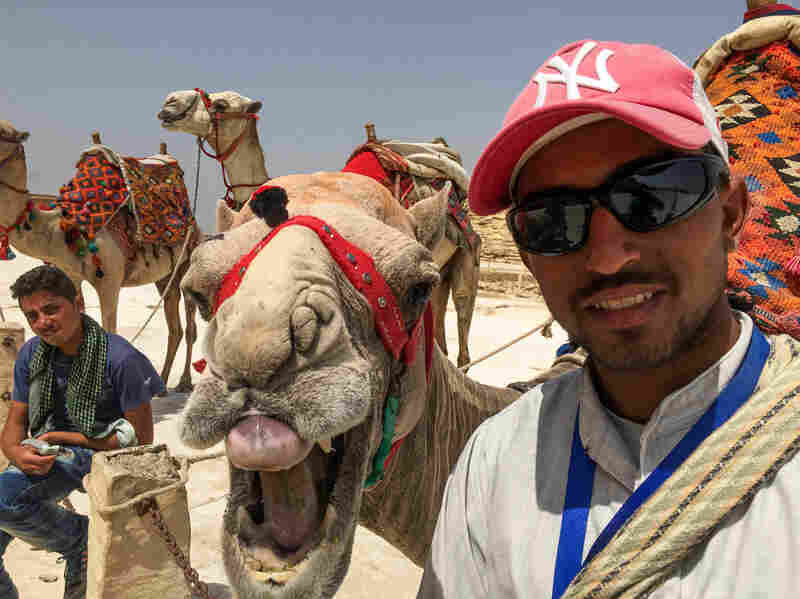
At the pyramids of Giza, Mahmoud Tayar and his camel, Charlie Brown, are gloomy about the steep drop in tourism to Egypt over the past five years.

At the pyramids of Giza, Mahmoud Tayar and his camel, Charlie Brown, are gloomy about the steep drop in tourism to Egypt over the past five years. Emily Harris/NPR hide caption

toggle caption Emily Harris/NPR

He says the EgyptAir crash last week does not worry him. “Not for my personal safety,” he says. “But I did feel sorry for the Egyptians, because they’ve taken one hit after another.”

Mahmoud Tayar knows what he means. He offers camel rides to pyramid visitors.

“There are a lot of camels to compete with but in good times I’d get 30 customers a day,” Tayar says. “Now it’s three, four, sometimes zero a day.”

Tayar says his camel, named Charlie Brown, feels the loss of business too. Charlie Brown, beside him, moans and bleats. “He told you ‘no business,’ ” says Tayar, translating for his camel. ” ‘Busy no. No business.’ “

But for visitors like Booker, that can also be a good thing. “It’s certainly better for getting cheap tours, that’s for sure,” he says. “There’s some quite cheap deals because they just aren’t getting the people in.”

Let’s block ads! (Why?)


No Image

A Decade Out From The Mortgage Crisis, Former Homeowners Still Grasp For Stability

Former homeowner Brian Burns, who now rents an apartment in Henderson, Nev., says he "still sees a lot of empty houses" in Las Vegas, where about 20 percent of homeowners are still underwater in the wake of the housing crisis almost 10 years ago.

Former homeowner Brian Burns, who now rents an apartment in Henderson, Nev., says he “still sees a lot of empty houses” in Las Vegas, where about 20 percent of homeowners are still underwater in the wake of the housing crisis almost 10 years ago. Ethan Miller/Getty Images hide caption

toggle caption Ethan Miller/Getty Images

Before the mortgage crisis hit, real estate seemed like a sure bet. Pretty much anyone could buy a house: no money down, thousands of square feet, second and third vacation homes were not out of the question. Then the bubble burst.

Homeowners across the U.S. confronted the reality that their houses were worth a fraction of what they paid for them. Now, a decade later, even though the recession is over, more than six million homeowners are still upside down on their mortgages.

This week on For the Record, we hear the stories of two people who lost their homes in the mortgage crisis – and how they’re coping today.

Brian Burns, Las Vegas

For 26 years, Brian Burns watched Vegas grow. He saw the desert dirt roads transformed by construction projects. The land was available and cheap. By 2004, housing prices soared.

“The builders couldn’t keep up with the demand,” he says. “Land prices went thru the roof.”

Burns and his then wife had bought into the dream. They lived in a huge house he estimates was 3,500 square feet. “There were parts of the house you never even saw – that’s how big it was,” he says.

When a realtor friend convinced him to sell, he was blown away by the profit he turned.

“That house that I bought for $250,000, my friend sold for $645,000 three years later,” he says. “I had never had remotely that much money in my life. Probably never had more than $10,000 to $15,000 in the bank before. And I took $40 out one time and I showed my friend my ATM receipt and it said $228,000 balance. And we just looked at each other and laughed, it was ridiculous. I didn’t know what to do with it.”

He decided to keep it in the bank and buy another, smaller house in a brand-new development in the town of Henderson, Nev. Sure, the tan, stucco tract-style housing didn’t have a whole lot of charm, but Burns didn’t care. He convinced some of his friends to buy other houses in the neighborhood. He had cash in the bank, excellent credit, and he put no money down.

Before we return to the second half of Brian’s story, let’s bring in a second voice.

Guillermo Galindo, Medford, Mass.

In 2005, Guillermo Galindo and his wife bought their house in Revere, Mass., for $450,000. They put about 5 percent down and ended up with a manageable monthly mortgage payment of about $2,000.

He worked delivering medical supplies, and they got monthly payments from a family who rented the unit on the second floor. Galindo and his wife lived there for a few years with their baby daughter, and life felt pretty stable.

But that security began to crumble in 2008, when his employer started cutting his hours. The interest rate on his adjustable mortgage started creeping up. Then, he lost more income from his second floor tenants.

“The people upstairs, to top it off, this girl had a baby and then she had problems with her husband,” Galindo says.

Eventually, the young woman’s husband abandoned her and the baby.

“At the end she was just was left alone and she stopped paying rent,” he says.

He wouldn’t kick her out, but that meant Galindo was now really struggling to make his mortgage payments. Around the same time, he found out that his home had lost a huge amount of its value, about 50 percent, so he got in touch with his bank hoping to work out a deal.

“They asked for more papers, I send them all. It was back and forth, back and forth, until they said they couldn’t help me, that the price was that. And they couldn’t do anything,” he says.

Across the country, Brian Burns had also seen the value of his home plummet in Las Vegas.

“I think everybody’s dream, when you are a normal person — not super rich, not super poor — is that your home is kind of your biggest asset,” Burns says, “that you feel like, ‘I’m going to play by the rules, I’m going to pay my mortgage, it’s just going to continue to increase in value.’ Maybe not by leaps and bounds, but by no means should it be worth a third of what you paid for it. And it started to scare everybody.”

He found out that the house he bought for $320,000 was now worth only $140,000.

At the same time, his work as a graphic designer was drying up. Eventually, he chose to stop paying his mortgage. He didn’t feel good about it.

“I wasn’t raised that way to not honor your obligations, and do the right thing and pay your bills on time,” he says. “My credit score was perfect. In fact, when I bought that little house, the guy said, ‘We’re willing to give you no down because you have one of the best. I’ve been doing this for 20 years and your credit score is 850 points or something like that and I’ve never seen one that high.’ “

He could have used his savings to keep paying his mortgage payments, but he thought that was a bad idea.

“The analogy I use back then is, I’m not going to pay Mercedes prices for a Kia. Why would I pay $320,000 for a house that’s never going to be worth that?”

The decision destroyed Burns’ credit, he let the bank take his house and he moved to Oregon to start over again.

Meanwhile, Guillermo Galindo was in a different situation because he didn’t want to leave. His life savings were wrapped up in this house, and that’s where he wanted to raise his daughter.

“I thought I was going to pass [the house] on to my daughter,” he says. “I thought it was going to be something that would last for my remaining life.”

He kept talking with the bank, trying to figure out how to stay. Eventually they sent him a letter saying they were foreclosing. He fought it for another five months and finally said, fine, take it.

They gave him $3,000 and he handed over the keys.

“It was very depressing for me,” Galindo recalls. “I was trying to show my best face to my wife and my daughter. I remember we had a dog because that was one of the things that I promised my daughter if we had our own house … And it was really, really, really heartbreaking for me to find the words to tell my little one, was probably 3 years by then, that we were going to have to get rid of the dog. So, believe it or not, I wasn’t even thinking on anything else but that how we were going to tell her her dog was gonna have to go.”

Today, Brian Burns is back in Las Vegas, where he rents an apartment with his fiancée. They feel really gun-shy about buying anything, mainly because it doesn’t seem like the housing crisis is over in Vegas. Roughly 20 percent of homeowners are still underwater there, and it doesn’t look like a recovery.

“I drive up into suburbia, and there are streets still of empty houses. No curtains, no nothing, weeds in the yard,” Burns says. “There are still a lot of empty houses in this town.”

Over in Medford, Mass., Guillermo Galindo also rents an apartment. There are two main rooms — one where Guillermo and his wife sleep, the other they use as a daycare facility. When all the children leave at 6 p.m., Guillermo’s now 12-year-old daughter converts it into her bedroom.

“My daughter is still thinking about having a house, and the first thing she’s going to do is to get a dog,” he says. “I feel very proud of her. She’s getting high honors. She’s been adapting really good.”

Galindo’s credit rating is still in the tank because of the foreclosure. And they don’t have any money for a down payment, so buying another house is not an option right now, and might not be for a long time.

Let’s block ads! (Why?)