Articles by admin

No Image

Texas Judge Rules Affordable Care Act Unconstitutional, But Supporters Vow To Appeal

A federal district court judge in Texas has threatened the future of the Affordable Care Act.

Judge Reed C. O’Connor struck down the law, siding with a group of 18 Republican state attorneys general and two GOP governors who brought the case. O’Connor said the tax bill passed by Congress in December 2017 effectively rendered the entire health law unconstitutional.

That tax measure eliminated the penalty for not having insurance. An earlier Supreme Court decision upheld the ACA based on the view that the penalty was a tax and thus the law was valid because it relied on appropriate power allowed Congress under the Constitution. O’Connor’s decision said that without that penalty, the law no longer met that Constitutional test.

“In some ways, the question before the Court involves the intent of both the 2010 and 2017 Congresses,” O’Connor wrote in his 55-page decision. “The former enacted the ACA. The latter sawed off the last leg it stood on.”

The decision came just hours before the end of open enrollment for ACA plans in most states that use the federal HealthCare.gov insurance exchange. It is not expected that the ruling will affect the coverage for those people. The final decision isn’t likely to be made until the case reaches the Supreme Court again.

The 16 Democratic state attorneys general who intervened in the case to defend the health law immediately vowed to appeal.

“The ACA has already survived more than 70 unsuccessful repeal attempts and withstood scrutiny in the Supreme Court,” said a statement from Xavier Becerra of California. “Today’s misguided ruling will not deter us: our coalition will continue to fight in court for the health and wellbeing of all Americans.”

It is all but certain the case will become the third time the Supreme Court decides a constitutional question related to the ACA. In addition to upholding the law in 2012, the court rejected another challenge to the law in 2015.

It is hard to overstate what would happen to the nation’s health care system if the decision is ultimately upheld. The Affordable Care Act touched almost every aspect of health care, including Medicare and Medicaid, generic biologic drugs, the Indian Health Service, and public health changes like calorie counts on menus.

The case, Texas v United States, was filed in February. The plaintiffs argued that because the Supreme Court upheld the ACA in 2012 as a constitutional use of its taxing power, the elimination of the tax makes the rest of the law unconstitutional.

In June, the Justice Department announced it would not fully defend the law in court. While the Trump administration said it did not agree with the plaintiffs that the tax law meant the entire ACA was unconstitutional, it said that the provisions of the law guaranteeing that people with preexisting health conditions could purchase coverage at the same price as everyone else were so inextricably linked to the tax penalty that they should be struck.

The administration urged the court to declare those provisions invalid beginning Jan. 1, 2019. That is the day the tax penalty for not having insurance disappears.

The protections for people with preexisting conditions was one of the top health issues in the midterm elections earlier in November. While the issue mostly played to the advantage of Democrats, one of the Republican plaintiffs, Missouri Attorney General Josh Hawley, defeated Democratic incumbent Sen. Claire McCaskill. Another plaintiff, West Virginia Attorney General Patrick Morrisey, lost to Democratic incumbent Sen. Joe Manchin.

President Donald Trump was quick to take a victory lap, and pressed Senate Majority Leader Mitch McConnell, R-Ky., and the presumed incoming House Speaker Nancy Pelosi, D-Calif., to fix the problem. The president tweeted Friday night: “As I predicted all along, Obamacare has been struck down as an UNCONSTITUTIONAL disaster! Now Congress must pass a STRONG law that provides GREAT healthcare and protects pre-existing conditions. Mitch and Nancy, get it done!”

But congressional leaders were quick to point out that the suit is far from over.

“The ruling seems to be based on faulty legal reasoning and hopefully it will be overturned,” said a statement from Senate Minority Leader Chuck Schumer, D-N.Y.

Many legal experts agreed with that assessment. “This is insanity in print, and it will not stand up on appeal,” tweeted University of Michigan Law School Professor Nicholas Bagley, an expert in health law.

Even some conservatives were left scratching their heads. “Congress acted last year to repeal the mandate, but leave everything else in place and the courts should have deferred to that,” tweeted former congressional GOP aide Chris Jacobs.

Kaiser Health News, a nonprofit news service, is an editorially independent program of the Kaiser Family Foundation, and not affiliated with Kaiser Permanente.

Let’s block ads! (Why?)


No Image

U.S. Gets A Big Win In Its Long Fight With Mexico Over 'Dolphin Safe' Labels

Tuna, seen on display last year at a fish market in Mexico City. The World Trade Organization dealt Mexico a defeat on appeal Friday, dismissing the country’s argument that labeling regulations in the U.S. violated WTO rules.

Henry Romero/Reuters


hide caption

toggle caption

Henry Romero/Reuters

More than a decade since Mexico first brought its case to the World Trade Organization, the country has lost its argument that U.S. labeling rules unfairly discriminate against its fishing industry. The WTO’s appellate body announced Friday that it was dismissing Mexico’s claim, saying the U.S. had justly denied Mexican tuna products the use of its “dolphin safe” label.

Though the label is not mandatory for tuna products to be sold in the U.S., denying Mexico the label, as the WTO itself observes, “constitutes an ‘advantage’ on the US market for tuna products.”

Authorities north of the border reject Mexican tuna products because they generally reject Mexican fishing techniques in the eastern Pacific Ocean — which frequently involve tracking dolphins because they often swim with tuna. Tuna fishers using large nets can kill large numbers of dolphins.

Here is what one of those “dolphin safe” labels may look like.

Tim Boyle/Getty Images


hide caption

toggle caption

Tim Boyle/Getty Images

“But over the years, those numbers have dropped significantly. Fishermen now use techniques so the mammals can escape. They’ve banned night fishing. And all boats in Mexico’s tuna fleet have independent observers onboard,” NPR’s Carrie Kahn reported in 2013, when a previous WTO ruling sided with Mexico.

Mexico’s government told the WTO that now that these changes were in place, it was unfair to punish Mexico in the U.S. market. The WTO initially agreed but then reversed itself in October 2017, and it was this decision that the WTO appellate body upheld Friday.

U.S. Trade Representative Robert Lighthizer said in a statement released last October, “The Trump Administration is committed to defending U.S. rights to enforce environmental measures that protect wildlife and facilitate fair trade.”

Environmental advocates cheered Friday’s decision, with Humane Society International calling it “truly amazing news for dolphins.”

“The WTO has delivered a US victory in what looks to be the final & decisive battle of a long war between the US & Mexico over the US Dolphin Safe label.”

(2/2) This is truly amazing news for dolphins! We really appreciate the herculean efforts over the years from @USTradeRep to defend this important measure at all costs. ?? pic.twitter.com/Nr2j8j56Xi

— Humane Society Int’l (@HSIGlobal) December 14, 2018

Let’s block ads! (Why?)


No Image

A Trans Man Steps Into The Ring – And Wins His Debut As A Professional Boxer

Patricio Manuel, the first openly transgender man to box professionally in the U.S., faced off against Hugo Aguilar on Saturday evening at a casino in Indio, Calif. The judges declared Manuel the winner.

Texas Isaiah


hide caption

toggle caption

Texas Isaiah

If you just happened to be in the crowd at a super featherweight bout in Indio, Calif., on Saturday evening, you might not understand the importance of that particular boxing match.

But for Patricio Manuel, it represented 12 minutes of triumph. With that fight, Manuel, 33, became the first openly trans man to compete in a professional boxing match in the U.S.

It was moment of joy following a long journey after Manuel first stepped into the ring as a high schooler in Gardena, a small city south of Los Angeles.

“The first week I fell in love with the sport and never looked back,” Manuel tells NPR. He was drawn by boxing’s rigor — “the specific, very grueling training from boxing, as well as the opportunity to compete consistently is what really attracted me to the sport.”

Boxing entered his life at the same time as another fateful event for Manuel: puberty.

“I had always seen myself as a boy, even though society basically kept telling me no,” he says. “And when I started going through puberty, it was like nature being like, no — you actually are a girl, no matter how much you don’t want to be.”

Manuel trained hard, developing a high-pressure style, throwing lots of shots at his opponents. He worked up the ranks of women’s boxing, winning five amateur championships – and qualified for the 2012 Olympic trials, the first time women’s boxing would be in the games. But after sustaining an injury in the first round at the trials, Manuel had to withdraw.

It was a career setback, but it forced a personal reckoning.

“Boxing was this thing I love, but it was also a distraction from me really looking at myself, and being like ‘Who are you, really? What will make you happy?’ ” he says. “I was just always like, ‘Boxing makes me happy.’ But there’s more to me than just a sport. And when the sport was taken away from me, I really had to look at myself, and be like, ‘There’s more to this than just losing the fight.'”

Manuel realized he had been lying to himself about being known as a female athlete and competing in women’s boxing: “I really was a man that wanted to be in boxing, but I was afraid that I would lose my ability to compete.”

It was time. Manuel decided to go by the name Pat, to use he/him/his pronouns and live publicly as a man. He also began taking hormones and medically transitioning, having a mastectomy and then surgery to give him a male-shaped chest.

Manuel flexes at the match on Saturday in Indio, Calif.

Texas Isaiah


hide caption

toggle caption

Texas Isaiah

But other complications arose now. His longtime gym told him that he could train there, but only if he didn’t tell anyone — an impossibility for Manuel. “I’ve never lived my life in a closet, and I refuse to compromise that way. So I walked out of that gym and I never came back.”

He found a new gym that welcomed him, and he fought two amateur bouts in 2016 – winning one, losing the other. But it was hard to find opponents, and he had to get used to taking on boxers who fought in a style more like his own.

“A lot of the male fighters — especially in Los Angeles, which is a primarily Mexican-populated boxing area — a lot of it’s hunting someone down and ripping them to the body, which used to be my style in the amateurs,” Manuel says. “But I faced a lot of female fighters who were really excellent boxers who worked on getting their distance, getting their points, moving out of the way. So it was an adjustment to turn from being the person who was always chasing down and breaking down the body of other fighters, to having someone do that to me.”

But he kept up his training regimen, and with some new support from Golden Boy, Oscar de la Hoya’s boxing promotion company, Manuel was able to get his pro license to box as a man. Golden Boy also found him an opponent.

So on Saturday evening, in an eight-fight card at a casino in Indio, Manuel battled a man named Hugo Aguilar. After four rounds, the judges declared Manuel the winner.

[embedded content]


A LO MACHO
YouTube

As Manuel was interviewed in the ring about what it all meant, boos and whistles could be heard from the crowd. But Manuel wasn’t shaken, and he says he wasn’t angry, either.

“I’m a black trans man. I’ve had people saying cruel, hateful things to me my entire life. People booing me – it’s more about them than me. They don’t know me. They don’t know what I’ve been through. They don’t know how much I love this sport, how happy I was in that moment. I refuse to give them power over me by feeling even angry toward it.”

And, he says, he’ll be back.

“This wasn’t a one-show, this wasn’t a publicity stunt. This is something I love, something I’ve invested my entire life to, this is something I’ve sacrificed for. This is just the start.”

Let’s block ads! (Why?)


No Image

'An Indescribable Feeling': Virgin Galactic Makes Historic Trip To Edge Of Space

Observers watch Virgin Galactic’s SpaceshipTwo take off for a suborbital test flight of the VSS Unity in Mojave, Calif. The company marked a major milestone Thursday as Unity made it to a peak height of more than 51 miles, meeting the Federal Aviation Administration’s definition of spaceflight.

Gene Blevins/AFP/Getty Images


hide caption

toggle caption

Gene Blevins/AFP/Getty Images

Virgin Galactic says it has reached a rather lofty milestone.

During a test flight Thursday morning in Mojave, Calif., a pair of pilots flying the company’s SpaceShipTwo spacecraft hit an altitude of 51.4 miles. That height clears the 50-mile threshold that is sometimes considered the boundary of space.

“Today, as I stood among a truly remarkable group of people with our eyes on the stars, we saw our biggest dream and our toughest challenge to date fulfilled,” Virgin founder Richard Branson said in a statement released Thursday. “It was an indescribable feeling: joy, relief, exhilaration and anticipation for what is yet to come.”

A close-up of Virgin Galactic’s SpaceshipTwo, seen Thursday during a test flight in Mojave, Calif. The craft, known as the VSS Unity, took off attached to an airplane, then fired its rocket motors to reach new heights.

Gene Blevins/AFP/Getty Images


hide caption

toggle caption

Gene Blevins/AFP/Getty Images

The space tourism company’s feat marks the first successful manned space flight launched on U.S. soil since NASA retired its space shuttle program in 2011. It has also earned the plane’s pilots, Mark “Forger” Stucky and Frederick “CJ” Sturckow, commercial astronaut wings from the Federal Aviation Administration.

“Like the early days of aviation, these commercial space flights take grit and innovation — the very attributes it takes to blaze a trail for generations to follow,” the FAA said in its announcement. “It’s that grit and innovation we want to recognize.”

Congrats to @VirginGalactic on SpaceShipTwo successfully flying to suborbital space with our four @NASA_Technology payloads onboard. With a good rocket motor burn, the mission went beyond the 50-mile altitude target. Learn more about our tech onboard: https://t.co/CnVFu1eSQz https://t.co/D1AhE1Uzxm

— NASA (@NASA) December 13, 2018

It should be noted that Virgin is using one measure of where space begins — but it’s not the only one. Perhaps the most common definition of space is the Karman Line, which is about 62 miles (100 km) above sea level.

“In theory, once this 100 km line is crossed, the atmosphere becomes too thin to provide enough lift for conventional aircraft to maintain flight,” the National Oceanic and Atmospheric Administration explains, noting that many international organizations use the Karman Line as their own benchmark. “At this altitude, a conventional plane would need to reach orbital velocity or risk falling back to Earth.”

SpaceShipTwo looking back on Spaceship Earth ? pic.twitter.com/ynr31mKzzf

— Virgin Galactic (@virgingalactic) December 13, 2018

However you measure it, though, the flight represents a triumph for Virgin Galactic — and a stark change from just over four years ago, when the company grabbed headlines for a very different, altogether tragic reason. In October 2014, its spacecraft crashed during a test flight over the Mojave Desert, killing one of the pilots aboard and severely injuring the other.

The National Transportation Safety Board’s months-long investigation into the incident ultimately concluded that it was caused by human error — though, as NPR’s Geoff Brumfiel reported at the time, “investigators found that SpaceShipTwo’s design was also to blame.” The believed that the ship should have had better safeguards to protect against such mistakes.

So the company went to work on updating the design, ultimately rolling out the ship flown Thursday, which goes by the name VSS Unity. Earlier this year, the supersonic plane climbed to about 32 miles during its third-ever rocket-powered flight.

“I’ve been so proud of the [Virgin Galactic] team, how they’ve responded to [the tragedy] and really moved forward with a sense of urgency,” Virgin Galactic CEO George Whitesides told CNN Business two weeks ago.

Unlike other rockets launched by NASA, Virgin’s spacecraft does not make a vertical launch from a pad on the ground. Instead, it is carried into the sky by another, larger plane, which then detaches the craft and drops it like a bomb. Then, the VSS Unity activates its rockets to push itself even faster, turning upward at the same time.

[embedded content]

YouTube

Thursday’s test flight “saw a 60 second planned rocket motor burn which propelled VSS Unity to almost three times the speed of sound and to an apogee of 51.4 miles,” the company explained in its news release. “As VSS Unity coasted upwards through the black sky and into space, Virgin Galactic Mission Control confirmed the news and congratulated the two astronaut pilots: ‘Unity, Welcome to Space.’ “

The successful spaceflight is something of a coup for Virgin Galactic, which has been competing with other commercial space ventures — Elon Musk’s SpaceX and Jeff Bezos’ Blue Origin among them — in what is increasingly becoming a crowded field. While SpaceX has had some high-profile launches of its own lately, Virgin Galactic says Thursday’s flight marks “the very first time that a crewed vehicle built for commercial, passenger service, has reached space.”

The development also likely comes as welcome news to the prospective space tourists who have already invested heavily in tickets aboard the first official flights, whenever they get off the ground. The price for a single ticket runs up to a quarter of a million dollars.

Let’s block ads! (Why?)


No Image

Nurse Denied Life Insurance Because She Carries Naloxone

Isela was denied life insurance because her medication list showed a prescription for the opioid-reversal drug naloxone. The Boston Medical Center nurse says she wants to have the drug on hand so she can save others.

Jesse Costa/WBUR


hide caption

toggle caption

Jesse Costa/WBUR

Bloodwork was supposed to be the last step in Isela’s application for life insurance. But when she arrived at the lab, her appointment had been canceled.

“That was my first warning,” Isela says. She contacted her insurance agent and was told her application was denied because something on her medication list indicated that Isela uses drugs. Isela, a registered nurse who works in an addiction treatment program at Boston Medical Center, scanned her med list. It showed a prescription for the opioid-reversal drug naloxone — brand name Narcan.

“But I’m a nurse, I use it to help people,” Isela remembers telling her agent. “If there is an overdose, I could save their life.”

That’s a message public health leaders aim to spread far and wide. “BE PREPARED. GET NALOXONE. SAVE A LIFE,” was the message at the top of a summary advisory from the U.S. surgeon general in April.

But some life insurers consider the use of prescription drugs when reviewing policy applicants. And it can be difficult, some say, to tell the difference between someone who carries naloxone to save others and someone who carries naloxone because they are at risk for an overdose.

Primerica is the insurer Isela says turned her down. (NPR has agreed to use just Isela’s first name because she is worried about how this story might affect her ongoing ability to get life insurance.) The company says it can’t discuss individual cases. But in a prepared statement, Primerica notes that naloxone has become increasingly available over the counter.

“Now, if a life insurance applicant has a prescription for naloxone, we request more information about its intended use as part of our underwriting process,” says Keith Hancock, the vice president for corporate communications. “Primerica is supportive of efforts to help turn the tide on the national opioid epidemic.”

After Primerica turned her down, Isela applied to a second life insurer and was again denied coverage. But the second company told her it might reconsider if she obtained a letter from her doctor explaining why she needs naloxone. So, Isela did contact her primary care physician — and then realized that her doctor had not prescribed the drug.

Isela had bought naloxone at a pharmacy. To help reduce overdose deaths, Massachusetts and many other states have established a standing order for naloxone — one prescription that works for everybody. Isela couldn’t just give her insurer that statewide prescription; she had to find the doctor who signed it. As it happens, that physician — Dr. Alex Walley — also works at Boston Medical Center.

Walley is an associate professor of medicine at Boston University; he also works in addiction medicine at Boston Medical Center and is the medical director for the Opioid Overdose Prevention Pilot Program at the Massachusetts Department of Public Health.

“We want naloxone to be available to a wide group of people — people who have an opioid use disorder themselves, but also [those in] their social networks and other people in a position to rescue them,” Walley says.

He says he’s written a half dozen letters for other BMC employees denied life or disability insurance because of naloxone, and that troubles him.

“My biggest concern is that people will be discouraged by this from going to get a naloxone rescue kit at the pharmacy,” Walley says. “So this has been frustrating.”

The life insurance hassle — and threat of being turned to down — has discouraged Isela and some of her fellow nurses. She is not carrying a naloxone kit outside the hospital right now because she doesn’t want it to show up on her active medication list until the life insurance problem is sorted out.

“So if something were to happen on the street, I don’t have one — just because I didn’t want another conflict,” Isela said.

BMC has alerted the state’s Division of Insurance, which has said in a written response that it is reviewing the cases and drafting guidelines for “the reasonable use of drug history information in determining whether to issue a life insurance policy.”

But Isela isn’t a drug user. And yet, she is being penalized as if she were.

Michael Botticelli, who runs the Grayken Center for Addiction Medicine at BMC, says friends and family members of patients with an addiction must be able to carry naloxone without fear that doing so will send them to the insurance reject pile.

“It’s incumbent on all of us to make sure that we try to kind of nip this in the bud,” he says, “before it is any more wide-scale.”

Botticelli says increased access to naloxone across Massachusetts is one of the main reasons overdose deaths are down in the state. The most recent state report shows 20 fewer fatalities this year compared to last.

Botticelli relayed his concerns in a letter to Dr. Jerome Adams, the U.S. surgeon general, who says he contacted the National Association of Insurance Commissioners. That group says it has not heard of any cases of life insurance applicants being denied because they purchased naloxone.

Adams says it’s good to, as Botticelli suggests, nip the problem in the bud.

“Naloxone saves lives,” Adams says, “and it is important that all Americans know about the vital role bystanders can play in preventing opioid overdose deaths when equipped with this lifesaving medication.”

Isela says the second company that rejected her has agreed to let her reapply, in light of Walley’s letter stating that she carries the drug so that she can reverse an overdose. Isela is in the process of reapplying.

This story is part of a reporting partnership with NPR, WBUR and Kaiser Health News.

Let’s block ads! (Why?)


No Image

Former Bahraini Soccer Pro Awaits His Fate In A Thai Prison

Hakeem al-Araibi, a soccer player with refugee status in Australia, was detained in Bangkok as he began a vacation. Bahrain wants him extradited after a vandalism conviction, but Araibi fears he will be tortured.

Lillian Suwanrumpha /AFP/Getty Images


hide caption

toggle caption

Lillian Suwanrumpha /AFP/Getty Images

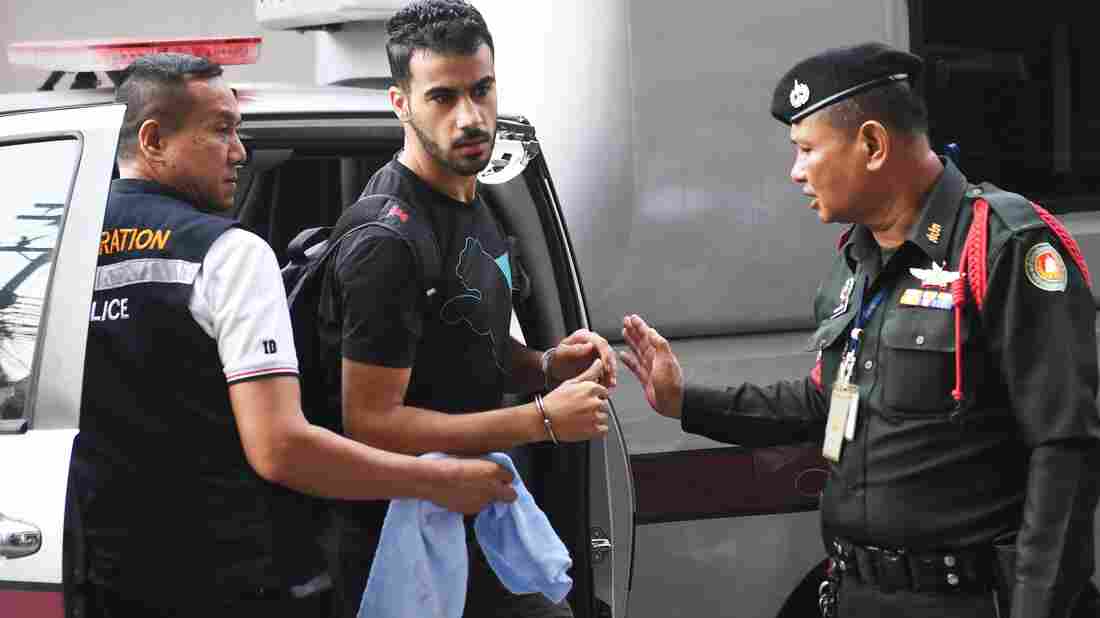
A professional soccer player is being held in a Bangkok prison while he awaits extradition to Bahrain, where he was convicted in absentia of vandalism and sentenced to 10 years imprisonment.

Hakeem al-Araibi, 25, formerly on the Bahraini national soccer team, denies he vandalized a police station and says he fears political persecution and torture if he is returned to Bahrain, according to the Associated Press.

On Tuesday a Thai court ruled that Araibi could be detained for 60 days pending the completion of Bahrain’s extradition request. The court also denied a request for bail.

The London-based Bahrain Institute for Rights and Democracy said it was in contact with Araibi, who communicated this message on Dec. 4:

“This might be my last message. I still don’t know whether I will be deported to Bahrain tomorrow. I appeal to the United Nations, individual states, FIFA, footballers, and all people, as my fate is now in danger and my future will soon be over. If I am deported to Bahrain, don’t forget me, and if once I’m there you hear me saying things, don’t believe me. I know what will happen to me and I know I will be tortured to confess things that I have never done. Please continue your fight to save me.”

Araibi fled his homeland four years ago. Since the failed Arab Spring uprising in 2011, the Bahraini government has become known for harshly repressing its critics. Araibi, who has criticized Bahrain’s ruling family in media interviews, made his way to Australia, where he was granted refugee status and, in 2017, permanent residency.

Araibi was arrested at a Bangkok airport on Nov. 27 upon entering Thailand with his wife for a vacation. Since then, there have been widespread calls for his release, including from the Australian government and international human rights organizations.

Thailand’s Immigration Bureau commissioner, Surachate Hakparn, told the Bangkok Post the detention of Araibi abides by international law on human rights.

When Araibi was detained in Bangkok, there was an Interpol red notice attached to him. Such a notice is meant to alert nations about individuals with active arrest warrants. They are not legally binding, but according to The New York Times, red notices have been “abused by authoritarian governments that want to bring home critics who have fled abroad.”

Thai authorities detained him “in response to the red notice alert received from the Interpol National Central Bureau of Australia and the formal request from the Bahraini government for his arrest and extradition,” the Thai Ministry of Foreign Affairs said in a statement.

Interpol rescinded the red notice for Araibi about a week after he was detained, the Times says.

Araibi’s Australian soccer club has urged the Thai government to free the Bahraini athlete. But FIFA, soccer’s governing body, which told The Guardian it supports his release, has been criticized by Human Rights Watch and other groups for not doing more to gain his freedom.

Bahrain, a small Persian Gulf nation ruled by a Sunni monarch, has been the focus of concern by human rights groups for some time. Last year Amnesty International warned that Bahrain was “heading towards total suppression of human rights.”

Sayed Ahmed Alwadaei, director of advocacy at the Bahrain Institute for Rights and Democracy, told The Guardian that “The Thai government must know it’s crossing a red line if it deports Hakeem.”

The Bahrain rights group notes on its website that Araibi “has been very critical of the current president of the Asian Football Confederation,” Sheikh Salman bin Ebrahim Khalifa, a member of Bahrain’s royal family, especially during his 2016 candidacy for the position of president of FIFA. Khalifa did not win but is a vice president of the organization.

Let’s block ads! (Why?)


No Image

Economic Insecurity

Economic insecurity.

LARS HAGBERG/AFP/Getty Images

Economic insecurity doesn’t get captured by the broader macroeconomic indicators. But if you suddenly get sick, can you afford to go to the doctor? Do you ever worry that you’ll run out of money to feed your kids before your next paycheck? Is your paycheck steady enough that you can plan and budget for future expenses? And if you needed to fix your car, would you still have enough money left over to afford that month’s rent? These are questions that even people with jobs — maybe even better jobs than they had last year — still struggle to answer. Today on the show, we look at some indicators that shed light on economic insecurity in the U.S.

And a special thanks to Matt Klein and Noah Smith for their recent articles on economic insecurity, to which we referred for this episode.

Music by Drop Electric. Find us: Twitter/ Facebook.

Subscribe to our show on Apple Podcasts, PocketCasts and NPR One.

Let’s block ads! (Why?)


No Image

Former NFL Player Tim Green Has A New Opponent — ALS

Tim Green, a former NFL player and former NPR commentator, has ALS, also known as Lou Gehrig’s disease. Green believes football gave him the disease.

Heather Ainsworth for NPR


hide caption

toggle caption

Heather Ainsworth for NPR

Tim Green first noticed the symptoms about five years ago.

The former NFL player, whose strength was a job requirement, suddenly found his hands weren’t strong enough to use a nail clipper. His words didn’t come out as fast as he was thinking them.

“I’m a strange guy,” Tim says. “I get something in my head and I can just run with it. I was really afraid I had ALS. But there was enough doubt that I said, ‘Alright, I don’t. Let’s not talk about it. Let’s not do anything.’ “

Denying pain and injury had been a survival strategy in football.

“I was well trained in that verse,” he says.

A Falcons game ball that was presented to Tim in 1991.

Heather Ainsworth for NPR


hide caption

toggle caption

Heather Ainsworth for NPR

But a diagnosis in 2016 made denial impossible. Doctors confirmed that Tim, also a former NPR commentator, had ALS, known as Lou Gehrig’s disease. The degenerative illness attacks the body’s motor nerve cells, weakening muscles in the arms and legs as well as the muscles that control speech, swallowing and breathing.

Tim tried to keep it private — he didn’t want people feeling sorry for him.

But he says, “I got to a point where I couldn’t hide it anymore.”

So Tim went on 60 Minutes and revealed his illness.

“What we said is, you either write your own history or someone’s going to write it for you,” says his 24-year-old son, Troy Green.

When one isn’t enough

I was one of Tim Green’s producers for his Morning Edition commentaries back in the 1990s. We went to dinner once when he was in Washington, D.C., for a game — his Atlanta Falcons were playing Washington. Tim had a huge plate of pasta. When we finished, the waiter came over and asked, “Anything else?” Tim pointed to his clean plate and said, “Yeah. Let’s do it again.”

That was him. One entree wasn’t enough. One high-profile career wasn’t enough — he’s also a prolific author, has a law degree and works for two firms.

And ultimately, it wasn’t enough for Tim to deal with ALS in silence. Last month, in conjunction with his 60 Minutes appearance, Tim helped launch a fundraising website, Tackle ALS.

Writing his own story

I recently visited Tim at his lakeside home in upstate New York, in the village of Skaneateles.

We sat down in a room with a huge picture window that normally offers a gorgeous view of Skaneateles Lake. On the day I visited, all you could see was driving snow. Troy Green sat next to his dad — Tim’s speech is slow and raspy, and sometimes Troy helps repeat or reinforce Tim’s words. During our talk, a tube connected to a port in Tim’s chest provided an infusion of Radicava. Last year, the FDA approved the new drug, which has been shown to slow the progress of what’s currently a fatal disease.

Tim’s daughter-in-law, Jessica Green, gives him an infusion of Radicava. Last year the FDA approved the new drug, which has been shown to slow the progress of what’s currently a fatal disease.

Heather Ainsworth for NPR


hide caption

toggle caption

Heather Ainsworth for NPR

The history Troy encouraged Tim to write is positive and hopeful. They stress that ALS can be cured, it’s just underfunded.

The history certainly includes family. Tim and his wife Illyssa have been married for 29 years. They have five kids — all with first names starting with “T” — that’s Illyssa’s doing, Tim says. And the family is incredibly close. Literally.

“My brother lives on the same lane as us. I’m their neighbor,” Troy says, adding, “My little sister’s at school, my little brother lives here and then my older sister lives the furthest away. She’s about a three-minute drive.”

“We’re going to reel her in,” Tim laughs.

Football, a complicated love

Of course, any Tim Green history has to include football.

For better and worse.

Tim believes football gave him the disease. His eight years in the NFL in the 1980s and 90s, as a defensive lineman and linebacker, were before protective rule changes and concussion protocols.

There were “countless” head collisions, Tim says. I mention that he had decades of those collisions, from an early age through the NFL.

“But in the NFL,” he says, “the violence and the impacts are extraordinary. Every day.”

Troy adds, “when [Tim] played, practices were worse than the games. Because in the game, you typically would see 45 to 65 plays. In practice, you could run 100, 200 by the time you’re done with drills.”

Researchers say repetitive head blows may play a part in causing ALS. The recent NFL concussion settlement acknowledged a link by including payouts to former players with the disease, including Tim.

His Morning Edition commentaries regularly took listeners inside the violent game. In 1992, Tim wrote one about a teammate, former Atlanta defensive end Rick Bryan, who’d had enough of the physical toll and was retiring.

The piece ended with this:

“Back at the locker room, I checked my protective neck padding and pumped some extra air into the padding of my helmet. Like a gypsy gazing into a crystal ball, I looked at my own distorted reflection in the glossy black surface of my helmet. The smile let me know I was glad to be there, but there was nothing I could see that told me how long it would last.”

Old uniforms and posters adorn the walls at Tim’s home gym.

Heather Ainsworth for NPR


hide caption

toggle caption

Heather Ainsworth for NPR

Tim could articulate what many players couldn’t. Why, I asked him, with his insights, would he play a sport that had the potential to do permanent damage?

Tim says as a kid, he had two passions: writing and football. From the earliest age, he says, he worked incredibly hard to succeed at both, and he did.

“I was just impassioned,” he says. “That’s what I wanted, and that’s what I got.”

“If [this disease] is part of the bargain, I don’t know,” he continues. But back then, he says, he had “no idea” of the potential long-term damage of football. “So the temporary pain and discomfort, I knew that was worth it. Some pain in the future with my back, neck, knees, I knew that was worth it.”

“Can I say getting ALS was worth it? I don’t know. I don’t know.”

His ambivalence illustrates Tim’s profound and complicated love for the game. Still. He says it gave him the disease. But it also taught him so many life lessons growing up. It allowed him to vent anger and violence in an acceptable way.

“I’m not indicting football or the NFL,” he says.

He passed on his love — his two oldest sons played football. His 12-year-old, Ty, plays now. And it has split the close-knit Greens. Illyssa doesn’t like it. Tim says he wants Ty to play if he wants to.

Troy Green helps his father on the computer. Tim can’t type, so he has a sensor on his glasses that highlights letters. Then he clicks a mouse with his right hand, and the letters show up on his laptop screen.

Heather Ainsworth for NPR


hide caption

toggle caption

Heather Ainsworth for NPR

Tim and Troy say the game now is different than it was. It’s much safer with less contact in practice. Both of them coached Ty’s junior team.

“We trained [so in] every tackling drill your head’s out of the play,” Troy says. “In practice we would penalize our players if they had their head in the drill. We really just encouraged the modern day football, not the 1980s edition.”

Still, football is inherently dangerous, and so far Ty wants to play.

“I don’t want to wrap him up in a bubble,” says Tim, “because where do you stop?”

But there’s a deeper, more complex reason behind Tim’s support. Troy says his dad doesn’t want the illness to be a burden on anyone. So Tim doesn’t want Ty not to play just because the game hurt him.

Translating science into treatment

“I do want to point out that most people who play football don’t develop ALS.”

So says Dr. Merit Cudkowicz, who treats Tim’s disease. Cudkowicz has researched ALS for nearly 25 years. She thinks football probably is a factor that led to his illness, but not the only one. The studies so far haven’t established a direct cause and effect.

“And that’s why we think there’s something else,” Cudkowicz says. “It’s a combination perhaps in someone’s immune system or something in their genetics that makes it more likely that if you also hit your head repetitively that you might come down with the disease.”

Tim works out at his home gym. Studies of ALS patients suggest people who do stretching and toning function much better. There’s a concern if a patient does too much and tries to bulk up, he or she could tear the muscles.

Heather Ainsworth for NPR


hide caption

toggle caption

Heather Ainsworth for NPR

Cudkowicz directs the Healey Center for ALS at Massachusetts General Hospital in Boston. She says Tim’s and other prominent people’s involvement and publicity present a great opportunity, as a follow up to the viral ice bucket challenges that raised money for ALS a few years ago.

“Absolutely I think this is a huge next step,” Cudkowicz says. “The ice bucket challenge came at the right time. The science was exploding, but there were no resources for it. And suddenly there’s this $220 million resource for ALS, and it fed this great science and drew in all these new people and new companies for the field.”

“But there’s still a [funding] gap in getting that great science to patients. And that’s where Tim’s Tackle ALS initiative and the Healey Center are going to partner and hopefully with many other groups, translate that great science into treatment for people.”

‘If you have a good life, it’s never long enough’

Later, on the day I visited, Tim sat down at a desk in a large wood-paneled den, indulging his other passion in life — writing.

He can’t type, so he has a sensor on his glasses that highlights letters. Then he clicks a mouse and the letters show up on his laptop screen. He’s working on a kid’s baseball book. It’s a third collaboration with former New York Yankees star Derek Jeter, and Tim says they both provide specific areas of expertise. Jeter brings baseball realism to the book; Tim draws on his many years of being surrounded by young people. Disgusting young people, he laughs.

Tim writes by clicking this mouse after a sensor on his eyeglasses has located letters. He clicks one letter at a time.

Heather Ainsworth for NPR


hide caption

toggle caption

Heather Ainsworth for NPR

“These are kids 10 to 14 years old. Tweens,” he says. “They think vomit is funny. [So] somebody has to throw up [in the book], and it’s best when they throw up on someone.”

“Writing [these scenes] is easy. It’s convincing Derek to keep them is where I earn my money.”

On cue, Troy looks up from his phone and makes an announcement.

“Just got an email that Jeter, and [his] Turn 2 Foundation donated $10,000 [to Tackle ALS]. His ears are ringing,” Troy says, laughing. “He heard about the vomit scenes!”

Tim says the fundraising is a chance to help others. He says he’s one of the luckier people with the disease. It’s relatively slow-moving.

Tim hugs his 12-year-old son, Ty. Tim coaches Ty in football and insists his son is playing a much safer game than his father did in the 1980s and ’90s. Still, Green and his wife disagree about Ty’s participation.

Heather Ainsworth for NPR


hide caption

toggle caption

Heather Ainsworth for NPR

I ask Tim what keeps him positive through this time. He answers by recounting a period 12 years ago, when Illyssa was diagnosed with cancer.

“She was out of her mind,” Tim says, “and I remember saying to her, ‘You’ve got great doctors, we’re gonna beat this and do everything we can. But in the meantime, I don’t want you to wallow in fear and anxiety and misery.’ I said, ‘because we have a very good life and if you have a good life … and a lot of people do, maybe they don’t realize it, but they do … but if you have a good life, it’s never long enough. We all know it’s finite.’ “

“So whenever the end point is, I ask to be strong enough to maintain that positive attitude no matter what the challenges are.”

Today, Illyssa is cancer-free. And it’s Tim trying to live by his own advice.

As I leave, I stop to look at two large sculptures outside their house. One is of five kids, playing. The other is a lone figure. A helmeted football player, running and catching a pass over the shoulder. Tim says it’s an homage to the game that let him “buy this amazing property and build a comfortable home.”

A home, and family, that now mean even more than they have all along.

A statue of a helmeted football player, running and catching a pass over the shoulder. Tim says it’s an homage to the game that let him “buy this amazing property and build a comfortable home.”

Heather Ainsworth for NPR


hide caption

toggle caption

Heather Ainsworth for NPR

Let’s block ads! (Why?)


No Image

Texas Judge Allows Former Baylor Frat President To Sidestep Rape Charge

A judge in Texas on Monday accepted a plea bargain that allows Jacob Anderson, a former Baylor University fraternity president accused of raping a woman at a fraternity party, to avoid serving jail time, marking at least the third time the judge has approved probation for men accused of sexually assaulting Baylor students.

McLennan County Sheriff’s Office via AP


hide caption

toggle caption

McLennan County Sheriff’s Office via AP

A judge has accepted a plea agreement under which the former president of a Baylor University fraternity, accused of raping a female student, will serve no jail time and won’t have to register as a sex offender.

The deal allowed Jacob Walter Anderson, 23, of Garland, Texas, to plead no contest on Monday to the lesser charge of unlawful restraint. In pleading no contest, a defendant does not admit guilt and does not offer a defense.

The woman who brought the charges expressed outrage at the decision.

“He stole my body, virginity and power over my body,” she said in court, according to a family spokesman, the Associated Press reports.

“I not only have to live with his rape and the repercussions of the rape, I have to live with the knowledge that the McLennan County justice system is severely broken,” the family statement quoted the woman as saying. “I have to live with the fact that after all these years and everything I have suffered, no justice was achieved.”

The McLennan County’s district attorney’s office, which dismissed four counts of sexual assault against Anderson, told the alleged victim’s family it was not confident enough to take the case to trial, according to NPR’s Wade Goodwyn.

Goodwyn reports the alleged victim told Judge Ralph Strother she was furious the prosecutors who struck the plea agreement did not attend the hearing. “If I had the courage to come back to Waco and face my rapist and testify, you could at least have had enough respect for me to show up today,” she said.

Strother, on at least two other occasions in the past couple of years, dealt leniently with men accused of raping or sexually assaulting Baylor students, AP reports.

The offer of a plea deal was made public in August, according to the Waco Tribune-Herald. Baylor is a private Christian university in Waco.

“The way the victim’s family found out about the plea deal is they read it in the local newspaper,” Goodwyn reports.

Upon learning the news, the woman and her family urged Strother to reject the plea agreement and send the case to trial, according to the Tribune-Herald.

At the time of the alleged rape, the woman was a 19-year-old Baylor sophomore.

NPR does not name individuals who are the alleged victims of sexual assaults, with some exceptions, such as when the individual goes public with her or his identity.

In the affidavit for Anderson’s arrest, the alleged rape victim told police Anderson raped her in February 2016 when she attended an off-campus party hosted by his fraternity, Phi Delta Theta.

After sipping some punch, “she became disoriented and felt very confused,” according to the affidavit. Anderson led her to a secluded area on the grounds so she could get some air, and then repeatedly raped her, leaving her unconscious, alone and “lying face down in her own vomit.”

Anderson was kicked out of Baylor and the fraternity was suspended.

Baylor University has been roiled in recent years by charges of sexual assault by its students, including the 2016 scandal involving members of Baylor’s football team. As Goodwyn reported, the scandal led to the firing of Baylor’s president, Kenneth Starr, and its head football coach, Art Briles.

Let’s block ads! (Why?)


No Image

Huawei Executive Granted Bail In Canada, Former Canadian Diplomat Is Detained In China

Supporters Ada Yu and Wade Meng (no relation) stand outside the British Columbia Supreme Court on Monday before the bail hearing for Huawei Technologies CFO Meng Wanzhou in Vancouver.

Rich Lam/Getty Images


hide caption

toggle caption

Rich Lam/Getty Images

Updated at 7:03 p.m. ET

A Canadian judge ruled Tuesday a Chinese tech executive, detained at the request of the U.S., can be free on bail while awaiting an extradition hearing.

The judge said Meng Wanzhou must meet stringent conditions aimed at making sure she doesn’t flee Canada for China.

The Vancouver judge, William Ehrcke, said Meng must post bail of $10 million Canadian ($7.5 million U.S.), according to Reuters. A portion of the money must be paid by other people, who presumably don’t have the vast resources of Meng’s family and would take a greater hit if she absconded.

Other conditions include handing over her multiple passports to the court, wearing an electronic monitor and not leaving home overnight.

Ehrcke said he believed under those conditions, the risk that she wouldn’t appear when required could “be reduced to an acceptable level.” He set her next court appearance for Feb. 6.

Ten days after Canadian authorities detained Meng, China reportedly detained a former Canadian diplomat — ratcheting up tensions in this diplomatic row.

The International Crisis Group said Tuesday it was aware of the reports that its North East Asia senior adviser Michael Kovrig had been detained. “We are doing everything possible to secure additional information on Michael’s whereabouts as well as his prompt and safe release,” the Brussels-based organization said in a statement. Kovrig was formerly a diplomat to Beijing and Hong Kong, as well as the United Nations.

Canada Public Safety Minister Ralph Goodale said he was “deeply concerned” about a Canadian citizen detained in China, but did not identify the person, Reuters reports.

While China has not discussed Kovrig’s detention, Bob Rae, former premier of Ontario tweeted that he finds the reason obvious: “Of course it’s clear. It’s called repression and retaliation.”

This wouldn’t be the first time that China has held a Canadian as part of larger geopolitical events. In 2014, a Canadian couple was arrested and detained seemingly as retribution for the U.S. seeking the deportation from Canada of a Chinese national accused of stealing U.S. military secrets. The husband, Kevin Garratt, was imprisoned for two years.

In Meng’s case, the U.S. seeks her extradition to stand trial on fraud charges. Meng, the chief financial officer at telecom juggernaut Huawei, owns two multimillion-dollar homes in Vancouver. Her lawyers offered those properties and a cash payment as bail, amounting to about $15 million, The New York Times reports.

She also offered to pay for the costs of her own security, and suggested her Chinese husband and the head of a security firm could be her sureties to guarantee her presence in court, an idea that the judge questioned.

“Is it appropriate to name as a surety someone who is not ordinarily resident in Canada, even though they might have the status which would permit them to reside in Canada?” said Justice William Ehrcke, according to the Vancouver Sun. “The purpose of naming a surety is that they act as the jailer for the person during the period of release. So that’s an important responsibility.”

In a letter, the U.S. Justice Department argued strongly against Meng’s release, warning that she would likely flee back to China, which has no extradition treaty with the U.S. The Justice Department also pointed to Meng’s access to enormous wealth: She is the daughter of Huawei’s founder, Ren Zhengfei, whom the U.S. says has a net worth of $3.2 billion and is the 83rd richest person in the world.

The Justice Department says that around April 2017, Huawei (and Meng) became aware of a U.S. criminal investigation into the company, and so its executives began avoiding traveling to or through the U.S. Meng traveled to the U.S. “on numerous occasions” from 2014 to 2016, but made no further trips to the U.S. after March 2017.

Meng has used seven different passports — four from China, three from Hong Kong — in the past eleven years, U.S. authorities say, adding that she may have more they don’t know about. “Even if Canadian authorities seized Meng’s travel document that she used to arrive in Canada, she could use any number of additional travel documents to flee from Canada,” they write.

Her husband, Liu Xiaozong, denies in his affidavits that Meng has extra passports, and says she needed the new ones, the Sun reports:

“His wife, he says, travelled so frequently between 2007 and 2016 and required so many visas that ‘the pages in these passports for such visas were utilized, requiring the acquisition of the replacement passports.’

Other passports were ‘broken,’ invalidated and replaced to reflect changes in her name after their marriage.”

As NPR’s Shannon Van Sant has reported, the U.S. alleges that Huawei used a Hong Kong-based subsidiary called Skycom as a shell company to circumvent U.S. sanctions on Iran:

“Meng’s arrest has become a flashpoint in relations between the U.S. and China, and came on the same day President Trump and China’s President Xi Jinping agreed to a 90-day truce in a trade war between the two countries.

“Huawei is China’s largest telecom equipment maker. Its sales recently surpassed Apple, making Huawei the world’s top supplier of mobile phones. U.S. intelligence agencies have warned Americans not to buy Huawei phones because of concerns over espionage, and pressured allies to not use Huawei technology.”

The Sun reports Meng is being held at the Alouette Correctional Centre for Women, about 20 miles east of Vancouver.

Let’s block ads! (Why?)