
Soccer-Playing Engineer Calls Foul On Pricey Knee Brace

After a sports injury, Esteban Serrano owed $829.41 for a knee brace purchased with insurance through his doctor’s office. He says he found the same kind of brace selling for less than $250 online.
Paula Andalo/Kaiser Health News
hide caption
toggle caption
Paula Andalo/Kaiser Health News
Last October, Esteban Serrano wrenched his knee badly during his weekly soccer game with friends.
Serrano, a software engineer, grew up playing soccer in Quito, Ecuador, and he has kept up the sport since moving to the United States two decades ago.
He hobbled off the field and iced his knee. But the pain was so severe that he made an appointment with Rothman Orthopaedic Institute, a network of orthopedists practicing in Greater Philadelphia, New Jersey and New York.
The doctor diagnosed a strain of the medial collateral ligament and prescribed over-the-counter pain medication as well as a hinged knee brace, which Serrano used for several weeks until he’d healed.
He expected his insurance to cover his treatment. A plan from a previous job had covered him when he needed surgery to fix a broken nose sustained in another soccer game in 2017.
Then the bill came.
Patient: Esteban Serrano, 41, a software engineer and father of two from Phoenixville, Pa., outside Philadelphia.
Total bill: $1,197. $210 for the office outpatient visit, $105 for an X-ray and $882 for a hinged knee brace, all billed by the orthopedic practice. His insurer, Aetna, negotiated only $52.59 off the cost of the brace. That left Serrano with a balance of $829.41 because he hadn’t met his $3,000 deductible for the year.
Service provider: Rothman Orthopaedic Institute in Bryn Mawr, Pa.
Medical service: A doctor examined Serrano’s knee and sent him for an X-ray. The doctor said he should use a knee brace for four weeks and recommended a hinged one sold through the practice.
What gives: A medial collateral ligament injury is a common knee injury occurring frequently among participants in contact sports. According to the American Academy of Physical Medicine and Rehabilitation, the medial collateral ligament is involved in at least 42 percent of knee ligament injuries. Although most cases are sports related, such injuries can also result from everyday activities like tripping on stairs.
“The doctor told me that he thought I didn’t have damage, that it was more of an inflammation, but he ordered an MRI just to make sure,” said Serrano. (The MRI, performed at a later date, confirmed that suspicion.)
Serrano said the brace did ease the discomfort and stabilized his knee as it healed. However, the bill was almost more painful — he owed the orthopedic practice $829.41.
“You can find the same brace for less than $250 online,” he said.

Serrano, a software engineer, grew up playing soccer in Quito, Ecuador. After straining a medial collateral ligament, he got a brace to help it heal.
Paula Andalo/Kaiser Health News
hide caption
toggle caption
Paula Andalo/Kaiser Health News
The bill came close to Christmas, when Serrano’s 12-year-old daughter wanted her first iPhone. “I told her, ‘Sorry, honey, but I already paid a price of an iPhone for the hinged knee brace,’ ” Serrano joked.
Serrano emphasized that he felt lucky to have the money to handle a bill that for many people could equal a month’s rent or three months of groceries.
Knee braces fall into a category of products called “durable medical equipment,” whose prices can vary widely. Items range from slings and braces to wheelchairs and commodes. They also include glucose meters and breast pumps for new mothers.
Doctors and hospitals that dispense such equipment for patients to take home almost always bill for them and add hefty markups that can catch patients unaware.
Braces and other products “are often marked up two or three times what the cost is, and unfortunately, that is the standard practice,” said Dr. Matthew Matava, an orthopedic surgeon and chief of sports medicine for Washington University Physicians in St. Louis.
Rothman Orthopaedic didn’t respond to requests for comments.
The type of hinged knee brace Serrano bought was a DonJoy Playmaker. DonJoy is one of the nation’s largest producers of braces. A customer service representative for the company said it charges a retail price of $242.51 for the model that Serrano got. Serrano paid more than three times that price.
In an emailed statement about the case, an Aetna spokesman wrote that “while the cost of a knee brace, or any other health care service, is determined by the negotiated rate between the health care provider and the health plan, the starting point is the charge from the health care provider.”
It is not even clear that such an elaborate knee brace was needed for Serrano’s injury.
Dr. Elizabeth Matzkin, chief of women’s sports medicine at Brigham and Women’s Hospital in Boston and an assistant professor at Harvard Medical School, said that while it is helpful to give patients some kind of knee brace for support after medial collateral ligament injuries, the use of a hinged knee brace does not influence recovery, according to studies. She called hinged braces “luxury products.” Simpler, cheaper braces also offer support.
Resolution: Serrano recalled that when he received the brace, an employee showed him a form with its estimated cost in writing. He remembered his share was more than $700, but he didn’t pay too much attention because he assumed his insurance would cover it.
After receiving the bill, he made several phone calls to the doctor’s practice to get a copy of the form he’d signed. It stated that the product could be returned within seven days. A month had already passed. Because he had not met his deductible, his $829.41 balance was even more than the estimate.
The takeaway: These days, many types of equipment dispensed by doctors’ offices or hospitals involve a charge. Don’t assume generosity. Ask the doctor to identify precisely what you need and explain why you need it.
When a doctor or hospital offers you a piece of equipment to help your healing, decide if you really need it or will use it. Say no if you won’t. Ask if you will be billed for it and how much.
Many items can be purchased at a fraction of the cost online or from a pharmacy just down the block.
Know your insurance plan’s copay or coinsurance for medical equipment (often 20 percent). The cost of purchasing the equipment yourself online may well be less than if you purchase through a medical office.
NPR produced and edited the interview with Kaiser Health News’ Elisabeth Rosenthal for broadcast.
Kaiser Health News is a nonprofit news service covering health issues. It is an editorially independent program of the Kaiser Family Foundation that isn’t affiliated with Kaiser Permanente.
Man Pleads Guilty To Phishing Scheme That Fleeced Facebook, Google Of $100 Million

Evaldas Rimasauskas pleaded guilty to wire fraud charges on Wednesday for his part in orchestrating a scheme to swindle Google and Facebook out of more than $100 million.
Marcio Jose Sanchez/AP
hide caption
toggle caption
Marcio Jose Sanchez/AP
A Lithuanian man pleaded guilty last week to bilking Google and Facebook out of more than $100 million in an elaborate scheme involving a fake company, fake emails and fake invoices.
In an indictment unsealed by the U.S. Attorney for the Southern District of New York last week, the Department of Justice alleged that Evaldas Rimasauskas and other unnamed co-conspirators impersonated the Taiwan-based hardware manufacturer, Quanta Computer — with which both tech companies do business — by setting up a company in Latvia with the same name. Using myriad forged invoices, contracts, letters, corporate stamps, and general confusion created by the corporate doppelganger, they successfully bamboozled Google and Facebook into paying tens of million of dollars in fraudulent bills from 2013 to 2015.
The payments were wired to bank accounts controlled by Rimasauskas, which he subsequently laundered through several other bank accounts throughout Latvia, Cyprus, Slovakia, Lithuania, Hungary and Hong Kong.
The 50-year-old, who was extradited to New York in 2017, pleaded guilty to one count of wire fraud on Wednesday and agreed to forfeit $49.7 million. He could face up to 30 years in prison when he is sentenced on July 24.
“As Evaldas Rimasauskas admitted today, he devised a blatant scheme to fleece U.S. companies out of $100 million, and then siphoned those funds to bank accounts around the globe,” said U.S. Attorney Geoffrey Berman in a statement. “Rimasauskas thought he could hide behind a computer screen halfway across the world while he conducted his fraudulent scheme, but as he has learned, the arms of American justice are long, and he now faces significant time in a U.S. prison.”
The indictment does not identify Google and Facebook by name, but the two tech giants confirmed to NPR they are Victim-1 and Victim-2, respectively.
Both companies said they recouped all or most of the money, but declined to comment on the exact sum. Bloomberg reported, “The scheme netted about $23 million from Google in 2013 and about $98 million from Facebook in 2015, according to a person familiar with the case.”
The FBI’s Internet Crime Complaint Center issued an advisory in June, warning that this type of fraud, called a Business Email Compromise, is up by 1,300 percent since January 2015. The FBI estimates companies have been defrauded of more than $3 billion dollars in recent years.
Iron & Wine with LA Philharmonic Orchestra Review – March 24, 2019
The Walt Disney Concert Hall is probably one of the best music halls for orchestral or any musical performances in Los Angeles, maybe even anywhere. A beautiful building with all wood walls allows for a…
New England Patriots' Star Tight End Is Calling It Quits

After four Super Bowls and a record-breaking number of touchdowns, Rob Gronkowski says it’s time to retire. In a post online, the 29-year-old said he’s looking forward to what comes next.
RACHEL MARTIN, HOST:
Good morning. Sad news for fans of the New England Patriots – star tight end Rob Gronkowski is calling it quits. After four Super Bowls, the Gronk says it’s time to retire. In a post online, the 29-year-old thanked his fans and teammates and said he’s looking forward to what comes next. And there’s probably no hurry in that regard. He got $54 million for the last six years. And according to CNBC, Gronkowski has lived off money from endorsements and hasn’t touched a dime of his NFL salary.
Copyright © 2019 NPR. All rights reserved. Visit our website terms of use and permissions pages at www.npr.org for further information.
NPR transcripts are created on a rush deadline by Verb8tm, Inc., an NPR contractor, and produced using a proprietary transcription process developed with NPR. This text may not be in its final form and may be updated or revised in the future. Accuracy and availability may vary. The authoritative record of NPR’s programming is the audio record.
Software Is Everywhere, But It's Not Always an Upgrade

The cockpit of a grounded Lion Air Boeing 737 Max 8 aircraft is seen on March 15.
Bloomberg/Getty Images
hide caption
toggle caption
Bloomberg/Getty Images
Investigations into the causes of the two Boeing 737 Max crashes, in Indonesia and Ethiopia, have focused on software — and the possibility that it was autonomously pointing the planes’ noses downward, acting without the pilots’ consent.
It’s a nightmare scenario. It’s also a reminder that software is everywhere, sometimes doing things we don’t expect.
This sank in for a lot of people four years ago, during the Volkswagen diesel emissions scandal. It turned out that software inside the cars had been quietly running the engines in such a way as to cheat on emissions tests.
While it’s always possible for manufacturers to use software dishonestly, the more common problem is software that’s used to enable sloppy designs.
“A lot of times, you see systems that would be much easier to control if somebody had been thoughtful about the mechanical design,” says Chris Gerdes, a professor of mechanical engineering at Stanford University.
He says sometimes he’s brought in as a consultant on a project and he’ll find that a moving part was poorly conceived — perhaps it generates too much friction. Designers will leave the problem, assuming the control software will make up for it.
Still, he says software has mostly helped improve cars and other complex systems. And it would be impossible to go back to purely mechanical designs, such as pre-digital automobiles.
“If you open these things up, it’s crazy!” he says, describing the intricate hydraulic systems inside automatic transmissions back before cars had computers. Complex systems of tubes and liquid would “calculate” when to shift gears, something no carmaker would attempt today.
“I have deep appreciation for this but also no idea about how one would implement logic in fluids,” Gerdes says.
Software is quicker, lighter, cheaper and much more flexible than mechanical systems.
For Kara Pernice, senior vice president of the user-experience design consulting firm Nielsen Norman Group, software is a very necessary part of modern manufacturing. But she says it’s often added too late in the design process.
“Many times, hardware-software creation is disjointed,” she says, calling it a “huge problem.”
As an example, she recalls driving her parents’ car recently and being flummoxed by the touch screen.
“I could not figure out how to turn down the air conditioning on a touch screen,” she says. “Are you kidding me?”
Touch screens may strike customers as up to date, but they can also be a shortcut for manufacturers. By leaving all the controls to the programmers of the screen, the mechanical designers can skip the more careful — and time-consuming — process of “considering the human that’s going to use that technology in the end,” as Pernice says. Touch screens often preclude consideration of mechanical controls — such as a knob for the air conditioning — in places where it would make more design sense.
Sometimes, the change to software controls can be deadly. Among the most notorious cases is the Therac-25, a radiation therapy machine built in the 1980s. It dispensed with mechanical safety interlocks of earlier models and replaced them with software. The software turned out to have bugs, and patients were over-radiated — a few were even killed. It became a case study for how not to design safety-critical systems.
But even now, software is a potential risk in medical devices — and programming was the most common cause of medical device recalls last year.
In aviation, software is indispensable. And generally speaking, designers say it has made airplanes much safer and more versatile.
It’s not just about autopilot, says Kristi Morgansen, professor of aeronautics and astronautics at the University of Washington. The next time you fly, she says, just look out the window at the wing.
“You sometimes see the control surfaces doing things, and a bunch of that is automatic,” she says. “Like gust load alleviation — ride quality, how it feels when you fly — a lot of that is handled automatically.”
On the 737 Max, Boeing used software to compensate for a compromise in the physical design. New, larger engines were added to an older airframe, changing its center of gravity. The software suspected of causing the crashes was there to correct for that and push the nose down when it rose too high.
That may strike the layperson as a “kluge” — using software to cover up a problem. But aviation designers say compromises and compensations are a necessary part of design.
Morgansen won’t comment on the 737 Max crashes, which are still under investigation, but she says that generally speaking, using new software on top of older systems is safe — and necessary.
“It would be so cost prohibitive to start from scratch,” she says. “It would take so long that the business model wouldn’t work.”
Commercial pilots have generally come to accept autonomous software as part of flying.
“I don’t think there’s anything inherently wrong about doing it through software, provided you do it correctly,” says Alex Fisher, a retired pilot of Boeing 767s. He says that long before computers, pilots have depended on mechanical autonomous systems to smooth out the controls.
“There are other features of the airplane that we were unaware of,” Fisher says, “[but] whether they really applied to the control systems is another matter. If you aren’t taught how the controls work, then you really don’t stand much of a chance.”
Columbia Law School professor Eben Moglen, who has long championed transparency in software, says the real lesson to take from the 737 Max is the necessity for autonomous software systems to “explain themselves” to the people using them.
He says software has allowed manufacturers to cut corners and costs on things like camera phones — say, using image-enhancement software to compensate for inferior lenses. “Every smartphone manufacturer I’ve ever dealt with regards the color-enhancement part of its camera software as among its most valuable trade secrets,” Moglen says.
But cheap physical designs are a minor consideration, he says, compared with what the 737 Max situation represents.
“What we’re looking at in the case of some aerodynamic software taking over from pilots without telling them,” he says, “is an example of why, even if you didn’t think any of this had anything to do with politics, it is still true that systems that don’t explain themselves to the human beings that interact with them are dangerous.”
Moglen says authoritarian autonomous software is becoming a hallmark of authoritarian societies, such as China, and it’s up to democratic societies “to build these technologies to support, rather than threaten, human freedom.”
The Last American Baseball Glove Factory
Baseball’s opening day is right around the corner and one company will be paying close attention. Nokona is the last remaining glove maker that still produces the gloves in the U.S. for MLB players.
LULU GARCIA-NAVARRO, HOST:
Baseball is back again. The first games of the regular season were played last week in Tokyo. America’s oldest professional sport has grown worldwide and the industry that supports it. But a tiny town in Texas is holding onto one tradition. KERA’s Bill Zeeble in Dallas takes us to the factory that’s still making gloves in the U.S. for major league baseball players.
BILL ZEEBLE, BYLINE: About a hundred miles northwest of Dallas-Fort Worth past pastures of crops and cattle sits Nocona, Texas, population 3,000, home to the Nokona baseball glove factory.
(SOUNDBITE OF MACHINERY WHIRRING)
ZEEBLE: Inside, stacks of tanned and dyed kangaroo, buffalo and calf skins are piled at one end of the 20,000-square-foot shop.
ROB STOREY: We literally bring leather in through one door. And magically, ball gloves come out the door at the very end – that and about 45 labor operations, then you’ve got a ball glove.
ZEEBLE: Rob Storey should know. He’s Nokona’s executive vice president. And this is the family business. To survive the depression, his grandfather Bob Storey added ball gloves to the family’s line of leather goods in 1934. Since then, just about every U.S. competitor has moved production overseas. Grandfather Bob, who died in 1980, said he’d rather quit and go fishing than import Nokonas.
STOREY: In some ways, we see it as a competitive advantage because we have people that understand the game of baseball. Our competitors are making them in factories. A lot of those factories – people have never even seen a baseball game or know what it is. Sure, it would be easy to go over there and do something. But that’s not who we are. We’re not about easy.
ZEEBLE: Nokona and it’s 75 employees are about making, marketing and selling their mostly handmade gloves in the town with the same name. The brand honors Comanche chief Peta Nocona. The company couldn’t legally use the city’s spelling, so Storey’s grandfather changed the C to a K. And its been spelled that way ever since. Martin Gomez has been Nocona’s master glove turner for 19 years. That’s a big deal because every glove is first sewn inside-out.
MARTIN GOMEZ: It’s not that hard. No, but it takes some time to learn, to get used to. Like, the first time you start to work, it give you a blister all over your hands. But you get used to it.
ZEEBLE: Storey says Gomez is modest. If he’s not careful, he can tear the leather and hand-stitching. Gomez slides a rod in each inside-out finger, pushes it hard against a wooden dowel and turns each leather finger back the right way. First, he sprays leather softener on the inside-out glove. Then, says Storey, he heats it on a 250-degree metal form.
STOREY: It’s very critical to do that so that you don’t rip out any of the seams while we’re going through this process because this process, in some ways, is more difficult on the glove than, actually, the game of baseball.
ZEEBLE: The game of baseball, after all, is what Nokona’s all about, even if it’s not nearly as well-known as giants like Rawlings or Wilson. In the youth market, though, it’s big.
ROBBY SCOTT: I grew up using a Nokona glove. My first glove that I ever really remember was a first baseman’s mitt that was a Nokona.
ZEEBLE: That’s Arizona relief pitcher Robby Scott. When we first talked long distance, he was with the Red Sox between World Series games. Nokona found him while searching for player endorsements. Scott says there’s just something special about it.
SCOTT: I will never wear a different glove. It’s a special bond that I have with them. They could have 200 players wearing their gloves. But to me, it seems special because they make it seem like I’m the only one.
ZEEBLE: And, says Storey, Nokona’s the only maker he knows of that’ll refurbish its old, tattered mitts. He says try that with a glove made overseas.
For NPR News, I’m Bill Zeeble in Nocona, Texas.
(SOUNDBITE OF MUSIC)
Copyright © 2019 NPR. All rights reserved. Visit our website terms of use and permissions pages at www.npr.org for further information.
NPR transcripts are created on a rush deadline by Verb8tm, Inc., an NPR contractor, and produced using a proprietary transcription process developed with NPR. This text may not be in its final form and may be updated or revised in the future. Accuracy and availability may vary. The authoritative record of NPR’s programming is the audio record.
Mueller's Investigation, According To The Media
For the nearly two years since Special Counsel Robert Mueller was appointed, cable networks CNN, MSNBC and Fox have shaped Americans’ perceptions of his investigation with their coverage.
MICHEL MARTIN, HOST:
We’re still waiting to hear what’s in special counsel Robert Mueller’s report on Russian interference in the 2016 election. And if you’re following developments on cable news, your understanding of this moment may depend on which network you’ve been watching. Here’s Pete Hegseth on “Fox & Friends” this morning.
(SOUNDBITE OF TV SHOW, “FOX & FRIENDS”)
PETE HEGSETH: Ding-dong, the witch hunt is done. The headline on all of this is, after all this money, all these days, all this investigation, no Russian collusion found or indictment brought against President Trump.
MARTIN: And this was Rachel Maddow on MSNBC last night.
(SOUNDBITE OF TV SHOW, “THE RACHEL MADDOW SHOW”)
RACHEL MADDOW: Finally, it’s happened. In terms of what that means and what Mueller found, we know only the smallest little bits. This is the start of something, apparently – not the end of something.
MARTIN: Throughout the nearly two years of the Mueller investigation, the cable networks have served up the news through very different lenses. So we wanted to think about that a bit more – to ask how the news coverage may have shaped public perceptions and expectations of the Mueller probe. For that, we’re joined now by NPR’s media correspondent, David Folkenflik.
David, thanks so much for joining us.
DAVID FOLKENFLIK, BYLINE: Of course.
MARTIN: So, first, what are you seeing today on the cable networks? And how does that track with what we’ve been seeing over the past two years?
FOLKENFLIK: It’s wall-to-wall coverage. On MSNBC, it’s really a question of, you know, what’s next, what else could possibly happen now we know that the special prosecutor is not going to file into any further indictments? At least, that’s the word from the Department of Justice.
On CNN, you’re seeing these enormous panels unfold, like, getting into every aspect of it, trying to talk to people on various elements of it, various levels of expertise. And that’s sort of analogous to the way they’ve covered it, you know, with these panels upon panels upon panels of all these surrogates of the Trumpites (ph), the Never Trump right and the, you know, deeply anti-Trump left being at times fact-checked by hosts or having CNN reporters on to kind of guide it journalistically.
Then, of course, there’s Fox. And Fox is giving you a very accurate picture of the world as long as that world is as defined as – by the president’s surrogates like, say, Rudy Giuliani, one of his attorneys – not necessarily about where the facts go. Fox has been playing a very vigorous defense against the president’s critics and against those running the investigation.
MARTIN: Now, we’ve been talking about the cable networks. What about the newspapers? And here, we’re mainly focused on the big national papers with experienced and robust reporting teams. How has their journalism held up?
FOLKENFLIK: I think, by and large, pretty well. The Mueller investigation has been an extraordinarily tight ship. It’s not leaky. There hasn’t been a lot of drips and drabs coming from investigators themselves. Instead, reporters have had to do their own investigative work sort of in parallel and follow the threads. And, as a result, they’ve had to make cases, really pinning down specific incidents.
So you’ve seen things that ultimately fed other investigations, like David Farenthold and his colleagues in The Washington Post raising questions about the legalities of some of the organizations the president has led and some of his associates have been involved with. I think there’s been some really good reporting, by and large, on the national level. And only now and then have little elements of it been seriously challenged.
MARTIN: So how may the coverage have shaped public perceptions and expectations about Mr. Mueller’s work?
FOLKENFLIK: Well, the stakes were grand and enormous because it was about the questions of criminality from the highest levels, about people around the president, about the president himself, both before running for office, in running for office and possibly in office itself. And at the same time, because the nature in which we absorb news, people say, well, if there are no indictments, maybe there wasn’t anything that was that severe. If collusion isn’t proved on a criminal level involving the president right now, maybe it’s not that big a deal.
And I think because of the instantaneous nature of the dissemination of news online on social media, digitally on cable, we forget that, you know, this was an investigation that seems to have yielded so far, I believe, something like three dozen indictments, a whole lot of criminal charges alleged and many of them seemingly confirmed and proven.
There are other parallel kinds of investigations taking place in the state and federal level and other outfits. I think this is pretty serious stuff, and I think the nature and way in which news is disseminated right now, people tend to forget that.
MARTIN: That’s NPR’s David Folkenflik.
David, thank you so much.
FOLKENFLIK: You bet.
Copyright © 2019 NPR. All rights reserved. Visit our website terms of use and permissions pages at www.npr.org for further information.
NPR transcripts are created on a rush deadline by Verb8tm, Inc., an NPR contractor, and produced using a proprietary transcription process developed with NPR. This text may not be in its final form and may be updated or revised in the future. Accuracy and availability may vary. The authoritative record of NPR’s programming is the audio record.
Opinion: How America's Pastime Became So Slow

Are The Risks Of Drugs That Enhance Imaging Tests Overblown?

Contrast agent, a drug that enhances CT scans, is sometimes skipped because of concerns about side effects.
Morsa Images/Getty Images
hide caption
toggle caption
Morsa Images/Getty Images
One of the most widely used drugs in the world isn’t really a drug, at least not in the usual sense.
It’s more like a dye.
Physicians call this drug “contrast,” shorthand for contrast agent.
Contrast agents are chemical compounds that doctors use to improve the quality of an imaging test. In the emergency room, where I work, contrast is most commonly given intravenously during a CT scan.
About 80 million CT scans are performed annually in the U.S., and the majority are done with contrast.
Most contrast agents I use contain iodine, which can block X-rays. This effect causes parts of an image to light up, which significantly enhances doctors’ ability to detect things like tumors, certain kinds of infections and blood clots.
One thing about contrast agents that makes them different from typical drugs is that they have no direct therapeutic effect. They don’t make you feel better or treat what’s ailing you. But they might be crucial in helping your doctor make the right diagnosis.
Because these drugs are used in some people who might not turn out to have anything wrong with them, and in others who may be seriously ill, contrast agents need to be quite safe.
And by and large they are. Some patients may develop serious allergic reactions or cardiovascular complications, but these are rare. Others may experience nausea or headache.
But there is one widely feared adverse effect of contrast — kidney damage. As a result, contrast is often withheld from patients deemed by their doctors to be at risk for kidney problems. The downside is that these patients may not receive the diagnostic information that would be most useful for them.
In recent years, though, new research has led some physicians to question whether this effect has been overstated.
Is it time to rethink the risk?
The first report of kidney damage after intravenous contrast, which became known as contrast-induced nephropathy, or CIN, appeared in a Scandinavian medical journal in 1954. An early form of contrast had been given to a patient for a diagnostic test. The patient quickly developed renal failure and died. The authors proposed that the contrast may have been responsible, because they could find no other clear cause during an autopsy.
With other physicians now primed to the possibility, similar reports began appearing. By the 1970s, renal injury had become a “well-known complication” of contrast in patients with risk factors for kidney disease, like diabetes. By 1987, intravenous contrast was proclaimed to be the third-leading cause of hospital-acquired kidney failure.
The belief that contrast agents were risky had a significant effect on how often doctors used them. In a 1999 survey of European radiologists, 100 percent of respondents believed that CIN occurred in at least 10-20 percent of at-risk patients, and nearly 20 percent believed it occurred in over 30 percent of such patients. A 2006 survey found that 94 percent of radiologists considered contrast to be contraindicated beyond a certain threshold of renal function — a threshold that nearly 1 in 10 middle-aged American men could exceed.
But Dr. Jeffrey Newhouse, a professor of radiology at Columbia University, had a hunch that something wasn’t quite right with the conventional wisdom. He has administered contrast thousands of times, and rarely did it seem to him that contrast could be said to have been directly toxic. There were often far too many variables at play.
Newhouse decided to go back to the primary literature. In 2006, he and a colleague reviewed more than 3,000 studies on contrast-induced nephropathy and came to an astounding conclusion — only two had used control groups, and neither of those had found that contrast was dangerous.
“Everyone assumed that any kidney injury after contrast was a result of the contrast,” Newhouse said, “but these studies had no control groups!”
In other words, there was no group of patients who hadn’t received contrast to use for comparison.
Newhouse discovered that nearly every study supporting CIN had fallen prey to this shortcoming. The importance of controls in any experiment is elementary-level science; without them, you can’t say anything about causation.
What came next was brilliant. “Having criticized those that did the experiment without the control, we decided to do the control without the experiment,” Newhouse said. He reviewed 10 years of data from 32,000 hospitalized patients, none of whom received contrast. He found that more than half of the patients had fluctuations in their renal function that would have met criteria for CIN had they received contrast.
This raised the possibility that other causes of kidney injury — and not the contrast — could have explained the association found in earlier studies.
Other researchers stepped up after Newhouse published his findings in 2008. Physicians in Wisconsin conducted the first large study of CIN with a control group in 2009. In more than 11,500 patients, overall rates of kidney injury were similar between people who received contrast and those who hadn’t.
There was one major weakness with the study, though — it was retrospective, meaning it relied on medical records and previously collected data. When a study is performed this way, randomization to different treatments can’t be used to guard against biases that could distort results.
So, for instance, if the physicians treating patients in the Wisconsin study were worried about giving contrast to high-risk patients, they may have steered them into the group receiving CT scans without it. These sicker patients might have been more likely to have kidney injury from other causes, which could mask a true difference between the groups.
The next generation of retrospective studies tried to use a special statistical technique to control for these biases.
The first two appeared in 2013. Researchers in Michigan found that contrast was associated with kidney injury in only the highest-risk patients, while counterparts at the Mayo Clinic, using slightly more sophisticated methods, found no association between contrast and kidney injury.
A third study, from Johns Hopkins, appeared in 2017. It, too, found no relationship between contrast and kidney injury in nearly 18,000 patients. And in 2018, a meta-analysis of more than 100,000 patients also found no association.
What did Newhouse make of these results?
“Nearly harmless and totally harmless — we’re somewhere between those two,” he says. “But how much harm is done in withholding the stuff? We just don’t know.”
Still, Dr. Michael Rudnick, a kidney specialist at the University of Pennsylvania, isn’t so sure it’s time to clear contrast agents completely. He thinks there still could be some danger to the highest-risk patients, as the Michigan researchers found. And he pointed out that even sophisticated statistical analyses can’t control for all possible biases. Only a randomized trial can do that.
Here’s the rub, though. Rudnick says we’re unlikely to get a randomized, controlled trial because there’s still a possibility that contrast could be harmful, and ethics committees are unlikely to approve such a trial.
It’s a conundrum that existing belief about contrast agents could actually limit our ability to conduct the appropriate trials to investigate that belief.
Matthew Davenport, lead author of the 2013 Michigan study, and chair of the American College of Radiology’s Committee on Drugs and Contrast Media, says “the vast majority of things we used to think were CIN probably weren’t.”
But he does agree with Rudnick that there could still be real danger for the highest-risk patients. He echoed the current American College of Radiology recommendations that the decision to use contrast in patients with pre-existing renal disease should remain an individualized clinical decision.
For now, if you are in need of a scan that could require contrast, talk about the risks and benefits of the medicine for you and make the decision together with your doctor.
Clayton Dalton is a resident physician at Massachusetts General Hospital in Boston.
Stocks Indexes Drop As Bond Market Flashes Recession Warning
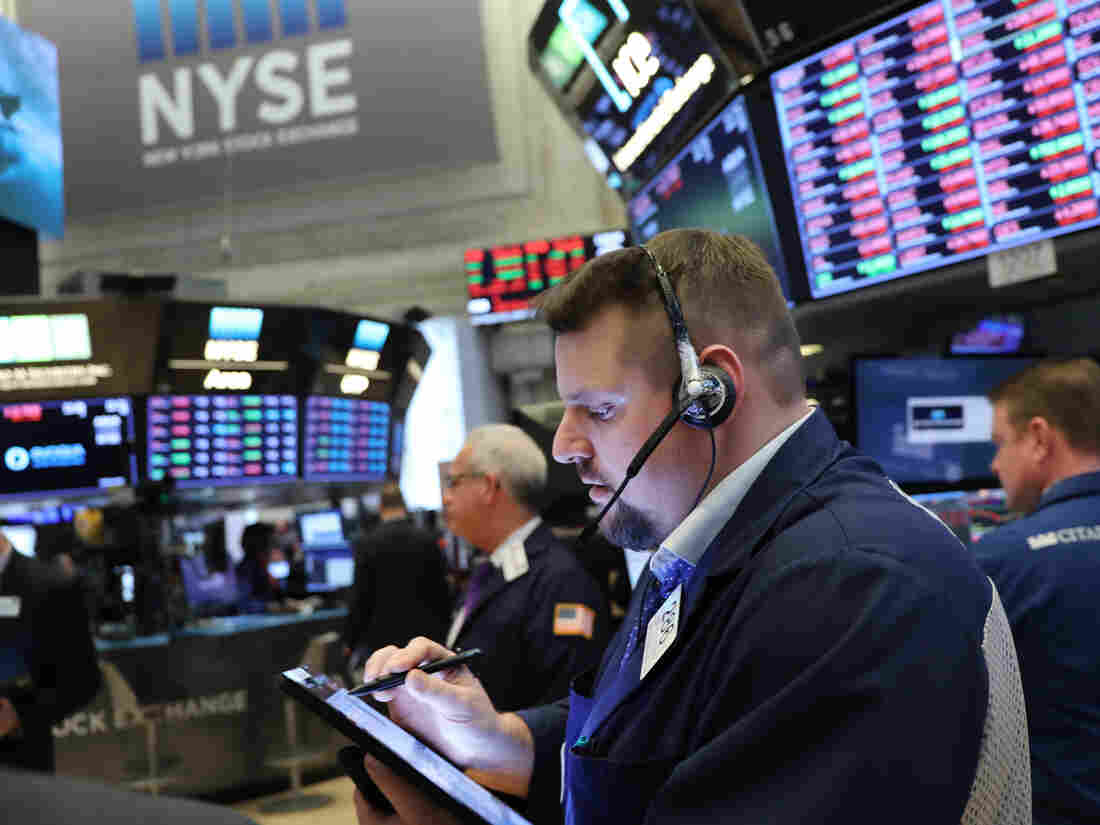
Major U.S. stock indexes fell Friday as short-term Treasury yields exceeded those on long-term bonds, in what some analysts consider a sign that a recession may be coming.
Spencer Platt/Getty Images
hide caption
toggle caption
Spencer Platt/Getty Images
The stock market tumbled Friday as investors digested an ominous warning sign: Interest rates on long-term government debt fell below the rate on short-term bills. That’s often a signal that a recession is on the horizon.
The Dow Jones Industrial Average fell more than 460 points Friday, or about 1.8 percent. The broader S&P 500 index fell 1.9 percent.
Ordinarily, the yield on long-term debt is higher, just as 10-year certificates of deposit tend to pay higher interest rates than 3-month CDs.
Bond watchers get nervous when that typical pattern is turned on its head.
“We don’t see that occur that often, but when it does, it’s almost always bad news,” said Campbell Harvey, a professor of finance at Duke University.
That’s why warning lights started flashing Friday morning when the yield on the 10-year Treasury note slipped below that of the three-month bill. The last time that happened was just before the Great Recession.
Harvey’s been keeping a close eye on these rare, “inverted” yield curves for more than 30 years, and treats them as a kind of early warning signal.
“My indicator has successfully predicted four of the last four recessions,” he said, “including a pretty important call before the global financial crisis.”
Harvey won’t actually forecast a recession unless the yield curve stays inverted for at least three months. But even a flat curve — in which long-term yields are just slightly above short-term yields — could be an indicator the economy is losing steam.
“It might be that we dodge a recession, but the economic growth will be lower — much lower,” Harvey said.
On Wednesday, the Federal Reserve stories from NPR Business.
