
U.S. Move To Isolate Huawei Sends Ripples Through Global Supply Chain

A member of Huawei’s reception staff walks in the foyer of a building at the company’s Bantian campus in April in Shenzhen, China.
Kevin Frayer/Getty Images
hide caption
toggle caption
Kevin Frayer/Getty Images
A Trump administration decision to restrict the sale of U.S. technology to Chinese telecommunications company Huawei will disrupt global supply chains, say analysts, ramping up pressure on U.S. allies reluctant to join in efforts to shut out Huawei from advanced 5G mobile networks.
The Commerce Department on Wednesday announced it would add Shenzhen, China-based Huawei and its subsidiaries to a U.S. “entity list” — meaning it can keep Huawei from buying U.S. technology if “the sale or transfer would harm U.S. national security or foreign policy interests.”
The listing came the same day President Trump signed an executive order enabling the government to block U.S. firms from buying foreign-made telecom equipment if it is deemed a national security threat — a move also widely viewed as directed at Huawei.
The apparent one-two punch is the administration’s latest in a series of measures against China’s largest telecom equipment company, as the two countries engage in tense trade and technology fights. The decision comes as some European countries consider whether or not to allow Huawei into their 5G systems.
“This is a direct message to Europe about how it should be thinking of the future of its 5G networks,” says Paul Triolo, geotechnology head at political consultancy Eurasia Group. “The U.S. can allow some companies to sell to Huawei while ultimately holding the cards.”
Telecom companies including Sweden’s Ericsson and Finland’s Nokia have been vying with Huawei to set up the world’s first 5G networks, the next generation in mobile data infrastructure.
The new networks are critical to reaching data transmission speeds needed to support future “internet of things” applications, such as driverless cars.
5G’s importance to emerging industries and its reliance on a complex mixture of software and hardware have countries like the U.S. worried that adversaries could easily hack the networks to access user data and divert communication traffic to their own servers.
Statement regarding U.S. Commerce Department’s addition of Huawei on the so-called Entity List pic.twitter.com/XgwS6AXc8G
— Huawei Technologies (@Huawei) May 16, 2019
In a statement, Huawei said it opposed the Commerce Department’s decision, saying it was “in no one’s interest” and would “do economic harm to the American companies with which Huawei does business.”
Lu Kang, a Chinese Foreign Ministry spokesman, said the U.S. should “stop its wrong practices” and should not “abuse export control measures while making ‘national security’ a catch-all phrase.”
Pressure to ban Huawei
The Trump administration has pressured its allies to preemptively ban Huawei equipment from their 5G networks, with limited success.
New Zealand, Australia and Japan have joined the U.S. in freezing out the Chinese company from future 5G plans. But Germany and France have not followed suit. Last month, the U.K. decided to allow Huawei restricted access to its 5G networks, a move first reported by the Daily Telegraph.
Experts say this hard-line strategy of circumscribing Huawei by citing expansive national security concerns signals a convergence with Beijing’s own restrictive cybersecurity and data laws. China has barred foreign companies from building significant market share in data-intensive technology sectors, such as cloud computing and financial services, which is a key sticking point in ongoing U.S.-China trade negotiations.
Samm Sacks, a cybersecurity fellow with think tank New America, says the administration’s executive order “is a page from Beijing’s playbook.”
She says looking at Wednesday’s executive order from Trump, “In some places, if you did a blind test with China’s cybersecurity law and tried to guess which is which, it would be hard to tell.”
“We didn’t even know there was this decision”
The announcement that Huawei would be put on the Commerce Department’s entity list took tech companies by surprise and many are now scrambling to figure out what that will mean for their operations. They argue a move to cut off Huawei from American technology sales would further decouple U.S. firms from the global technology supply chain and end an important revenue stream.
The entity listing affects major firms like chipmakers Qualcomm and Intel, which are Huawei suppliers. Even software suppliers like Google would have to apply for explicit Commerce Department permission to update Huawei’s smartphone operating systems, which run on Google Android.
“We didn’t even know there was this decision until members of the press received a statement Wednesday night,” says on industry representative who declined to be named because they were not authorized to speak publicly.
Details of how these export controls will work have not been released and it isn’t yet clear whether restrictions on Huawei will cover all American components or only a narrow subset.
If interpreted broadly, the controls on U.S. sales to Huawei could prove the biggest move yet to thwart the Chinese telecom company’s ambitions to build the hardware underpinning its global 5G network.
“It’s very difficult for Huawei to build a 5G base station without U.S. semiconductor technology,” says Brett Simpson, co-founder at Arete Research, a London-based technology research group. He was referring to the thousands of antenna stations that will process 5G bandwidth. Huawei will have to procure parts from U.S. firms like Xilinx, Texas Instruments and Analog Devices, according to Simpson.
There will be less impact on Huawei’s mobile handset business. Last year, Huawei was the world’s second-largest mobile phone supplier by sales after Samsung.
Wary of growing hostility from policymakers in Washington, Huawei has been stockpiling U.S.-made components that go into its cellphones in case the flow of parts from America is disrupted. Analysts believe this strategic reserve of electronic parts could sustain Huawei for another year without new purchases from the U.S.
Meanwhile, memory chips used in Huawei smartphones that are produced by American firms like Micron could be substituted out for South Korean products.
Huawei has also poured significant investment into the development of its own advanced microprocessors through its chip design subsidiary HiSilicon. It runs research and development bases around the world in an effort to wean itself off of high-end U.S. components.
That could allow Huawei to avoid the fate of its domestic rival, Chinese telecom company ZTE. The U.S. ordered a complete halt of U.S. components to ZTE in April 2018, forcing the company to temporarily cease operations before the Trump administration significantly eased the restrictions in July.
Trump Takes Aim At Huawei, Paves Way For Ban Of Foreign Telecom Equipment
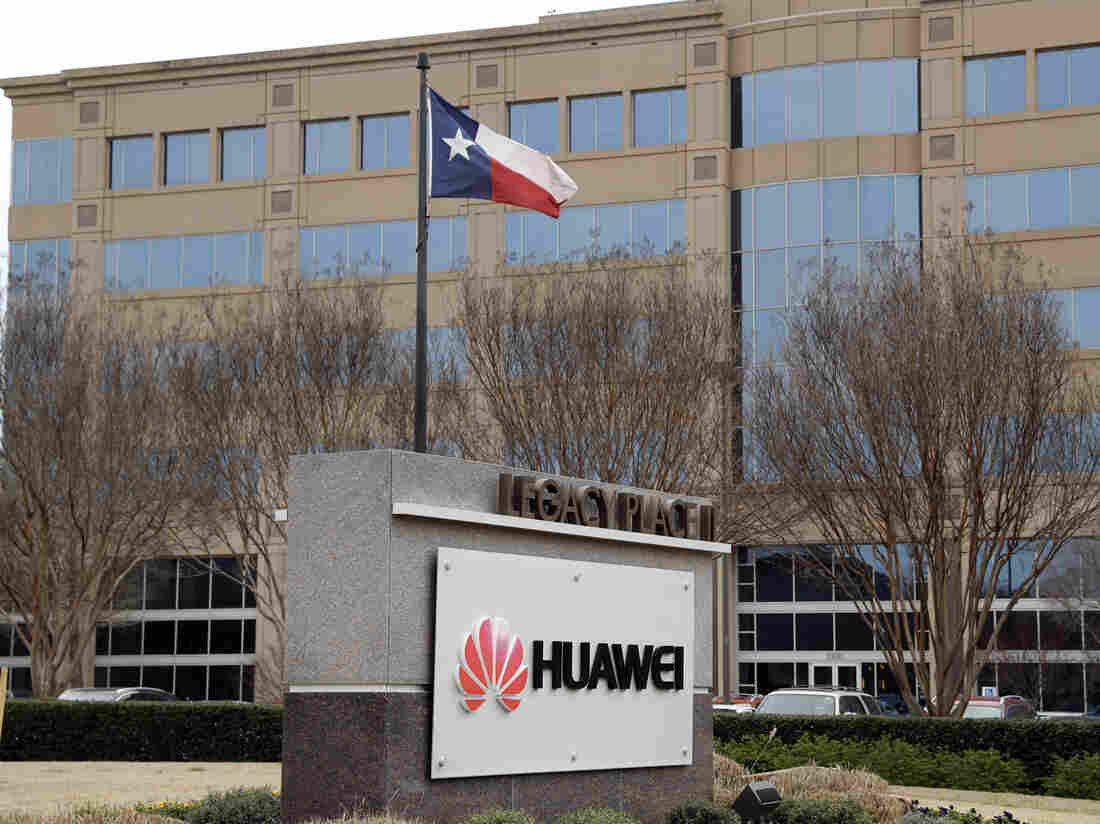
The Huawei Technologies Ltd. business location in Plano, Texas. Trump’s executive order does not name Huawei, but it appears to be directed at the Chinese telecom manufacturer.
Tony Gutierrez/AP
hide caption
toggle caption
Tony Gutierrez/AP
President Trump signed an executive order Wednesday designed to bar U.S. telecommunications networks from using equipment from foreign suppliers, a move apparently targeting Chinese telecom giant Huawei.
The order declares a “national emergency” and says that “foreign adversaries are increasingly creating and exploiting vulnerabilities in information and communications technology and services” and committing economic and industrial espionage against the U.S.
Trump’s order directs Commerce Secretary Wilbur Ross to draft rules to restrict the purchase of information and communications technology from companies “owned by, controlled by, or subject to the jurisdiction or direction of a foreign adversary.”
A senior administration official says the order is not directed at any particular country or company, but the order appears to be aimed at Chinese telecom manufacturer Huawei.
Separately, the Commerce Department reportedly said Wednesday it was adding Huawei to its “Entity List,” preventing it from buying components from American companies without U.S. government approval.
The administration says Huawei’s technology could become a conduit for snooping or sabotage by the government in Beijing. The U.S. federal government itself is already barred from doing business with Huawei and another Chinese telecom firm, ZTE. The administration has also been discouraging allies from using Huawei equipment as they build out 5G networks.
The executive order gives the Commerce Department 150 days to write regulations implementing it.
The Trump administration “will do what it takes to keep America safe and prosperous, and to protect America from foreign adversaries” targeting vulnerabilities in American communications infrastructure, White House press secretary Sarah Sanders said in a statement.
The president’s action was described by a senior administration official as “company and country agnostic.” Even so, it was greeted with bipartisan endorsements on Capitol Hill as strong action against China amid American fears of technological vulnerability.
“This is a needed step, and reflects the reality that Huawei and ZTE represent a threat to the security of U.S. and allied communications networks,” said Virginia Sen. Mark Warner, the top Democrat on the Senate Intelligence Committee, in a statement. “Under current Chinese security laws, these and other companies based in China are required to provide assistance to the Chinese state.”
Republican Sen. Ben Sasse of Nebraska, also a member of the Senate Intelligence Committee, said in a statement, “Let’s cut to the chase: China’s main export is espionage, and the distinction between the Chinese Communist Party and Chinese ‘private-sector’ businesses like Huawei is imaginary. The Trump Administration is right to recognize this reality and issue this order.”
The president’s executive order comes as the U.S. and China are locked in a trade war, with both nations imposing tariffs on products from the other.
NPR’s Scott Horsley contributed to this report.
Highly Potent Weed Has Swept The Market, Raising Concerns About Health Risks

Studies have shown that the levels of THC, the main psychoactive compound in pot, have risen dramatically in the U.S. from 1995 to 2017.
David McNew/Getty Images
hide caption
toggle caption
David McNew/Getty Images
As more states legalize marijuana, more people in the U.S. are buying and using weed — and the kind of weed they can buy has become much stronger.
That concerns scientists who study marijuana and its effects on the body, as well as emergency room doctors who say they’re starting to see more patients who come into the ER with weed-associated issues.
Some 26 million Americans ages 12 and older reported being current marijuana users in 2017, according to the National Survey on Drug Use and Health. It’s not clear how many users have had serious health issues from strong weed, and there’s a lot that’s still unknown about the potential risks. But scientists are starting to learn more about some of them.
The potency of weed depends on the amount of delta-9-tetrahydrocannabinol, or THC, the main compound responsible for the drug’s psychoactive effects. One study of pot products seized by the U.S. Drug Enforcement Administration found the potency increased from about 4% THC in 1995 to about 12% in 2014. By 2017, another study showed, the potency of illicit drug samples had gone up to 17.1% THC.
“That’s an increase of more than 300% from 1995 to about 2017,” says Staci Gruber, director of the Marijuana Investigations for Neuroscientific Discovery (MIND) program at the Harvard-affiliated McLean Hospital in Belmont, Mass. “I would say that’s a considerable increase.”
And some products with concentrated forms of cannabis, like hash and hash oil, can have as much as 80% to 90% THC, she adds.
“I think most people are aware of the phenomenon that ‘this is not your grand daddy’s weed,’ Gruber says. “I hear this all the time.”
But people might not be aware of the potential health risks of highly potent weed. “The negative effects of cannabis have primarily been isolated and localized to THC,” says Gruber. “So it stands to reason that higher levels of THC may in fact confer a greater risk for negative outcome.”
“In general, people think, ‘Oh, I don’t have to worry about marijuana. It’s a safe drug,’ ” says Nora Volkow, director of the National Institute on Drug Abuse. “The notion that it is completely safe drug is incorrect when you start to address the consequences of this very high content of 9THC.”
Pot’s paradoxical effects
THC can have opposite effects on our bodies at high and low doses, Volkow says. Take anxiety levels, for example.
“When someone takes marijuana at a low [THC] content to relax and to stone out, actually, it decreases your anxiety,” she says. But high concentrations can cause panic attacks, and if someone consumes high-enough levels of THC, “you become full-blown psychotic and paranoid.”
Weed can have a similar paradoxical effect on the vascular system. Volkow says: “If you take low-content THC it will increase your blood flow, but high content [THC] can produce massive vasoconstriction, it decreases the flow through the vessels.”
And at low concentrations, THC can be used to treat nausea in cancer patients undergoing chemotherapy. But Volkow says that “patients that consume high content THC chronically came to the emergency department with a syndrome where they couldn’t stop vomiting and with intense abdominal pain.”
It’s a condition called cannabinoid hyperemesis syndrome.
“The typical patient uses [inhales] about 10 times per day … and they come in with really difficult to treat nausea and vomiting,” says Andrew Monte, an associate professor of emergency medicine and medical toxicology at the University of Colorado’s school of medicine. “Some people have died from this … syndrome, so that is concerning.”
Scientists don’t know exactly how high levels of THC can trigger the syndrome, but the only known treatment is stopping cannabis use.
While the number of people who’ve had the syndrome is small, Monte says he and his colleagues have documented a rise in the number of cases at emergency rooms in Colorado since marijuana was legalized there five years ago. A study by Monte and his team found that cyclical vomiting cases made up about 18% of inhaled cannabis-related cases at his ER.
They also found that statewide, the overall number of ER cases associated with cannabis use has gone up. And Monte says his ER has “seen an approximately a three-fold increase in emergency department visits just by frequency. It doesn’t mean we’re getting overwhelmed by these visits due to cannabis, it’s just that means that there are more patients overall.”
Most people show up at his emergency department because of “intoxication” from too much pot, either straight or mixed with other drugs, Monte says. The bulk of these cases are due to inhaled cannabis, though edibles are associated with more psychiatric visits.
“We’re seeing an increase in psychosis and hallucinations, as well as anxiety and even depression and suicidality,” Monte says.
He thinks the increased potency of marijuana plays a role in all these cases. “Whenever you have a higher dose of one of these types of drugs, the patient is at a higher risk of having an adverse drug event. If the concentration is so much higher … it’s much easier to overshoot the low-level high that they’re looking for.”
Not everyone is at equal risk, Monte adds. “Many many people use cannabis safely,” he says. “The vast majority don’t end up in our emergency department.”
Different risks for users
Some people are more vulnerable than others to the potential negative effects of high THC cannabis.
Adolescent and young adults who use recreationally are especially susceptible because their brains are still developing and are sensitive to drugs in general, says Gruber of the MIND program. In a recent review of existing studies, she found that marijuana use among adolescents affects cognition — especially memory and executive functions, which determine mental flexibility and ability to change our behavior.
Medical marijuana users can face unexpected and unwelcome effects from potent weed. “It’s very important for people to understand that they may not get the response they anticipated,” Gruber notes.
Studies done on the medical benefits of pot usually involve very low doses of THC, says Monte, who adds that those doses “are far lower than what people are getting in a dispensary right now.”
David Dooks, a 51-year-old based in the Boston area turned to marijuana after an ankle surgery last year. “I thought that medical marijuana might be a good alternative to opioids for pain management,” he says.
Based on the advice at a dispensary, David began using a variety of weed with 56.5% THC and says it only “exacerbated the nerve pain.” After experimenting with a few other strains, he says, what worked for him was one with low (0.9%) THC, which eased his nerve pain.
‘Start low, go slow’
Whether people are using recreationally or medically, patients should educate themselves as much as possible and be cautious while using, Monte says.
Avoiding higher THC products and using infrequently can also help reduce risk, Volkow adds. “Anyone who has had a bad experience, whether it’s psychological or biological, they should stay away from this drug,” she notes.
Ask for as much information as possible before buying. “You have to know what’s in your weed,” Gruber says. “Whether or not it’s conventional flower that you’re smoking or vaping, an edible or tincture, it’s very important to know what’s in it.”
And the old saying “start low, go slow,” is a good rule of thumb, she adds. “You can always add, but you can never take it away. Once it’s in, it’s in.”
The Thistle & Shamrock: New Spring Sounds

Dervish
Collin Gillen/Courtesy of the artist
hide caption
toggle caption
Collin Gillen/Courtesy of the artist
Step into springtime by tuning into some of the fresh new music that recently arrived at The Thistle & Shamrock offices in the U.S. and Scotland. We feature exciting new recordings form Dervish, Liz Carroll and Flook.
Alabama Lawmakers Pass Bill Banning Nearly All Abortions

The Alabama Senate has passed an abortion ban that would be one of the most restrictive in the United States. The bill would make it a crime for doctors to perform abortions at any stage of a pregnancy unless a woman’s life is threatened or in case of lethal fetal anomaly.
Dave Martin/AP
hide caption
toggle caption
Dave Martin/AP
Updated Wednesday at 12:03 a.m. ET
The Alabama Senate passed a bill Tuesday evening to ban nearly all abortions. The state House had already overwhelmingly approved the legislation. It’s part of a broader anti-abortion strategy to prompt the U.S. Supreme Court to reconsider the right to abortion.
It would be one of the most restrictive abortion bans in the United States. The bill would make it a crime for doctors to perform abortions at any stage of a pregnancy, unless a woman’s life is threatened or in case of a lethal fetal anomaly.
The vote was 25-6, with one abstention.
Doctors in the state would face felony jail time up to 99 years if convicted. But a woman would not be held criminally liable for having an abortion.

Laura Stiller of Montgomery protests outside the Alabama State House as the Senate debates an abortion ban. Stiller calls the legislation political and an “affront to women’s rights.”
Debbie Elliott/NPR
hide caption
toggle caption
Debbie Elliott/NPR
There are no exceptions in the bill for cases of rape or incest, and that was a sticking point when the Alabama Senate first tried to debate the measure last Thursday. The Republican-majority chamber adjourned in dramatic fashion when leaders tried to strip a committee amendment that would have added an exception for cases of rape or incest.
Sponsors insist they want to limit exceptions because the bill is designed to push the idea that a fetus is a person with rights, in a direct challenge to the U.S. Supreme Court’s landmark Roe v. Wade decision that established a woman’s right to abortion.
“Human life has rights, and when someone takes those rights, that’s when we as government have to step in,” said Republican Clyde Chambliss, the Senate sponsor of the abortion ban.
The amendment has divided Republicans. Lt. Gov. Will Ainsworth, who presides over the Senate, posted on Twitter that his position is simple — “Abortion is murder.” But other Senate leaders have insisted that there be exceptions for rape and incest.
‘Abortion is murder,’ those three simple words sum up my position on an issue that many falsely claim is a complex one. #PassHB314 #NoAmendments pic.twitter.com/NjpYW2wu8T
— Will Ainsworth (@willainsworthAL) May 13, 2019
Democrats didn’t have the votes to stop the bill but tried to slow down proceedings during the debate.
Democratic Sen. Vivian Davis Figures questioned why supporters would not want victims of rape or incest to have an exception for a horrific act.
“To take that choice away from that person who had such a traumatic act committed against them, to be left with the residue of that person if you will, to have to bring that child into this world and be reminded of it every single day,” Figures said.
Republican Gov. Kay Ivey has not said whether she will sign it, and said she was waiting for a final version of the bill. She is considered a strong opponent of abortion.
The ACLU of Alabama says it will sue if the bill becomes law. “This bill will not take effect anytime in the near future, and abortion will remain a safe, legal medical procedure at all clinics in Alabama,” the organization tweeted Tuesday night, along with a map showing clinic locations in the state.
PLEASE REMEMBER: This bill will not take effect anytime in the near future, and abortion will remain a safe, legal medical procedure at all clinics in Alabama. #mybodymychoice #HB314 pic.twitter.com/vVohsiR5Md
— ACLU of Alabama (@ACLUAlabama) May 15, 2019
“Abortion is still legal in all 50 states,” the ACLU’s national organization wrote. “It’s true that states have passed laws trying to make abortion a crime, but we will sue in court to make sure none of those laws ever go into effect.”
Chipping away at abortion rights
In recent years, conservative states have passed laws that have chipped away at the right to abortion with stricter regulations, including time limits, waiting periods and medical requirements on doctors and clinics. This year state lawmakers are going even further now that there’s a conservative majority on the U.S. Supreme Court.
“The strategy here is that we will win,” says Alabama Pro-Life Coalition President Eric Johnston, who helped craft the Alabama abortion ban.
“There are a lot of factors and the main one is two new judges that may give the ability to have Roe reviewed,” Johnston said. “And Justice Ginsburg — no one knows about her health.”
So states are pushing the envelope. Several, including Alabama’s neighbors Georgia and Mississippi, have passed laws that prohibit abortion once a fetal heartbeat can be detected. But the drafters of the Alabama bill think by having no threshold other than if a woman is pregnant, their law might be the one ripe for Supreme Court review.
The National Organization for Women denounced the ban’s passage.
“This unconstitutional measure would send women in the state back to the dark days of policymakers having control over their bodies, health and lives,” the organization said in a statement. “NOW firmly believes that women have the constitutional right to safe, legal, affordable and accessible abortion care and we strongly oppose this bill and the other egregious pieces of legislation that extremist lawmakers are trying to pass in what they claim is an attempt to force the Supreme Court to overturn Roe.”
What It Would Take For U.S. Companies To Switch Supply Chains Away From China

President Trump wants manufacturers to source raw materials from outside China. NPR’s Ari Shapiro talks with Syracuse University economist Mary Lovely about how companies could move supply chains.
ARI SHAPIRO, HOST:
If you dig into how a smartphone or bicycle or a pair of shoes is put together, you will eventually reach China. Even companies that make products in the U.S. often get their parts from China. This week, President Trump suggested that to avoid tariffs, those companies should buy parts domestically or from a different country like Vietnam.
To get a sense of what it takes to move a global supply chain, we’re joined now by Mary Lovely, an economist with Syracuse University. Welcome to ALL THINGS CONSIDERED.
MARY LOVELY: Thank you, Ari.
SHAPIRO: Have you already started to see manufacturers move their supply chains out of China as a reaction to these tariffs?
LOVELY: Well, there certainly have been a lot of reports, and we’ve seen some. But on a scale that would move China’s exports here very much – no, not yet.
SHAPIRO: Why do you think that is?
LOVELY: Well, the adjustment is going to be costly. You have to either find a new supplier or build a new factory. And so far, the tariffs have been conditional. You know, we might get a deal. The president might roll them back. So if firms believe the tariffs are temporary and there’s a lot of uncertainty, then they won’t go ahead and make that investment.
SHAPIRO: Is it harder to move production of a high-end product like a smartphone than something like a pair of shoes?
LOVELY: Definitely. It’s not only just the production process itself. There’s a whole host of other things. So for example, in shoes, say an American company may have a set of representatives who go out and find subcontractors. These subcontractors may change from season to season. Some subcontractors go out of business. Some of them don’t provide the level of quality that was wanted. So there’s a lot of fluidity in this process. And they can switch suppliers pretty quickly.
When we look at something like an iPhone, you’re seeing a process where at each point along the way, Apple has a role to play with very specific technology that’s done in a very specific way to very high standards. And moving that kind of supply chain from the people you know and trust and have had relationships with for a long time is going to be costly and much more difficult.
SHAPIRO: Do you think there could come a point when the trade war stretches on for so long or the tariffs get so high that companies decide they’re just going to suck up the costs and relocate?
LOVELY: Yes, and I think we’re approaching that point. Businesses aren’t seeing the trade conflict calm down. They’re actually probably seeing it escalate. So this may be the time that firms actually say, hey, this is going to be around for quite a while, and maybe it’s the time for us to start making the investments that we need.
SHAPIRO: China is so large. If American manufacturers did decide to move their supply chains out of China, is there capacity in other countries to pick up all of this business?
LOVELY: Short answer is really no, not in the short run. Longer-term, countries like India which have a large, untapped population that would like to be more deeply embedded into global value chains – they will be able to come online and gradually get the capacity to replicate what China had done. That’s not just building factories. It’s also developing the skills within the population, within the managers to get things like failure rates very low.
You know, we kind of take for granted if we buy a television set that’s made in Asia that it’s going to work. This wasn’t always the case. Products have gotten to be very good. And as we shift supply chains, you know, we’ll see those types of costs going up where you get a piece of equipment, and it’s what we might call a lemon, and you take it back to the store. That’s going to raise the costs for the companies that are involved in that business.
SHAPIRO: Mary Lovely is an economics professor at Syracuse University. Thanks for joining us.
LOVELY: Thanks, Ari.
Copyright © 2019 NPR. All rights reserved. Visit our website terms of use and permissions pages at www.npr.org for further information.
NPR transcripts are created on a rush deadline by Verb8tm, Inc., an NPR contractor, and produced using a proprietary transcription process developed with NPR. This text may not be in its final form and may be updated or revised in the future. Accuracy and availability may vary. The authoritative record of NPR’s programming is the audio record.
Who Is Believed?

“They all needed Larry. Gymnastics is punishing. Spend enough hours hoisting your body up and over those wooden gymnastics bars, eventually the skin on your palms rips right open.”
That’s a quote from host Lindsey Smith in the first episode of the podcast Believed, from NPR and Michigan Radio.
In 2018, Nassar was convicted of criminal sexual conduct and federal child pornography charges.
He serially abused hundreds of young women. His victims included household names like Simone Biles and Aly Raisman, but they weren’t all famous. Vox reports that the majority “were students and young female athletes — gymnasts, dancers, and volleyball players.”
At the very minimum, isn’t it unsettling to think that because of Nassar’s expertise treating athletes, he was kept on despite suspicions he was abusing his patients? And that when girls and young women came forward with their stories, no one believed them?
But it happened. For decades.
The purpose of Believed is to discover “how Larry Nassar abused so many for so long.”
In one instance, the police just believed Nassar instead of what his victim reported. And local detectives never referred the case to a local prosecutor for review, to see if this report of Nassar’s behavior reflected an isolated incident, or something worse.
We reached out to USA Gymnastics, and they sent us this statement.
We will never forget the appalling acts of abuse that have forever impacted our athletes and the gymnastics community. We admire the survivors’ courage and strength in sharing their stories, and our goal is to do everything we can to prevent the opportunity for it to happen again. USA Gymnastics is further strengthening its athlete safety policies — including provisions on mandatory reporting and setting boundaries for athlete-adult interaction — to establish greater accountability and make reporting easier. Athletes are the heart and soul of our sport, their safety is of paramount importance to us, and we are focused on making our organization more athlete-centric.
We bring you the latest on what’s happened since Nassar’s conviction and speak with Lindsey Smith about her work.
Produced by Kathryn Fink.
This show will discuss sexual abuse and assault. If you or someone you know needs to speak to someone, the National Sexual Assault Hotline is 1-800-656-4673. You can also use the RAINN online hotline, which you can find here.
California Jury Awards $2 Billion To Couple In Roundup Weed Killer Cancer Trial

Containers of Roundup are displayed on a store shelf in San Francisco. A third California jury has awarded a multimillion-dollar court judgment against the herbicide.
Haven Daley/AP
hide caption
toggle caption
Haven Daley/AP
A California jury has awarded a couple more than $2 billion in a verdict against Monsanto, a subsidiary of Bayer. This is the third recent court decision involving claims that the company’s Roundup weed killer caused cancer.
The jury in Alameda County, just east of San Francisco, ruled that the couple, Alva and Alberta Pilliod of Livermore, California, contracted non-Hodgkins lymphoma due to their use of the glyphosate-based herbicide. They were each awarded $1 billion in punitive damages and an additional $55 million in collective compensatory damages.
Many legal experts believe the damages will be drastically reduced on appeal.
The verdict represents the third such legal setback for the company in California since mid-2018. In March, a San Francisco jury awarded a man $80 million who blamed his cancer on his extensive use of Roundup. In August 2018, another San Francisco jury awarded $289 million to a fourth plaintiff. On appeal a judge later slashed that payout to $78 million. Bayer is appealing each of these verdicts. And the company insists there is no link between Roundup and non-Hodgkins’s lymphoma.
“Bayer is disappointed with the jury’s decision and will appeal the verdict in this case, which conflicts directly with the U.S. Environmental Protection Agency’s interim registration review decision released just last month, the consensus among leading health regulators worldwide that glyphosate-based products can be used safely and that glyphosate is not carcinogenic, and the 40 years of extensive scientific research on which their favorable conclusions are based,” the company said in a statement.
At least one environmental group praised the verdict.
Ken Cook, president of the Environmental Working Group said “The cloud hanging over Bayer will only grow bigger and darker, as more juries hear how Monsanto manipulated its own research, colluded with regulators and intimidated scientists to keep secret the cancer risks from glyphosate.”
Four year ago, a United Nations-sponsored scientific agency declared that Roundup probably causes cancer. As NPR’s Dan Charles reported, the finding from the International Agency for Research on Cancer caused Monsanto to launch a fierce campaign to discredit the IARC’s conclusions.
“Internal company emails, released as part of a lawsuit against the company, show how Monsanto recruited outside scientists to co-author reports defending the safety of glyphosate, sold under the brand name Roundup. Monsanto executive William Heydens proposed that the company ‘ghost-write’ one paper. In an email, Heydens wrote that ‘we would be keeping the cost down by us doing the writing and they would just edit & sign their names so to speak.’ Heydens wrote that this is how Monsanto had ‘handled’ an earlier paper on glyphosate’s safety.”
More than 13,000 other lawsuits have been filed against its subsidiary, Monsanto, the maker of Roundup.
After three jury verdicts in California, a trial is scheduled for August in St. Louis County in Missouri, the site of Monsanto’s former headquarters.
States Sue Drugmakers Over Alleged Generic-Price-Fixing Scheme

Jose A. Bernat Bacete/Getty Images
Connecticut Attorney General William Tong has a skin condition called rosacea, and he says he takes the antibiotic doxycycline once a day for it.
In 2013, the average market price of doxycycline rose from $20 to $1,829 a year later. That’s an increase of over 8,000%.
Tong alleges in a new lawsuit that this kind of price jump is part of an industrywide conspiracy to fix prices.
The suit is a whopper — at least 43 states are suing 20 companies, and the document is over 500 pages long. It was filed Friday in the U.S. District Court in Connecticut.
The lawsuit alleges that sometimes one company would decide to raise prices on a particular drug, and other companies would follow suit. Other times, companies would agree to divide up the market rather than competing for market share by lowering prices.
It says these kind of activities have been happening for years and that companies would avoid creating evidence by making these agreements on golf outings or during “girls nights outs” or over text message.
In several examples, the suit cites call logs between executives at different companies, showing a flurry of phone calls right before several companies would all raise prices in lockstep.
All of this, according to the lawsuit, resulted “in many billions of dollars of harm to the national economy.”
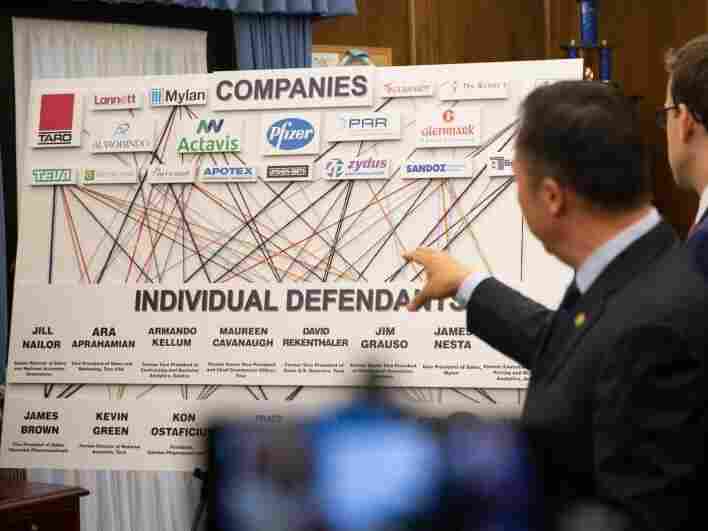
Connecticut Attorney General William Tong says the generic drug industry is profiting “in a highly illegal way” from Americans. Tong is at the forefront of a multistate lawsuit filed May 10 that alleges companies worked together to set prices.
Frankie Grazian/Connecticut Public Radio
hide caption
toggle caption
Frankie Grazian/Connecticut Public Radio
Consumers don’t always notice when a generic drug’s price increases rapidly. People without insurance, of course, pay full price, but even people with insurance can feel the impact.
“More people than ever before are paying based on the price of the drugs,” explains Stacie Dusetzina, a professor at Vanderbilt University who studies drug pricing. Often, patients have to meet a deductible before their health plan’s coverage kicks in, so “they pay full price until they reach a certain level of spending, or they pay a percentage of the drug’s price — we call that a coinsurance.”
Surveys show more Americans are having trouble paying out-of-pocket medical costs. The average annual deductible in job-based health plans has quadrupled in the past 12 years and now averages $1,300.
But, Dusetzina says, even if you only pay a modest copay — such as $5 for every prescription you pick up — if your insurance company is paying more for prescription drugs, it can raise your health plan’s premiums the following year. “So ultimately these costs do get borne by the consumer in some way,” she says.
Dusetzina says what this lawsuit alleges is “very disappointing” — a situation in which consumers put up with the high price of branded drugs because of the implicit promise that a generic is coming some day and will eventually bring the price down.
But that outcome doesn’t happen automatically; it relies on healthy competition and market forces to work. If there’s only one generic version available, that drugmaker can set the price at pretty much the same level as the brand name.
“The higher the number of competitors, the more we see price reductions from the branded drug price,” she says. “So the magic number seems to be around four manufacturers.”
And that assumes those drugmakers aren’t talking to each other and agreeing to coordinate rather than compete.
The main drugmaker cited in the lawsuit is Teva, an Israeli company. In a statement, Kelley Dougherty, vice president of communications and brand, Teva North America, told NPR that the company is reviewing the allegations internally and that Teva “has not engaged in any conduct that would lead to civil or criminal liability.”
The company has also asserted that there’s nothing new here. It’s true that the new lawsuit is similar to past lawsuits, though none of them included so many states as plaintiffs.
Tong has emphasized that the investigation is ongoing. Given the amount of political appetite there is to bring drug prices down, there are certainly more lawsuits to come.
Trump Administration Ratchets Up Tariffs, So Far Without Retaliation From China

Chinese Vice Premier Liu He talks with U.S. Trade Representative Robert Lighthizer and Treasury Secretary Steven Mnuchin as he departs a round of trade talks in Washington on Friday.
Leah Millis/Reuters
hide caption
toggle caption
Leah Millis/Reuters
The Trump administration imposed new higher tariffs on $200 billion in Chinese goods on Friday morning after trade talks failed to yield a deal. But to the surprise of many, China has yet to retaliate with new tariffs of its own.
Larry Kudlow, Trump’s top economic adviser said on Sunday that he is among those expecting a reaction from China. But so far “the expected countermeasures haven’t yet materialized,” Kudlow said on Fox News Sunday. “I reckon they will. We’ll see what they come up with.”
President Trump had struck a genial tone in tweets on Friday, calling the talks “candid and constructive.” But he struck a very different note Saturday, when he came out swinging at a number of targets.
“I think that China felt they were being beaten so badly in the recent negotiation that they may as well wait around for the next election, 2020, to see if they could get lucky & have a Democrat win – in which case they would continue to rip-off the USA for $500 Billion a year,” he tweeted. “The only problem is that they know I am going to win (best economy & employment numbers in U.S. history, & much more), and the deal will become far worse for them if it has to be negotiated in my second term. Would be wise for them to act now, but love collecting BIG TARIFFS!”
Kudlow was considerably more measured on Sunday. He emphasized the talks’ ongoing nature, and discouraged the term “trade war,” saying that the tariffs were simply part of the negotiations.
Trump and Xi will likely talk at the G20 summit late next month in Japan, Kudlow said, and China’s ambassador has invited U.S. Trade Representative Robert Lighthizer and Treasury Secretary Steven Mnuchin to Beijing.
Tariffs on Chinese goods increased from 10% to 25% on Friday, making the underlying cost of those items higher for U.S. customers. The Trump administration has imposed tariffs on Chinese goods before, and in each case, China was quick to impose tariffs on U.S. products. It was expected that Beijing would raise tariffs on U.S. goods to 25%.
But that hasn’t happened yet. And it’s not clear why not.
Wei Jianguo, a former vice-minister at the Ministry of Commerce who handled foreign trade, told the South China Morning Post that China was prepared for a long trade war.
“China will not only act as a kung fu master in response to US tricks, but also as an experienced boxer and can deliver a deadly punch at the end,” Wei said.
With the talks in limbo, Chinese stock markets dipped on Monday, and the yuan hit a four-month low. But markets there are still higher than analysts had predicted.
Who pays?
Trump has repeatedly framed the tariffs as primarily hurting China. For instance, last week at the White House, he said, “Our country can take in $120 billion a year in tariffs. Paid for mostly by China, by the way. Not by us. A lot of people try and steer it in a different direction. Ultimately it’s paid for largely by China.”
But actually it’s American businesses that will pay the tariffs, and in many cases, pass the expense on to their American customers. In some cases, China might absorb some of the cost to stay competitive, but for the most part, it’s folks in the U.S. that will pay the price.
Kudlow, Trump’s economic adviser, said as much on Sunday. “I don’t disagree with that,” he said to Fox News’s Chris Wallace. But he added that “both sides will suffer on this.”
He downplayed concerns that the tariffs would lead to U.S. job losses and hurt the GDP. “The United States’ economy is in a boom,” he said. “You’ve got to do what you’ve got to do. We have had unfair trading practices all these years and so in my judgment, the economic consequences are so small, but the possible improvement in trade and exports and open markets for the United States — this is worthwhile doing.”
Previous rounds of tariffs is already making life more expensive in the U.S., as NPR’s Yuki Noguchi reports:
“They’ve increased consumer costs by $1.4 billion a month, according to experts from the Federal Reserve Bank of New York and Princeton and Columbia University. To date, tariffs have largely affected raw materials like chemicals and wooden beams used to make other products, so the cost increases appear incremental to the consumer. But additional new tariffs would boost prices on a broader number of finished goods — things consumers actually buy, like bicycles.
This latest round of tariffs will add another $500 a year in costs for the average American household, says Katheryn Russ, an economics professor at the University of California at Davis. And that could grow. President Trump has pledged to broaden tariffs even further to all Chinese imports — including big-ticket items. ‘Once the tariffs go onto cellphones, I mean then you’re going to see people scream,'” she says.
NPR Shanghai correspondent Rob Schmitz contributed to this report.
