
Articles by admin

No Image

Behind The Rise In Hotel Rates — And How It's Benefitting Airbnb

3:12

Download

The cost of a hotel room is up — a lot. Recently, prices have leapt nationwide at triple the rate of inflation. Even some business travelers are turning to peer-to-peer rentals to escape the prices.

Transcript

KELLY MCEVERS, HOST:

The cost of a hotel room is going up a lot. In big cities like Boston, Seattle and San Francisco, a regular room is nearly 40 percent more expensive than it was in 2011. From member station WSHU, Charles Lane explains why the economic downturn made room prices go up.

CHARLES LANE, BYLINE: This is another headache you can blame on the recession.

ALAN WEISSMAN: It was as if someone turned a valve off on the money.

LANE: Alan Weissman is a hotel developer, and he says you need money to build hotels. And back during the recession…

WEISSMAN: Literally, overnight, the credit market dried up. This is where you’ll come in. This will be the front door here.

LANE: Weissman is showing off his latest, a five-story Hilton in Westchester just north of New York City. Framers have the walls studded out, and Weissman hopes to get windows in before winter so they can have rooms ready by summer. And travelers will be glad to have them.

WEISSMAN: I think there was an absolute stop in new construction, so there’s kind of a back log.

LANE: The recession-induced lag in construction lasted until 2012. Once money started flowing again, developers raced to catch up. But it takes time to build a hotel. Today, some 132,000 hotel rooms are being built. Until they’re done, there simply aren’t enough beds to go around. And right now, demand is huge from business travelers. Coleen Clark is managing editor of Jet Setter, an online magazine and hotel booking site.

COLEEN CLARK: The economy’s good. People are traveling more. Gas prices have gone down, so it’s even cheaper to get around now. So people are on the road more.

LANE: It’s a double whammy – short supply and high demand with business travelers. But then there’s this third whammy – vacationers. Clark says social media is rewiring what people value in life.

CLARK: These amazing vacation shots of – people are taking all the time might be the one vacation they take every year. But when you look at a feed, you’re seeing these pictures every day. And so I think a lot of times, vacation’s just top of mind now.

LANE: The bottom line is sticker shock. In some cities, run of the mill hotel rooms are renting for $400 to $500 a night.

CLARK: And as demand has gone up, prices have gone up as well.

LANE: That can be tough on business travelers whose budgets are sometimes capped by company per diem policies.

MARC MCCABE: We say that business trips are the trips you have to take, not necessarily the ones that you want to take.

LANE: Marc McCabe runs the business travel division for Airbnb, the home-sharing website. When hotel rates first started going up, McCabe says travel managers for large companies reached out to him for ways to cut costs. Airbnb will soon add more features aimed at more comfortable business travel.

MCCABE: Airbnb has the opportunity, I think, to make business travelers feel a little bit more at home and to give a traveler who’s on, you know – in the same location for two or three weeks that extra space to cook some food, to wash their own clothes.

LANE: McCabe says the hotel shortage and the recession catapulted Airbnb to where they are now. The company plans to sell stock and says they’re worth $24 billion. Still, even McCabe says traditional hotels won’t be replaced. He sees peer-to-peer rentals more like a safety valve for when sporting events or conventions bring to town more heads than beds. For NPR News, I’m Charles Lane.

Copyright © 2015 NPR. All rights reserved. Visit our website terms of use and permissions pages at www.npr.org for further information.

NPR transcripts are created on a rush deadline by a contractor for NPR, and accuracy and availability may vary. This text may not be in its final form and may be updated or revised in the future. Please be aware that the authoritative record of NPR’s programming is the audio.

This entry passed through the Full-Text RSS service – if this is your content and you’re reading it on someone else’s site, please read the FAQ at fivefilters.org/content-only/faq.php#publishers.


No Image

A Metronome Can Help Set The CPR Beat

Metronome GIF
2:25

Download

Credit: Meredith Rizzo/NPR

The heart beats rhythmically, and so does a metronome.

So it makes sense that a metronome, typically used by musicians to help keep a steady beat, could help medical professionals restart a heart.

“What we know for sure,” says pediatric cardiologist Dianne Atkins, a spokeswoman with the American Heart Association, is that “high-quality CPR improves survival.” So anything that improves CPR could save lives.

For CPR to be effective, the rescuer kneels at the side of the person in distress, presses one hand on top of the other in the center of the person’s chest and pushes down about 2 inches to force blood through the body before releasing and then compressing again.

The optimal rate for compression is 100 to 120 per minute, which is “fairly fast” says Atkins, and hard to maintain without something to guide you. “When chest compression is too slow or too fast, it decreases the effectiveness of CPR,” she says.

That’s where the metronome comes in. It offers a consistent guide. With every click, you do a chest compression and the metronome helps you keep the beat. Previously researchers have tried using music, including the songs “Disco Science” and “Achy Breaky Heart” to set the beat.

Now we’re not talking about everyone carrying around a metronome just in case CPR is needed. Most studies of metronomes have involved medical professionals doing CPR on adults. The most recent study in the journal Pediatrics looked at using metronomes to guide CPR for children.

More than 150 medical providers performed two rounds of chest compression on pediatric manikins, one with the metronome and one without. It turned out the metronome increased CPR effectiveness by 22 percent.

Surprisingly, this simple tool isn’t typically found in emergency medical kits with EMS teams or in hospitals. Atkins hopes the findings of the research will change that. In the meantime, she says there are several apps that can be easily downloaded on your mobile phone. Set it to 100 beats per minute, or quarter notes, since the app is typically designed for musicians.

It’s not a bad idea, says Atkins, for all of us, medical professional or not, to download a metronome app and get trained in CPR just in case.

This entry passed through the Full-Text RSS service – if this is your content and you’re reading it on someone else’s site, please read the FAQ at fivefilters.org/content-only/faq.php#publishers.


No Image

To Prevent Aggression Off The Pitch, Jerusalem Takes Aim At Teams' Purses

Fans of Beitar Jerusalem, often known as La Familia, hold up scarves during a match against Bnei Sakhnin at Teddy Stadium in Jerusalem. With a reputation for aggression and racist behavior, La Familia has come under the scrutiny of city leaders.
4:36

Download

Fans of Beitar Jerusalem, often known as La Familia, hold up scarves during a match against Bnei Sakhnin at Teddy Stadium in Jerusalem. With a reputation for aggression and racist behavior, La Familia has come under the scrutiny of city leaders. Nir Elias/Reuters/Landov hide caption

itoggle caption Nir Elias/Reuters/Landov

Israeli security forces are struggling to contain a recent wave of violence between Israelis and Palestinians that has erupted across Israel, the West Bank and Gaza, killing more than two dozen people in less than two weeks.

The government is deploying more security forces to areas of conflict, including Arab towns in Israel.

But shortly before this recent escalation began, city leaders in Jerusalem decided to try a new way to fight the separation and mistrust between Jews and Arabs, who constitute about 20 percent of all Israeli citizens.

Their efforts are focused on the soccer field. They say too many Israeli fans exhibit racist and violent behavior, particularly toward Israel’s Arab fans and players — and city officials also have a solution: Take public funding away from teams associated with such behavior.

Their main target is Beitar Jerusalem, the country’s most popular pro team, with a fan club that calls itself La Familia.

They are an aggressive group. At a recent game, city leaders warned me several times that fans sometimes beat up reporters who want to ask them questions. Their cheering section had a lot of 20-something men, but also teens and some middle-schoolers with their dads.

Sixteen-year-old Itai Ben Avi, one of the few fans who agreed to talk, said he’s disappointed with the city’s plan, which could take away over $350,000 per season per team, according to city officials.

“It’s sad that they’re going to try to take funding from us,” he said, standing outside Jerusalem’s Teddy Stadium in a black sweatshirt with the emblem of La Familia. “And they’re probably going to try to force us to hire an Arab player.”

Ben Avi says the racist label has unfairly stuck to Beitar fans. But the team is the only major league soccer team in Israel that has never hired an Arab player. Two Chechen Muslims were brought on briefly in 2013, to the wrath of some fans. And three La Familia members were recently charged with brutally beating the fan of another Israeli team.

La Familia’s racist and violent reputation goes beyond soccer. Last week, with violence increasing in Jerusalem, many marched through city streets shouting “death to Arabs,” which they also shout at games.

Beitar Jerusalem fans watch a State Cup soccer match against Maccabi Umm al-Fahm F.C. at the Teddy Stadium in Jerusalem. The right tattoo shows the Beitar Jerusalem logo and reads, "I have set watchmen on your walls, Jerusalem; they shall never hold their peace day nor night."

Beitar Jerusalem fans watch a State Cup soccer match against Maccabi Umm al-Fahm F.C. at the Teddy Stadium in Jerusalem. The right tattoo shows the Beitar Jerusalem logo and reads, “I have set watchmen on your walls, Jerusalem; they shall never hold their peace day nor night.” Bernat Armangue/AP hide caption

itoggle caption Bernat Armangue/AP

The fan group’s members at the march, like those at games, were suspicious of the media. Yossi, a young man who refused to give his last name, said La Familia marched to show support for Israel. A friend with him said it was “sad” that a sports group was the one to organize the march.

But critics say La Familia’s behavior embarrasses Israel. Last season, referees cited Beitar with more incidents of racial taunts than the rest of the league’s teams combined.

Jerusalem city council member Hanan Rubin sponsored the bill to make public funds for sports teams contingent on fan behavior. He says Beitar fans are so aggressive no one wants to stop them.

“Not the team, not the owners, not anyone else,” he says. “So we have decided to do it ourselves.”

Khalid Khalaliya, the captain of a mixed Jewish-Arab team from Sakhnin, an Arab town in Israel, has heard plenty of insults from Beitar fans.

“They say lots of racist things,” Khalaliya says. “They have called me a terrorist, by name. Sometimes they curse the Prophet Mohammad. But it just makes me want to play better and win the game.”

Khalaliya, 32, likes Jerusalem’s plan to take away funding as a way to improve fan behavior. But Sakhnin’s spokesman, Munthir Khalaya, does not.

“That kind of such a punishment won’t change the behavior of the fans,” Khalaya says. “But any financial punishment will weaken the team.”

A relatively new Jerusalem team offers another way to change racist behavior. Hapoel Katamon Jerusalem is owned by its fans. Manager Shai Aharon says the team’s youth program regularly brings Arab and Jewish kids together.

They are invited to train together, rather than play against each other, he says.

“We make them be together, not one against each other. So they understand the ‘other’ side is not the other side,” he says.

Aharon says very difficult to make an impact but he’s just trying for a little bit of change.

“We are not trying to change the world,” he says.

Kobby Barda, spokesperson for the Israeli Professional Football League, says Arab-Jewish separation is changing in Israeli soccer. His organization doesn’t keep statistics, but he sees ever more Arab premier league players — especially as lower-income Arab-Israeli families view soccer as a way to move up, he says.

“I’m not a demographical Ph.D., but you only need two eyes to understand that there is a serious change within the professional leagues of Israel,” he says.

The first budget cuts from Jerusalem against racist or violent teams will begin when behavior tallies are in for this season. Whatever change that makes will play out against the backdrop of the larger conflict.

This entry passed through the Full-Text RSS service – if this is your content and you’re reading it on someone else’s site, please read the FAQ at fivefilters.org/content-only/faq.php#publishers.


No Image

Scrubbing A Trade Deal: Translators Get Behind The Ears Of The TPP

President Barack Obama speaks about the Trans-Pacific Partnership, or TPP, at the Agriculture Department in Washington, D.C., on Oct. 6.
3:56

Download

President Barack Obama speaks about the Trans-Pacific Partnership, or TPP, at the Agriculture Department in Washington, D.C., on Oct. 6. Nicholas Kamm /AFP/Getty Images hide caption

itoggle caption Nicholas Kamm /AFP/Getty Images

Ever since the Obama administration announced last week it had agreed to a massive trade deal, called the Trans-Pacific Partnership, lawmakers have been saying they must review the agreement’s specific language before passing judgment.

“Without having read it … I’m going to reserve my time to read it,” Sen. Orrin Hatch, R-Utah, told NPR when asked whether TPP would win support in Congress.

So, why don’t members of Congress just take a look at the TPP? If the administration has signed off on the trade agreement involving the U.S. and 11 other Pacific Rim countries, then where is the document?

For now, it is indisposed while getting cleaned up.

But it’s not taking a shower. Rather, the TPP is getting a “legal scrub.”

That’s the term used by the U.S. Trade Representative’s office to describe the process that follows a handshake deal. Lawyers, translators and other staffers have to come up with the final, detailed language that ensures the deal is clear in each country.

That’s not easy. TPP includes Australia, Brunei, Canada, Chile, Japan, Malaysia, Mexico, New Zealand, Peru, Singapore, the United States and Vietnam. So documents have to line up precisely in English, Japanese, Spanish, Chinese, Vietnamese, Malay and more.

The deal was closed on Monday, and later in the week, U.S. Trade Representative Michael Froman told reporters that scrubbing all of the words in a document covering 30 chapters may take about a month.

Then, the TPP will be made available online. Congress will have at least 90 legislative days to review it. Both the House and Senate must approve implementing legislation for TPP to take effect.

For now, everyone can see overview material posted by the USTR office.

Deciding whether to approve the TPP will be difficult for many lawmakers. Most business groups strongly support it, but labor groups, environmentalists and others — including many Tea Partiers — are fiercely opposed.

As long as the “scrubbing” goes on, the lawmakers can keep their hands clean of the TPP. But at some point in 2016, they will be pushed to make a decision. Most analysts are predicting the vote will happen between Easter and Memorial Day.

This entry passed through the Full-Text RSS service – if this is your content and you’re reading it on someone else’s site, please read the FAQ at fivefilters.org/content-only/faq.php#publishers.

No Image

Mexico Nabs 3-2 Victory Over U.S.

Mexico's Oribe Peralta (#19) celebrates after scoring against the United States during the CONCACAF playoff game, a 2017 Confederations Cup qualifier, at Rose Bowl on Saturday night, Oct. 10.

Mexico’s Oribe Peralta (#19) celebrates after scoring against the United States during the CONCACAF playoff game, a 2017 Confederations Cup qualifier, at Rose Bowl on Saturday night, Oct. 10. Jonathan Moore/Getty Images hide caption

itoggle caption Jonathan Moore/Getty Images

Mexico beat the United States 3-2 in Saturday night’s CONCACAF playoff game at the Rose Bowl in Pasadena, Calif., thanks to an overtime goal from Mexico’s Paul Aguilar. With the win, Mexico will advance to play in the 2017 Confederation’s Cup in Russia.

At the end of regulation, the match was tied 1-1 after two first half goals — one from U.S. defender Geoff Cameron and the other from Mexico’s star Javier “Chicharito” Hernandez. During extra time, Mexico’s Oribe Peralta scored the go-ahead goal before U.S. substitute Bobby Wood knocked home the equalizer in the 108th minute. The game seemed destined for penalty kicks but then Aguilar, assisted by a bicycle-kick from Raul Jimenez, sealed the win for El Tri.

Goal MEX – No.22 Paul AGUILAR – MEX 3-2 USA #CONCACAFCup @miseleccionmx @ussoccer http://t.co/4YCiB4FONy

— CONCACAF (@CONCACAF) October 11, 2015

This also marks Mexico’s first win against their rivals under U.S. Coach Jurgen Klinsmann.

Their victory places them in the 2017 Confederations Cup, as NPR’s Laura Wagner previously reported:

“Saturday’s game between the rivals has been looming for months, ever since Mexico won the Gold Cup in July. Tournament rules required the tiebreaker game because the U.S. won the 2013 Gold Cup and Mexico took the following title this summer. The winning team advances to play in the Confederations Cup, a tournament held one year before the World Cup that allows the best teams from around the world to see how they measure up against stiff international competition.”

More than 90,000 fans were in attendance at the game and while disappointment and disbelief were etched on the face of U.S. soccer fans, the stadium was raucous with the celebrations of Mexico supporters who actually outnumbered U.S. fans in the typically pro-Mexico venue.

This entry passed through the Full-Text RSS service – if this is your content and you’re reading it on someone else’s site, please read the FAQ at fivefilters.org/content-only/faq.php#publishers.


No Image

Some Cars Ads Taking Shots At Older Drivers

3:56

Download

Car ads don’t seem keen on aging consumers. NPR’s Scott Simon and national desk correspondent Ina Jaffe discuss exactly how ads are becoming Boomer-averse and why.

Transcript

SCOTT SIMON, HOST:

A recent magazine ad for Buick said, we engineered all the grandma out of it. NPR’s Ina Jaffe covers aging and noticed this ad seems to be part of a trend in car advertising. Ina, thanks so much for being with us.

INA JAFFE, BYLINE: Oh, my pleasure, Scott.

SIMON: And where’d you see the ad?

JAFFE: It was in last month’s issue of Bon Appetit magazine. For people who aren’t familiar, it’s a cooking magazine. Almost three quarters of the subscribers are women, and I’m one of them. But I wondered about this ad placement because I just bet a lot of Bon Appetit subscribers are grandmothers.

SIMON: Is it possibly just some advertising copywriter playing off the old it’s not your father’s Oldsmobile line?

JAFFE: Well, they’re definitely re-launching the Buick brand. But in this case, it wasn’t dad’s car. It was grandma’s. And I think I noticed it because of some other car commercials on TV that are using grandmas to make their point.

SIMON: I mean, I think of the three older women who are test-driving a Volkswagen.

JAFFE: Exactly, exactly. They’re known as the Golden Sisters. And they really are sisters, two in their 70s and one is over 80. In at least a couple of the Volkswagen spots, they appear to be sexually harassing much-younger men. There’s one with a blue jean-wearing guy bending over to inspect something on a car in the showroom. And he does not go unnoticed by the sisters.

(SOUNDBITE OF VOLKSWAGEN ADVERTISEMENT)

UNIDENTIFIED ACTRESS #1: You like the color? It’s silver fox.

UNIDENTIFIED ACTRESS #2: Terse, stop it right now. You’re both trying to pick him up.

UNIDENTIFIED ACTRESS #1: You are gorgeous.

UNIDENTIFIED ACTOR #1: Thank you.

UNIDENTIFIED ACTRESS #3: Do you have junk in your trunk?

SIMON: Oh, my, now, some people would find that funny. Some people would find it offensive.

JAFFE: You know, you’re right, there are bunch of online comments and articles in the trades by people who think these commercials are hilarious, though one column I read thought the ads were so disrespectful, it called them elder abuse. But, you know, you also see the same kind of divide when it comes to a campaign for a BMW SUV. They’re touting the cars three tiers of seats. Mom and dad are sitting in front, brother and sister in the second row. And way in the back with her little face just visible above the seat in front of her is grandma.

(SOUNDBITE OF BMW ADVERTISEMENT)

UNIDENTIFIED ACTRESS #3: Make a left at the drug store.

UNIDENTIFIED ACTOR #2: Thanks, mom. It’s all right here on the head-up display.

UNIDENTIFIED ACTRESS #3: My mom used to yell heads up when she spotted a twister coming across the plains. (Shouting) Heads up.

UNIDENTIFIED ACTOR #2: OK, that’s loud, mom.

UNIDENTIFIED ACTRESS #3: That’s how we did it on the plains. We’re plains people.

UNIDENTIFIED ACTOR #2: You’re from Queens, mom.

JAFFE: And I should mention that grandma’s son, the dad, looks so pained during these exchanges.

SIMON: So is this sexist? Is it ageist, a little of both, or just demeaning?

JAFFE: Well, one of the people I call when I have those questions is Ashton Applewhite. She writes about aging on a blog called This Chair Rocks. And those BMW spots – don’t get her started.

ASHTON APPLEWHITE: I mean, what do we put in the way back of our cars? Groceries, maybe the golden retriever. You know, also, she’s annoying. She’s sort of generally clueless. And those are cliches that we just accept about older people because it hasn’t gone challenged.

JAFFE: And she says the women in the VW commercials are also annoying and clueless. But she gives the ads props for at least acknowledging that the three sisters are sexual beings, which is rare in portrayals of older people.

SIMON: But do you reach women of a certain age by defaming grandmothers?

JAFFE: Well, the head of the Buick brand, Duncan Aldred, told Automotive News that they’re consciously attacking the image of Buick as an old-person’s brand. But you know Scott, maybe he’s on to something. Everyone knows that boomers don’t ever want to get old, right? So maybe even older women don’t want a car that says grandma.

SIMON: NPR’s Ina Jaffe, thanks so much.

JAFFE: Oh, my pleasure.

Copyright © 2015 NPR. All rights reserved. Visit our website terms of use and permissions pages at www.npr.org for further information.

NPR transcripts are created on a rush deadline by a contractor for NPR, and accuracy and availability may vary. This text may not be in its final form and may be updated or revised in the future. Please be aware that the authoritative record of NPR’s programming is the audio.

This entry passed through the Full-Text RSS service – if this is your content and you’re reading it on someone else’s site, please read the FAQ at fivefilters.org/content-only/faq.php#publishers.


No Image

Best of the Week: 'Fast & Furious 8' Finally Found a Director, Marvel Announced 'Ant-Man and The Wasp' and More

The Important News

Franchise Fever: F. Gary Gray will direct Fast & Furious 8. Paramount is making at least four more Transformers movies. George Miller will make two Mad Max: Fury Road sequels. Bad Boys 3 is coming soon. Incredibles 2 got a release date. Will Forte says Macgruber 2 is still happening.

More Sequelitis: Keanu Reeves revealed the premise of John Wick 2. Ridley Scott revealed the premise of Alien: Paradise Lost. Fox revealed more plot details for X-Men: Apocalypse.

Marvel Madness: The Ant-Man sequel is titled Ant-Man and The Wasp. Taiki Waititi will direct Thor: Ragnarok. Joe Robert Cole will write Black Panther.

DC Delirium: Seth Grahame-Smith will direct The Flash.

Star Wars Mania: Gugu Mbatha-Raw may co-star in Star Wars Episode VIII. Hasbro unveiled more Star Wars: The Force Awakens toys.

Casting Net: James McAvoy will star in the next M. Night Shyamalan thriller. Tatiana Maslany may star in David Gordon Green’s Stronger. Jon Voight joined the Harry Potter spin-off.

Remake Report: Ellen Page will star in a Flatliners remake. Haywire will be redone as a TV series.

Product Tie-Ins: Pepsi Perfect from Back to the Future Part II is now a reality.

Box Office: The Martian had a great opening weekend.

The Videos and Geek Stuff

New Movie Trailers: Hail, Caesar!, Trumbo, Bone Tomahawk, The Good Dinosaur, Capture the Flag, Shelter, Experimenter and Bare.

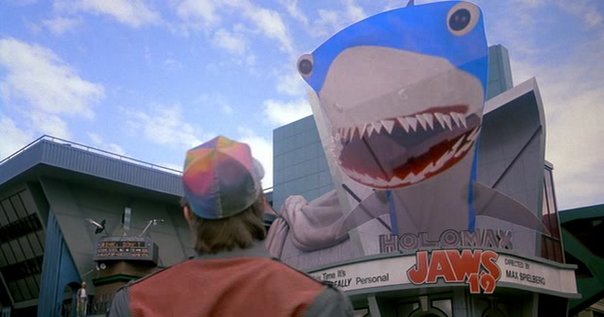
Watch: A fake trailer for Jaws 19. And a fake trailer or a Dell Computers movies. And an honest trailer for Aladdin.

See: Star Wars: The Force Awakens with a lot of Disney characters added in. And how much the Princess Leia slave outfit sold for at auction. And how to make your own Kylo Ren costume and lightsaber.

Read: Why Loki was cut out of Avengers: Age of Ultron.

See: Alternate credit designs for Avengers: Age of Ultron.

Watch: A rare behind the scenes video from Back to the Future Part III.

Learn: A bunch of trivia about Who Framed Roger Rabbit.

Watch: An adorable introduction to Disney’s young Moana star Auli’i Cravalho.

See: Original artwork based on American Horror Story.

Learn: Who would have starred in Bridge of Spies in 1965.

Watch: A supercut of movie characters at the moment of tremendous revelation.

Find Out: Which obviously fictional new sci-fi movie a lot of people think is a true story.

Watch: A viral video for Batman v Superman: Dawn of Justice.

Learn: Why the author of The Revenant can’t talk about the movie.

See: This week’s best new movie posters.

Our Features

Reviews: Steve Jobs and The Devil’s Candy.

Festival Report: The best science fiction movies at Fantastic Fest. The best characters of Fantastic Fest.

Comic Book Movie Guide: What Marvel is doing to fight superhero movie fatigue.

Geek Movie Guide: Everything you need to see, read and buy this month.

Sci-Fi Movie Guide: Comparing The Martian, Interstellar and Gravity.

Photo Gallery: Halloween costumes of movie nerds in the 1970s and 1980s.

Home Viewing: Here’s our guide to everything hitting VOD this week. And here’s our guide to essentials to stream on Paramount’s new free YouTube channel. And here’s our guide to the must-see new indie and foreign DVDs and Blu-rays.

and

MORE FROM AROUND THE WEB:

This entry passed through the Full-Text RSS service – if this is your content and you’re reading it on someone else’s site, please read the FAQ at fivefilters.org/content-only/faq.php#publishers.


No Image

Next Chapter In U.S. Vs. Mexico Soccer Rivalry Kicks Off Saturday

Members of the Mexico team celebrate a 4-2 win against the United States in the CONCACAF Gold Cup soccer final at the Rose Bowl in Pasadena, Calif., June 25, 2011.

Members of the Mexico team celebrate a 4-2 win against the United States in the CONCACAF Gold Cup soccer final at the Rose Bowl in Pasadena, Calif., June 25, 2011. Jae C. Hong/AP hide caption

itoggle caption Jae C. Hong/AP

Here we go: some international soccer news that doesn’t involve FIFA President Sepp Blatter.

Saturday night at 9:30 p.m. ET on Fox Sports 1, the United States men’s national team will square off against Mexico’s in a one-game playoff that’s being called the CONCACAF Cup. It will be held at the Rose Bowl in Pasadena, Calif., a historically pro-Mexico venue, and the winner of the game will go on to represent the region in the Confederations Cup in Russia in 2017.

Saturday’s game between the rivals has been looming for months, ever since Mexico won the Gold Cup in July. Tournament rules required the tiebreaker game because the U.S. won the 2013 Gold Cup and Mexico took the following title this summer. The winning team advances to play in the Confederations Cup, a tournament held one year before the World Cup that allows the best teams from around the world to see how they measure up against stiff international competition.

Here’s what you need to know about the game:

1. U.S. Head Coach Jurgen Klinsmann Under Pressure

After a disappointing performance in this summer’s Gold Cup, Klinsmann started to feel the heat. While the German’s leadership and vision for the U.S. squad has been questioned repeatedly since he took over in 2011, former U.S. star Landon Donovan ramped up the rhetoric this week, calling for Klinsmann’s job should the U.S. lose, according to ESPN.

“Around the world, if a player plays poorly and a player has a bad string of results, they get dropped from the team. Jurgen said many times he wants our players to feel pressure — so if they lose a game they can’t go to the grocery store the next day. If they lose a game, they are getting hammered in the press.

“Well, the same holds true for the coach, and so we had a very poor summer with bad results in the Gold Cup. The last game against Brazil was probably the worst game I’ve seen them play under Jurgen.

“The reality is that now, anywhere else in the world, if this coach had those results, and they lose this game against Mexico, they’d be fired.

“I think if Jurgen wants to hold all the players to that standard, then he has to be held to that standard too.”

Of course, it’s worth keeping in mind that some bad blood lingers between Donovan and his former coach after Klinsmann decided to leave the all-time leading scorer for the U.S. off the 2014 World Cup roster. But then again, former U.S. head coach Bob Bradley was fired after the team lost to Mexico in the 2011 Gold Cup final, which could be seen as a precedent should the U.S. decide to cut ties with the coach. For what it’s worth, the U.S. has never lost to Mexico under Klinsmann.

2. Mexican Star Giovani Dos Santos Out With Injury

The Mexican national team confirmed on Twitter this week that Giovani Dos Santos is suffering from a muscular injury and will not be with the team.

“Gio tiene un problema muscular y no podrá estar con nosotros. Estamos viendo quién conformaría el plantel”: Ferretti
#ElFutbolEsNuestro

— Selección Nacional (@miseleccionmx) October 5, 2015

The 26-year-old striker already has 89 starts with the national team and 17 goals, including the winning goal in Mexico’s 4-2 victory over the U.S. in the 2011 Gold Cup final.

Dos Santos’ absence could definitely hurt Mexico, but El Tri has a talented cast of characters ready to step up and fill his cleats, including his brother, Jonathan Dos Santos.

3. Battle Of The Advertisements

Remember the ad aired on Mexican TV last month that used Donald Trump’s controversial remarks on immigration to hype the game? As we reported at the time, the ad spliced snippets from Trump’s comments with footage of the U.S. team losing to the Mexican side.

“In the ad, an electric guitar wails ‘The Star-Spangled Banner’ in the background as the Republican presidential candidate says things like ‘we don’t have victories anymore’ and ‘the American dream is dead.’ Meanwhile, a video montage plays of Mexican players scoring goals, frustrated U.S. players and disappointed American fans.”

On Friday, Fox Soccer responded with its own ad, again using Trump’s words. In this promotion, however, Trump is seen saying, “Our country has tremendous people, tremendous potential,” and “we will make American great again.” He also says, “I love the Mexican people.”

(2/2) Well, now watch this Trump pump up video for the #USMNT! Get ready. #USAvMEX kicks tomorrow on @FS1!
https://t.co/1mfnfZiqTo

— FOX Soccer (@FOXSoccer) October 9, 2015

The ad immediately incurred backlash on social media. There were hundreds of negative responses to the commercial, including from U.S. men’s national team player Herculez Gomez and the Twitter account for one of the main U.S. soccer fan groups, American Outlaws.

I’m 100% positive that this view is not shared by all @FOXSoccer employees or @ussoccer fans. We’ve come too far to stoop to this.

— herculez gomez (@herculezg) October 9, 2015

.@FOXSoccer @FS1 No.

— The American Outlaws (@AmericanOutlaws) October 9, 2015

I don’t think Fox understands the demographics of the American soccer-watching public.

— Travis Waldron (@Travis_Waldron) October 9, 2015

.@FOXSoccer @FS1 Delete your account.

— Russ Andolina (@rjandolina) October 9, 2015

This entry passed through the Full-Text RSS service – if this is your content and you’re reading it on someone else’s site, please read the FAQ at fivefilters.org/content-only/faq.php#publishers.


No Image

Volkswagen Faces Uphill Battle In Repairing Tarnished Reputation

3:54

Download

Volkswagen faces two enormous repair jobs: fixing its polluting diesel cars and its battered reputation. Both may be much harder to fix than anything other scandal-plagued car companies have faced.

Transcript

KELLY MCEVERS, HOST:

Volkswagen now faces two enormously difficult repair jobs. First, fixing millions of polluting VW diesel vehicles, and second, fixing Volkswagen’s reputation after the company was found cheating on emissions tests. Car companies have patched their battered brands before, but, as NPR’s Sonari Glinton reports, the scandal at Volkswagen is different.

SONARI GLINTON, BYLINE: Some practices on Capitol Hill get repeated so often, they become rituals. Every year or so a car CEO gets taken to the woodshed by Congress. It’s kind of like an annual rite – the shaming of the car executives.

(SOUNDBITE OF ARCHIVED RECORDING)

UNIDENTIFIED MAN #1: I don’t see here in GM they’re just whistleblowers.

UNIDENTIFIED MAN #2: You would also be insane if the top executives from the three automakers came here on private jets.

UNIDENTIFIED WOMAN: You just can’t say now, now, and forget the past because people died.

GLINTON: Those were from car hearings past – General Motors’ ignition switch, the auto bailout, Takata air bags, et cetera. And I don’t have to play you a montage to give you a sense of how Congress feels about Volkswagen this week – this bit of tape from Illinois Congresswoman Jan Schakowsky does the trick.

(SOUNDBITE OF ARCHIVED RECORDING)

JAN SCHAKOWSKY: The company’s word isn’t worth a dime. The only thing I want to hear today is exactly how will Volkswagen make this right by consumers.

REBECCA LINDLAND: It’s just another black mark against an industry that, to some extent, people love to hate.

GLINTON: Rebecca Lindland is senior auto analyst with KBB.com. She says the backlash against Volkswagen is different. Beyond the inherent deception, Lindland says the cheat feels personal to people in the U.S. who specifically sought out VW, especially Gen Xers, who are most loyal to the brand.

GLINTON: We went out on a limb. You know, we didn’t go with the obvious choices of a Chevrolet or a Honda. We went with a Volkswagen, and that’s a statement.

GLINTON: Lindland says fixing that relationship will take years, and so will fixing the actual cars.

LINDLAND: The reason that the fix is going to take so long over time is that there’s a number of different generations that are involved and there’s a number of different fixes. So not all vehicles can be fixed through a software upgrade.

GLINTON: Lindland and others say as bad as it may seem for Volkswagen, the company could actually improve its relationship with customers by handling the fix quickly and well. Jack Fitzgerald has been a car dealer since 1966, and he’s had two VW dealerships since the ’90s. He says when it comes to the VW fix, speed matters.

JACK FITZGERALD: Well, the most important thing they can do is to get the matter resolved quickly, get whatever the fix is going to be, and get it installed. And the sooner they do that the sooner the interest in the media will calm down.

GLINTON: Fitzgerald says the anger people feel about Volkswagen is anger he’s felt many times before about other big car companies.

FITZGERALD: Is it cheating to knowingly put out a car with a defective emissions switch that you could fix for a buck or less? How about air bags that you were told by your own employees, it’s going to blow up. But you do it anyway. Isn’t that cheating?

GLINTON: Fitzgerald says customers have a right to be angry, but he’s not surprised.

FITZGERALD: These manufacturers do so many things like this so I suspect that we will periodically run into things like this forever.

GLINTON: Fitzgerald says the real fix would be if consumers paid more attention to recalls, and regulators found the problems and caught the cheaters sooner. Sonari Glinton, NPR News.

Copyright © 2015 NPR. All rights reserved. Visit our website terms of use and permissions pages at www.npr.org for further information.

NPR transcripts are created on a rush deadline by a contractor for NPR, and accuracy and availability may vary. This text may not be in its final form and may be updated or revised in the future. Please be aware that the authoritative record of NPR’s programming is the audio.

This entry passed through the Full-Text RSS service – if this is your content and you’re reading it on someone else’s site, please read the FAQ at fivefilters.org/content-only/faq.php#publishers.