Articles by admin

No Image

Amid Industry Troubles, Nevada Treats Daily Fantasy Sports As Gambling

4:00

Download

NPR’s Audie Cornish talks with Chris Grove, editor of Legal Sports Report, about Nevada’s decision to treat daily fantasy sports as gambling and the industry’s ongoing legal troubles.

This entry passed through the Full-Text RSS service – if this is your content and you’re reading it on someone else’s site, please read the FAQ at fivefilters.org/content-only/faq.php#publishers.



No Image

N.Y. Takes Action Against Surprise Medical Bills From Urgent Care Clinics

New York Attorney General Eric T. Schneiderman asked 20 urgent care clinics for information about how they represent insurance coverage to customers. Now four companies have agreed to change their practices.

New York Attorney General Eric T. Schneiderman asked 20 urgent care clinics for information about how they represent insurance coverage to customers. Now four companies have agreed to change their practices. Andrew Burton/Getty Images hide caption

itoggle caption Andrew Burton/Getty Images

Four companies running urgent care centers in New York have agreed to disclose more fully which insurance plans they accept, following an inquiry by the state’s attorney general that found unclear or incomplete information on their websites that could result in larger-than-expected bills for consumers.

The agreements mark the first enforcement action brought under New York’s new law that targets surprise medical bills, seen as one of the broadest in the nation. The law aims to reduce the number of consumers who get such bills when they unknowingly see providers who are not part of their insurance plan networks.

Although many consumers don’t realize it, visits to urgent care clinics can lead to such out-of-network bills.

In July, New York Attorney General Eric T. Schneiderman sent strongly worded letters to about 20 urgent care clinics, asking for more information. Some of their websites, the letters noted, could be improperly listing which health plans they were part of, potentially a deceptive business practice. Similar concerns have been raised by advocates in other states, who note that urgent care centers often say they “work with” or “accept” insurance, but don’t clearly say whether they are part of particular insurers’ networks.

Such statements “may lead consumers to believe that an out-of-network urgent care center is … ‘in network’ with their health plan,” the July 2 letters said.

That’s important because consumers who go to clinics that aren’t part of their plans’ networks might owe the balance between clinic charges and what their insurers pay toward out-of-network visits, sometimes resulting in large bills.

Those bills, also known as balance bills, are part of the complex way that health care is paid for in the U.S. They occur because insurers form networks of doctors, hospitals and other providers who have agreed to negotiated rates, which are generally lower than their usual fees.

Patients who go outside the network for care — because they want to, don’t know or are seen by an out-of-network provider while at an in-network facility — are subject to balance billing.

Although such bills have long led to consumer complaints, relatively few states have addressed balance billing except for emergency room care.

After reviewing the responses to its July letters, the attorney general’s office determined the information from the four companies, which have more than a half-dozen facilities altogether, was unclear, incomplete or not specific enough.

Under the agreement announced Friday, those owners will specifically list all the health plans they contract with as in-network providers and stop using the terms “works with” or “accepts.” They must also clearly explain that if they are out of network, the consumer could incur higher charges.

New York’s law covering surprise bills law went into effect in March, imposing new requirements on hospitals, doctors and other medical providers. Among other things, the law requires that most health groups and facilities disclose in writing or on their websites the names of the health plans with whom they participate.

The urgent centers that signed agreements are: 181st Street Urgent Care in Manhattan; Brookdale Urgent Care, affiliated with Brookdale Hospital; New York Doctor’s Urgent Care with two locations in Manhattan; and Cure Urgent Care, with three locations in Manhattan and Long Island.

This entry passed through the Full-Text RSS service – if this is your content and you’re reading it on someone else’s site, please read the FAQ at fivefilters.org/content-only/faq.php#publishers.


No Image

Today in Movie Culture: 'Hail, Caesar!' References, A Surreal HItchcock-Kubrick Video and More

Here are a bunch of little bites to satisfy your hunger for movie culture:

Movie References of the Day:

For Slate, Jacob T. Swinney shows us all the MGM movies referenced in just the trailer for the CoensHail, Caesar!:

Movie Mashup of the Day:

James Stewart has a very weird dream in this surreal, NSFW mashup of movies by Alfred Hitchcock and Stanley Kubrick (via Oscilloscope Labs):

[embedded content]

Director Mashup of the Day:

Speaking of Stanley Kubrick, here’s a tease of what 2001: A Space Odyssey looks like as directed by Wes Anderson. This is just the trailer for a full-length fan edit by Nathan Hartman that you can download here.

[embedded content]

Vintage Image of the Day:

Charlie Chaplin and wife/co-star Paulette Goddard seated and laughing during the New York premiere of The Last Dictator, which occurred 75 years ago today.

Cosplay of the Day:

See the best cosplay from last weekend’s New York Comic Con, including the very awesome Iron Man in Hulkbuster suit everyone’s been talking about, in this video by Sneaky Zebra:

[embedded content]

Movie and TV Show Comparison of the Day:

Parallels between Pulp Fiction and Breaking Bad are shown in the latest video by Jorge Luengo:

[embedded content]

Star Wars of the Day:

Learn how to carve an awesome BB-8-o-lantern in the tutorial below (via Fashionably Geek):

BB8-0-Lantern (with tutorial)

Video Essay of the Day:

Now You See It shows us how settings in many movies, including Lost in Translation and Office Space, are like another character (via The Film Stage):

[embedded content]

Movie Science of the Day:

For Nerdist’s Because Science, Kyle Hill addresses vampires to tell them how they’ve been biting people incorrectly:

[embedded content]

Classic Trailer of the Day:

This weekend marks the 30th anniversary of the release of Re-Animator. Watch the original trailer for the horror classic below.

[embedded content]

Send tips or follow us via Twitter:

and

This entry passed through the Full-Text RSS service – if this is your content and you’re reading it on someone else’s site, please read the FAQ at fivefilters.org/content-only/faq.php#publishers.


No Image

Nevada Shuts Down Daily Fantasy Sports Sites

Nevada regulators have ordered daily fantasy sports sites like FanDuel and DraftKings to shut down, saying the businesses can’t operate in the state without a gambling license.

The sites, which claim they operate under a chance-based wagering model — not skill-based — and therefore should not be subject to gambling regulations, have soared in popularity over the last year, the Associated Press reports. But recently, increased scrutiny by regulators have dampened some of the excitement surrounding the sites.

In fact, Nevada’s order comes just one day after it was reported that federal authorities had begun questioning the practices of daily fantasy sites, according to The New York Times.

The FBI reportedly asked daily fantasy sports players whether the sites accepted bets from states where the practice is prohibited and if daily fantasy site employees benefited improperly from insider knowledge.

The questioning began shortly after a DraftKings employee accidentally released data showing which NFL players were started in the most fantasy lineups — before some games had started.

As we reported at the time, that same employee won $350,000 in a contest on rival site FanDuel, which prompted New York state to open an investigation.

The incident also spurred DraftKings and FanDuel to issue a joint statement saying that they valued “the integrity of the games” and were temporarily barring their employees from participating in either site’s contest.

It remains to be seen if the growing backlash against the sites will interrupt their meteoric rise. As Sports Business Daily reported, investors and participants alike quickly embraced the daily fantasy sports model.

“In 2014, 1.5 million Americans paid more than $1 billion in tournament entry fees and FanDuel grew 300 percent in active customers. Yahoo announced on July 8 that it will join the fray. KKR,Comcast/NBC and others have invested in FanDuel, whose valuation now exceeds $1 billion. DraftKings’ exclusive advertising deal with Disney reportedly guarantees $250 million in advertising on ESPN. With sponsorships in every U.S. major league, DFS advertising will soon exceed the levels of online poker sites PokerStars and FullTilt during the pre-2011 poker boom.”

This entry passed through the Full-Text RSS service – if this is your content and you’re reading it on someone else’s site, please read the FAQ at fivefilters.org/content-only/faq.php#publishers.


No Image

Nevada Shuts Down Daily Fantasy Sports Sites

Nevada regulators have ordered daily fantasy sports sites like FanDuel and DraftKings to shut down, saying the businesses can’t operate in the state without a gambling license.

The sites, which claim they operate under a chance-based wagering model — not skill-based — and therefore should not be subject to gambling regulations, have soared in popularity over the last year, the Associated Press reports. But recently, increased scrutiny by regulators have dampened some of the excitement surrounding the sites.

In fact, Nevada’s order comes just one day after it was reported that federal authorities had begun questioning the practices of daily fantasy sites, according to The New York Times.

The FBI reportedly asked daily fantasy sports players whether the sites accepted bets from states where the practice is prohibited and if daily fantasy site employees benefited improperly from insider knowledge.

The questioning began shortly after a DraftKings employee accidentally released data showing which NFL players were started in the most fantasy lineups — before some games had started.

As we reported at the time, that same employee won $350,000 in a contest on rival site FanDuel, which prompted New York state to open an investigation.

The incident also spurred DraftKings and FanDuel to issue a joint statement saying that they valued “the integrity of the games” and were temporarily barring their employees from participating in either site’s contest.

It remains to be seen if the growing backlash against the sites will interrupt their meteoric rise. As Sports Business Daily reported, investors and participants alike quickly embraced the daily fantasy sports model.

“In 2014, 1.5 million Americans paid more than $1 billion in tournament entry fees and FanDuel grew 300 percent in active customers. Yahoo announced on July 8 that it will join the fray. KKR,Comcast/NBC and others have invested in FanDuel, whose valuation now exceeds $1 billion. DraftKings’ exclusive advertising deal with Disney reportedly guarantees $250 million in advertising on ESPN. With sponsorships in every U.S. major league, DFS advertising will soon exceed the levels of online poker sites PokerStars and FullTilt during the pre-2011 poker boom.”

This entry passed through the Full-Text RSS service – if this is your content and you’re reading it on someone else’s site, please read the FAQ at fivefilters.org/content-only/faq.php#publishers.


No Image

Called Back After A Mammogram? Doctors Are Trying To Make It Less Scary

Although false alarms are not at all unusual when it comes to mammograms, they can cause women much anxiety. Doctors are thinking about ways to ease those fears.

Although false alarms are not at all unusual when it comes to mammograms, they can cause women much anxiety. Doctors are thinking about ways to ease those fears. Helen King/Corbis hide caption

itoggle caption Helen King/Corbis

When I left my first mammogram appointment a few weeks ago, I felt fine.

Everything had gone smoothly, the technologist hadn’t made a concerned face when she looked at the screen, and I was convinced I’d get the all-clear from my primary care doctor in a week or so.

Then came the phone calls the following day — first from my doctor’s office, then from the mammography center — telling me the radiologist had seen something that didn’t look quite right. I needed to come back for another mammogram and this time an ultrasound exam, too.

I shouldn’t worry, both callers said. But it was too late.

My thoughts had already leapt to the worst-case scenario, and remained there for the (blessedly few) days it took to get a follow-up scan and then the reassurance that it was nothing to worry about.

I’m still pretty shocked by the degree of anxiety the whole incident provoked. I write about health and in theory should know that the odds were in my favor. But I spent those couple of days in between scans miserable.

My stress went away pretty soon after getting the good news. But the experience made me wonder about the frequency of these recalls and the anxiety they can provoke. And I also wondered if there’s anything to be done about it.

As it turns out, false alarms are not at all unusual when it comes to mammograms.

According to the American College of Radiology, for every 1,000 women who have a screening mammogram, 100 will be called back for another look, and 61 will find nothing wrong after follow-up imaging. Five of those 1,000 will ultimately be diagnosed with breast cancer after further testing, according to the ACR.

The recall rate is higher for women, like me, having their first mammograms — likely closer to 20 percent on average and as high as 50 percent at some facilities, says Stamatia Destounis, a radiologist at Elizabeth Wende Breast Care in Rochester, N.Y., and a professor of radiology at the University of Rochester.

For a first visit, if a radiologist sees an area of density or calcification or a nodule, it’s not possible to look back on previous scans to see if it’s new or has been there, unchanged, for years. So those things are more likely to get checked out by follow-up imaging.

Assessing a mammogram is very different than, say, looking at a femur on an X-ray. “Every breast looks different,” says Debra Monticciolo, chairwoman of the ACR’s Commission on Breast Imaging and a professor of radiology at Texas A&M University College of Medicine. “It’s like reading fingerprints. There isn’t just one normal.”

Women who are pre-menopausal also tend to have denser breast tissue, which makes mammograms harder to read and more likely to prompt a recall, says Destounis.

Those false positives aren’t happening in the same women over and over again, either. According to an analysis published last year in JAMA, the journal of the American Medical Association, over the course of 10 years of annual mammograms starting at age 50, about 61 percent of women will have at least one false positive result.

As for the emotional consequences, a study published last year in JAMA Internal Medicine found false positives are associated with anxiety, but that it had dissipated a year later.

“When you first get called back, you go through all these ideas of what that might mean,” says Anna Tosteson, a professor of medicine at the Geisel School of Medicine at Dartmouth University and an author of the study. “Then you think, ‘I’m so glad I don’t have cancer.’ ” She says anxiety might be more persistent, however, if a woman is recalled year after year.

Doctors are thinking about how to make recalls less miserable.

A study published in 2004 in the Journal of the National Cancer Institute looked at two interventions to see if they would reduce the worry and stress caused by false positive mammograms. The first was immediate reading of the initial mammogram so that follow-up imaging could be done at the same visit, eliminating those days or weeks of worried waiting. (Some women still needed a biopsy or other follow-up to confirm a false positive.)

And the second focused on educational materials — a pamphlet and video that included information about the risk of an abnormal mammogram, common follow-up procedures and tips and strategies for reducing stress and anxiety. That material was provided to women while they waited to see whether mammogram images were clear enough to be read.

“We were trying to normalize the experience” of getting a false positive mammogram, says Mary Barton, an author of the study and now vice president of performance measurement at the nonprofit National Committee for Quality Assurance.

The study found that three weeks after the mammogram, the women with false positive results whose scans were read on the same day had lower levels of anxiety than those whose scans were read later. But that difference had balanced out three months after the mammogram.

Some centers do offer the option of same-day reading, says the ACR’s Monticciolo, though it can be less efficient for the imaging center. And, she says, “some patients don’t want to wait around.”

Receiving the educational materials during the visit wasn’t associated with any difference in anxiety, though. That may be because of the cultural fears surrounding breast cancer, says Barton. As a comparison, she notes, very few people get really stressed out while awaiting the results of a cholesterol test.

There’s a broader debate going on about when to start mammography. And when a woman speaks with her primary care doctor about the screening test, “part of that conversation should be educating women just how common these callbacks are,” says Tosteson.

I’m hoping to be less stressed out if it happens to me again, but I’d just as soon it didn’t.

Katherine Hobson is a freelance health and science writer based in Brooklyn, N.Y. She’s on Twitter: @katherinehobson

This entry passed through the Full-Text RSS service – if this is your content and you’re reading it on someone else’s site, please read the FAQ at fivefilters.org/content-only/faq.php#publishers.


No Image

Today in Movie Culture: 'Back to the Future' Reunion, Deleted 'Monty Python' Animated Sequences and More

Here are a bunch of little bites to satisfy your hunger for movie culture:

Movie Reunion of the Day:

Back to the Future stars Christoper Lloyd and Michael J. Fox reunited for a Toyota commercial where they talk about technology from Back to the Future Part II that we still don’t have (via ComingSoon.net):

[embedded content]

Movie Parody of the Day:

College Humor addresses the same topic by showing us what Back to the Future Part II would be like if Doc and Marty traveled to the real 2015:

[embedded content]

Deleted Scenes of the Day:

Watch newly released animated sequences by Terry Gilliam that didn’t make it into Monty Python and the Holy Grail (via Dangerous Minds):

[embedded content]

Casting Depiction of the Day:

Boss Logic has rendered another potential casting idea with this poster of Vin Diesel as Black Bolt in Marvel‘s Inhumans, for ComicBook.com:

Movie Mash-Up of the Day:

What if Zack Snyder directed a Harry Potter movie? Here’s a trailer for the wizarding franchise in the style of Watchmen‘s (via Cinematic Montage Creators):

[embedded content]

Movie Recreation of the Day:

The lastest from 8 Bit Cinema shows us what a plot-faithful old-school video game based on Mad Max: Fury Road would look and sound like:

[embedded content]

Movie Comparison of the Day:

Couch Tomato shows us 30 reasons Avengers: Age of Ultron is the same movie as The Empire Strikes Back:

[embedded content]

Star Wars of the Day:

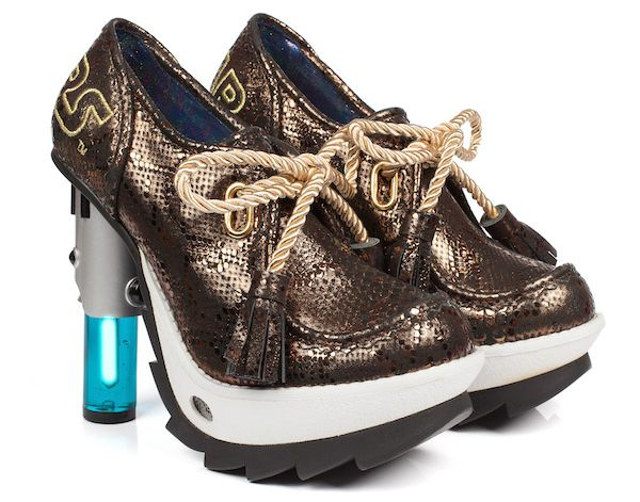
A crossguard lightsaber is crazy enough, but can you imagine having lightsabers on your feet? These Star Wars high heels are made by a British company called Irregular Choice, and they also have shoes with R2-D2s as the heels, which you can see at Geekologie.

Filmmaker in Focus:

Here’s a supercut by WhoIsPablo of close-ups on lips and eyes in Quentin Tarantino movies:

[embedded content]

Classic Trailer of the Day:

Today is the 21st anniversary of the release of Quentin Tarantino‘s Pulp Fiction. Watch the original trailer for the groundbreaking movie below.

[embedded content]

Send tips or follow us via Twitter:

and

This entry passed through the Full-Text RSS service – if this is your content and you’re reading it on someone else’s site, please read the FAQ at fivefilters.org/content-only/faq.php#publishers.

No Image

First Listen: Dexter Story, 'Wondem'

Dexter Story's new album, Wondem, comes out Oct. 23.
44:08

Dexter Story’s new album, Wondem, comes out Oct. 23. Courtesy of the artist hide caption

itoggle caption Courtesy of the artist

Finding an acceptable line between influence and appropriation has dogged musicians for generations, and Dexter Story addresses the issue in surprising and joyous ways on Wondem, his second album as a bandleader.

A 50-year-old multi-instrumentalist born and bred in L.A., Story has created a song cycle under the spell of Ethiopian music. Before recording Wondem, he’d never visited that part of the world — he traveled to the country himself for the first time only a month or so ago — or apprenticed with any of the region’s musical masters, as tradition dictates. But he’s a studied player and arranger, with a list of musical credits that reads like an insider’s guide to the roots of L.A.’s current polyglot underground music uprising: music director at Temple Bar, member of Build An Ark and The Life Force Trio, accompanist to the likes of Kamasi Washington, Gaslamp Killer, Madlib and many others. Still, on this project, he was admittedly just a cultural tourist who’d surfed the Internet and taken inspiration from what he’d seen and heard.

Which is why Wondem, Amharic for “brother,” simply feels like an informed take on pan-global music, focused on the multiverse of tonalities found in one of the birthplaces of humanity. After years of listening to West African recordings under the influence of the Americas and the Caribbean, Story made a conscious decision to take that fusion mindset and apply it to East Africa from a modern Californian’s point of view. The caring knowledge of an archivist, the loving whimsy of a fan, the seasoning and chops that come with musical experience — all are alive in this mix.

Story’s devotion to Ethiopian music arose from a chance 2011 gig as a drummer with EthioCali, trumpeter Todd Simon’s expert rotating-cast ensemble, as it performed Ethiopian jazz. His awakening began there, but when Story started writing these songs, it wasn’t with the mindset of a musical purist enthused by the newest sound in his arsenal. Instead, he opted to combine ideas that encompassed his entire rhythmic education. For Story, “fusion” is not a dirty word.

The possibilities of musical commingling begin at the top: The opener, “A New Day,” is Story’s attempt to write a modern Ethiopian pop vocal; it ends up sounding like a Memphis soul song translated to a funky Wolayta rhythm as a bright Moog rides the brass fanfares. “Be My Habesha” features guitarist Damon Aaron, drummer Te’Amir Sweeney and a clapping female chorus as they re-create the Tuareg groove popularized in the U.S. by Tinariwen. “Mowa,” dedicated to the legendary Sudanese singer and oud player Mohammed Wardi — whose popularity crossed most East African borders — features a graceful Arabic melody arranged for violin and viola by Miguel Atwood-Ferguson, set amid Story and Mark de Clive Lowe’s keyboards. Co-written by vocalist Yared Teshale, “Sidet Eskemache,” Amharic for “one will remember,” views Afrobeat through the lens of the Oromo music traditions. “Yene Konjo” finds the thread between Ethiopian music and R&B: A Wollo beat powers its sunset melody and Dexter’s plaintive notion, before de Clive-Lowe’s piano and Randall Fisher’s flute carry the coda. It’s a gorgeous ending to an album that’s only beginning to uncover a world of influence and possibility.

First Listen: Dexter Story, ‘Wondem’

Cover for Wondem

A New Day

  • Artist: Dexter Story
  • From: Wondem
  • Add to Playlist
  • Embed
    Embed <iframe src="https://www.npr.org/player/embed/448404476/448572730" width="100%" height="290" frameborder="0" scrolling="no">
  • Purchase Music

Be My Habesha

  • Artist: Dexter Story
  • From: Wondem
  • Add to Playlist
  • Embed
    Embed <iframe src="https://www.npr.org/player/embed/448404476/448572774" width="100%" height="290" frameborder="0" scrolling="no">
  • Purchase Music

Merkato Star

  • Artist: Dexter Story
  • From: Wondem
  • Add to Playlist
  • Embed
    Embed <iframe src="https://www.npr.org/player/embed/448404476/448573570" width="100%" height="290" frameborder="0" scrolling="no">
  • Purchase Music

Saba

  • Artist: Dexter Story
  • From: Wondem
  • Add to Playlist
  • Embed
    Embed <iframe src="https://www.npr.org/player/embed/448404476/448573680" width="100%" height="290" frameborder="0" scrolling="no">
  • Purchase Music

Xamar

  • Artist: Dexter Story
  • From: Wondem
  • Add to Playlist
  • Embed
    Embed <iframe src="https://www.npr.org/player/embed/448404476/448573998" width="100%" height="290" frameborder="0" scrolling="no">
  • Purchase Music

This entry passed through the Full-Text RSS service – if this is your content and you’re reading it on someone else’s site, please read the FAQ at fivefilters.org/content-only/faq.php#publishers.


No Image

Fact Check: Did Glass-Steagall Cause The 2008 Financial Crisis?

Some Democratic candidates have blamed the 1999 scaling back of the Glass-Steagall Act for the financial collapse. That's arguably only partially true.

Some Democratic candidates have blamed the 1999 scaling back of the Glass-Steagall Act for the financial collapse. That’s arguably only partially true. Mary Altaffer/AP hide caption

itoggle caption Mary Altaffer/AP

Taking on Wall Street makes for good politics in the Democratic Party. And several of the candidates at Tuesday night’s debate had tough words about big banks. That was particularly true of former Maryland Gov. Martin O’Malley and Vermont Sen. Bernie Sanders.

Although he didn’t say so directly, O’Malley suggested several times that consolidation in the banking business was a big factor in the 2008 financial crash and that the U.S. economy remains vulnerable because of it.

His solution: Bring back Glass-Steagall, the Depression-era law that barred commercial banks from engaging in investment banking that was scaled back in the Clinton administration. We decided to look at O’Malley’s claim about the risks of bank consolidation.

The Claim:

“[T]he big banks — I mean, once we repealed Glass-Steagall back in the late 1999s, the big banks, the six of them, went from controlling, what, the equivalent of 15 percent of our GDP to now 65 percent of our GDP.”

The Big Question:

How much bigger have the largest banks gotten, what did Glass-Steagall have to do with it and, most important, did the scaling back of Glass-Steagall lead to the 2008 financial collapse?

The Broader Context:

Despite what O’Malley and many other people believe, Glass-Steagall was not technically repealed in 1999, but it was effectively neutered. Legislation was passed that year that allowed bank holding companies to engage in previously forbidden commercial activities, such as insurance and investment banking.

The change in the law opened the floodgates for giant mergers, such as the $33 billion deal between J.P. Morgan and Chase Manhattan in September of 2000. During the darkest days of the financial crisis, Bank of America acquired two troubled financial companies — Countrywide Financial Services and Merrill Lynch, deals that wouldn’t have been possible before 1999.

The Long Answer:

The biggest banks are a lot bigger than they once were, mostly because of mergers and acquisitions. What’s not in dispute is that changes to Glass-Steagall allowed the biggest banks to grow bigger, which has raised new concerns about risks to the financial system.

At issue is the “too big to fail” problem: Will the federal government once again be forced to come to the aid of federally insured megabanks that have taken outsize risks with their money?

Since 2008, regulatory changes in the U.S. and abroad have supposedly mitigated that danger. The Dodd-Frank financial overhaul bill contains complicated provisions that would allow regulators to step in and take over failing banks, if necessary.

But there’s plenty of skepticism that the changes have gone far enough.

Some critics, such as Nobel laureate Joseph Stiglitz, have long seen the changes to Glass-Steagall as a major factor in the 2008 crash. By bringing “investment and commercial banks together, the investment bank culture came out on top,” Stiglitz wrote in 2009. “There was a demand for the kind of high returns that could be obtained only through high leverage and big risk-taking.”

But others, like former Treasury Secretary Tim Geithner, have said the focus on Glass-Steagall is misguided. They argue other factors were more important in causing the 2008 crisis, such as bad mortgage underwriting, poor work by the ratings agencies and a securitization market gone crazy. All of that would have happened no matter the size of the big banks.

In fact, some of the financial institutions that fared the worst, such as Bear Stearns, AIG, Lehman Brothers and Washington Mutual, weren’t part of large bank holding companies at all.

“I have often posed the following question to critics who claim that repealing Glass-Steagall was a major cause of the financial crisis: What bad practices would have been prevented if Glass-Steagall was still on the books?” wrote former Federal Reserve Vice Chairman Alan Blinder. “I’ve yet to hear a good answer.”

Democratic Sen. Elizabeth Warren of Massachusetts and Republican Sen. John McCain of Arizona teamed up to sponsor a bill that would bring back Glass-Steagall-type restrictions.

It was never allowed to come up for a vote.

The Short Answer:

The 1999 changes to Glass-Steagall led to much bigger banks, but that was, at best, just one factor in the 2008 financial crisis.

Sources:

  • Hearing before the Joint Economic Committee, “Financial Regulatory Reform: Protecting Taxpayers and the Economy,” Nov 19, 2009
  • Stiglitz, Joseph, “Capitalist Fools,” Vanity Fair, January 2009
  • Blinder, Alan, “It’s Broke, Let’s Fix It: Rethinking Financial Regulation,” Prepared for the Federal Reserve Bank of Boston, Oct. 23, 2009
  • Sens. Warren, McCain, Cantwell and King, “We Need to Rein In ‘Too Big To Fail’ Banks,” U.S. Senate documents, July 17, 2014
  • Phone interview with Karen Shaw Petrou, Federal Financial Analytics

This story is part of NPR’s fact-checking series, “Break It Down,” in which we try to cut through the spin and put things in context. Have something you want us to fact check? Put it in the comments section or send us an email at nprpolitics@npr.org.

This entry passed through the Full-Text RSS service – if this is your content and you’re reading it on someone else’s site, please read the FAQ at fivefilters.org/content-only/faq.php#publishers.