Articles by admin

No Image

FDA Approves Experimental Zika Screening For Blood Donations

On Wednesday, the FDA approved an experimental test that screens blood donations for the Zika virus. It’s a response to a blood donation shortage in Puerto Rico, where local donations were halted out of fear of spreading the virus.

Transcript

KELLY MCEVERS, HOST:

The federal government has been paying for blood banks around the country to ship blood to Puerto Rico. The FDA issued guidelines last month to stop blood donations on the island because of the Zika virus. The virus is most commonly transmitted through mosquitoes, but Brazil has reported cases of transmission through blood transfusions. Puerto Rico has more than 300 reported Zika cases.

Within the next week or two, Puerto Rico will be able to start collecting blood again. That’s because the FDA has just give the go-ahead to a new test to screen blood donations for the virus. Peter Marks is the director of the FDA’s Center for Biologics Evaluation and Research. Welcome to the show.

PETER MARKS: Thanks very much.

MCEVERS: This test was developed by the drug company Roche, and it will be used on what’s called an investigational basis. First, can you tell us what that means?

MARKS: So investigational use of a test means that data continue to be collected on the tests performance at specific participating sites that are conducting the test. And that means that the test itself has not yet received approval to be marketed commercially.

MCEVERS: Is there any question at all about whether or not this test actually works?

MARKS: So the best way that I can answer that is to say that, yes, the test is under investigational use. But before we allowed this investigation – new drug application to proceed, we carefully considered any potential risks prior to determining that it was safe for it to proceed.

And we also considered the possibility that the test might malfunction in a manner that could put patients at risk. And we consider the latter really highly unlikely. So we feel that it was reasonable to allow this test to proceed at this time.

MCEVERS: OK. I mention that blood banks from all over the U.S. have been sending blood to Puerto Rico. Was there a real possibility of a blood shortage if Zika were to spread to Florida or other Gulf states?

MARKS: The good news is that currently, the blood supply in the United States is quite adequate. And there actually is an interorganizational disaster task force which has been monitoring the situation and feels that, at least at this point, the blood supply would be adequate to meet the needs would there have been spread of Zika to a larger area on the continental United States.

MCEVERS: So let’s say if Zika were to be transmitted elsewhere in the U.S., could this test be rolled out quickly to affected areas?

MARKS: So I’m going to have to defer part of that to the sponsor, Roche. But my understanding is that they are aware of the potential need that this could be a larger outbreak than the existing one in Puerto Rico.

MCEVERS: If you can, put this in perspective for us in terms of other developments regarding Zika.

MARKS: So in terms of the perspective of having a blood screening test, I would say that this is a major step forward in helping to keep the blood supply safe. It will allow blood to potentially be collected in areas where there is active transmission, which is quite important for something like Zika which could be transmitted by either mosquitoes or could possibly be sexually transmitted. So we feel it is a step forward.

MCEVERS: Dr. Peter Marks heads the FDA’s Center for Biologics Evaluation and Research. Thank you very much.

MARKS: Thank you.

Copyright © 2016 NPR. All rights reserved. Visit our website terms of use and permissions pages at www.npr.org for further information.

NPR transcripts are created on a rush deadline by a contractor for NPR, and accuracy and availability may vary. This text may not be in its final form and may be updated or revised in the future. Please be aware that the authoritative record of NPR’s programming is the audio.


Let’s block ads! (Why?)


No Image

U.S. Women's Soccer Team Members File Wage Discrimination Complaint

Five members of the U.S. women’s national soccer team have filed a federal complaint against the U.S. Soccer Federation, alleging wage discrimination.

Transcript

AUDIE CORNISH, HOST:

Five of the best-known members of the U.S. women’s soccer team have filed a federal complaint against the U.S. Soccer Federation. They accuse it of wage discrimination. Female soccer players, the complaint says, earn a fraction of what male players make and the women have had far more success on the field. NPR’s Nathan Rott reports.

NATHAN ROTT, BYLINE: All right, let’s start with two approximate numbers. The first is 40 percent. That’s what a women’s soccer player that makes a World Cup team should expect to earn compared to a male counterpart, about 40 percent of what he makes according to the complaint that was filed with the Equal Employment Opportunity Commission.

The second number also listed in that complaint is 20 million, as in $20 million, which is how much more money in revenue the women’s team generated last year than the men’s. It’s numbers like that and the discrepancy between them that compelled the five U.S. women’s national soccer team players to file a federal wage discrimination complaint. Here’s the team’s co-captain Carli Lloyd in an interview with her teammates on NBC’s “Today.”

(SOUNDBITE OF TV SHOW, “TODAY”)

CARLI LLOYD: The pay disparity between the men and women is just too large.

ROTT: The players are being represented by prominent sports attorney Jeffrey Kessler. He represented NFL star quarterback Tom Brady during the Deflategate inquiry and has worked on a number of other cases. He told NPR in an email that they believe they have a very strong case of blatant gender discrimination and that the Equal Employment Opportunity Commission will agree. Heidi Hartmann agrees. She’s president of the Institute for Women’s Policy Research. And she says the difference in pay between male soccer players and female is egregious.

HEIDI HARTMANN: We’re not talking about comparing ice skaters to football players. We’re talking about comparing soccer players to soccer players.

ROTT: But Hartmann says it’s not necessarily surprising. She says federal wage data shows that there’s about a 21 percent gap between men’s and women’s pay in the U.S. overall. And the claim that men’s soccer players get everything from bigger bonuses to higher per diem than women on international trips is in line with other national trends too.

HARTMANN: This is not uncommon in the rest of the business world. That – it just happens that men will get more of these bonuses and awards than women.

ROTT: Hartmann says she’s hopeful that the tension brought to the issue by a group as popular as the U.S. women’s soccer team will help raise awareness. And it’s hard to argue with that popularity.

(SOUNDBITE OF ARCHIVED RECORDING)

UNIDENTIFIED CROWD: (Chanting) USA, USA, USA.

ROTT: It wasn’t all that long ago that the U.S. women’s soccer team was doing their victory lap around the country in front of thousands of fans at rallies like this one in Downtown Los Angeles.

(SOUNDBITE OF ARCHIVED RECORDING)

UNIDENTIFIED WOMAN: World Cup champions.

(APPLAUSE)

ROTT: When the U.S. women won their third World Cup last year, the final became the most-watched soccer game in U.S. history, men or women. But it’s fair to say that the relationship between U.S. soccer and the women’s team is already strained. U.S. soccer sued the women’s national team players’ union last month over a contract dispute over their collective bargaining agreement.

In a statement regarding this issue, U.S. soccer says its efforts to be advocates for women’s soccer are unwavering and it says it’s committed to negotiating a new collective bargaining agreement that addresses compensation with the Women’s National Team’s Players Association at the end of this year. In a tweet responding to that statement, U.S. soccer co-captain Becky Sauerbrunn says, quote, “where in the statement do they address or even attempt to refute the pay discrepancy?” She ends it with the hashtag Equal Play Equal Pay. Nathan Rott, NPR News.

Copyright © 2016 NPR. All rights reserved. Visit our website terms of use and permissions pages at www.npr.org for further information.

NPR transcripts are created on a rush deadline by a contractor for NPR, and accuracy and availability may vary. This text may not be in its final form and may be updated or revised in the future. Please be aware that the authoritative record of NPR’s programming is the audio.

Let’s block ads! (Why?)


No Image

Latitudes: Hear Great Global Music Right Now, With A World Premiere

Guitarist Asad Ali from the Sachal Ensemble of Lahore, Pakistan.

Guitarist Asad Ali from the Sachal Ensemble of Lahore, Pakistan. Mobeen Ansari/Courtesy of the artists hide caption

toggle caption Mobeen Ansari/Courtesy of the artists


It was five years ago that an unassuming — and highly unlikely — band became the toast of the jazz world. Pakistan’s Sachal Ensemble includes studio musicians from their country’s once-healthy film industry, which began to decline in the 1970s in a wave of political and religious pressure.

With their audience at home close to eviscerated, the members of the Sachal Ensemble and their champion and impresario, banker Izzat Majeed, were casting about to find some way of appealing to an international audience. They wound up blending distinctly American jazz with South Asian instruments like sitar, sarod, tabla and dholak along with Western instruments that had long been incorporated into local music, like violin and guitar.

The group’s road to a 2013 collaboration with Jazz At Lincoln Center became the subject of a documentary film, Song of Lahore, which will be in theaters in May. Along with the documentary, an album featuring the enemble with many well-known American guest artists, including Wynton Marsalis, Nels Cline, Jim James, Susan Tedeschi and Derek Trucks, and Meryl Streep.

On this track — premiering here on NPR Music — the Sachal Ensemble works with Sean Lennon on a cover of Nick Lowe’s “(What’s So Funny ‘Bout) Peace, Love and Understanding,” a song made famous by Elvis Costello. Perhaps unsurprisingly, their collaboration rides a rather George Harrisonian psychedelic wave.

The Easter Sunday bombing in Pakistan took place in the Sachal Ensemble’s hometown of Lahore, in an act of terrorism that seems to have been intended as an attack particularly on Christians there. The musicians’ work and this song in particular feel all the more tragically timely.

[embedded content]
Vevo

An Indian rapper named Divine (a.k.a. Vivian Fernandes) has made something of a cottage industry in repping the harder-edged neighborhoods of his hometown, Mumbai — light-years away from the playgrounds of India’s super-wealthy.

The beat and backing tracks on this new song, “Jungli Sher” (Jungle Lions), tip toward the bombastic. But Divine’s flow is packed with brilliant internal rhymes and trenchant observations like “Hope is the rickshaw of the poor/on which the rich cruise.” (To catch the translation, turn the subtitles to “English [United Kingdom]”.) The video’s visuals, shot via iPhone, are just as scrappy as the lyrics.

[embedded content]
Sony Music India YouTube

The Congolese-French singer and rapper known as Maître Gims (Gandhi Djuna) has a brand-new ballad featuring Sia called “Je Te Pardonne” (I Forgive You), out this week. It’s already been viewed on YouTube well over 2 million times. That’s a big ballad, but I still prefer the thoroughly African beats of his smash-hit ode to well-dressed men called “Sapés comme jamais” (Dressed Like Never Before), featuring fellow rapper Niska.

Being a sapeur — that is, an adherent to the Société des Ambianceurs et des Personnes Élégantes (The Society of Ambiance-Makers and Elegant People) — is a way of life for a certain stratum of Congolese men. And that is something that Maître Gims can claim as part of his heritage. His dad, Djuna Djanana, was a band member for Congolese rumba legend Papa Wemba, the artist nicknamed Le Pape (The Pope) de la Sape.”

[embedded content]
Maître Gims VEVO YouTube

By this time, it’s no secret that I’ve become a big fan of the trio of sisters who call themselves A-WA: Tair, Liron and Tagel Haim. They come from southern Israel and draw deeply from their Yemeni Jewish roots, not just in terms of the language they sing in — Yemeni Arabic — but also in their particular aesthetic. They frame their tradition with thrillingly up-to-date sounds and ideas.

So I was thrilled when they agreed to a late-night meetup with the NPR Music crew at SXSW this year to perform a lullaby of sorts, an achingly sweet love song, sung in Arabic and in three-part harmony, called “Ya Shaifin Al Malih.”

[embedded content]
NPR Music YouTube

Let’s block ads! (Why?)


No Image

Today in Movie Culture: Movie Villains Assemble for 'Suicide Squad' B Team, the Many Faces of Superheroes and More

Here are a bunch of little bites to satisfy your hunger for movie culture:

Mashup of the Day:

See all your favorite villains, incluidng Dr. Evil, Gollum and the Wet Bandits from Home Alone, assembled in Funny or Die’s Suicide Squad parody trailer:

Superhero Movie Truth of the Day:

PBS’s Idea Channel attempts to answer who should pay for all the destruction seen in superhero movies and how it would happen in real life:

[embedded content]

Superhero Movie Infogram of the Day:

Keep track of which superheroes have been portrayed by which actors and how many times in this handy infogram (via Geekologie):

Superhero Supercut of the Day:

It’s Batman versus Superman in terms of who gets referenced more in movies and TV shows:

Adorable Star Wars Cosplay of the Day:

More cute cosplay out of WonderCon this week, here’s a family dressed as Rey, Finn and baby BB-8 from Star Wars: The Force Awakens (via Fashionably Geek):

Star Wars Trivia of the Day:

There are a lot of things we know the names of in the Star Wars universe, even though they’re never named in the movies. Here is a video highlighting 23 such things (via /Film):

[embedded content]

Adorable Vintage Image of the Day:

In honor of Warren Beatty‘s birthday, here’s a photo of him and sister Shirley MacLaine as kids:

Movie Comparison of the Day:

Couch Tomato shares 24 reasons why Christopher Nolan‘s Inception and Harry Potter and the Half-Blood Prince are the same movie:

[embedded content]

Filmmaker Comparison of the Day:

David Lynch is linked to Maya Deren with a side-by-side comparison between many of his movies, plus Twin Peaks, and her experimental film classic Meshes in the Afternoon:

[embedded content]

Classic Trailer of the Day:

Today is the 15th anniversary of the release of Spy Kids. Watch the original trailer for Robert Rodriguez‘s family film below.

[embedded content]

and

Let’s block ads! (Why?)


No Image

Obama Task Force Director On The Cancer 'Moonshot' Initiative

NPR’s Audie Cornish talks with Greg Simon, executive director of the Obama administration’s Cancer Moonshot Task Force, about the barriers to advancements in treating cancer.

Transcript

AUDIE CORNISH, HOST:

Back in January at the president’s State of the Union address, there was one ambitious announcement that stood out.

(SOUNDBITE OF ARCHIVED RECORDING)

BARACK OBAMA: Let’s make America the country that cures cancer once and for all. What do you think, Joe?

(CHEERING)

CORNISH: President Obama put Vice President Joe Biden in charge of what is now called the Cancer Moonshot Task Force. The mission is as ambitious as putting a man on the moon used to be – eliminate cancer as we know it. The task force now has an executive director – Greg Simon. He’s been on the job for a week and a half, and he joins me now. Greg Simon, welcome to the program.

GREG SIMON: Thank you.

CORNISH: So talk about exactly what this task force is supposed to do, especially in so short a period of time, right? President Obama’s tenure’s coming to a close.

SIMON: Well, it is a short period of time, but there are very few problems that are holding us back in cancer research that are unknown. We know what the problems are, and now we need to start the action to deal with those problems because the overarching goal of this initiative is to achieve 10 years of progress in five years.

Now, there are some things that can’t be speeded up. You can’t do a three-minute egg in one minute, but you don’t have to spend six weeks setting it up. And that’s often what we do in science. So we’re looking at, how can we share data from cancer centers to cancer centers to accelerate knowledge transfer? We’re looking at how to communicate with the public the importance of being in clinical trials. We’re looking at the importance of the pharmaceutical industry of opening up their compound libraries for more people to explore possible therapeutic agents in those libraries.

CORNISH: You mentioned this idea of getting different cancer center databases to share information. What are the obstacles to that right now?

SIMON: Well, there are cultural obstacles. People tend to want to keep the data in their institution because that data is valuable. It can lead to new therapies. It can lead to new ways to treat patients, and people want them to come to their center.

Our technology for sharing has improved faster than our attitude about sharing, and that’s part of what the vice president is doing – is helping change that attitude so that people realize the more you share, the more you have.

CORNISH: Now, you have worked with the medical company Pfizer. You’ve worked with nonprofits in the cancer care industry. Fundamentally, this is still business, and people are competing with each other.

SIMON: That’s true, but this is sort of the tragedy of the commons example. If people don’t take care of a common space, it deteriorates, and everybody suffers. The common space here is people surviving cancer. Academia is not very good at taking a drug to market, and they’re not very good, and they shouldn’t be that good at raising billions of dollars for those clinical trials and the cost of bringing a drug to market.

The pharmaceutical industry is very good at clinical trials and marketing, but they tend not to often have the trust of the people they’re trying to help. There are many foundations that want to partner with the pharmaceutical industry to do research into a rare disease that would otherwise not be funded. And the foundations bring money, and they bring patients. But what they don’t have are the scientists to develop the drug.

And those collaborations are a way that we can link patient community and the pharmaceutical community for both people’s benefits.

CORNISH: Do you worry about overselling what can accomplished here? I mean, it’s called the Cancer Moonshot Initiative. Do you think people think you’re going to cure caner altogether?

SIMON: Well, we try to avoid giving the impression that in between now and the end of term we’re going to cure cancer now and forever, but what we can do, is we can identify what needs to be done and put the power of the vice president and the president behind it while we’re here and create a blueprint for any next administration to take this forward because the kind of issues we’re dealing with are things that can ease the path for the scientist out there to do their job better.

You know, I always say that the people who are in the system don’t have the time to fix the system. They’re too busy trying to save our lives with new drugs and therapies. But those of us on the outside – it’s our job to fix the system. And there are plenty of things in the system that are totally amenable to being improved this year and over the next several years that will save lives.

CORNISH: Greg Simon is executive director of the White House Cancer Moonshot Task Force. Thank you so much for speaking with us.

SIMON: Thank you.

Copyright © 2016 NPR. All rights reserved. Visit our website terms of use and permissions pages at www.npr.org for further information.

NPR transcripts are created on a rush deadline by a contractor for NPR, and accuracy and availability may vary. This text may not be in its final form and may be updated or revised in the future. Please be aware that the authoritative record of NPR’s programming is the audio.

Let’s block ads! (Why?)


No Image

UConn Women's Basketball Team Confronts Consequences Of Being 'Too Good'

The University of Connecticut women’s basketball team is destroying the competition. In fact, this year, there hasn’t been any competition. But as the Huskies are closing in on their fourth consecutive title, the lack of competition is hurting the women’s game. NPR’s Audie Cornish talks to David Ubben of the website “Sports on Earth.”

Transcript

AUDIE CORNISH, HOST:

This year’s University of Connecticut women’s basketball team is the stuff of video games, not real life. The Huskies are beating teams by an average of 40 points. The three-time defending champion is undefeated heading into this weekend’s final four, and they’re on a 73-game winning streak. And as everyone expects UConn to win its record fourth consecutive title, there’s some that wonder if being this good is actually a bad thing for women’s basketball. Joining us now is David Ubben. He covers college sports for the website Sports on Earth. Welcome to the program.

DAVID UBBEN: Thanks. I’m glad to be here.

CORNISH: So Dan Shaughnessy of the Boston Glove riled up the Internet when he tweeted during UConn’s 60-point victory over Mississippi State in the Sweet 16. He said, quote, “hate to punish them for being great, but they’re killing women’s game. Watch? No thanks.” OK, so, David Ubben, this is a seriously backhanded compliment. What’s going on here?

UBBEN: I think a lot of people do believe, when you have teams that are this far out in front of the pack, it’s like running a marathon where the guy that’s ahead is, you know, five miles ahead of anyone else that’s on the track. It’s kind of pointless to watch.

CORNISH: What? We love that guy. That guy’s the greatest runner ever. That’s why we watch it.

UBBEN: In theory. You know, this is not a dynamic that’s limited to women’s basketball. I think when you have things that are this dominant, when they aren’t unprecedented, people tune out.

CORNISH: All right. Well, coach Geno Auriemma was asked about Shaughnessy’s comments after another recent tournament rout. Here’s how he responded.

(SOUNDBITE OF ARCHIVED RECORDING)

GENO AURIEMMA: When Tiger was winning every major, nobody said he was bad for golf. Actually, he did a lot for golf. He made everybody have to be a better golfer.

CORNISH: So what’s your answer to this?

UBBEN: It’s not a great argument. Tiger Woods isn’t recruiting the best golf balls and the best golf clubs to come play for him. Tiger Woods is the golfer. And when he plays, he’s not preventing anyone else from getting better. But Geno Auriemma has to recruit, every single year, the best women’s players in the country. So when he gets a good player, somebody else doesn’t get a good player. And so when you’re asking everyone to improve your game, well, you could start by handing off some of those good players to other programs. And that’s a ludicrous request, but UConn’s still going to be out in front as long as Geno keeps getting the best players and developing the best players. It’s a credit to them, but it’s still not helping the women’s game.

CORNISH: What do you say to women, especially young women players, who hear this and may think that this kind of argument from Shaughnessy and others is essentially sexism passed off as sports opinion, right? I mean, the idea being that women – we don’t want to watch them. They’re not as good, until they’re really good, and then we say we don’t to watch them because they’re really good. I mean, this is – this is seeming very much like a catch-22.

UBBEN: Yeah, I think there’s certainly something to that. And I think it’s a tough line because I think that it’s hard to sort out. And a lot of times, it’s hard to have honest conversations about, how do we improve the women’s game? How do we fix these issues without sort of being drowned out by, well, you’re being a sexist.

CORNISH: In the meantime, is there any chance that UConn could use lose this weekend to Oregon State in the national semifinals or in a title game?

UBBEN: No.

CORNISH: Are you still going to watch?

UBBEN: (Laughter). I’ll probably tune in. That’s one thing that Geno Auriemma is unbelievable about doing. He keeps his team invested. They’re competing against themselves. We want to be as good as we can be. It’s incredible to watch. Geno Auriemma is a fantastic coach – one of the best in the history of the game.

CORNISH: That’s David Ubben. He covers college sports for the website Sports on Earth. Thanks so much.

UBBEN: Thank you, appreciate it.

Copyright © 2016 NPR. All rights reserved. Visit our website terms of use and permissions pages at www.npr.org for further information.

NPR transcripts are created on a rush deadline by a contractor for NPR, and accuracy and availability may vary. This text may not be in its final form and may be updated or revised in the future. Please be aware that the authoritative record of NPR’s programming is the audio.

Let’s block ads! (Why?)


No Image

Apple, Google Ordered To Unlock Smartphones Since At Least 2008

Apple and Google have been asked to unlock cell phones since at least 2008.

Photo Illustration: Ariel Zambelich/NPR

Throughout the fight over whether Apple should help unlock the San Bernardino shooter’s iPhone was the understanding that this was not Apple’s first time at bat.

Now, documents show that Apple has been facing similar requests since at least 2008, and that the Silicon Valley giant is not alone, as Google, too, has fielded calls for help unlocking phones in court, for instance to bypass a lock screen and reset a password.

The documents came out of a request by the American Civil Liberties Union, which obtained court records from around the country on cases where the government invoked the All Writs Act — the broad 1789 law at the center of the Apple-FBI dispute — to compel a tech company’s help in retrieving contents of a locked device.

The documents reveal 63 confirmed cases where the government asked Apple or Google through courts to help get inside a locked device, predominantly in drug crime investigations, the ACLU says. Though disclosures in an ongoing Brooklyn case had confirmed that the Justice Department had about 70 existing All Writs orders, the documents show that Google is as involved in them as Apple.

Google said this in a statement to The Wall Street Journal:

“We carefully scrutinize subpoenas and court orders to make sure they meet both the letter and spirit of the law,” a Google spokesman said. “However, we’ve never received an All Writs Act order like the one Apple recently fought that demands we build new tools that actively compromise our products’ security…. We would strongly object to such an order.”

What the documents also show is the extent to which a legal precedent from the high-profile San Bernardino case could have had a far-reaching influence. More and more commonly, investigators are faced with complex digital locks that they believe hide important evidence. But what should be the role of the tech companies in unlocking them?

“The FBI wants you to think that it will use the All Writs Act only in extraordinary cases to force tech companies to assist in the unlocking of phones,” ACLU attorney Eliza Sweren-Becker said. “Turns out, these kinds of orders have actually become quite ordinary.”

Over the years, government agencies including the FBI, the Department of Homeland Security, the Drug Enforcement Administration and the Bureau of Alcohol, Tobacco, Firearms and Explosives have requested a variety of types of help from Google and Apple in cases that span all regions of the country from New Mexico to Massachusetts, Oregon to Alabama, court records show.

Though the documents don’t show the extent of the companies’ compliance, we do know that in some cases, Apple did comply as has been disclosed before.

For instance, in the 2008 Secret Service investigation of a child exploitation case, United States v. Jansen, Apple helped bypass the lock screen of an iPhone at the court’s request.

In some of the cases in the ACLU records, the government plays out the arguments seen in the San Bernardino case. “The government is aware, and can represent, that in other cases, courts have ordered the unlocking of an iPhone under this authority,” U.S. Attorney Melinda Haag and Assistant U.S. Attorney Garth Hire write in a 2014 case in the Northern District of California. “Additionally, Apple has routinely complied with such orders.”

And then, the magistrate judge, Kandis Westmore, writes in response: “Apple shall not be required to maintain copies of any user data … all evidence preservation shall remain the responsibility of law enforcement agents.”

Naomi LaChance is a business news intern at NPR.

Let’s block ads! (Why?)


No Image

Big Financial Costs Are Part Of Alzheimer's Toll On Families

Paul Hornback was a senior engineer and analyst for the U.S. Army when he was diagnosed with Alzheimer's six years ago at age 55. His wife Sarah had to retire 18 months ago to care for Paul full-time.

Paul Hornback was a senior engineer and analyst for the U.S. Army when he was diagnosed with Alzheimer’s six years ago at age 55. His wife Sarah had to retire 18 months ago to care for Paul full-time. Courtesy of the Hornbeck family hide caption

toggle caption Courtesy of the Hornbeck family

First, Alzheimer’s takes a person’s memory. Then it takes their family’s money.

That’s the central finding of a report published Wednesday by the Alzheimer’s Association on the financial burden friends and families bear when they care for someone with dementia.

“What we found was really startling,” says Beth Kallmyer, vice president of constituent services for the organization. “The cost of paying for care was putting people in a situation where they had to make really difficult choices around basic necessities — things like food, medical care, transportation.”

The report, based on a survey of more than 3,500 Americans contributing to the care of someone with dementia, also found that:

  • Friends and family spent, on average, more than $5,000 a year of their own money on the expenses of their loved one with dementia, ranging from food to adult diapers.
  • More than one-third of these contributors to care who had jobs had to reduce their hours or quit.
  • To make ends meet, about 13 percent had to raise money by selling personal belongings, such as a car.
  • Nearly half of the care contributors surveyed had to dip into their savings or retirement funds.

The Alzheimer’s Association decided to conduct the survey, Kallmyer says, after hearing lots of stories of financial hardship from friends and family members of people with Alzheimer’s. One of those stories came from Paul and Sarah Hornback, who live in central Kentucky.

Paul Hornback was a senior engineer and analyst for the U.S. Army when was diagnosed with Alzheimer’s six years ago. He was just 55.

“I was kind of at the height of my career and then this dreadful diagnosis came and it just wiped out every plan I had for my career,” he says.

Hornback and his wife, Sarah, had to re-imagine their future. Then they began to consider the financial implications.

The Hornbacks had borrowed a lot of money to put three children through college. Now Paul was being forced to retire early and they wouldn’t have his salary to pay off the debt.

“We had to sell basically everything but my wife’s car and an old truck that I kept to drive around here on the farm,” he says.

Paul Hornback lost his engineer's salary when diagnosed with Alzheimer's at age 55. He still tends chores on his farm, but worries about how his wife and kids will pay off the medical debt as his health deteriorates.

Paul Hornback lost his engineer’s salary when diagnosed with Alzheimer’s at age 55. He still tends chores on his farm, but worries about how his wife and kids will pay off the medical debt as his health deteriorates. Courtesy of the Hornback family hide caption

toggle caption Courtesy of the Hornback family

At first, Sarah Hornback kept working as a school administrator. But about 18 months ago, she also had to retire early — to care for her husband.

“It got to the point where it just wasn’t safe for him to stay alone just because of memory and decision making,” she says. “He might leave the stove on or he might decide that there was a tree branch bothering him and he should get out the chain saw.”

The Hornbacks are getting by on their early retirement income. But Sarah Hornback says the real financial problems will start when she can no longer care for her husband on her own.

“When he has to go into full-time care, I’m going to be at the poverty level, basically,” she says.

The financial burden is greatest for people like the Hornbacks, who have to pay more while working less, Kallmyer says.

“It’s really a double whammy,” she says. “People are sometimes not able to work as much or not able to work at all in order to provide care, and then they’re paying money out of pocket on top of that.”

The survey also found that about two-thirds of Americans believe Medicare will help cover nursing home costs, or aren’t sure whether it will. It won’t.

“What that tells us is that families are ultimately unprepared for that really, really significant cost of long-term care,” Kallmyer says.

Clinics that specialize in Alzheimer’s often try to help family members navigate the financial aspects of care.

“It’s a challenge for almost every family that we see,” says Dr. Pierre Tariot, a geriatric psychiatrist and director of the Banner Alzheimer’s Institute in Phoenix. “We do see folks who are lucky and have considerable resources. But even for those families it’s a major financial obligation.”

And it’s not realistic to expect every family to absorb the cost, Tariot says.

“Ultimately,” he says, “society will need to think of other ways of funding care for our elders as they become vulnerable.”

Let’s block ads! (Why?)


No Image

Today in Movie Culture: 'Batman vs. Terminator,' How 'The Revenant' Should Have Ended and More

Here are a bunch of little bites to satisfy your hunger for movie culture:

Mashup of the Day:

You’ve seen him fight Superman, now watch Batman vs Terminator in a stop-motion animated short (via Live for Films):

[embedded content]

Movie Takedown of the Day:

While acknowledging Leonardo DiCaprio deserved an Oscar, Honest Trailers compares The Revenant to Jackass:

[embedded content]

Alternate Ending of the Day:

Speaking of The Revenant, if you wished it was much shorter, you’ll appreciate the two ways it could have ended shown here:

[embedded content]

Film Studies Lesson of the Day:

Speaking of the work of Alejandro G. Inarritu, here’s a video essay from Now You See It on what long takes can’t do:

[embedded content]

Adorable Star Wars Cosplay of the Day:

Is this meant to be the Kylo Ren version of Calvin from Calvin and Hobbes or just a little guy dressed as the Star Wars: The Force Awakens villain at WonderCon? Either way, it’s absolutely precious (via Fashionably Geek):

This kid? AWESOME. #WonderCon #GeekAndNerdy pic.twitter.com/OMpxPhpyQt

— Geek & Sundry (@GeekandSundry) March 26, 2016

Star Wars Montage of the Day:

See the path of a the Skywalker family lightsaber through the seven Star Wars movies in this chronologically cut video:

[embedded content]

Vintage Image of the Day:

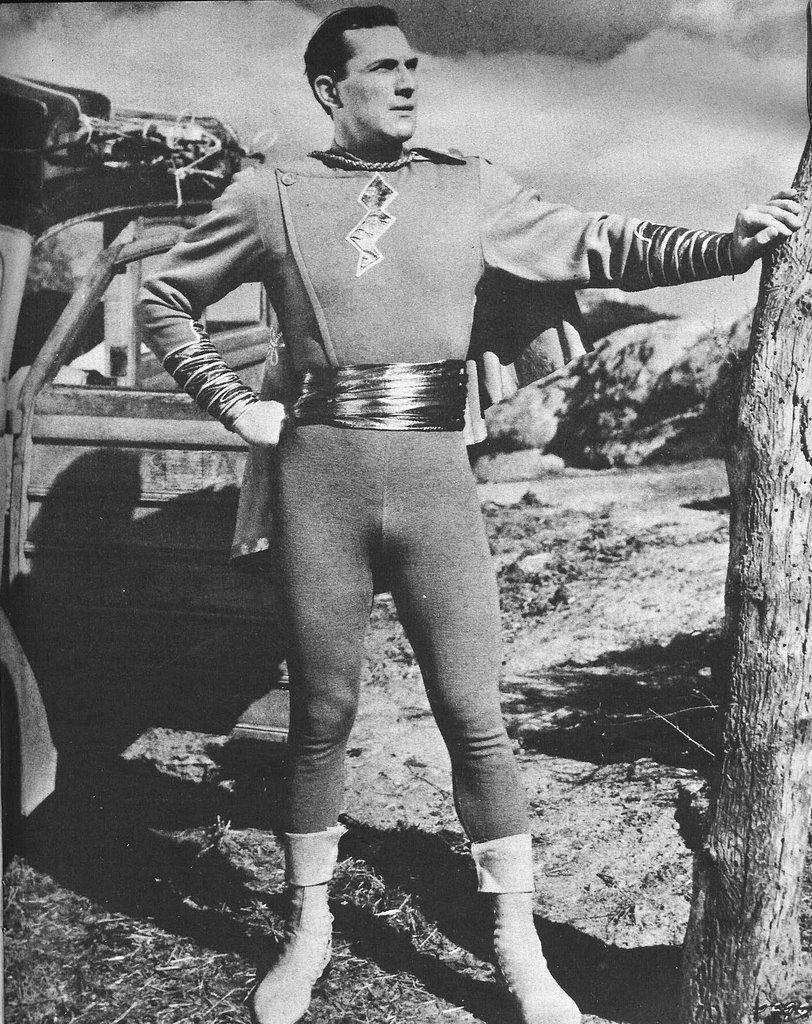
This week marks the 75th anniverary of the official release of the classic serial Captain Marvel, one of the first instance of superheroes on the big screen, seen below:

Filmmaker in Focus:

Steven Spielberg is the focus again today with a supercut showcasing flight in his movies (via Cinematic Montage Creators):

[embedded content]

Film Analysis of the Day:

For Must See Movies, Darren Foley explores the duality found in Denis Villeneuve‘s Sicario:

[embedded content]

Classic Trailer of the Day:

Today is the 50th anniversary of the UK premiere of Alfie, starring Michael Caine. Watch the original trailer for the movie’s U.S. release later in the year below.

[embedded content]

and

Let’s block ads! (Why?)


No Image

Adopt A Beehive — Save A Beekeeper?

A beehive at Frangiosa Farms, in Parker, Colo. The farm introduced an adopt-a-hive program in 2012. The one-time adoption fees per hive range from $45 to $130 (the latter gets you three jars of honey).

A beehive at Frangiosa Farms, in Parker, Colo. The farm introduced an adopt-a-hive program in 2012. The one-time adoption fees per hive range from $45 to $130 (the latter gets you three jars of honey). Courtesy of Nick French/Frangiosa Farms hide caption

toggle caption Courtesy of Nick French/Frangiosa Farms

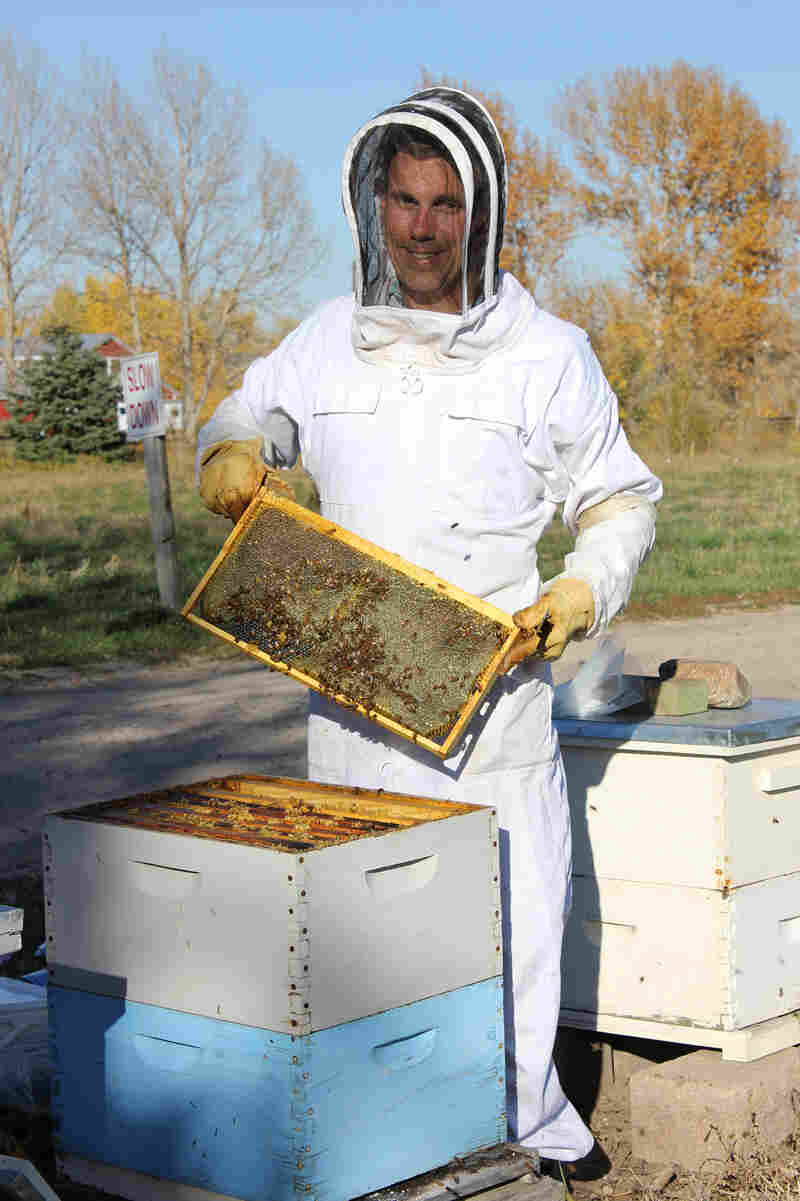
Beekeeper Nick French never knows what he’ll find when he opens up his hives for the first spring inspections. Of the 40 hives he manages in Parker, Colo., French loses about one-quarter of his colonies every year.

“I work all summer long to raise healthy bees, but there are no guarantees they’ll make it through the winter,” says French, founder of Frangiosa Farm.

Recent years have been especially hard on beekeepers. The latest research shows that beekeepers have lost almost a third of their hives over the winter — and replacing them is expensive. “Losing bees is like watching dollar bills fly out the window,” says Tanya Phillips, beekeeper and founder of Bee Friendly Austin.

A few creative beekeepers have come up with a new source of funding: They’re inviting bee supporters to “adopt a hive.”

Most programs operate with similar models. Adopters pay a fee in exchange for honey from their “adopted” bees and an adoption certificate acknowledging their support.

The Adopt A Bee program at Frangiosa Farm was introduced in 2012. The one-time adoption fees per hive range from $45 to $130 (the latter gets you three jars of honey). French signed up 25 adopters the first year; last year, the number of adopters jumped to 300.

Adopting a hive is about more than increasing honey sales — it’s a matter of survival, says French.

“In any other industry, you’d go out of business with the kind of losses beekeepers experience,” French says. “I couldn’t keep going without community support.”

The programs take advantage of public concern and raise awareness of the plight of bees.

Beekeepers are experiencing average annual losses of more than 30 percent, according to Bee Informed Partnership, a nonprofit collaboration of universities and research labs studying honeybee losses.

In managed colonies (hives raised by beekeepers), losses can be caused by a number of factors, including parasites, pesticides, loss of forage and colony collapse disorder, according to David Tarpy, a professor and extension apiculturist for North Carolina State University.

Beekeeper Nick French of Frangiosa Farms loses about one-quarter of his colonies every year. Last year, he had 300 adopters sign up for his farm's adopt-a-bee program.

Beekeeper Nick French of Frangiosa Farms loses about one-quarter of his colonies every year. Last year, he had 300 adopters sign up for his farm’s adopt-a-bee program. Courtesy of Nick French/Frangiosa Farms hide caption

toggle caption Courtesy of Nick French/Frangiosa Farms

Bees are essential to the health of the food supply. More than 100 different crops — about one-third of the foods we eat — depend on pollination from bees and other pollinators. While native bees do some of the work, it’s honeybees that do the bulk of the pollination for agricultural crops.

“Honeybees provide a service that native bees cannot,” Tarpy says. “And beekeepers face uncertainty every single year about whether or not they’ll have enough bees to match pollination demands.”

Of course, beekeepers can add more bees, but the options come at a great expense.

Packages of bees to populate a new hive are upwards of $100 per hive. Splitting the bees from an existing hive into two new hives is free — but it curbs honey production as bees work to populate their new colonies and boost honey stores.

And when infectious diseases like American foulbrood strike, beekeepers often burn affected hives to prevent it from spreading, triggering expenses for new equipment.

The concept of adopt-a-hive programs is catching on. In addition to the four-year-old program at Frangiosa Farm, there is a similar initiative at University of Hawaii, Hilo.

In Jacksonville, Fla., the Bee Friends Farm program promises adopters will make 60,000 new friends when they adopt a hive for $35. The fee covers adoption benefits like a bottle of honey, adoption certificate and a photo of a hive with the adopter’s name on it.

Bee Friendly Austin introduced an Adopt-a-Beehive program this spring. Rather than use the $49 adoption fee to cover the cost of her bee losses — which Phillips estimates are just between 5 and 10 percent of her colonies per year, thanks to the temperate Texas climate — Phillips plans to use adoption fees to support new beekeepers. The fees from all hive adoptions will be donated to the launch of a local master beekeeper program.

“The only way to help the bees is to teach people how to raise them right,” Phillips says. Without the additional financial support, beekeepers would be forced to raise the price of honey to offset the costs of colony losses.

The combination of support for bees and beekeepers alike make Tarpy a fan of the programs.

“It’s a powerful means of giving everyday citizens a chance to support our beleaguered honeybee population by supporting those who manage their colonies,” he says. “It’s a lot easier to replace bees than to replace beekeepers.”


Jodi Helmer is a North Carolina-based journalist covering food and farming.

Let’s block ads! (Why?)