Articles by admin

No Image

Borrowers Rejoice: A Treasury Benchmark Rate Fell To Record Low

Money is on sale! Come in and enjoy the low, low prices!

On Tuesday, borrowed money got cheaper — and cheaper. For example, Bankrate, a consumer financial services company, started the day by saying lenders were offering 30-year fixed-rate mortgages at an average of just 3.4 percent.

By the end of the day, Zillow’s mortgage rate tracker was showing that the national average had slipped down to 3.27 percent.

And investors around the world were sending the U.S. Treasury this important message: We’ll lend you the cheapest money you’ve ever seen.

The yield on the benchmark U.S. 10-year Treasury note closed below 1.4 percent for the first time on record. It settled at 1.367 percent. Even during the Great Depression, interest rates were never that low on the 10-year Treasury note. You could look it up.

And the 30-year bond’s yield slipped to 2.138 percent, below its record low of 2.226 percent Friday. Incredibly, some analysts are saying the yield may soon fall below 2 percent.

Why such cheap money?

Because following the United Kingdom’s vote on June 23 to exit the European Union, investors have gotten very nervous about the global economy. They want to park their cash someplace safe. And that means investing in government debt issued by safe-looking countries like the U.S., Germany, Switzerland and Sweden. In other words, taxpayers in such countries can get cash at historically low rates.

And the low Treasury rates, in turn, serve as benchmarks for other types of lending rates, like auto loans, home equity loans and credit cards. They even set the tone for mortgage rates.

“The Brexit aftermath left markets rattled throughout last week, driving the continued decline in mortgage rates near all-time historical lows,” Erin Lantz, vice president of mortgages at Zillow, said in a statement.

So if you need to borrow money, this is a good time to do it.

And if you are a saver who lets out a sad sigh when you see your savings account statement — which shows you earned maybe a dime in interest — prepare to get even sadder.

Let’s block ads! (Why?)


No Image

What Puts The Waddle In The Walk Of Moms-To-Be?

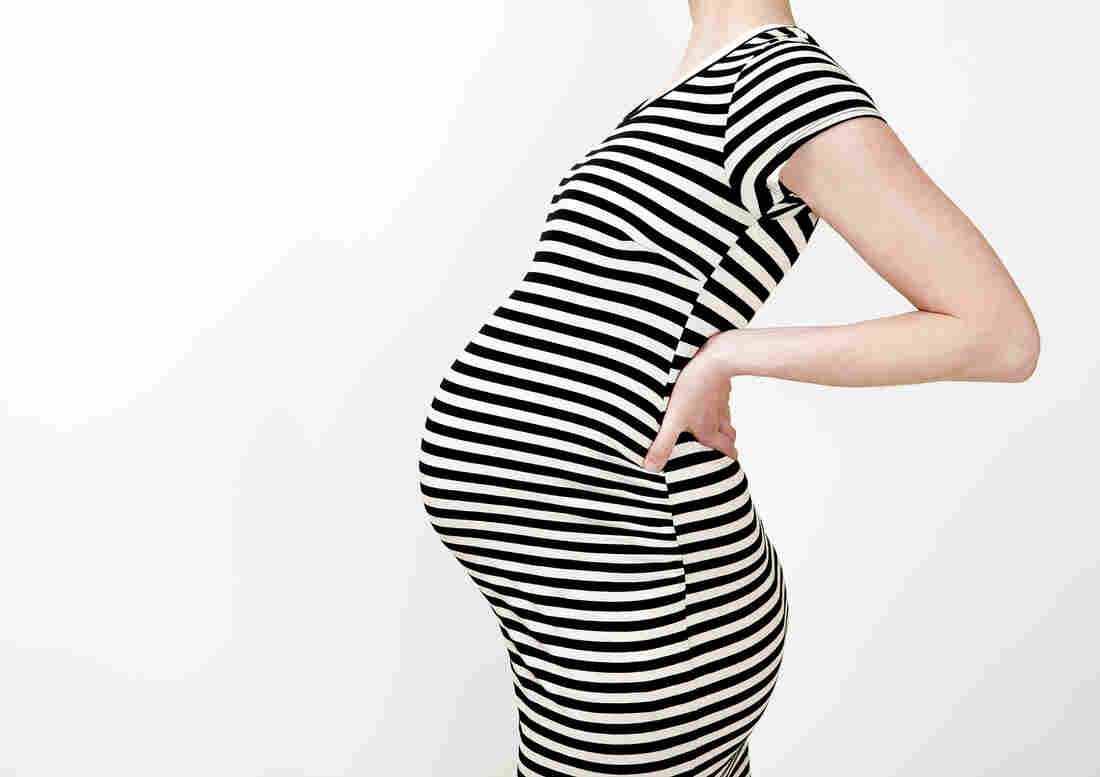
Waddle, don't run.

Waddle, don’t run. Compassionate Eye Foundation/Natasha Alipour Faridani/Getty Images hide caption

toggle caption Compassionate Eye Foundation/Natasha Alipour Faridani/Getty Images

I was never good at strolling.

If I had a destination, I walked quickly. Not because I wanted exercise, mind you, but because it felt natural.

That all changed with my first pregnancy. The nonpregnant me bolted across a street with five seconds left on the crossing signal. The uber-pregnant me much preferred a full 30-second allotment. Anything less and I waited for the next traffic cycle.

This change of pace was entirely out of my control. As I neared my due date, my once-brisk stride was shorter, my stance wider, my torso tilted farther backward.

I had morphed into a waddler! And I could only waddle so fast.

Now, at 28-weeks pregnant with my second child, I’m beginning to waddle again. I’m thrilled to be expecting, but I’m already missing my normal speed.

Obstetricians tell us that there’s a good explanation for why pregnancy changes our gaits.

“There are a lot of joints in the pelvis. Those are going to loosen as the pregnancy goes on, which is probably how the body adapts to allow a fairly good-sized baby to fit through,” explains Dr. Daniela Carusi, director of both general gynecology and surgical obstetrics at Brigham and Women’s Hospital in Boston. The loosening of the joints and the downward pressure from the growing belly actually cause the pelvis to get wider, she says. A wider pelvis means a wider stance.

That explains part of the waddle. The other part, according to Carusi, is caused by a shift in our center of balance. “As the belly gets bigger, which is the spot in the body which marks the center point, the weight moves forward and that makes the spine curve more inward,” she says.

We pregnant women can’t help but lean back.

I wondered what would happen if I attempted to trade comfort for more graceful motion, if it was even possible to force myself to return to something closer to my former stride.

Carusi warns that it wouldn’t work. “You could reposition your legs, but it’s hard to make your hips narrower,” she says. “What you’d be doing is compensating for the change instead of overriding it.”

“I don’t think it makes sense to narrow the gait,” agrees Stephanie Prendergast, a physical therapist at The Pelvic Health and Rehabilitation Center in Los Angeles. “Keeping the gait wider is safer for balance reasons.”

Prendergast says we could consider making slight adjustments to the way we stand. “When they’re standing still, many pregnant women will push their bellies out and lean backward,” she explains. “But then your ligaments at the front of the hip are holding up your weight.” If we don’t lean back so far, she says, our gluteal muscles could take some of the weight and our hips would hurt less.

I tried to adjust my stride anyway, of course. Unsurprisingly, it felt terrible. When I straightened my back, my shoulders arched forward. When I narrowed my stance, my balance was all off. Other women have had similar experiences.

“I tried to walk with my feet closer together, but after a while that hurt more than changing my gait,” says mother-to-be Keke Gibb, a science professor at Baker University in Baldwin City, Kan., who spoke with me on her due date. “It’s most comfortable if you widen your stance a lot,” she explains. “It feels like my thighs hate each other. I try not to let them touch while I do a really awkward sashay through the neighborhood. I use my whole body to swing one leg forward at a time.”

There is no fighting the pregnant waddle.

I take some comfort in knowing that there’s a small community of scientists investigating how this altered motion affects our lives. These researchers attach reflective stickers to a pregnant woman’s body and then use special cameras to capture the 3-D movement of the stickers as she walks, stands up, or does other simple tasks that can become challenging late in pregnancy.

“When we look in our software, the women look like stick figures moving in 3-D, so we can capture different aspects of how they move, rotate, flex and extend,” says Jean McCrory, a biomechanist at West Virginia University who studies gait and balance in pregnant women.

McCrory documented, for example, how pregnant women walk with pelvises tilted backward and feet spread wider apart. Others have shown how we rise from chairs more slowly, and with a greater attention to balance.

In a recent study, scientists at Hiroshima University studied the mechanics of movement as pregnant and nonpregnant women rose from a chair, picked up two stacked plates, turned to the right, and then walked away. The researchers showed that pregnant women flex their hips less while walking and lean back more while standing.

These findings will come as no surprise to obstetricians or anyone who has ever had a baby bump of her own. But studies like these might one day help scientists figure out how to make everyday tasks safer for pregnant women. McCrory, for example, wants to use her knowledge of pregnant motion to find ways to prevent pregnant women from falling — a worthy goal since over a quarter of pregnant women fall at some point.

I joined that statistic during my last pregnancy when I got overexcited about an old friend visiting. As she got out of her car, I momentarily forgot to waddle and leaped forward to hug her. My toe caught the sidewalk and I fell so slowly and awkwardly that she thought it was intentional — that I was trying to entertain her with some sad attempt at pregnant lady slapstick. The baby and I were fine.

So far I’ve managed to stay on my feet this pregnancy. For the moment, I also still have some of my prepregnancy speed. I know this because, like so many aspects of pregnancy, people comment on it. Last week, as I strode past two men on my way to work, I overheard one say, “Whoa! Look at how fast she walks — for a pregnant lady.”

Let’s block ads! (Why?)


No Image

Independence Day in Movie Culture: Patriotism From Patrick Stewart, Deadpool, Captain America and More

Here are a bunch of little bites to satisfy your hunger for Fourth of July movie culture:

Movie Promo of the Day:

The upcoming animated movie Sausage Party has a very special Fourth of July-themed PSA this holiday weekend:

[embedded content]

Musical Melody of the Day:

It doesn’t get much more American than a beloved British actor, such as Patrick Stewart, dressed up as a cowboy and singing country and western classics (via Live for Films):

[embedded content]

Fake Movie of the Day:

Michael Bay already depicted a heroic Franklin Delano Roosevelt in Pearl Harbor. But this fake Michael Bay movie focused on FDR would be much more entertaining (via BuzzFeed):

Supercut of the Day:

For Fandor Keyframe, Nelson Carvajal compiles the greatest Fourth of July and patriot American scenes in movies:

[embedded content]

Mashup of the Day:

And here’s an oldie but goodie from Fandango and Movieclips mashing up clips from movies celebrating America:

[embedded content]

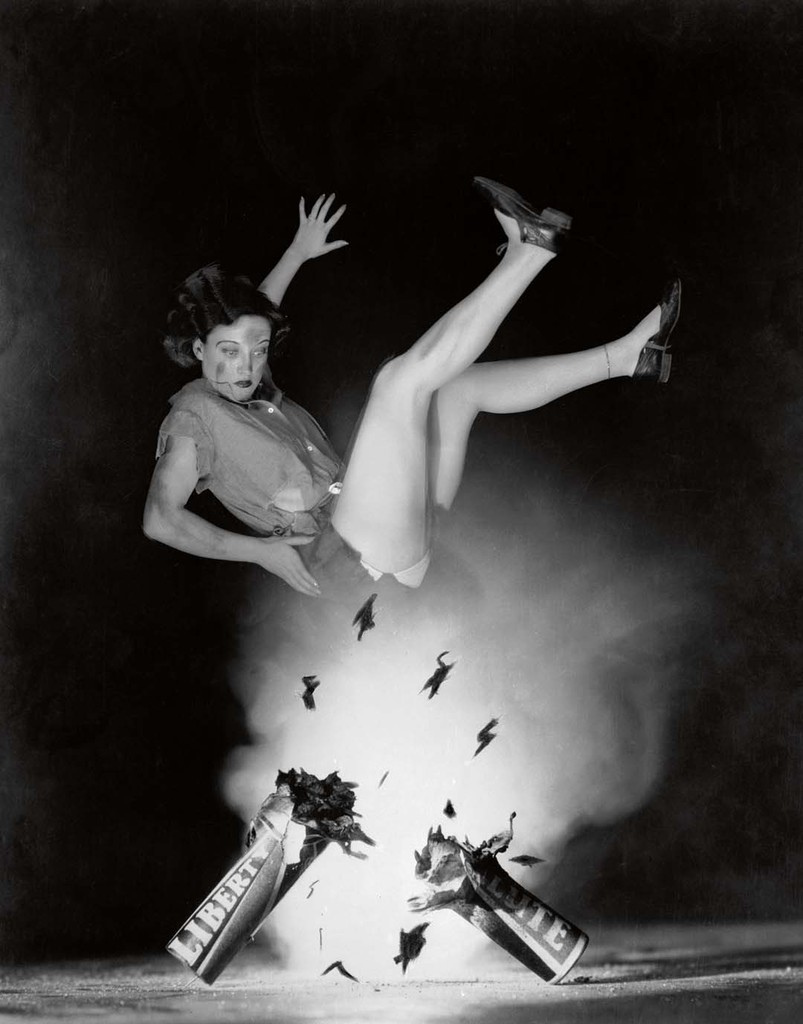
Vintage Image of the Day:

Young Joan Crawford and an exploding firecracker in 1927:

Video Essay of the Day:

Frame by Frame investigates whether or not Captain America is truly an American movie hero:

[embedded content]

Fan Art of the Day:

Speaking of Captain America, here he is with Optimus Prime, Sam the Eagle and Snake Eyes from G.I. Joe loving America:

Cosplay of the Day:

America’s new favorite movie character, Deadpool, gets patriotic for the holiday in this fan get-up:

Classic Trailer of the Day:

America was born on the Fourth of July, so today’s classic trailer to showcase has to be for Oliver Stone’s Born on the Fourth of July, starring Tom Cruise in his first Oscar-nominated performance. Watch it below.

[embedded content]

and

Let’s block ads! (Why?)


No Image

From Farm To Distillery, Heirloom Corn Varieties Are Sweet Treasures

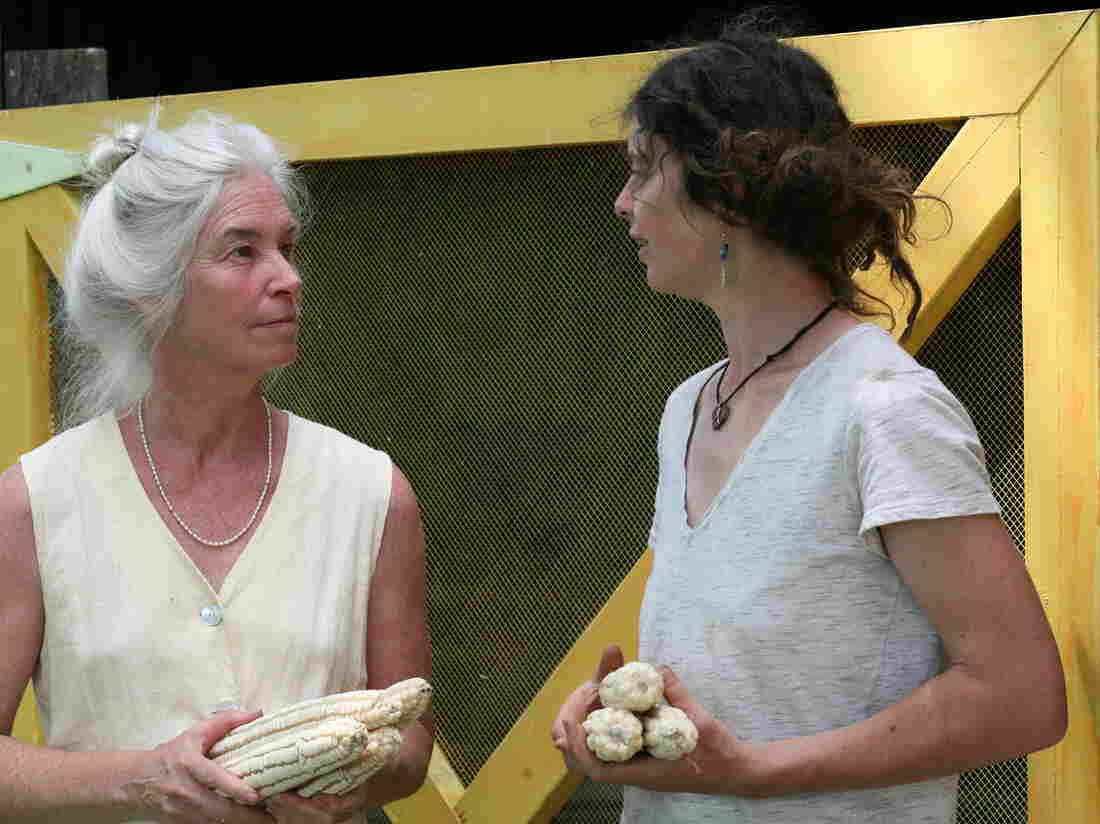
Jennifer Gleason (left) and Alice Melendez, who's growing Hickory King heirloom corn on her farm to help Gleason make corn chips.

Jennifer Gleason (left) and Alice Melendez, who’s growing Hickory King heirloom corn on her farm to help Gleason make corn chips. Noah Adams/NPR hide caption

toggle caption Noah Adams/NPR

“Knee-high by the Fourth of July” is an old favorite saying, when you’d drive past a field of corn out in the country. And many of the old favorite varieties, called heirloom corn, have lots of new friends.

In recent years, seed companies have been reporting big sales numbers for these varieties. Baker Creek Heirloom Seeds in Missouri says sales are “skyrocketing” — a fitting verb for the fireworks holiday.

And in Kentucky, two projects are growing up around heirloom corn. One is a new adventure in bourbon distilling, and the other takes place on a hilltop farm in the northern part of the state.

I went to see Jennifer Gleason’s small farm, and on the way I was thinking of some of the colorful heirloom names, such as Painted Mountain Corn, Bloody Butcher and Country Gentleman.

Gleason’s favorite? Hickory King Corn.

A longtime farmer, she’s trying to raise enough food for her family, mostly fruits and vegetables. Fifteen years ago she decided to start growing a grain, and went looking for corn. She was introduced to Hickory King.

Jennifer Gleason's field of Hickory King Corn, with buckwheat growing between the rows, in Mount Olivet, Ky.

Jennifer Gleason’s field of Hickory King Corn, with buckwheat growing between the rows, in Mount Olivet, Ky. Courtesy of Jennifer Gleason hide caption

toggle caption Courtesy of Jennifer Gleason

“I went to the local hardware store in downtown Maysville … a really old-fashioned one where you had the seeds in bins that you shoveled out and weighed. And it was the only corn that wasn’t pink. All the other corn was coated with a fungicide,” she says.

Gleason now has a corn house where she works with a grain mill, grinding the Hickory King she brings in from the fields. For the home table she makes grits, hominy and corn bread.

“With time I learned it was an open-pollinated heirloom variety best known for making great moonshine, making great hominy. Animals love it as fodder,” she says.

Gleason’s farm is now a tiny factory, called Sunflower Sundries. She makes and sells lot of soap, jars of jam, pickled asparagus, and the Hickory King line which now includes corn chips. They come in 12-ounce bags, which sell well in nearby counties and by mail order. Two local farmers help her grow enough of the corn.

I was pleased to hear Jennifer mention moonshine. Of course, that’s how bourbon got started in the first place, with the Scots-Irish settlers in Appalachia growing corn, adding value by cooking it, distilling it, and transporting the liquor in barrels. And I’d heard that Buffalo Trace Distillery in Frankfort, alongside the Kentucky River, has an experimental project underway that uses heirloom corn.

Master Distiller Harlen Wheatley stands below a portrait of E.H. Taylor, one of the founders of what is now the Buffalo Trace Distillery in Frankfort, Ky.

Master Distiller Harlen Wheatley stands below a portrait of E.H. Taylor, one of the founders of what is now the Buffalo Trace Distillery in Frankfort, Ky. Noah Adams/NPR hide caption

toggle caption Noah Adams/NPR

I went to meet Master Distiller Harlen Wheatley and we talked amid the noise and the steam and the sweet aroma of fermenting corn. Buffalo Trace plans to make bourbon from heirloom corn, using a different variety each year. On the morning I visited he was watching over the project’s first selection, harvested last fall, called Boone County White.

“All the grain from the farm, we dried it in a silo and then we brought it in and ground it. It’s been fermented about five days. We’re going to still it today,” Wheatley says.

The company has set aside 18 acres on a farm it’s bought next door, making it easy to keep watch during the season.

“The stuff was 15 feet tall,” Wheatley says. “Some of the ears were 24 inches long. We were pretty excited when we saw the ears, but the problem was there was only one or two per stalk.”

Two ears on each stalk? That’s about right for most corn — it was the 24-inch ear that impressed Wheatley.

As it turned out they had a good enough crop for 117 barrels of bourbon. Now it will take six years to age, the barrels stored away in a warehouse. No one can predict what it might end up tasting like, although the company has grand expectations.

Boone County White corn is seen fermenting just before distillation at Buffalo Trace.

Boone County White corn is seen fermenting just before distillation at Buffalo Trace. Noah Adams/NPR hide caption

toggle caption Noah Adams/NPR

When the proper time comes there will be a taste test. Respectable whiskey writers will get together and sip and decide what’s really in the heirloom corn barrel. The highest rated of all time? That’s Pappy Van Winkle, namesake of the bourbon now produced by Buffalo Trace, scoring 95 out of 100 points.

Amy Preske, the company’s public relations director, says they’re hoping this experiment produces a perfect 100 score.

Preske’s department loves to send out stories about elegantly dressed gentlemen who once made fine whiskey. In this case — the choice of the heirloom variety factors in. Boone County White was said to be a favorite corn of E.H Taylor, who’s often referred to as a “founding father” of the bourbon industry. Buffalo Trace can date its beginnings back to Taylor’s distillery in the late 1800s. That’s job satisfaction for Perske. “We like things that have good history behind them, because that’s basically what marketing is about — it’s telling good stories.”

Taylor’s new bourbon will be ready in 2022, followed in one year by heirloom crop No. 2 — Japonica Striped Corn, which did come from Japan, and has striped leaves, purple tassels, and burgundy kernels.

That corn — here on the Fourth of July — is reported to be 12 inches high.

Let’s block ads! (Why?)


No Image

Kevin Durant Picks Golden State Warriors, Ending Free Agency Saga

Kevin Durant (left) will leave the Oklahoma City Thunder to join the Golden State Warriors and guard Stephen Curry (far right). The Warriors ended the Thunder's season in May.

Kevin Durant (left) will leave the Oklahoma City Thunder to join the Golden State Warriors and guard Stephen Curry (far right). The Warriors ended the Thunder’s season in May. Sue Ogrocki/AP hide caption

toggle caption Sue Ogrocki/AP

The question of where one of the NBA’s biggest stars will play next season is now over: Kevin Durant is leaving the Oklahoma City Thunder to join a fellow superstar in Stephen Curry, whose Golden State Warriors narrowly missed out on repeating as NBA champions last month.

In May, Durant and the Thunder had pushed Curry and the Warriors to a Game 7 of their Western Conference playoff before the Oklahoma squad was eliminated from contention.

Durant was named the NBA’s Most Valuable Player after the 2013-14 season; in Curry, he’ll be joining the player who won the award for the past two seasons.

“Durant will play beside Steph Curry and Klay Thompson on a loaded Warriors team that set the NBA’s regular season record for victories, but fell one win short of the championship,” Jacob McCleland reports from member station KGOU. McCleland adds, “ESPN reports the two-year deal is worth over $54 million.”

Durant, who had been courted by nearly as many teams as the number whose fans yearned for him to revitalize their local NBA franchise, made his announcement in a post for The Players’ Tribune. In it, Durant, 27, said his free agency had brought on an emotional and careful process.

From his post:

“The primary mandate I had for myself in making this decision was to have it based on the potential for my growth as a player — as that has always steered me in the right direction. But I am also at a point in my life where it is of equal importance to find an opportunity that encourages my evolution as a man: moving out of my comfort zone to a new city and community which offers the greatest potential for my contribution and personal growth. With this in mind, I have decided that I am going to join the Golden State Warriors.

“I’m from Washington, D.C. originally, but Oklahoma City truly raised me. It taught me so much about family as well as what it means to be a man. There are no words to express what the organization and the community mean to me, and what they will represent in my life and in my heart forever. The memories and friendships are something that go far beyond the game. Those invaluable relationships are what made this deliberation so challenging.”

Durant’s choice quickly gained the endorsement of Lil B, a rapper whose sobriquet is The BasedGod.

More than five years after leveling a curse on Durant that stated the talented forward would never win an NBA title, Lil B — who is a Warriors fan — rescinded that punishment today.

“The BasedGod” wants to speak,As life unravels and superstars make decisions that change lifes, welcome home KD the curse is lifted – Lil B

— Lil B THE BASEDGOD (@LILBTHEBASEDGOD) July 4, 2016

That famous curse had been prompted by Durant’s surmising that Lil B was “a wack rapper.” But now, all is forgiven.

“As life unravels and superstars make decisions that change lifes, welcome home KD the curse is lifted,” Lil B tweeted shortly after Durant announced his decision today.

Let’s block ads! (Why?)


No Image

Episiotomies Still Common During Childbirth Despite Advice To Do Fewer

Women go through a lot in the delivery of a healthy baby. But in most cases, doctors say, an episiotomy needn't be part of the experience.

Women go through a lot in the delivery of a healthy baby. But in most cases, doctors say, an episiotomy needn’t be part of the experience. Marc Romanelli/Blend Images/Getty Images hide caption

toggle caption Marc Romanelli/Blend Images/Getty Images

Episiotomy, a once-routine surgical incision made in a woman’s vaginal opening during childbirth to speed the baby’s passage, has been officially discouraged for at least a decade by the leading association of obstetrician-gynecologists in the United States.

Nonetheless, despite evidence that the procedure is only rarely necessary, and in some cases leads to serious pain and injuries to the mother, it is still being performed at much higher than recommended rates by certain doctors and in certain hospitals.

In one recent case, Kimberly Turbin, a 29-year-old dental assistant who lives in Stockton, Calif., is suing her former obstetrician for assault and battery after he performed an episiotomy on her in 2013. A video of the birth, with Turbin begging the doctor not to cut her, has been viewed more than 420,000 times.

After the episiotomy, Turbin says, “I had major, major, major, major pain.”

In 2006, the American College of Obstetricians and Gynecologists released a recommendation against the routine use of episiotomy, finding that except in relatively rare cases, the procedure benefited neither mothers nor newborns. In 2008, the National Quality Forum also endorsed limiting the routine use of episiotomies.

Since then, the use of this surgical incision has dropped significantly — from 21 percent of all vaginal births in California in 2005, for example, to fewer than 12 percent in 2014. National trends have been similar.

But that overall drop masks some giant disparities. While the majority of California’s hospitals now have episiotomy rates under 10 percent, according to state data, the technique’s use at individual hospitals can be five or six times as high.

Dr. Alexander Friedman, an assistant clinical professor of obstetrics and gynecology at Columbia University Medical Center in New York City, who has studied the issue, says sky-high rates at some institutions are surely based on factors that go beyond medical need.

“If you perform an episiotomy, you’re more likely than not going to cause more postpartum pain and discomfort,” says Friedman, who was lead author of a 2015 report, published in JAMA, the Journal of the American Medical Association, about the variation in episiotomy rates among hospitals nationally. While the ideal rate of episiotomy is unknown, he says, it should likely be less than 10 percent.

As recently as the late 1970s, episiotomy was used in more than 60 percent of vaginal deliveries across the U.S. because doctors believed a clean incision helped prevent tears between the vagina and rectum, that a clean cut was easier to stitch than a tear, and that the incision prevented overstretching of the muscles surrounding the vagina.

In the past few decades, though, research has shown that the cuts sometimes cause serious pain and injuries, including deep tissue tears, incontinence and sexual dysfunction. The repaired incisions often prove slower to heal than a natural tear.

Armed with this information, many pregnant women started refusing the procedure, and most obstetricians stopped doing it routinely.

But certain doctors are going against that trend.

Dr. Emiliano Chavira, a maternal and fetal medicine specialist at Dignity Health’s California Hospital Medical Center in Los Angeles, says he suspects three main reasons why some providers continue to perform routine episiotomies: They’ve always done them; they lack awareness of best practices; or they want to speed up deliveries.

“Certain segments of the obstetric community are very slow to modernize the practice,” Chavira says. “They’re very slow to abandon procedures that are not a benefit and, in fact, may be harmful. And it’s really disappointing.”

There can also be great variation from hospital to nearby hospital, research shows.

For example, in Los Angeles each of the six hospitals owned by AHMC Healthcare have continued to do episiotomies in more than 29 percent of vaginal births, according to state data. And two of the institutions — Garfield Medical Center in Monterey Park and Whittier Hospital Medical Center in the city of Whittier — have episiotomy rates close to 60 percent. Representatives of the chain and its hospitals didn’t return repeated calls and emails requesting comment.

Meanwhile, Kaiser hospitals in Northern California have seen huge reductions in the use of the procedure since the Oakland-based managed care organization undertook an intentional effort to address overuse.

Dr. Tracy Flanagan, director of women’s health and maternity at Kaiser Permanente in Northern California, says her office began examining episiotomy rates at different hospitals four or five years ago. They first looked at rates at the hospital level, then at the physician level, she says, and found ” a lot of variation.”

They first sent the data to the individual hospitals. Then, doctors at each hospital who rarely performed episiotomies were asked to educate their colleagues about the appropriate use and relative risks of the procedure.

Physicians tend to respond best if other physicians present them with a compelling argument to change their ways, Flanagan says. Reliable data, transparency and peer-to-peer education, she adds, is a good recipe for narrowing variation.

The average episiotomy rate for the Northern California Kaiser hospitals is now about 3 percent, Flanagan says.

Zero percent would be too low, she adds; in some cases — if a baby’s shoulder is stuck, for instance, or the infant’s heart rate drops, or if the mother is exhausted and wants an episiotomy — the procedure’s use is warranted.

Dr. Elliott Main, medical director of the California Maternal Quality Care Collaborative and a clinical OB-GYN professor at Stanford University, says the episiotomy data offer a lesson in how quickly practices can change. This evidence also highlights the hospitals where doctors refuse to alter their ways, he says.

In the case of C-sections, doctors may be motivated to perform the procedures because they allow for faster deliveries or better pay, Main says. But the main reason some doctors still perform too many episiotomies is probably that they always have done so — in some cases for decades.

“It is always hard for people to relearn,” Main says.

His organization is leading an effort to provide doctors and hospitals with data on certain childbirth practices, to show them how they compare with their peers around the state. Beginning in 2010, the group partnered with the March of Dimes to educate providers about the dangers of elective delivery prior to 39 weeks. Within three years, that practice had dropped off rapidly, he says. The organization is currently undertaking similar efforts related to C-sections.

Chavira, the maternal and fetal medicine specialist at California Hospital in Los Angeles, says he would like to see similar transparency with data on episiotomies.

“If you have a hospital where people are doing 5 percent episiotomies and one guy is doing 60 percent episiotomies, all of a sudden he sticks out like a sore thumb,” Chavira says.

A lot of women don’t want the procedure, Chavira notes, and doctors are supposed to honor their patients’ wishes.

In June, a Superior Court judge in Los Angeles County ruled that Turbin’s lawsuit against her former obstetrician can go to trial in the fall. Meanwhile, Turbin says she is terrified of getting pregnant again.

“If I go back to that day, there’s nothing I could have done,” she says. “That doctor was going to cut me, no matter what.”

Kaiser Health News is an editorially independent news service that is part of the nonpartisan Henry J. Kaiser Family Foundation. (Kaiser Permanente has no relationship with Kaiser Health News.)

Let’s block ads! (Why?)


No Image

Few Young Doctors Are Training To Care For U.S. Elderly

Mary Mullens, age 93, in her room at Edgewood Summit Retirement Community in Charleston, W.Va. Mullens is a patient of Dr. Todd Goldberg, one of only 36 geriatricians in the state.

Mary Mullens, age 93, in her room at Edgewood Summit Retirement Community in Charleston, W.Va. Mullens is a patient of Dr. Todd Goldberg, one of only 36 geriatricians in the state. Kara Lofton/West Virginia Public Broadcasting hide caption

toggle caption Kara Lofton/West Virginia Public Broadcasting

At Edgewood Summit retirement community in Charleston, W.Va., 93-year-old Mary Mullens is waxing eloquent about her geriatrician, Dr. Todd Goldberg.

“He’s sure got a lot to do,” she says, “and does it so well.”

West Virginia has the third oldest population in the nation, right behind Maine and Florida. But Goldberg is one of only 36 geriatricians in the state.

“With the growing elderly population across America and West Virginia, obviously we need healthcare providers,” says Goldberg.

That includes geriatricians — physicians who specialize in the treatment of adults age 65 and older — as well as nurses, physical therapists, and psychologists who know how to care for this population.

“The current workforce is inadequately trained and inadequately prepared to deal with what’s been called the silver tsunami — a tidal wave of elderly people — increasing in the population in West Virginia, across America, and across the world really,” Goldberg says.

The deficit of properly trained physicians is expected to get worse. By 2030, one in five Americans will be eligible for Medicare, the government health insurance for those 65 and older.

Goldberg also teaches at the Charleston division of West Virginia University, and runs one of the state’s four geriatric fellowship programs for medical residents. Geriatric fellowships are required for any physician wanting to enter the field.

For the past three years, no physicians have entered the fellowship program at WVU-Charleston. In fact, no students have enrolled in any of the four geriatric fellowship programs in West Virginia in the past three years.

“This is not just our local program, or in West Virginia,” says Goldberg. “This is a national problem.”

The United States has 130 geriatric fellowship programs, with 383 positions. In 2016, only 192 of them were filled. With that kind of competition, Goldberg laments, why would a resident apply to a West Virginia School, when they could get into a program like Yale or Harvard?

Adding to the problem, the average medical student graduates with $183,000 in debt, and every year of added education pushes that debt higher.

Dr. Shirley Neitch, head of the geriatrics department at Marshall University Medical School in Huntington, W.Va., says students express interest in geriatrics almost every year. But, “they fear their debt,” she says, “and they think that they need to get into something without the fellowship year where they can start getting paid for their work.”

This trend troubles many people, including Todd Plumley, whose mother Gladys has dementia, and lives in West Virginia.

“It’s kind of scary that [older patients] don’t have the care that they really need to help them through these times, and help them prolong their life and give them a better life,” Plumley says.

There are no geriatricians in the family’s hometown of Hamlin, so Plumley drives his mother almost 45 minutes to another town, Huntington, to see one. He says seeing this specialist has helped stabilize his mother’s symptoms.

“Right now, if we didn’t have the knowledge and resource,” he says, “I believe my mother would have progressed a lot further along, quicker.”

Plumley is in his 50s. He worries that if he needs the care of a geriatrician as he gets older, driving even 45 minutes may not be an option.

This story is part of NPR’s reporting partnership with West Virginia Public Broadcasting and Kaiser Health News.

Let’s block ads! (Why?)


No Image

Irked By Broadcast Coverage, Gymnastics Sites Aim To Raise The Bar

Simone Biles took first place overall in the U.S. women's gymnastics championships on June 26 in St. Louis. Biles is expected to win several gold medals in the Olympics.

Simone Biles took first place overall in the U.S. women’s gymnastics championships on June 26 in St. Louis. Biles is expected to win several gold medals in the Olympics. Jeff Roberson/AP hide caption

toggle caption Jeff Roberson/AP

There are two types of people in this world: those who know their Stalder Shaposhnikovas from their Pak Saltos — and those who have absolutely no idea if the first half of this sentence was even written in English.

For the group that does know though — the hardcore gymnastics fans — a set of blogs, podcasts and resources have been emerging to fill a gap in the major broadcast coverage of women’s gymnastics. Call it the “gymternet,” an alternative group of sites that are shaking up the ways the sport is covered.

Specifically, these superfans are moving to correct what they see as condescension in broadcast coverage of the sport.

“It was very much focused on these ‘little girls dancing on a playground.’ That’s a cliche you would hear on NBC over and over again,” says the reporter and gym fan Elspeth Reeve, who wrote about the gymternet in the New Republic. “Even at the 2012 Olympics, you had the Russian gymnasts referred to as ‘divas’ and ‘temperamental.’ It was honestly a bit sexist.”

Reeve points to one example in particular, when an NBC commentator compared a gymnast’s injury to getting a tear in her wedding dress right before walking down the aisle.

McKayla Maroney, unimpressed — possibly with the state of broadcast coverage of women's gymnastics.

McKayla Maroney, unimpressed — possibly with the state of broadcast coverage of women’s gymnastics. Ronald Martinez/Getty Images hide caption

toggle caption Ronald Martinez/Getty Images

But starting around 2008, Reeve says, blogs began popping up to give gymnastics addicts the in-depth coverage they craved. The gymternet was born around the same time as Tumblr — the site popular for sharing animated GIFs — perhaps because watching a gymnast do a backflip works out to be a good GIF length.

Sites like The Gymternet and the site and podcast GymCastic “provide the real necessary pushback that’s not about the sparkles and the girlishness,” Reeve tells host Ray Suarez on All Things Considered. “It’s about the crazy workouts, the incredible athletics, the injuries, coming back from injuries.”

The Gymternet website covers gymnastics from all over the world, not just the U.S. You’ll find results from competitions in South Korea, South Africa, Turkey, Russia and more.

But here in the U.S., the big action is the upcoming Olympic trials in San Jose on July 8 and 10, which will determine the members to represent the country in the Olympic Games in Brazil next month.

Nineteen-year-old Simone Biles leads the way, and is expected to rack up gold medals in Rio de Janeiro. Last weekend she won a fourth consecutive national title at the P&G Championships in St. Louis. She’s already a three-time world champion.

5 videos of @Simone_Biles‘s amazing gymnastics routines to get you excited for the Olympics: https://t.co/VCIQxdck9Z pic.twitter.com/bOKs2eKj7J

— The Cut (@TheCut) June 27, 2016

“If she stays mentally healthy and physically healthy, she could walk away with five golds,” Reeve says.

The athletes embrace the clout of the gymternet too. Biles has almost half a million followers on Instagram, and more than 57,000 on Twitter. Reeve writes that McKayla Maroney, a gold medalist, announced her retirement on the GymCastic podcast instead of a major network.

Women’s gymnastics qualifying in the Olympics starts Aug. 7 — and there’s a good chance the gymternet will have full coverage.

Let’s block ads! (Why?)


No Image

If Some Homeowner Trends Continue, Signs Of Another Housing Bubble Ahead

Double-digit price rises, easy credit and no money down — these all led to a housing bubble a decade ago. NPR’s Rachel Martin asks UCLA economist Stephen Oliner if we are headed for disaster.

Transcript

UNIDENTIFIED WOMAN #1: I think most people hate to think of themselves as middle class.

UNIDENTIFIED WOMAN #2: Have what you need, but maybe not everything you want.

UNIDENTIFIED MAN #1: We have a car but we live in an apartment. That’s middle class.

UNIDENTIFIED MAN #2: If you add a boat, then you’re not middle class anymore. That’s what changes it right there.

UNIDENTIFIED MAN #3: The middle class are families who are earning six figures.

UNIDENTIFIED MAN #4: Thirty thousand, $35,000 probably.

UNIDENTIFIED MAN #5: That means me, and it means I’m in trouble (laughter).

RACHEL MARTIN, HOST:

This is Hanging On, our continuing series about the American middle class, looking at the economic pressures of American life in 2016. And today we’re talking about the housing bubble. What bubble, you say? Wasn’t that the thing that caused the Great Recession? And isn’t it over now?

Yes, all that is true, but our next guest says there are signs another housing bubble may be on the horizon. Stephen Oliner used to be with the Federal Reserve Board. Now he’s at UCLA, where he analyzes real estate markets, and he’s here now. Thanks so much for being with us.

STEPHEN OLINER: Thanks, Rachel. I’m really happy to be with you.

MARTIN: You track housing market indicators. What are you seeing right now?

OLINER: So we’re seeing worrying signs of building excesses again in the housing and the mortgage markets. It’s not that we’re in a crisis today or in a bubble today, but there are trends underway that, if they’d run for a very long time, will put us back into a situation that will look a little bit like what we had in the last crisis.

MARTIN: That’s unbelievable because we went through all kinds of collective strife over this, and there was legislation passed. So before we get into what didn’t work in all those changes, what specifically are you seeing? What are the indicators?

OLINER: So there are really two types of indicators. The first concerns the risk that’s in the mortgage loans that are being made today. So at the American Enterprise Institute, where I have a position as well as at UCLA, we analyze about 80 percent of the individual home mortgage loans made every month to purchase homes. And many of these loans are very risky, subprime-style loans that are now being made with government guarantees rather than being held by private investors. But nonetheless, they’re quite risky.

MARTIN: How can this be possible? I mean, the whole problem, as I understand it, was that people who could not afford these mortgages were being enticed into signing on the dotted line, and the lenders knew it.

OLINER: Right, so the element of fraud that was rampant during the financial crisis in the lead-up to the bubble, that’s basically gone. But there still are other ways for loans to be risky in many dimensions, and that is still happening. So let me give you just a couple of specifics. Now, we normally think that people in a prudent lending situation will put down 10 or 20 percent. That’s so old-school. That’s not happening now. The median down payment for a first-time buyer in the United States is 3 and a half percent.

If they were to turn around and need to sell the house, they wouldn’t get enough money to repay the mortgage. So they’re actually underwater on day one of the mortgage. There are other ways in which the mortgages are risky. One is that people are still stretching to buy bigger houses with larger monthly payments than is really safe given their incomes, and that is completely allowable under our current mortgage regulations.

MARTIN: Which is good and bad, right? After the housing crisis, people were so scared that nobody wanted to buy anything. And now you’re saying we’ve overcompensated and people are living beyond their means again.

OLINER: Yes, that is what I’m saying. And we tend to think that a very strict, regulatory framework was put in place that would prevent this from happening again. And the problem is the following – 80 percent or so of the loans that are being made in the United States today are loans that have a government guarantee of some kind, federal government guarantee, and those loans are exempt from the regulations.

MARTIN: So what do you say, Stephen, to someone who is looking to get into the market right now and might be enticed by the fact that they only have to put 3 and a half percent down?

OLINER: Right. So I would say a couple of things. First, I think homeownership is a great thing. And if you want to become a homeowner, that’s fantastic. Don’t do it, though, because you think it’s going to be a great investment. In most cases, it’s not. The second thing is don’t stretch. Be honest about how much you can really afford to buy given your other expenses and how you predict your income will change over the next couple years.

And the third thing would be if possible, finance the purchase with a 15 or a 20-year mortgage so that you build up equity quickly and be much less likely to be in a situation where you’re underwater at some point in the future.

MARTIN: Beware of the bubble. Stephen Oliner is an economist with the Ziman Center for Real Estate at the University of California, Los Angeles. Thanks so much, Stephen.

OLINER: You’re very welcome.

Copyright © 2016 NPR. All rights reserved. Visit our website terms of use and permissions pages at www.npr.org for further information.

NPR transcripts are created on a rush deadline by Verb8tm, Inc., an NPR contractor, and produced using a proprietary transcription process developed with NPR. This text may not be in its final form and may be updated or revised in the future. Accuracy and availability may vary. The authoritative record of NPR’s programming is the audio record.

Let’s block ads! (Why?)


No Image

Best of the Week: 'Wreck-It Ralph 2' Confirmed, Margot Robbie Celebrated and More

The Important News

Sequelitis: Disney officially announced Wreck-it Ralph 2. Roland Emmerich has big ideas for Independence Day 3. Vinnie Jones joined Kingsman: The Golden Circle. Scott Eastwood joined Pacific Rim 2.

Franchise Fever: Silver Sable might get a spin-off after Spider-Man: Homecoming. Tyrese Gibson is returning to the Transformers movies. Another Fantastic Beasts and Where to Find Them movie is already written.

Remake Report: Justin Lin might direct the live-action Akira. Ansel Engort will star in the new Dungeons and Dragons movie. Another version of 20,000 Leagues Under the Sea is being made in China. A new version of Lone Wolf and Cub is on the way.

Casting Net: John Boyega will star in another movie by Joe Cornish. Daniel Craig will star in a movie set during the Rodney King trial.

New Directors, New Films: Roland Emmerich will helm the sci-fi disaster movie Moonfall. Peter Jackson is making a secret movie for Steven Spielberg.

Biopic Bonanza: Alicia Vikander and Emma Stone are starring in dueling Agatha Christie biopics.

Box Office: Finding Dory broke more records while Independence Day: Resurgence flopped.

Exhibition Station: Art House Theater Day will be like Free Comic Book Day for movie fans.

The Videos and Geek Stuff

New Movie Trailers: Sully, Trolls, Star Trek Beyond, Bridget Jones’s Baby, Bad Moms, War Dogs, Why Him?, Bleed for This, Equity, Voyage of Time, Lights Out, Viral, Morgan, and The 9th Life of Louis Drax.

Clip: The Adderall Diaries.

Watch: A music video for the Japanese theme song for the new Ghostbusters.

See: New Justice League concept art shows all the heroes in costume.

Watch: Deadpool hijacks a Japanese X-Men: Apocalypse trailer. And a video of all the Easter eggs in Deadpool.

See: A real-life Cyclops from X-Men. And a new look at the X-Men TV series, Legion.

Watch: An honest trailer for Jaws.

See: A forensic sketch artist tries to draw movie characters from their descriptions.

Watch: Matt Damon tricks people into becoming spies.

See: Why Zootopia is like a remake of Training Day.

Watch: Steven Spielberg gives a guided tour of the Universal Studios backlot.

See: An alternate version of a Captain America: Civil War fight done in Lego.

Watch: Rihanna’s new music video for her Star Trek Beyond song.

Our Features

Movie Calendar: Check out your guide to all the releases and trivia you need for July above.

Actor Guide: 5 reasons we love Margot Robbie.

Marvel Movie Guide: What we want announced at Comic-Con.

DC Movie Guide: Revisiting Superman Returns 10 years later.

Interviews: Nicolas Winding Refn on The Neon Demon. And the Daniels on Swiss Army Man.

R.I.P.: Remembering the real-important people we lost in June.

Home Viewing: Here’s our guide to everything hitting VOD this week.

and

MORE FROM AROUND THE WEB:

Let’s block ads! (Why?)