Articles by admin

No Image

Tim Duncan, 'The Ultimate Teammate,' Retires From Spurs

San Antonio Spurs player Tim Duncan with Spurs coach Gregg Popovich, left. The two won more games than any other coach-player pair in NBA history. Duncan announced today he is retiring after 19 seasons with the team.

San Antonio Spurs player Tim Duncan with Spurs coach Gregg Popovich, left. The two won more games than any other coach-player pair in NBA history. Duncan announced today he is retiring after 19 seasons with the team. Eric Gay/AP hide caption

toggle caption Eric Gay/AP

Tim Duncan, the long-time star of the San Antonio Spurs, announced today that he is retiring. He helped the team win five NBA titles since he joined the franchise in 1997.

Duncan’s reserved personality kept him largely out of the spotlight, despite his consistently stellar performances with the Spurs, who made the playoffs every year that Duncan played for the team. Duncan was voted most valuable player five times, two of them regular-season M.V.P. awards and three others for his performances in NBA finals.

NBA Commissioner Adam Silver said in a statement that Duncan had earned, “a place among the all-time greats, while his understated selflessness made him the ultimate teammate.”

In keeping with Duncan’s low profile, the announcement of his retirement came in a press release heavy on statistics and light on personal details.

“The 40-year-old Duncan comes off of a season in which he led the NBA in Defensive RPM (5.41) and became just the third player in league history to reach 1,000 career wins, as well as the only player to reach 1,000 wins with one team. He helped the Spurs to a franchise-best 67-15 record and also became one of two players in NBA history to record at least 26,000 points, 15,000 rebounds and 3,000 blocks in his career (Kareem Abdul-Jabbar).”

Many fans on Twitter followed suit, sharing more of Duncan’s many impressive career statistics. Duncan’s name was trending, even though he doesn’t have a personal account on the social media site.

Tim Duncan has more wins than 6 NBA teams:

TIM DUNCAN 1158
Magic 1119
Hornets 939
Wolves 864
Raptors 758
Grizzlies 721
Pelicans 543

— NBA Stats (@StatisticsNBA) July 11, 2016

Spurs coach Gregg Popovich told Sports Illustrated earlier this year, “Timmy’s never been a very outspoken or emoting sort of individual on the court. Everybody does it differently.” Together, Popovich and Duncan won 1,001 games, more than any other coach-player pair in NBA history.

Former teammates and fellow NBA stars reacted to news of the 15-time All Star’s retirement with words of praise.

Golden State Warriors coach Steve Kerr played with Duncan for four seasons.

Congrats to Tim Duncan. Probably a top 5 all time player and undoubtedly a top 5 all time teammate. Wow, what a career.

— Steve Kerr (@SteveKerr) July 11, 2016

LeBron James, who recently led the Cleveland Cavaliers to their first NBA title in decades, expressed his admiration for Duncan.

Timmy D you know how I feel about you, what you did for me and for the entire NBA. Thank you for an amazing career! #BestPFEver #Legend

— LeBron James (@KingJames) July 11, 2016

This entry passed through the Full-Text RSS service – if this is your content and you’re reading it on someone else’s site, please read the FAQ at fivefilters.org/content-only/faq.php#publishers.
Recommended article from FiveFilters.org: Most Labour MPs in the UK Are Revolting.


No Image

Obama Renews Call For A 'Public Option' In Federal Health Law

President Obama speaks in Dallas in 2013 about the technical problems that affected the initial rollout of the Affordable Care Act. Now, citing the law's success, he is urging Congress to expand the insurance offerings.

President Obama speaks in Dallas in 2013 about the technical problems that affected the initial rollout of the Affordable Care Act. Now, citing the law’s success, he is urging Congress to expand the insurance offerings. Brendan Smialowski/AFP/Getty Images hide caption

toggle caption Brendan Smialowski/AFP/Getty Images

President Obama on Monday called on Congress to revisit the controversial idea of providing a government-run insurance plan as part of the offerings under the Affordable Care Act.

What’s been described as the “public option” was jettisoned from the health law in 2009 by a handful of conservative Democrats in the Senate. Every Democrat’s vote was needed to pass the bill in the face of unanimous Republican opposition.

But in a “special communication” article published Monday on the website of JAMA, the American Medical Association’s top journal, the president says a lack of competition among insurance plan offerings in some regions may warrant a new look.

“Now, based on experience with the ACA, I think Congress should revisit a public plan to compete alongside private insurers in areas of the country where competition is limited,” Obama writes.

The president calls on Congress to take more steps to rein in the cost of prescription drugs and make government assistance more generous for those who still cannot afford health coverage; he also urges the 19 states that have not yet expanded the Medicaid program under the health law to do so.

The public option has been a point of controversy from the start. It was included in the version of the health law passed by the House of Representatives, and had support from most Democrats in the Senate, before it was dropped. Many liberals hoped — and conservatives feared — that having the government provide insurance alongside private companies would be a step toward a fully government-run system.

Presumptive Democratic presidential nominee Hillary Clinton — under pressure from Sen. Bernie Sanders’ call for a single-payer government system — in February endorsed the idea of including a public option to allow people age 55 and older to purchase Medicare coverage.

On Saturday, as part of a deal with Sanders, Clinton announced she will also “pursue efforts to give Americans in every state in the country the choice of a public-option insurance plan,” which is broader than what Obama is endorsing.

But even if Clinton wins and the Democrats take back control of Congress in November, a public option remains a political long shot.

Obama’s article, titled “United States Health Care Reform: Progress to Date and Next Steps,” is apparently the first by a sitting president to be published by the prestigious medical journal.

Along with these recommendations for further action, Obama’s article includes a justification for the federal health law and statistics on how its implementation has improved insurance coverage for patients and improved health care quality.

Kristie Canegallo, the White House deputy chief of staff for implementation, says the article grew out of a comprehensive review of the law that the president requested from his staff late last year.

The review was to look at “what’s working, what’s not, and what we should do about it,” Canegallo says. Upon receiving the review, she adds, Obama “thought it was important to share some of this publicly.”

Among those parts of the law the administration says are working are the coverage provisions. “The number of uninsured individuals in the United States has declined from 49 million in 2010 to 29 million in 2015,” the president writes.

The article also says that the health law has played a substantial role in slowing the rate of health spending.

“While the Great Recession and other factors played a role in recent trends, the [president’s] Council of Economic Advisers has found evidence that the reforms introduced by the ACA helped both slow health care costs growth and drive improvements in the quality of care,” says the article.

Jason Furman, chairman of the council, says the continuing slow growth in health spending so many years out from the recession makes the argument by some other economists that the turndown in the U.S. economy was mostly responsible for the slowing of health spending “absurd at this point.”

While most of Obama’s journal article is a chart-driven, footnoted recitation of the impact of the health law, he does use his perch to suggest that the current state of politics in Washington threatens progress going forward.

“Any change is difficult, but it is especially difficult in the face of hyperpartisanship,” he writes. “Republicans reversed course and rejected their own ideas once they appeared in the text of a bill that I supported.”

Republicans are continuing their assault on the health law. Just last week, two House committees released a joint investigative report and held two hearings asserting that the administration is illegally providing funds to help lower-income individuals pay for their health coverage.

That claim is also the subject of a lawsuit in federal court.

The White House, however, remains unimpressed by the Republican claim.

“The Department of Justice … has made clear we have a permanent appropriation for this,” Canegallo says.

Kaiser Health News is an editorially independent news service that is part of the nonpartisan Henry J. Kaiser Family Foundation.

This entry passed through the Full-Text RSS service – if this is your content and you’re reading it on someone else’s site, please read the FAQ at fivefilters.org/content-only/faq.php#publishers.
Recommended article from FiveFilters.org: Most Labour MPs in the UK Are Revolting.


No Image

Firms Are Buying, Sharing Your Online Info. What Can You Do About It?

Data brokers collect information on how you use the Internet, from personal data you share on Facebook to online shopping.

Data brokers collect information on how you use the Internet, from personal data you share on Facebook to online shopping. Bloomberg via Getty Images hide caption

toggle caption Bloomberg via Getty Images

There are some big companies out there that you’ve probably never heard of, that know more about you than you can imagine.

They’re called data brokers, and they collect all sorts of information — names, addresses, income, where you go on the Internet and who you connect with online. That information is then sold to other companies. There are few regulations governing these brokers.

Data brokers have been around for a long time, collecting information about your magazine and newspaper subscriptions. They know whether you prefer dogs or cats. From public records they can tell if you drive a Ford or a Subaru or if you’ve declared bankruptcy.

But the Internet upped the ante considerably. Think of all that personal data you share on Facebook, or your online shopping. According to Julie Brill, who recently stepped down as a commissioner on the Federal Trade Commission, these companies share just about everything.

“It’s what Web pages we visit, where we’re shopping, who we’re interfacing with on social media — all of that information is available to be collected by entities that park themselves on the various websites,” Brill said.

Once these companies collect the information, the data brokers package and sell it — sometimes to other brokers, sometimes to businesses — that then use the information to target ads to consumers. And it’s a lucrative industry. One of the largest brokers, Acxiom, reported over $800 million in revenue last year.

When the FTC studied data brokers two years ago, it found that brokers take the information they gleaned about consumers and use it to put us into categories.

Some of the categories are innocuous — pet owner, or winter sports enthusiast.

But Brill says others were more problematic, like “single mom struggling in an urban setting” or “people who did not speak English and felt more comfortable speaking in Spanish” or “gamblers.”

“And so the concern is not only the fact that these profiles are being created, but how are they being used,” Brill said.

Say, for instance, you do an online search for heart disease or diabetes.

Depending upon the website, that information can go to ad networks and analytics companies. If the contents of that heart disease or diabetes search end up with a data broker, that information could then be added to your digital biography.

“That becomes a part of your profile and others see that and can market to you based on that information,” Brill said.

And there’s little to stop data brokers from using the information they’ve gathered from us in whatever way they please, says Jeff Chester, a privacy advocate and director of the Center for Digital Democracy.

“Because there are no online privacy laws in the United States, there’s no stop sign, there’s no go slow sign, there’s no crossing guard. The message is anything goes,” Chester said.

Like Chester, former FTC Commissioner Brill says legislation is needed to make the industry more transparent.

She says there should be a website where consumers could see what data has been collected about them and correct it or block it from being used. Some individual companies, like Acxiom, do this.

And the industry does have voluntary guidelines to limit how information is used.

Xenia Boone is the vice president for corporate and social responsibility at the Direct Marketing Association, which represents many data brokers. She says companies are not creating “dossiers” about consumers.

Boone says marketing companies and fundraiser organizations “are working with data companies in order to get the right information about potential prospects because they need to go out there, they need the data in order to reach someone.”

A marketing industry website, aboutads.info, lets consumers opt out of having some ads sent to their browsers. Consumers can also block individual ads by clicking on that little triangle in the upper right hand corner of many of them. You can also install an ad blocker and clear the cookies from your browser.

But blocking ads is one thing, keeping your information away from the data brokers is much harder to do.

This entry passed through the Full-Text RSS service – if this is your content and you’re reading it on someone else’s site, please read the FAQ at fivefilters.org/content-only/faq.php#publishers.
Recommended article from FiveFilters.org: Most Labour MPs in the UK Are Revolting.


No Image

Work Can Be A Stressful And Dangerous Place For Many

Employers’ efforts to reduce stress get low grades in a new poll by NPR, the Robert Wood Johnson Foundation and Harvard’s T.H. Chan School of Public Health.

In particular, among those working adults who say they’ve experienced a great deal of stress at work in the past 12 months, the vast majority (85 percent) rate the efforts of their workplace to reduce stress as fair or poor.

Overall, 43 percent of working adults who told us their job negatively affects their stress levels. Others said their job negatively affects their eating habits (28 percent), sleeping habits (27 percent) and weight (22 percent).

“The takeaway here is that job No. 1 for U.S. employers is to reduce stress in the workplace,” said Robert J. Blendon, professor of health policy and political analysis at the Harvard Chan School, who directed the survey. It included interviews with 1,601 workers, by landline and cellphone. The margin of error is 2.9 percentage points.

The poll also found that only about half of working adults have workplaces that offer wellness or health-improvement programs. About 1 in 4 rate their workplace as fair or poor in providing a healthy work environment, and more than 4 in 10 rate their workplace as fair or poor in providing opportunities for physical exercise or healthful food options at work.

About 1 in 5 working adults (22 percent) say something at their job may be harmful to their health, with chemicals and contaminants topping the list at 30 percent of those who have concerns about their workplace. We found 43 percent of construction or outdoor workers and 34 percent in medical jobs have health concerns in the workplace.

One of the obvious reasons for stress in the workplace may be overwork.

As is detailed in the poll report, working adults in our sample lived up to America’s reputation for being workaholics, with almost two-thirds of them saying they often or sometimes work overtime or on the weekends. About 1 in 5 say they work 50 or more hours each week in their main job.

Of course, taking breaks and vacations may help relieve stress. But our survey found that even among those who get paid vacations days, less than half use all or most of the days they earned in the past year. And when they do take vacation, 43 percent of high-pay workers say they often or sometimes work on vacation, with 28 percent of average pay workers and 18 percent of low-pay workers saying the same.

Why do Americans work so much? A majority (56 percent) of people working 50-plus hours a week in their main job say they do so because “it’s important for their career to work longer hours.” Half (50 percent) say they do so because they “enjoy it,” and 37 percent say they “need the money.”

These responses may be reflected somewhat in the chart below, where higher-paid workers more frequently say they work 50-plus hours, versus lower-pay workers.

It’s a similar story when it comes to sick leave. A majority of workers who get paid sick days and who did not use them all (73 percent) say they weren’t sick enough to use all of their days. More than one-third (37 percent) say a major reason why they didn’t take all their sick days is that they want to save them for another time, while 28 percent say there wouldn’t be enough people to cover their work.

Twenty percent of those who didn’t use all their sick pay say their workload made it too hard to take sick days, while another 20 percent say working more (and not taking sick leave) would help them get ahead at work.

Overall, just 16 percent of workers have used all of their paid sick days in the past year, while 6 percent used most, 45 percent used only some and 32 percent used none.

And then there are those who get no sick leave at all. While two-thirds of full- or part-time employed workers overall say their workplace offers them paid sick days, just 38 percent of workers in low-pay jobs say they get paid sick leave. Those ranking lowest in paid sick leave were those in construction/outdoor jobs (42 percent) and restaurant jobs (22 percent).

Does reluctance to use paid leave lead workers to go to work sick? A majority of working adults in our survey say they do just that. Of interest: Half of restaurant workers and more than half of workers in medical jobs say they still go to work always or most of the time when they have a cold or the flu.

But the connection between paid leave and going to work is fuzzy. Laura Brown, who studies the issue at the Centers for Disease Control and Prevention, tells NPR’s Rae Ellen Bichell that their studies don’t show a strong link between the two.

“Forty percent of workers did say to us that they’d worked while sick in the past because they wouldn’t get paid if they didn’t work,” she says. “But when we look at the data statistically, that doesn’t really seem to be a large driving factor in whether or not people actually work when they’re sick.”

Leaving their coworkers short-staffed was a more likely reason for going to work while sick, she says.

In one of the first stories in our series, “The Workplace and Your Health,” we will look at the issue of juggling medical care with work in more depth, and how the lack of paid leave can lead to more medical problems. In another story, we’ll hear more about the stress that people with disabilities experience at work. Over 6 in 10 (62 percent), say their job has a bad impact on their stress level, compared with 41 percent of workers without disabilities.

Our poll found many working adults have concerns about safety at work. As the chart below shows, those in low paying jobs were more likely than those in high-paying jobs to say they often or sometimes face potentially dangerous situations.

And it’s unclear from the survey why so many restaurant and retail outlet workers say they often or sometimes face potentially dangerous situations on the job. But we did find that, overall, 19 percent of working adults have seen or heard of violence against employees in their workplace.

And while shift workers (54 percent) are more likely than day workers (38 percent) to say they face danger, a significant proportion of shift workers say they do so because it is better for their lifestyle (39 percent) and/or it makes it easier to care for the family (38 percent). Half say better pay associated with shift work is the reason they do it.

But it may be that the workplace is getting safer overall. Among those who ever face potentially dangerous situations at work, almost three-quarters (73 percent) believe their workplace is actively working to reduce these dangerous conditions.

This entry passed through the Full-Text RSS service – if this is your content and you’re reading it on someone else’s site, please read the FAQ at fivefilters.org/content-only/faq.php#publishers.
Recommended article from FiveFilters.org: Most Labour MPs in the UK Are Revolting.


No Image

Portugal Beats France 1-0 In Extra Time To Win 2016 UEFA Euro Cup

Portugal's Eder, centre, celebrates after scoring the opening goal during the Euro 2016 final soccer match between Portugal and France at the Stade de France in Saint-Denis, north of Paris, Sunday, July 10, 2016.

Portugal’s Eder, centre, celebrates after scoring the opening goal during the Euro 2016 final soccer match between Portugal and France at the Stade de France in Saint-Denis, north of Paris, Sunday, July 10, 2016. Michael Probst/AP hide caption

toggle caption Michael Probst/AP

Portugal overcame the loss of injured captain Cristiano Ronaldo to beat France 1-0 in the European Championship final on Sunday, with a goal in extra time from substitute Eder securing their country’s first football title.

Just as the final looked destined for a penalty shootout, Eder cut through the French defense and struck a low shot from 25 yards past goalkeeper Hugo Lloris in the 109th minute at the Stade de France.

Twelve years after losing to Greece on home soil in their last final appearance, it was Portugal’s turn to spoil the host nation’s party. And they achieved it by winning only one of their seven games at Euro 2016 inside 90 minutes.

It was dull and stodgy at times but the record books will only show that Portugal went from third-place in its group to champion, with little help from Ronaldo in its last match.

European football’s biggest match lost its biggest name midway through the first half of a cagey final on the outskirts of the French capital.

Ronaldo went down under Dimitri Payet’s ninth-minute challenge and was twice forced off to receive treatment on the touchline.

However determined Ronaldo was to lead Portugal to glory, his left knee could cope no more and he was carried off on a stretcher midway through the first half.

Ronaldo was in tears but he returned just before extra time to address his weary teammates. They seemed to be inspired by Ronaldo’s re-emergence and the Real Madrid forward was soon leaping off the bench in celebrations.

Then he was lying on the turf again at the final whistle, this time in disbelief rather than pain.

This entry passed through the Full-Text RSS service – if this is your content and you’re reading it on someone else’s site, please read the FAQ at fivefilters.org/content-only/faq.php#publishers.
Recommended article from FiveFilters.org: Most Labour MPs in the UK Are Revolting.


No Image

'Ghostbusters' Is Just As Fun and Goofy As the Original, and Here's Why

Here’s the thing about the original Ghostbusters: the jokes are strong, the ensemble is fantastic and the ghosts perfectly straddle the line between being both amusing and terrifying at the same time. But what really made Ghostbusters such a great movie for its time was the way it reintroduced some of our favorite funnymen in an unfamiliar setting, allowing their already popular comedic sensibilities to play in an environment we weren’t used to seeing them in.

It’s like that 1984 Ghostbusters is a deep-fried Twinkie. You already love Twinkies — I mean, who doesn’t love a good Twinkie? — but when you deep fry a Twinkie it completely reinvents the way you experience that Twinkie. The flavors and essence of that Twinkie are still there, but now it’s got this extra flair that allows you to enjoy it in a new way.

The main reason why the 2016 Ghostbusters is just as strong as the original is because it taps into that same deep-friedishness. Instead of a group of popular male comedians and Saturday Night Live veterans, now we have a group of popular female comedians and Saturday Night Live veterans (and current castmembers) who apply their own hilariously whip-smart sensibilities to a comedy with sci-fi and supernatural elements, allowing us to experience their brand of humor in a whole new way.

As much as the film is full of nods to the original ’84 classic (and cameos from most of its cast), the new Ghostbusters still feels surprisingly refreshing, much in the same way all of director Paul Feig’s recent films feel. From the way he reimagined the wedding movie with Bridesmaids, to the way he reimagined the buddy-cop movie with The Heat, to the way he reimagined the action-comedy with Spy, Feig is a genius when it comes to reinterpreting a genre from a female perspective, and Ghostbusters is just the latest in a string of successful efforts.

[embedded content]

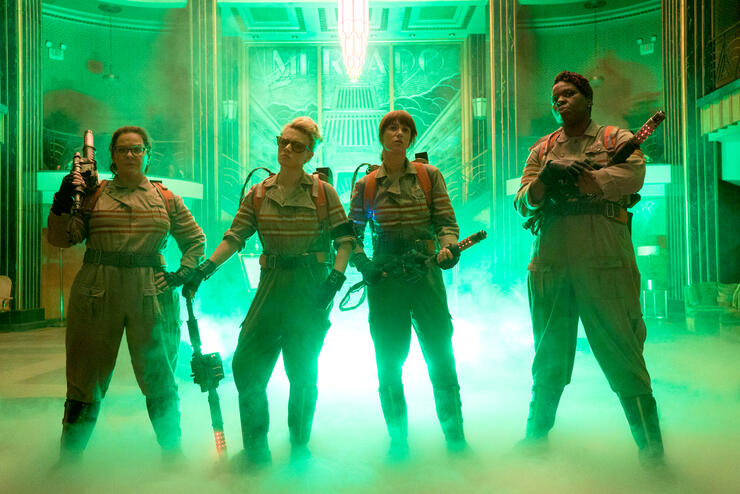
Kristen Wiig, Melissa McCarthy, Kate McKinnon and Leslie Jones masterfully navigate their way around a ghost-fueled movie that fully embraces their brand of comedy, just as Dan Aykroyd, Harold Ramis, Bill Murray and Ernie Hudson did all those years ago. And Feig — while continuously finding new ways to pay homage to the original — actually elevates his movie above the ’84 version at times by building a bit of a stronger framework around his story, his villain and his science.

Yes, this new Ghostbusters sciences the f**k out. It goes so hard with the nerdy language in an effort to make the film feel more grounded in the real world than the original that you’ll have no idea what they’re talking about at times, but you’ll appreciate the homework done by cowriters Feig and Kate Dippold (The Heat).

The best stuff

I’ve been rambling a bit, so let’s break it down:

— The film’s sense of humor is both modernized for 2016, but also very much rooted in old-school tropes. You’ll have scenes where the women are cracking jokes about nasty YouTube commenters (mirroring the film’s real-life struggles within the online forum) and getting into trouble when one of their ghost videos hits Reddit, but then they also find so many inventive ways to use that old redirection gag. Like in a scene where Kristen Wiig’s Erin is trying to convince the mayor (Andy Garcia) that ghosts are invading the city and there’s a giant rumble outside, only it’s just a garbage truck. The movie is full of those kinds of redirection-based gags.

— Unlike the original where the heart of the movie is found somewhere amidst Venkman’s creepy stalker-ish obsession with Sigourney Weaver’s Dana, this new one scraps any romantic subplot in favor of friendship. The heart of this movie is firmly rooted in the relationship between Wiig’s Erin and McCarthy’s Abby, and so in that regard the new film has a stronger emotional resonance than its predecessor.

— Kate McKinnon is without a doubt the film’s all-star. Her Holtzmann is so eccentric and such an oddball, I don’t even know if McKinnon fully grasps what Holtzmann’s all about. She just goes for it. Even when Holtzmann doesn’t have any dialogue, McKinnon is in the background working for that smile, that laugh, either with a facial expression or a body twitch. You’ll probably have to watch the movie multiple times to catch all of Holtzmann’s idiosyncrasies tucked into a wildly amusing star-making performance from McKinnon.

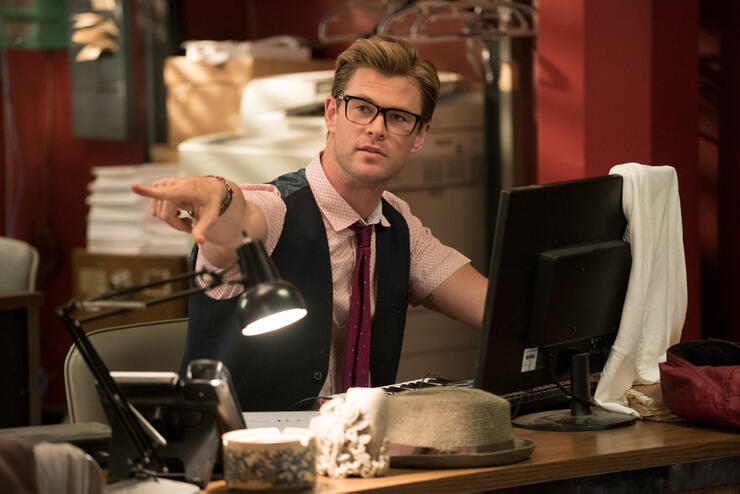
— Chris Hemsworth is terrific as the Ghostbusters secretary Kevin, perhaps destined to become the most memorable “movie Kevin” since Kevin McCallister in Home Alone. They essentially reverse the stereotypical dumb, but super sexy secretary with Hemsworth rocking this amusing sort of sophisticated moron vibe. He’s almost cocky, but not, and Hemsworth does such a great, subtle job, with many jokes coming at his expense.
Ghostbusters: Answer the Call is quietly the new name of this film now, as they kind of altered the title to differentiate it more from the original but really didn’t tell anyone they did it (think Edge of Tomorrow: Live Die Repeat). And while it may seem tacked-on and a bit of a cop out, the title becomes so much funnier once you’ve seen the film, in part because of a running gag involving the phone not being answered.

— The villain played by Neil Casey has his strengths and weaknesses, but the general concept of him — how he’s just as nerdy about the supernatural as the Ghostbusters foursome, except he’s decided to use his knowledge to exact revenge upon a world that’s forever bullied him — is pretty great and inventive. He’s also an odd one who evolves throughout the film, and though their final confrontation gets super special effects-y and a tad over the top, he might be the strongest, most well-rounded villain we’ve seen yet in a Ghostbusters film.

The worst stuff

— While one or two of the cameos from the original Ghostbusters cast are amusing, they weren’t needed and they sort of jolt you out of the film in places. Not going to ruin any of them here, though make sure you stay till the end of the credits because not only is there a major cameo in the credits, but also a stinger at the end fans of the original will want to stick around to see.

— Not crazy about the updated theme song, and when it’s used in the movie I kept wishing for the original version to be used instead. Embrace those ’80s roots!

— The film takes place in New York City, but it was primarily shot in Boston. If you’re from New York or familiar with the city, it’s pretty easy to notice and doesn’t feel as authentic to New York as the original does.

— Kudos to Feig for trying to work the Ghostbusters logo creation into the film, including a very funny scene where the ladies turn to Kevin for his logo concepts, but the way they get the final version feels pretty forced and eye-roll inducing.

— As is the case way too often these days, unfortunately a lot of the film’s funniest moments are included in the trailers, though they do get funnier once you see everything built in around them.

Look, that first Ghostbusters is a classic, and it will forever be a classic. This new one, while just as strong with its cast, story and humor, may never match its predecessor in terms of how much it’s beloved by movie fans around the world. That’s just a fact.

We have a different relationship with movies now than we did back in the ’80s, and much of our desire to remake and reboot those movies from 30 years ago comes from us wanting to tap back into what made that period in cinematic history so special and memorable.

The new Ghostbusters is a special film, in part because it expertly extracts the essence of what was so fun and goofy about the original, but also because it celebrates female-driven humor in a sci-fi/supernatural movie, which is a rarity. We never see films like this today, just like we never saw films like Ghostbusters when it arrived on the scene in 1984.

Both films are unique to their respective era, and both films will forever be worth celebrating.

This entry passed through the Full-Text RSS service – if this is your content and you’re reading it on someone else’s site, please read the FAQ at fivefilters.org/content-only/faq.php#publishers.
Recommended article from FiveFilters.org: Most Labour MPs in the UK Are Revolting.


No Image

Serena Williams Wins Wimbledon In Straight Sets For 22nd Grand Slam Title

Serena Williams of The United States plays a forehand during The Ladies Singles Final against Angelique Kerber of Germany on day twelve of the Wimbledon Lawn Tennis Championships at the All England Lawn Tennis and Croquet Club on July 9, 2016 in London, England.

Serena Williams of The United States plays a forehand during The Ladies Singles Final against Angelique Kerber of Germany on day twelve of the Wimbledon Lawn Tennis Championships at the All England Lawn Tennis and Croquet Club on July 9, 2016 in London, England. Clive Brunskill/Getty Images hide caption

toggle caption Clive Brunskill/Getty Images

If she wasn’t already one of the best tennis players ever, Serena Williams solidified her case Saturday by winning Wimbledon in straight sets for her 22nd Grand Slam title.

Williams defeated Angelique Kerber 7-5, 6-3 to win her second consecutive and seventh overall Wimbledon title, according to The Associated Press. The two women played against each other in the Australia Open in January, with Kerber taking that win.

But on Saturday, the 34-year-old tennis star celebrated her latest victory by raising two fingers on each hand to symbolize “22.”

“I love playing her,” Williams said of Kerber. “She’s such a great opponent.”

Williams ties Steffi Graf with 22 Grand Slam titles in the Open Era. This seventh title also means Williams is closing in Martina Navratilova’s nine trophy wins.

“It makes the victory even sweeter to know how hard I worked for it,” Williams told ESPN following the match. “I don’t know what else to say. I’m so excited.”

Reuters reported the first set was a fierce back-and-forth battle, but that Williams capitalized midway through the second set for the victory.

“At the end, I was trying everything, but she deserved it today. She really played an unbelievable match,” said Kerber, who hadn’t appeared in a major final until beating Williams in Melbourne. “I think we both play on a really high level.”

Serena Williams, left, and Venus Williams hold their trophies after winning the women's doubles final against Yaroslava Shvedova of Kazahkstan and Timea Babos of Hungary on day 13 of the Wimbledon Tennis Championships in London on Saturday.

Serena Williams, left, and Venus Williams hold their trophies after winning the women’s doubles final against Yaroslava Shvedova of Kazahkstan and Timea Babos of Hungary on day 13 of the Wimbledon Tennis Championships in London on Saturday. Tim Ireland/AP hide caption

toggle caption Tim Ireland/AP

It was a day of wins for Serena. Hours after winning the singles title, she competed alongside her sister Venus in the doubles title match, and the two walked away with their sixth Wimbledon championship and 14th Grand Slam title. The sisters hold the doubles title for 2000, 2002, 2008, 2009 and 2012.

“It’s a privilege, it’s an honour,” Venus said, according to Reuters. “When you enter the doubles draw, you dream of winning. Then we enter the singles, we dream of winning.

“To have Williams on both of those, somehow in 2016, it’s another dream come true.”

The Williams sisters plan to compete in singles and doubles at the Olympics in Rio de Janeiro next month.

Let’s block ads! (Why?)


No Image

Theranos Founder Elizabeth Holmes Barred From Operating Labs For Two Years

Elizabeth Holmes, founder and CEO of Theranos, speaks at the Fortune Global Forum in San Francisco in November 2015.

Elizabeth Holmes, founder and CEO of Theranos, speaks at the Fortune Global Forum in San Francisco in November 2015. Jeff Chiu/AP hide caption

toggle caption Jeff Chiu/AP

Theranos was poised to revolutionize the blood testing industry by using only a few drops of blood in inexpensive tests. But now, federal regulators say they will bar the company’s dynamic founder and CEO Elizabeth Holmes from owning or operating a lab for at least two years.

“Last year the government began to scrutinize the company after experts found that the results of the blood tests were inaccurate,” as NPR’s Laura Sydell told our Newscast unit.

Centers for Medicare & Medicaid Services, a federal regulator, said in a letter made public Friday that it is also revoking certification for the company’s Newark, California laboratory and cancelling the lab’s approval to receive Medicare payments. The sanctions will not take full effect until September and the company can appeal.

The company will also be fined $10,000 for every day it is out of compliance with the regulator’s recommendations on how to run the labs, starting on July 12.

Theranos repeatedly failed to prove it had corrected issues previously identified by the regulator, according to the CMS letter, including a finding of “immediate jeopardy to patient health and safety.” According to The New York Times, “that apparently referred to erroneous results in a test of blood clotting used for patients who take the blood thinner warfarin.”

Erik Gordon, a business professor at the University of Michigan, told Laura that while the company can appeal, the likelihood for success is miniscule. “If the technology doesn’t work, there’s nothing. There’s just smoke and mirrors. A lot of hype and nothing,” he said. As for Holmes: “She’s radioactive at this point,” Gordon says. “I mean, she can’t stay at the company.”

Theranos said in a statement that it accepts “full responsibility” and vowed to “work non-stop to resolve the issues identified.” It added that Holmes will continue to lead the company and denied that any patients were harmed by their tests.

Holmes dropped out of Stanford at 19 to found the company, which sought to disrupt the tech industry with cheaper, simpler tests. As Laura reported, “Theranos was valued at 9 billion dollars; it had a contract with Walgreens.” Holmes herself was viewed as a wunderkind and drew comparisons to Apple co-founder Steve Jobs, Laura said:

“Holmes had a beautiful vision, backed by hundreds of millions of dollars in investment, and a board of big names like Henry Kissinger and George P. Schulz. The media had a love fest. Time magazine called Holmes one of the 100 most influential people in the world. She was profiled in Fortune andThe New Yorker.”

But as Laura reported, the Theranos story is now viewed as a cautionary tale, “and questions are being raised about whether applying hardware and software business culture to biotechnology is dangerous.”

Let’s block ads! (Why?)


No Image

Theranos Founder Elizabeth Holmes Barred From Operating Labs For Two Years

Elizabeth Holmes, founder and CEO of Theranos, speaks at the Fortune Global Forum in San Francisco in November 2015.

Elizabeth Holmes, founder and CEO of Theranos, speaks at the Fortune Global Forum in San Francisco in November 2015. Jeff Chiu/AP hide caption

toggle caption Jeff Chiu/AP

Theranos was poised to revolutionize the blood testing industry by using only a few drops of blood in inexpensive tests. But now, federal regulators say they will bar the company’s dynamic founder and CEO Elizabeth Holmes from owning or operating a lab for at least two years.

“Last year the government began to scrutinize the company after experts found that the results of the blood tests were inaccurate,” as NPR’s Laura Sydell told our Newscast unit.

Centers for Medicare & Medicaid Services, a federal regulator, said in a letter made public Friday that it is also revoking certification for the company’s Newark, California laboratory and cancelling the lab’s approval to receive Medicare payments. The sanctions will not take full effect until September and the company can appeal.

The company will also be fined $10,000 for every day it is out of compliance with the regulator’s recommendations on how to run the labs, starting on July 12.

Theranos repeatedly failed to prove it had corrected issues previously identified by the regulator, according to the CMS letter, including a finding of “immediate jeopardy to patient health and safety.” According to The New York Times, “that apparently referred to erroneous results in a test of blood clotting used for patients who take the blood thinner warfarin.”

Erik Gordon, a business professor at the University of Michigan, told Laura that while the company can appeal, the likelihood for success is miniscule. “If the technology doesn’t work, there’s nothing. There’s just smoke and mirrors. A lot of hype and nothing,” he said. As for Holmes: “She’s radioactive at this point,” Gordon says. “I mean, she can’t stay at the company.”

Theranos said in a statement that it accepts “full responsibility” and vowed to “work non-stop to resolve the issues identified.” It added that Holmes will continue to lead the company and denied that any patients were harmed by their tests.

Holmes dropped out of Stanford at 19 to found the company, which sought to disrupt the tech industry with cheaper, simpler tests. As Laura reported, “Theranos was valued at 9 billion dollars; it had a contract with Walgreens.” Holmes herself was viewed as a wunderkind and drew comparisons to Apple co-founder Steve Jobs, Laura said:

“Holmes had a beautiful vision, backed by hundreds of millions of dollars in investment, and a board of big names like Henry Kissinger and George P. Schulz. The media had a love fest. Time magazine called Holmes one of the 100 most influential people in the world. She was profiled in Fortune andThe New Yorker.”

But as Laura reported, the Theranos story is now viewed as a cautionary tale, “and questions are being raised about whether applying hardware and software business culture to biotechnology is dangerous.”

Let’s block ads! (Why?)


No Image

Best of the Week: 'Star Trek' Outted a Classic Character, Captain America is Getting a Monument and More

The Important News

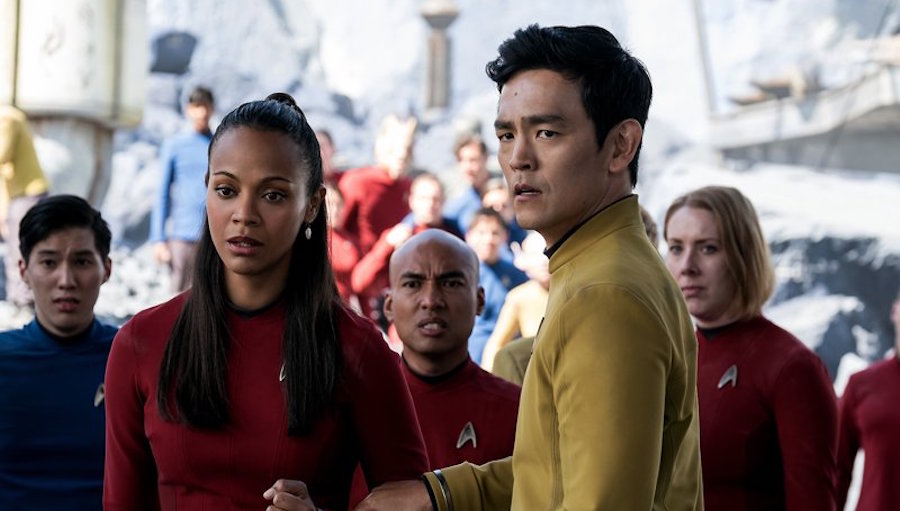
Trekkie Time: Sulu became the first primary LGBTQ role in a major movie franchise.

Marvel Madness: Angourie Rice joined Spider-Man: Homecoming. Captain America is getting a statue in Brooklyn inspired by his movies. Anna Kendrick wants to be Squirrel Girl.

Reel TV: The Russo Brothers are making a TV series based on The Warriors.

Remake Report: Kiefer Sutherland will return for the Flatliners remake.

Sequelitis: Jackie Chan is going to star in The Nut Job 2. An Aliens reunion panel is scheduled for Comic-Con.

Casting Net: Michelle Williams and Zac Efron are joining The Greatest Showman on Earth.

New Directors, New Films: Steven Soderbergh may direct Secrecy World. Steven Spielberg is making another movie about aliens.

Box Office: Finding Dory is on its way to become the highest-grossing animated movie of all time.

Animation Station: Pixar reports they have no sequels planned after 2019.

The Videos and Geek Stuff

New Movie Trailers: Imperium, Sing, Edge of Winter, Kubo and the Two Strings, The Intervention, Table 19, Sausage Party and Train to Busan.

TV Spot: Star Trek Beyond.

Clips: Ghostbusters.

See: Daisy Ridley shared a Star Wars: Episode VIII set photo. And Tom Holland shared a Spider-Man: Homecoming set selfie.

Watch: Patrick Stewart sings classic Western songs.

See: A poster of Bryan Cranston as Stan Lee in a fake biopic. And a fake, fan-made poster for Deadpool Number Two.

Watch: A terrific music video tribute to horror movie fandom.

See: How Captain America: Civil War should have ended.

Watch: A masculinity-infused version of the Ghostbusters reboot trailer.

See: A poster featuring 185 movie monsters in one image.

Watch: A video teasing the mayhem to come in Transformers: The Last Knight.

See: The week’s best new movie posters.

Watch: A supercut of the 40 greatest jump scares.

Our Features

Sci-Fi Movie Guide: The Purge is the sci-fi movie franchise we need.

Geek Movie Guide: 10 things all movie geeks should look out for this month.

Horror Movie Guide: 8 great movies featuring underwater creatures.

Marvel Movie Guide: How Thor: Ragnarok can put the hero on top at Marvel.

Home Viewing: Here’s our guide to everything hitting VOD this week. And here’s our guide to all the essential new indie and foreign film releases this month.

and

MORE FROM AROUND THE WEB:

Let’s block ads! (Why?)