Articles by admin

No Image

President Trump Praises Senate Republican Health Care Bill

President Trump is praising the Senate’s health care bill. But the bill lacks a mechanism requiring people to have continuous coverage, which could create problems in the individual health care market.

AUDIE CORNISH, HOST:

President Trump says he’s very supportive of the Senate’s new bill to repeal and replace the Affordable Care Act or Obamacare. But the president admits tinkering with the nation’s health care system is complicated. Senate Republican leaders unveiled the legislation yesterday. They want it to pass next week. They have little margin for error, as NPR’s Scott Horsley reports.

SCOTT HORSLEY, BYLINE: Senate Republicans can only afford to lose two votes if they hope to pass their bill. And five Republicans are already on record in opposition to the measure in its current form. After the first four Republicans raised concerns, President Trump told “Fox & Friends” there’s a narrow path to success.

(SOUNDBITE OF TV SHOW, “FOX AND FRIENDS”)

PRESIDENT DONALD TRUMP: I think we’re going to get there and we have four very good people that – it’s not that they’re opposed. They’d like to get certain changes. And we’ll see if we can take care of that.

HORSLEY: One of the holdouts is Kentucky Sen. Rand Paul. He told NBC’s “Today” show, in its current form, the Senate bill could aggravate the problem of healthy people going without insurance and driving up costs for everyone else.

(SOUNDBITE OF TV SHOW, “TODAY”)

RAND PAUL: If you can get insurance after you get sick, you will. And without the individual mandate, that sort of adverse selection, the death spiral, the elevated premiums – all of that that’s going on gets worse under this bill.

HORSLEY: Obamacare addressed that problem by requiring Americans to have health insurance or pay a penalty. But the so-called individual mandate is one of the least popular provisions of the law. And Senate Republican leader Mitch McConnell and his colleagues are determined to get rid of it.

(SOUNDBITE OF ARCHIVED RECORDING)

MITCH MCCONNELL: We agreed on the need to free Americans from Obamacare’s mandates so Americans are no longer forced to buy insurance they don’t need or can’t afford.

HORSLEY: But the Senate bill preserves another, more popular piece of Obamacare, the requirement that insurance companies cover everyone, even those with pre-existing conditions. Health policy expert Linda Blumberg of the Urban Institute says imposing a coverage requirement on insurance companies without a corresponding mandate for customers creates a very shaky insurance market.

LINDA BLUMBERG: What you don’t want to have is a situation where you’re saying, we’re going to have everybody, regardless of their health problems, come in and then have all of the healthy people exit the market because then the average cost of those who remain goes up really high.

HORSLEY: As premium costs go up, even more healthy people drop out. That’s the so-called death spiral. The House version of the health care bill tried to discourage healthy people from fleeing the market by allowing insurance companies to charge more for those who don’t maintain continuous coverage. Former GOP Senate staffer Rodney Whitlock thinks the Senate bill will have to add something similar.

RODNEY WHITLOCK: I believe that the bill that the Senate will vote on, assuming they get to that point, will have some sort of mechanism to cause participation in it.

HORSLEY: So why isn’t that already in the bill? Whitlock says McConnell may be worried that it runs afoul of procedural rules that allow Republicans to pass the health care bill with a simple majority vote.

WHITLOCK: If you are concerned that that might be the case, then, strategically, you may want to wait until the very last second to be presenting the language to the parliamentarian.

HORSLEY: Blumberg warns without a strong provision to keep healthy customers in the marketplace, insurance companies will be tempted to offer more stripped-down policies. And that could leave the individual market in worse shape than before Obamacare.

BLUMBERG: What will be available are policies that don’t cover a number of benefits that people are used to getting coverage for today. They will have much higher deductibles than they’re used to seeing. And I think, as you get older, the coverage will be less and less affordable.

HORSLEY: AARP is already on record against the Senate bill, citing what it calls an age tax, as well as cuts to Medicaid. The senior lobby is promising to hold all senators accountable for their votes. Scott Horsley, NPR News, the White House.

Copyright © 2017 NPR. All rights reserved. Visit our website terms of use and permissions pages at www.npr.org for further information.

NPR transcripts are created on a rush deadline by Verb8tm, Inc., an NPR contractor, and produced using a proprietary transcription process developed with NPR. This text may not be in its final form and may be updated or revised in the future. Accuracy and availability may vary. The authoritative record of NPR’s programming is the audio record.
Let’s block ads! (Why?)


No Image

Today in Movie Culture: Darth Vader vs. Tony Montana, the Definitive 'Alien' Xenomorph Life Cycle and More

Here are a bunch of little bites to satisfy your hunger for movie culture:

Mashup of the Day:

In the latest Phone Fights video, Darth Vader from Star Wars and Tony Montana from Scarface have a heated conversation:

[embedded content]

Movie Science of the Day:

Kyle Hill attempts to scientifically explain the definitive xenomorph life cycle as depicted in the Alien movies:

[embedded content]

Fake Movie Poster of the Day:

Who else watched the first act of Wonder Woman and imagined a sequel to The Princess Bride?

“Farm boy, polish my armor. I want to see my face shining in it by morning.” pic.twitter.com/BvvLCvh4Zv

— Tarah M. Wheeler (@tarah) June 20, 2017

Soundtrack Cover of the Day:

With Transformers: The Last Knight in theaters, The Warp Zone offers up an a capella cover of “The Touch” from Transformers: The Movie (and Boogie Nights):

[embedded content]

Vintage Image of the Day:

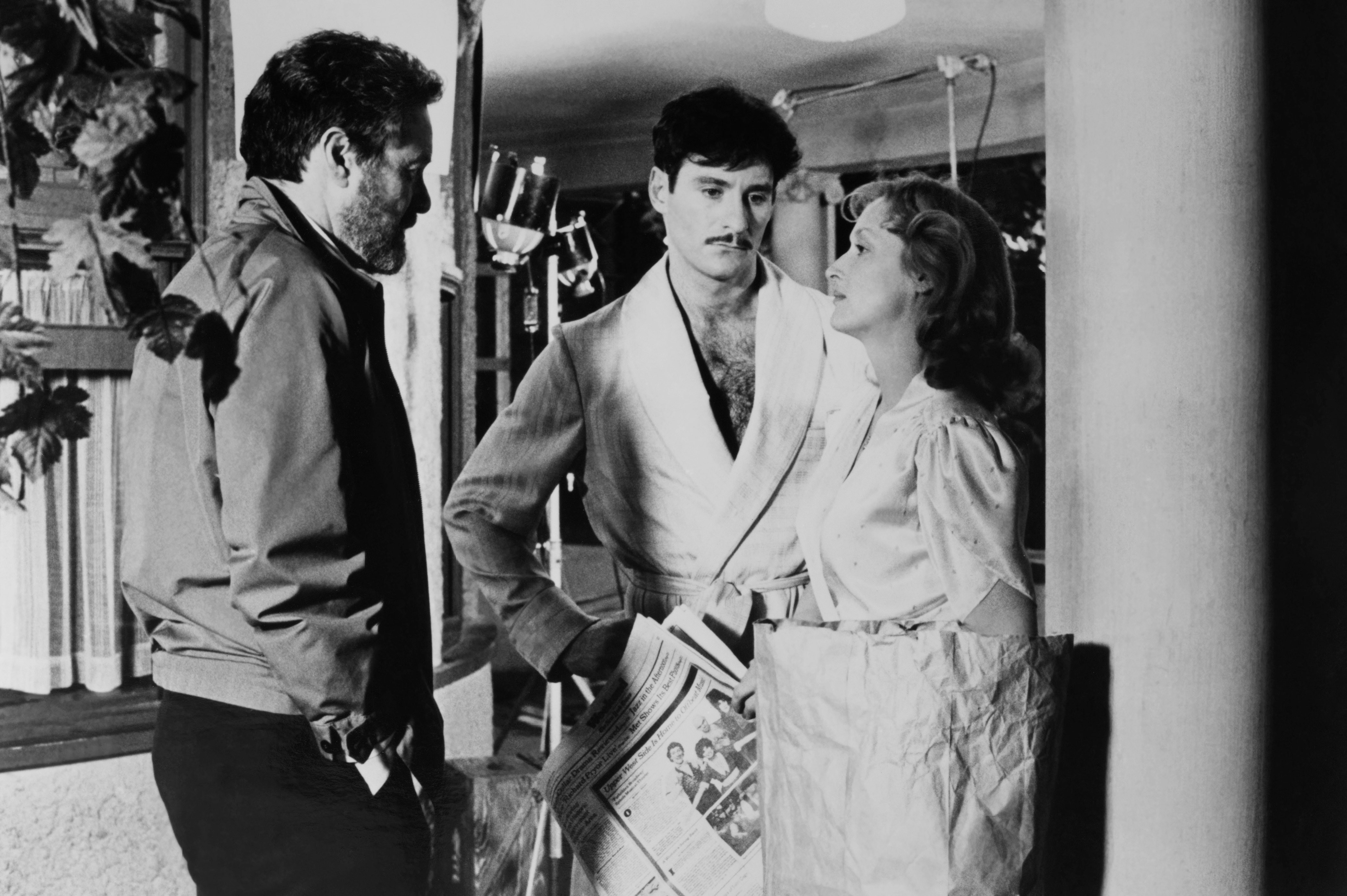
Meryl Streep, who turns 68 today, with Kevin Kline and director Alan J. Pakula on the set of Sophie’s Choice in 1982. Streep would go on to win her second Oscar, her first for Best Actress, for her performance.

Actress in the Spotlight:

Mubi pays tribute to Greta Gerwig with this video montage that mostly features clips of her dancing:

[embedded content]

Filmmaker in Focus:

Watch an animated Woody Allen talk about food, showers and luck in an adaptation of a 2013 Esquire interview:

[embedded content]

Supercut of the Day:

Speaking of Woody Allen, you can’t have a New York in film supercut without some of his movies, so of course this one does (via Film School Rejects):

[embedded content]

Cosplay of the Day:

Cosplayer Philip Odango shows off two ’80s movie villains he’s dresed up as, Mola Ram from Indiana Jones and the Temple of Doom and Lo-Pan from Big Trouble in Little China (via Fashionably Geek):

Classic Trailer of the Day:

Today is the 40th anniversary of the release of Disney’s The Rescuers. Watch the original trailer for the animated classic below.

[embedded content]

and

Let’s block ads! (Why?)


No Image

OB-GYNs Give Women More Say In When They Have Mammograms

Women have gotten conflicting advice from doctors about when to have mammograms.


Amelie Benoist/Science Source
hide caption

toggle caption


Amelie Benoist/Science Source

Women in their 40s at average risk for breast cancer should talk to their health care provider about the risks and benefits of mammography before starting regular screening at that age, according to guidelines released Thursday by the American College of Obstetricians and Gynecologists.

The group had previously recommended annual mammograms starting at age 40. But the advice has changed to better incorporate input from the woman being screened, says physician Christopher Zahn, vice president of practice activities at ACOG. “A patient’s preferences and values need to be an important part” of the decision, he says.

Now the group says providers should offer the test when a woman enters her 40s, and that after a discussion, she may opt to start screening. If she doesn’t, she should start by age 50, ACOG says. Zahn says the guidance intentionally encompasses advice from other major groups.

The U.S. Preventive Services Task Force says women should start regular mammograms at 50, and that women in their 40s should make an individual decision about whether or not to screen. The American Cancer Society says screening should be offered starting at age 40, and outright recommends starting at 45. And the National Comprehensive Cancer Network, an alliance of major cancer centers, recommends starting at 40.

The question all these groups have wrestled with is how to balance the benefits and harms of mammography; their different recommendations reflect differences in how they interpreted and weighed the available data. “All three [schedules] are reasonable approaches to take,” says Zahn.

Mammography clearly saves lives for women over 50 and likely does so overall for women in their 40s, says Otis Brawley, chief medical officer at the American Cancer Society. But the benefits in those younger women are smaller, and they come at the cost of false alarms, unnecessary biopsies and overdiagnosis, when cancer that is detected and treated never would have threatened a woman’s health had it gone undiscovered. (The ACS says estimates of overdiagnosis vary widely, from 0 percent to 54 percent of breast cancers, in part depending on whether cases of ductal carcinoma in situ — abnormal cells that sometimes turn into cancer — are included.)

Once a woman starts mammography, she can be screened every one or two years, again after a discussion about the pros and cons of the different schedules, ACOG advises. The American Cancer Society recommends annual screening for women through age 54 and every other year for older women, with the option to continue annual tests, while USPSTF says every other year is sufficient and the network of cancer centers recommends annual screening.

A statistical model from the USPSTF finds that if 1,000 women are screened every other year from age 40 to 74, there will be eight fewer breast cancer deaths compared with no screening, 213 unnecessary breast biopsies and 21 overdiagnosed breast tumors. Meantime, if 1,000 women are screened every other year from 50 to 74, there will be seven fewer breast cancer deaths compared with no screening, 146 unnecessary biopsies and 19 overdiagnosed tumors.

Some women may decide that the small additional benefit doesn’t outweigh the increased risk of biopsy or possibly being treated for a cancer that didn’t need attention. There’s as yet no sure way to know which tumors are harmless and can be left alone. Others may choose differently. “There’s more of a respect for the individual person,” says Brawley about the new ACOG guidelines and the 2015 changes by his own organization. “You’re starting to hear, ‘Let the woman decide.’ “

“If a woman is told to get a mammogram starting at 40, it’s very reasonable to question that and ask, ‘Why? I’ve read that there are conflicting guidelines,’ ” says Deanna Attai, assistant clinical professor of surgery at the David Geffen School of Medicine at UCLA.

She says women should know, or ask about, the risk factors for breast cancer so they can have the screening conversation with some understanding of where they fall on the spectrum. And don’t stop the risk-reduction discussion at screening. “Ask what lifestyle or health habits can help reduce risk,” she says. (For example, research suggests exercise can cut breast cancer risk.)

On the question of when to stop routine mammograms, ACOG says screening beyond age 75 should be based on a conversation about a woman’s health status and longevity. The group also recommends against regular breast self-exams but says women should be aware of the normal feel and appearance of their breasts so they can report any changes.

Keep in mind that these recommendations are for average-risk women who are not experiencing symptoms. Many factors can increase risk, including a family history of breast or ovarian cancer and certain genetic mutations. So those women should check with their physician about when, how and how frequently they should be screened. There’s also not enough evidence to make recommendations on whether women with dense breasts should be screened differently.


Katherine Hobson is a freelance health and science writer based in Brooklyn, N.Y. She’s on Twitter: @katherinehobson

Let’s block ads! (Why?)


No Image

Man Accused Of Making Millions Of Robocalls Faces Biggest-Ever FCC Fine

Telemarketers are prohibited from making prerecorded phone calls to people without prior consent. It’s also illegal to deliberately falsify caller ID with the intent to harm or defraud consumers.

PeopleImages/Getty Images/iStock

hide caption

toggle caption

PeopleImages/Getty Images/iStock

Federal regulators on Thursday said they’ve identified “the perpetrator of one of the largest … illegal robocalling campaigns” they have ever investigated.

The Federal Communications Commission has proposed a $120 million fine for a Miami resident said to be single-handedly responsible for almost 97 million robocalls over just the last three months of 2016.

Officials say Adrian Abramovich auto-dialed hundreds of millions of phone calls to landlines and cellphones in the U.S. and Canada and at one point even overwhelmed an emergency medical paging service.

Making prerecorded telemarketing phone calls to people without their prior consent is prohibited. So is making telemarketing calls to emergency phone lines and deliberately falsifying caller ID to disguise identity with the intent to harm or defraud consumers.

According to the FCC, the robocalls made by Abramovich through his ambiguously named companies (Marketing Strategy Leaders or Marketing Leaders) would show up “spoofed” as if they came from a phone number with the same area code and the same first three digits of the recipient’s number.

If the recipients answered, they’d get a recording offering an “exclusive” vacation deal from prominent travel companies such as Expedia, Marriott, Hilton or TripAdvisor — instructing them to “Press 1” to learn more. But pressing 1 would instead land people on a line with a call center hawking “discounted” vacation packages and time-shares unaffiliated with any of those brands.

According to FCC documents, TripAdvisor investigated some of the robocalls that purported to offer that company’s deals and found call centers that it said were based in Mexico.

Abramovich now faces the largest penalty ever proposed by the FCC, according to FCC Commissioner Mignon Clyburn. The fine is for Abramovich’s unlawful caller ID spoofing, the FCC says. The agency’s Enforcement Bureau has also issued a citation to Abramovich, and the documents say his “mass robocalling campaigns violate the Communications Act, and his misrepresentations in the prerecorded messages constitute criminal wire fraud.”

Abramovich now has 30 days to respond to the FCC, which is expected to finalize the investigation and penalties in the following months.

Let’s block ads! (Why?)


No Image

NBA Draft Day – The Impossible Dream To Beat The Golden State Warriors?

Golden State Warriors celebrate their 2017 NBA Championship at The Henry J. Kaiser Convention Center in Oakland, Calif., on June 15.

Thearon W. Henderson/Getty Images

hide caption

toggle caption

Thearon W. Henderson/Getty Images

For those too young to remember the NBA’s Michael Jordan era, you’re living it now. The Golden State Warriors are the new Michael Jordan.

When Jordan ruled the earth’s hardwood, everyone else played for second. That’s where we are today with the super team from the Bay Area that just wrapped up its second title in three years.

So why even play games for the next 3 to 5 years? Just build a permanent trophy case in Oakland’s Oracle Arena, right?

WRONG.

Sports, if anything, represent hope. It’s why they play the games. On any given Sunday. David did beat Goliath.

Which brings us to today’s annual day of NBA hope – the draft. Teams will replenish rosters with fresh faced, college-aged talent; they’ll execute trades to move up in the draft order.

Draft day also begins what’s expected to be a frenzied summer that will see the better teams try to beef up AND bolster their rosters in an effort to challenge you-know-who.

Here’s some of what’s being said about the expected frenzy – an offseason drama that may as well be scored to “Man of La Mancha.”

To dream the impossible dream
To fight the unbeatable foe

“Cleveland is closer than anyone to competing with Golden State, and the only player who realistically gets them closer is [Indiana Pacers star Paul] George.”

That’s from a CBSSPORTS.com article titled “Six trades or free-agent signings that could challenge Warriors’ NBA supremacy.” The article also suggests sending Chicago’s Jimmy Butler and Utah’s Gordon Hayward to Boston, Chris Paul of the L.A. Clippers to San Antonio and sums up with the three-team trade that would “save the world.”

To try when your arms are too weary
To reach the unreachable star

If the quest to topple Golden State begins with tonight’s draft, it’s not as easy as taking one of the projected stars, such as Washington’s Markelle Fultz, UCLA’s Lonzo Ball OR Josh Jackson of Kansas. Teams have to get the right players that fit, then develop them into stars, says Neil Paine from fivethirtyeight.com. “To beat the Warriors,” Paine writes, “you have to do what the Warriors did.” That included drafting Draymond Green 35th in 2012. The Warriors did pick Stephen Curry and Klay Thompson in the first round of the 2009 and 2011 drafts respectively. But Curry wasn’t an NBA all-star until 2014 and Thompson, in 2015.

The Warriors, as it turns out, do not have any picks in tonight’s draft. That doesn’t mean they won’t be active – at the right moment. Golden State still could buy a draft pick, which it did last year, getting the Warriors UNLV’s Patrick McCaw. He got regular playing time in his first year, giving him the confidence to play effectively even in critical moments. He played 11 minutes in this month’s title-clinching game and scored 6 points.

Everything Golden State touches, it seems, turns to gold.

OK, almost everything. The Warriors drafted Ekpe Udoh with the 6th pick in the 2010 draft. He’s now playing in Turkey.

Still, Golden State mostly has made the right moves and made itself into a great team that was able to lure Kevin Durant last offseason – a super free-agent signing that turned the Warriors into a super team.

Tonight, the Philadelphia 76ers have the first draft pick – the first official counter move in this new NBA era of “Golden State vs. the World.”

Philly, you’re on the clock.

And so are 28 other NBA teams that will do what they can – draft, trade, buy, sell – to pull closer to the Warriors. Ever closer.

And the world will be better for this
That one man scorned and covered with scars
Still strove with his last ounce of courage
To fight the unbeatable foe, to reach the unreachable star

Let’s block ads! (Why?)


No Image

Mali's Oumou Sangaré Keeps Speaking Out On 'Mogoya'

For Mogoya, her first album in eight years, Oumou Sangaré enlisted young Swedish and French producers to help rejuvenate her sound.

Benoit Peverelli/Courtesy of the artist

hide caption

toggle caption

Benoit Peverelli/Courtesy of the artist

One of Mali’s most celebrated singers, Oumou Sangaré began her career as an outspoken champion for the rights of women. On her 1989 debut, Moussolou, she offered sharp critiques of practices such as arranged marriages and polygamy, drawing on her own experiences growing up in a polygamous household.

Sangaré’s irresistible voice enhances her music’s power to disarm critics and make defenders of outmoded traditions think twice. She is often referred to as the Songbird of Wassoulou — the name of a region in Mali’s forested south and also the name of a musical style Sangaré has helped define.

But she chose to take stylistic liberties on her new album, Mogoya (which means “Today’s People”). Sangaré enlisted young producers in Sweden and France to create a more contemporary sound, rejuvenating her music and aiming her pointed messages at a younger audience.

Over the course of Mogoya, Sangaré briskly covers important ground: Malians who lose hope in their country and risk their lives trying to reach Europe by sea, the dangers of gossip and rumors, the breakdown of trust between people in the wake of Mali’s recent political crises. And in the song “Yere Faga,” which features Afrobeat drummer Tony Allen, she takes on the sensitive subject of suicide.

[embedded content]
YouTube

Mogoya is Sangaré’s first album in eight years, and only her fifth studio album in some 30 years. That’s partly because Sangaré also owns a hotel in Mali and runs other businesses, remaining unencumbered by the normal rigors of a pop music career. She makes a new album only when she’s good and ready, which shows in the work: Though Mali undoubtedly punches far above its weight in producing great and innovative music, Mogoya is still a landmark release.

Let’s block ads! (Why?)


No Image

Today in Movie Culture: Spider-Man's Driver's Test, What Makes a 'Transformers' Movie and More

Here are a bunch of little bites to satisfy your hunger for movie culture:

Franchise Recap of the Day:

With Transformers: The Last Knight in theaters, Couch Tomato shows us 24 reasons all Transformers movies are the same:

[embedded content]

Commercial of the Day:

Watch Peter Parker (Tom Holland) take his driver’s test in a new Audi ad cross-promoting Spider-Man: Homecoming:

[embedded content]

DIY Prop Build of the Day:

Speaking of Marvel characters, learn how to make your own replica of Thor’s hammer mashed with the look of the xenomorphs from Alien:

[embedded content]

Vintage Image of the Day:

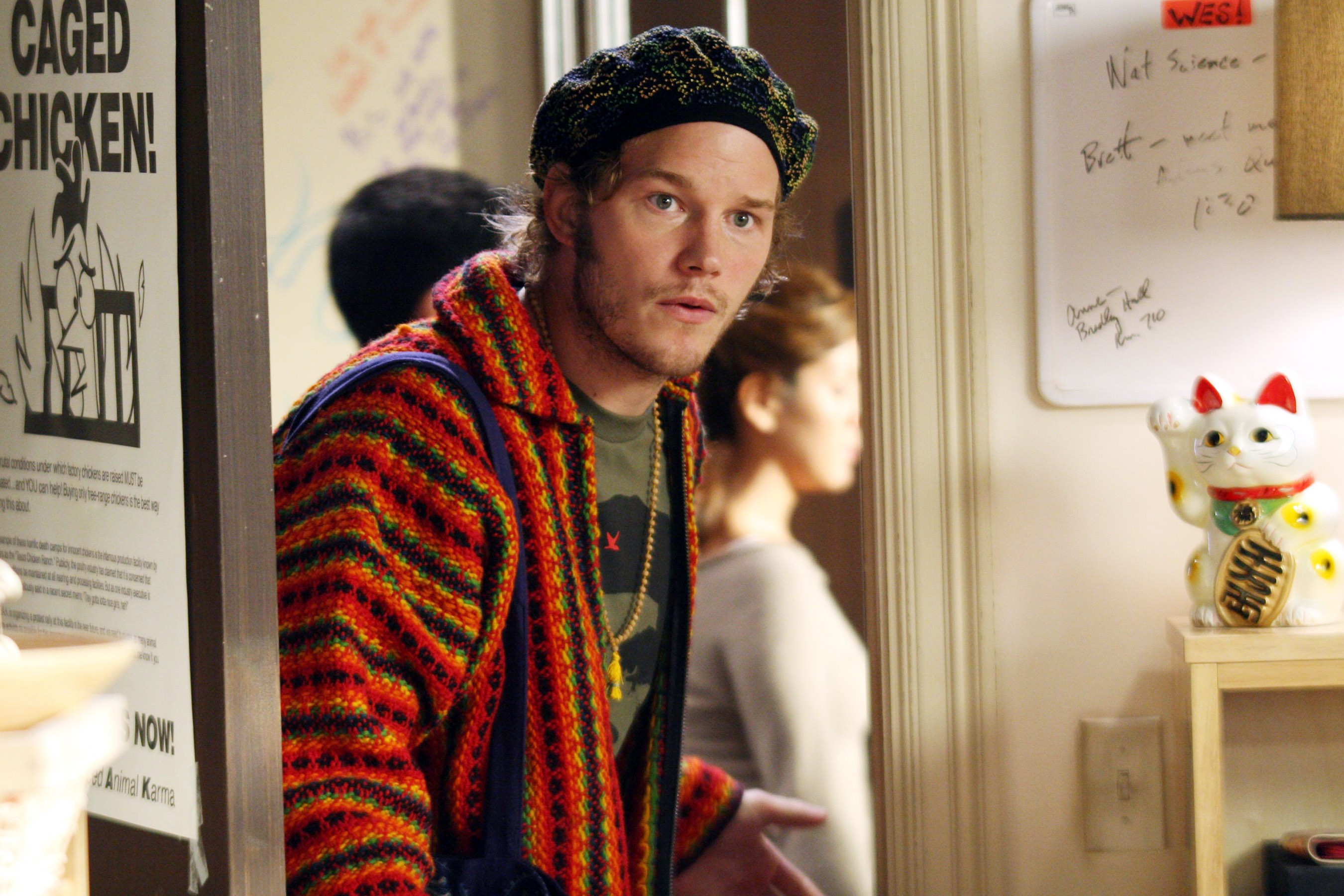
Chris Pratt, who turns 38 today, in his pre-Marvel days in a 2006 episode of The O.C. that just so happens to be titled “The Avengers”:

Reworked Trailer of the Day:

Marvel shouldn’t have all the fun. Here’s a version of the Justice League trailer with Danny Elfman’s Batman music:

[embedded content]

Movie Science of the Day:

Could a lion really live off a diet of bugs alone, as Simba does in The Lion King? MatPat finds out for The Film Theorists:

[embedded content]

Cosplay of the Day:

Also the charitable act of the day, 8-year-old Braeden suits up as a Ghostbusters in this video from For the Win, which granted the bronchomalacia-afflicted child’s greatest wish (via /Film):

[embedded content]

Actor in the Spotlight:

Speaking of Alien and Ghostbusters, here’s an animated Sigourney Weaver in an adaptation of a 2010 Esquire interview:

[embedded content]

Video Essay of the Day:

Signature Views makes the case for movies based on books in this video essay (via /Film):

[embedded content]

Classic Trailer of the Day:

Today is the 40th anniversary of the release of Martin Scorsese’s New York, New York. Watch the original trailer for the classic musical below.

[embedded content]

and

Let’s block ads! (Why?)


No Image

After CEO Resignation, Is Uber Kalanick-less Or Kalanick-free?

Uber co-founder Travis Kalanick, pictured here at a Vanity Fair summit in October 2016, resigned abruptly this week as the company’s CEO after weeks of scandals about workplace culture.

Mike Windle/Getty Images for Vanity Fair

hide caption

toggle caption

Mike Windle/Getty Images for Vanity Fair

If you think of a company as a sports team — let’s say, basketball — then Uber is at a point where the players are still on the court, but the coaches and general manager are gone, the arena is filled with jeers and the owner’s hair is on fire.

The resignation of co-founder Travis Kalanick as CEO under pressure from investors (instead of the originally announced leave of absence) is only the most dramatic of various dramatic turning points in the disorderly narrative arc of Uber. And though business annals are rife with powerful founders who were forced to leave their companies, such stories typically hinge on poor financial results or wrong business decisions.

Few companies have had such a rapid fallout from such a vast number of crises stemming from the workplace culture perpetuated from the top, while appearing to be at the peak of their success. (Uber is one of the largest privately held companies, valued at nearly $70 billion.)

How long will Kalanick’s shadow be over Uber’s future?

Leadership void

In a statement, Uber’s board of directors said the departure of Kalanick — who was at the helm for more than six years — will give the company “room to fully embrace this new chapter in Uber’s history.”

And the slate is remarkably clean thanks to an exodus of executives in recent weeks as the company shed employees amid the very public airing of stories involving sexist HR practices, sexual harassment of female employees, rampant bro culture and immaturity, shady skirting of regulations, lawsuits by drivers and allegations of intellectual-property theft.

What does history teach about turning around a company in turmoil with an empty executive bench?

“I think that the people who are now in charge — and the question is who is really in charge … — that better get sorted out pretty quickly,” says Rosabeth Moss Kanter, a professor at Harvard Business School and expert on corporate leadership. “That’s the real historic lesson, that you need to move quickly or you’re highly vulnerable. … It’s a perfect time for competitors to start poaching the best executives, for morale to go down, because even staff who have great ideas aren’t sure they can implement them.”

The Uber board had already been searching for a chief operating officer — a more seasoned executive who might tone down the volcanic Kalanick as CEO. This call followed a pledge from Kalanick to “grow up” after a leaked video showed him berating an Uber driver, who complained to him about pay. According to Recode, the board had considered former Disney Chief Operating Officer Tom Staggs, Helena Foulkes from CVS and various executives of media and transportation companies.

Investors are also calling on Uber to hurry up and hire a chief financial officer — a position that’s been vacant since 2015. Uber has also lost executives from its product, engineering, mapping, communications, business, finance and self-driving units.

“Clearly there was a terrible workplace culture … terrible enough for a lot of these people who are highly competent individuals to want to go,” says Valerie Demont, a lawyer at Pepper Hamilton who represents companies undergoing restructuring. In other words, the exodus is also a reflection on Kalanick’s ability to pick and retain talent.

But is he really leaving?

Kalanick is a polarizing figure. He’s come to personify both Uber’s toxic cowboy culture, but also its phenomenal business growth. On Friday, before his abrupt resignation, NPR asked an early Uber investor Jason Calacanis what he thought of the CEO.

“Indefatigable, phenomenal, unlimited upside,” Calacanis said. “I think he has another 20, 30 years ahead of him as founder, and I think the company can grow 10x from here, 20x from here. I think he’s going to wind up being one of the top 10 CEOs that Silicon Valley has ever seen.”

Kalanick’s resignation comes as a surprise to employees and people close to the company. Notably, he and his close allies have majority voting shares in Uber, which means he could have fought it. He’s known for not caving. But here he did cave, under tremendous pressure from large, powerful Silicon Valley investors.

One tricky thing is that technically, Kalanick isn’t leaving for good. His large stake in the company keeps him on Uber’s board of directors — the same board that will search for his and his team’s successors.

“I would like to know who’s heading the search and how much independence they’ll have and how much veto power Travis will have,” Harvard’s Kanter says.

She predicts Kalanick’s successor might be someone unexpected, someone seasoned and, notably, someone with a “calming presence” — again, because Uber’s turnaround will be not financial, but cultural.

Stories of other ousted CEOs include the famous departures of Steve Jobs from Apple or Jack Dorsey from Twitter — both of whom later returned to the companies they helped found. This has spurred speculation of Kalanick doing the same.

But Kanter argues, Uber as a company is not closely tied to its founder at all — in fact, he has come to be the face of Uber’s problems, not of Uber as a company.

“What Uber is to its consumers is … whatever driver they get, Uber is the app on their smartphone,” she says. “Uber is not Travis. In fact, most people can’t even pronounce his name, let alone know who he is.”

Let’s block ads! (Why?)


No Image

Fans Of Pakistan's Cricket Team Arrested For Sedition In India

Pakistan’s captain, Sarfraz Ahmed, gives a teammate a leaping hug defeating India in the ICC Champions Trophy final in London on Sunday.

Kirsty Wigglesworth/AP

hide caption

toggle caption

Kirsty Wigglesworth/AP

When Pakistan clobbered India in the ICC Champions Trophy final on Sunday — pulling off an upset so shocking, ESPN called it “some diamond-studded, galactic-scale nonsense” — flabbergasted fans took to the streets in several countries to celebrate the national cricket team’s big win.

In India, those celebrations got some fans in deep legal trouble.

Police have arrested at least 19 people across the country on charges of sedition, according to the Times of India.

“While the entire country was saddened by the defeat, these people were raising slogans in favour of Pakistan and burst crackers on Sunday night, threatening peace in the area,” Sanjay Pathak, a police inspector in Madhya Pradesh, a state where 15 men were arrested, told the newspaper.

“They celebrated with firecrackers, distributing sweets and raising slogans of ‘Long live Pakistan,’ ” another Madhya Pradesh police officer, Ramasray Yadav, told The New York Times. “They expressed hatred toward India and friendship toward Pakistan. They are charged for sedition and criminal conspiracy.”

The Times reports that all the people arrested are Muslims:

“The arrests come as some Muslims in India say they feel a sense of rising alienation. There have been episodes of violence, including by vigilante groups that have staged attacks on Muslims and low-caste Hindus suspected of slaughtering cows, which are considered sacred in Hinduism, the dominant religion in India.”

“These arrests are patently absurd, and the 19 men should be released immediately,” Asmita Basu, program director of Amnesty International India, said in a statement.

“Even if the arrested men had supported Pakistan, as the police claim, that is not a crime,” Basu continued. “Supporting a sporting team is a matter of individual choice, and arresting someone for cheering a rival team clearly violates their right to freedom of expression.”

But Pathak maintains similar situations have caused unrest in the past.

“This has been happening for several years, whenever there is an India-Pakistan match,” he told CNN. “We don’t have any previous cases or official complaints on record but those residing in Mohad have told us that this has happened before.”

As NPR’s Michel Martin reported, the two countries rarely play each other in cricket, partly because of political tensions between them — which made Sunday’s match all the more heavy with consequence.

Osman Samiuddin, senior editor of ESPNCricinfo, told Michel that “450 to 500 million people watched it around the world on TV. … It’s not just a sport. It’s not just a religion. I think it’s become a compulsion.”

Let’s block ads! (Why?)


No Image

CEOs Say They'll Sell Health Insurance Next Year, But Are Flying Blind

Mario Schlosser, CEO of the startup Oscar Health, says he’s optimistic that Congress will come up with a humane health care bill.

Noam Galai/Getty Images

hide caption

toggle caption

Noam Galai/Getty Images

The Senate vote on a bill to repeal and replace the Affordable Care Act is, according to conventional wisdom, one week away.

And we still don’t know what’s in the bill.

Not having concrete information is deeply uncomfortable for a journalist like me.

But for lots of people, like those who work in the insurance industry, not knowing what’s in that bill is a bigger deal. Wednesday is a deadline of sorts for these companies. If they want to sell policies next year in states that use the federal health exchange on Healthcare.gov, they have to let Health and Human Services know their intentions.

How are they dealing?

I reached out to a couple of insurance executives and asked.

Mario Schlosser is CEO of Oscar, the insurance startup that’s betting hard on the Affordable Care Act, also known as Obamacare.

Wednesday morning, Oscar announced it’s going to keep selling individual insurance in New York in 2018, and expanding its offerings in five states – New Jersey, Ohio, California, Florida and Tennessee.

It’s a bold move, considering Congress is right now considering dismantling the Affordable Care Act markets and changing the rules governing health insurance.

“When the dust settles, the individual market will be stable, and we want to be part of getting it there,” Schlosser told me.

He agreed with President Trump that the American Health Care Act, passed by the House in May, is “mean.”

“I think that bill was mean and I think that bill would lead to loss of coverage that would be bad for pretty much everybody in the system,” he said.

Schlosser said it’s crucial for the Trump administration to stabilize the current system in preparation for any changes. That includes enforcing the individual mandate, which penalizes people who don’t buy insurance, and promising to make cost-sharing payments required under the ACA that reimburse insurers for giving extra discounts to the lowest-income customers.

If they don’t, “it would kill the market overnight.” Schlosser said.

“That would be terrible for society, it would be terrible for the whole health care system, and everybody would be worse off,” he said.

I pointed out to Schlosser that his company has a direct line to the White House. His partner and co-founder is Joshua Kushner, the brother of Jared Kushner, Trump’s son-in-law and senior adviser.

Schlosser avoided talking about that relationship and suggested he didn’t know what Trump will do.

Later, I sat down for a cup of coffee at the National Press Club with Dan Hilferty, who runs Independence Blue Cross in Philadelphia and is chairman of the board of the Blue Cross Blue Shield Association. His company sells ACA health plans in the Philadelphia area and southern New Jersey.

“I’m here in DC because of what’s happening in health care,” he said. But acknowledged he doesn’t know what’s in the Senate bill, even though the Blue plans he represents as chairman of the association insure one-third of all Americans.

Hilferty said the ACA has problems, but it did manage to bring insurance coverage to about 20 million people who didn’t have it before. That’s what he’s focused on in meetings with members of Congress.

The Congressional Budget Office says the bill passed by the House would result in 23 million fewer people having insurance coverage in 10 years, compared to current law.

“So I would say let’s build a system that doesn’t that doesn’t push those 20 million people back to uninsured, “Hilferty said.

He says his company is focused on ensuring that whatever lawmakers do, they don’t make it harder for low-income people to get insurance.

“Frankly, we don’t care if it’s the ACA or the AHCA as long as it gives us the ability to cover more people, get them access to care and not lose money,” Hilferty said.

Like Schlosser, Hilferty is worried about what’s going to happen next year. His company has filed to sell ACA plans in the Philadelphia area. But if the Trump administration doesn’t commit to making cost-sharing payments or to enforcing the individual mandate that requires people to have insurance, his rates could go up a lot.

Either way, both companies are operating as if the ACA markets will be alive and functioning in 2018.

“I do think that in the end, reason and compassion will prevail in DC,” Schlosser said.

Let’s block ads! (Why?)