
Cities Try Convincing Amazon They're Ready For Its New Headquarters

Nikol Szymul staffs a reception desk at Amazon offices in downtown Seattle. Online retail powerhouse Amazon is searching for a second headquarters location, which an official from Toronto has called “the Olympics of the corporate world.”
Glenn Chapman/Getty Images
hide caption
toggle caption
Glenn Chapman/Getty Images
An official from Toronto has called Amazon’s search for the second headquarters “the Olympics of the corporate world.”
It’s a unique situation of its kind and scale. Typically, cities and states vie for factories or offices behind the scenes. This time, Amazon’s public solicitation of bids from essentially all major metropolitan areas in North America has prompted reporters and analysts across the continent to run their own odds on potential winners.
What’s at stake?
The top-line pitch is Amazon’s promise to invest $5 billion in whatever community it picks to be the home of its second headquarters. And the company says it would bring up to 50,000 new jobs, with an average salary of more than $100,000.
In Seattle, Amazon’s towering 8.1 million-square-foot downtown campus employs tens of thousands of employees and has served as a testing ground for new retail ideas, like a store without checkout registers. Amazon says HQ2 would be a “full equal.”
What is Amazon looking for?
The company’s call for applications is extremely detailed. It should be a metro area with more than 1 million people, a business-friendly tax structure, close to an international airport and near major highways, a place with mass transit, good Internet and “excellent” higher education.
The company is also not shy about saying it wants an attractive offer of a financial incentive — a move that has become customary for corporate expansions, which often involve tax cuts, relocation grants or fee reductions. “The initial cost and ongoing cost of doing business are critical decision drivers,” Amazon says in the request for proposal.
Whicht communities are vying for the HQ2?
With almost four weeks until the deadline, the list of potential contenders is expansive: Austin, Texas; New York, Boston, Chicago, Washington/Baltimore, Atlanta, Denver, Ottawa and Toronto — cities up and down and across the continent, tallied to number more than 100 by the Chicago Tribune.
Loading…
And the communities aren’t shy about their public pitches.
“We have sites that are ready, that are transit-oriented,” says Scott Levitan, head of the Research Triangle Foundation in North Carolina. “We have tremendous fiber backbone at our site and we have a region that is absolutely focused on being the best possible location for HQ2,” he says, adding that the Raleigh-Durham-Chapel Hill metro area sits equally between the ocean and the mountains.
“Colorado is perfectly aligned with the company’s culture of collaboration and innovation and focusing on its customers,” says Yuriy Gorlov, vice president of the Aurora Economic Development Council, also highlighting the Denver area’s access to fiber, power, transit and a nationally recognized hiking trail system.
“We feel like we have a lot to offer, in terms of our talent base, our logistics, our business-friendly climate,” says A.J. Robinson, president of Central Atlanta Progress. “And most of all, people love to live and work here.”
(Note: Amazon is one of NPR’s financial supporters.)
What are the cities’ biggest considerations or potential concerns?
Though Amazon likes to tout the billions of dollars it says it has injected into Seattle’s economy, the city has been tested by the massive corporate presence.
Over the years, frustrations aired by residents of Seattle (headquarters there employs 40,000 employees) have included rapidly rising housing costs, traffic congestion, gentrification and pressure on local businesses. As The New York Timesreported recently:
“Some local lawmakers have blamed Amazon for being a primary contributor to the region’s lack of affordable housing and other woes. The City Council recently unanimously approved a tax on individual income over $250,000 and $500,000 for couples, which would affect high-earners at Amazon. The legislation is facing legal challenges.
“The local antipathy toward the company was summed up in graffiti that recently appeared on the wall of a busy downtown traffic tunnel: an expletive before the last name of Mr. Bezos.”
The communities seeking HQ2 aren’t likely to be naive about what happens when a city gets flooded with thousands of high-net-worth office workers. But in the heat of a bidding war, none of the economic development officials interviewed by NPR said that anyone on their team has suggested avoiding the bid because of potential negatives.
Of course, bidding for Amazon isn’t like bidding for the Olympics — the games come and go; the corporate headquarters stays — but Atlanta’s Robinson said his city definitely learned a useful lesson from hosting the 1996 Games.
Founded: 1994 in Seattle
U.S. employees:341,400 (in January, the company said it plans to create 100,000 more jobs in 18 months)
2016 revenues:$136 billion
Stock market capitalization:$467 billion
Stock price growth in past five years: up 281 percent
Fortune 500 ranking:12th
U.S. facilities:214 across the country
“Having survived the Olympics, we know that post-winning, you have to deliver,” Robinson says. “You have to have the infrastructure; you have to be willing to invest in transit, in types of things that this number of workers will need, the housing stock and so forth.”
Major pushback has so far focused on the potential cost to taxpayers, as all bidding communities weigh how they can entice Amazon with tax credits, free land or other financial perks.
After The New York Times analysis zeroed in on Denver as the best candidate for Amazon’s HQ2, The Denver Post published aneditorial titled, “In Denver’s courting of Amazon, officials should remember the taxpayers.” The Post‘s editorial board wrote:
“We’d love to see Amazon locate here, as long as we’re not left feeling like we’ve given away the store.”
NPR’s Art Silverman, Emily Sullivan and Business Desk intern Yu-Ning Aileen Chuang contributed to this report.
Around The World In Not Quite 80 Days, Cyclist Smashes Record

Mark Beaumont poses with his Guinness World Records in Paris Monday after cycling for 79 days around the world.
Aurelien Meunier/Getty Images
hide caption
toggle caption
Aurelien Meunier/Getty Images
Seventy-eight days, 14 hours and 40 minutes of pure pedaling around the globe gave Mark Beaumont a new world record Monday, besting the former record of 123 days.
“This has been, without doubt, the most punishing challenge I have ever put my body and mind through,” Beaumont said upon completing the journey in Paris, reports the BBC. “The experience has been incredible, and I’m excited to share this journey for years to come.”
He also won a second Guinness title for the most ground covered in a month on a bike, from Paris to Perth at 7,031 miles, says the BBC.
The 34-year-old Scotsman began in Paris on July 2, cycling over 18,000 miles of diverse terrain, across Europe to Mongolia, over China, traversing Australia, across North America and back through Western Europe (hopping flights over the ocean portions, of course). See the map of his route here.
Sometimes the conditions and the climate were punishing. Beaumont breathed in smoke from North American forest fires and powered through freezing temperatures in the Southern Hemisphere, ice forming on his jacket.
He covered 240 miles a day in about 16 hours.
Beaumont burned 9,000 calories each day of the trek. He told VisitScotland.com that gels and sports bars wouldn’t cut it and he tried to refuel with around 40 grams of protein per meal, along with sufficient carbohydrates and fat. Moroccan lamb, spaghetti bolognese and smoothies were all on the menu.
Still, Beaumont’s body was feeling the burn from all that exercise. “As you can imagine the legs and backside and neck and all the bits which have been abused were grumbling,” Beaumont told British newspaper The Daily Telegraph toward the end of the journey.
Officially made it around the world in 78 days,14hrs & 40 mins. Thx to all the supporters and support teams. https://t.co/fp8LxjnSCQ#80days
— Mark Beaumont (@MrMarkBeaumont) September 18, 2017
But Beaumont was lucky to have evaded major injury. “To pull off something like this requires a huge amount of suffering and hurting but I am not injured and that is the important part,” he told the Telegraph.
That is not to say Beaumont completed the challenge unscathed. While in Russia, a pothole sent him flying, resulting in a broken tooth and a fractured elbow.
“It was a pretty awful moment and it is one of the only times during my ride when I thought: is this it? Is this over?” Beaumont told the newspaper.
Luckily his performance manager, Laura Penhaul, was able to do some “DIY dentistry,” Beaumont said, and he pedaled on.
In addition to Penhaul, Beaumont’s support crew included a navigator, a bike mechanic, and his mother, Una Beaumont, who would take care of the details at base camp. A camera team also stuck with him, filming the journey for online review as well as a documentary.
An incredible achievement and two well earned @GWR titles!
Congratulations to Mark and his team#OfficiallyAmazinghttps://t.co/Hj9c8ql4o8— Mark McKinley (@markgmckinley) September 18, 2017
Smashing records on his bicycle is well-worn ground for Beaumont. He had already set a world record of 194 days for pedaling around the planet in 2008.
This time, Beaumont was inspired by Jules Verne’s classic 19th century novel Around The World In 80 Days and had made it his own mission to circumnavigate the globe in 80 days, putting his Monday arrival in Paris one day ahead of schedule.
Now that he can finally put his feet up, Beaumont told the Telegraph he is looking forward to simple pleasures. “I don’t want anything big or grand,” he said. “So I look forward to walking the dog and sleeping in a normal bed and eating a nice meal without getting pummeled with a massage at the same time.”
As Federal Government Cuts Obamacare Ads, Private Insurer Steps Up

Health insurance company Oscar has started its own ad campaign for the Affordable Care Act.
Oscar Health
hide caption
toggle caption
Oscar Health
Open enrollment for Affordable Care Act insurance doesn’t start for another six weeks. But the quirky insurance startup Oscar Health is launching an ad campaign Monday aimed at getting young people to enroll.
The company is boosting its ad spending after the Trump administration announced it would slash its ACA advertising budget by 90 percent.
On Monday morning, commuters in New York City were met with posters blanketing the subway system that showed actual Oscar customers touting the benefits of having insurance coverage.
One poster shows a pregnant woman holding her belly with a bandage on it that says “we’re covered.”
Oscar Vice President Sara Rowghani says the company is stepping up in part because the government is pulling back.
“Particularly in this year of uncertainty, it’s really important for us to be in market early and and reassure the 22 million folks that are insured that it is really important to get covered,” she tells Shots.
Rowghani says the early message focuses on reminding people about open enrollment. The ads include the dates enrollment starts and ends, with the Oscar logo much less prominent.
“What we’re really communicating is this message of getting coverage — get covered, ” she says.
The company declined to say how much it’s spending on the ads, but did say it’s a multi-million dollar campaign. It will run in the six states where Oscar does business, and will be on TV, radio and in subways and buses. That includes in New York state, where open enrollment runs from Nov. 1 through Jan. 31, 2018.
But advertising from private insurers won’t be able to match the power of the advertising in years past by the federal government, says Lori Lodes, who ran outreach for the Affordable Care Act during the Obama administration as director of Communications for the Centers for Medicare and Medicaid Services.
“The reality is there’s only so much that issuers and advocates and other folks can do from the outside, because the government, historically, has been a very trusted messenger,” she says.
Trump’s Department of Health and Human Services says it’s cutting the advertising budget for open enrollment from $100 million down to $10 million. And it will cut back on grants for navigators who help people sign up for a health plan by about 40 percent to $36 million.
The state of California, which runs its own insurance exchange, spent $110 million on advertising around its open enrollment period last year.
HHS officials say that most consumers are already aware of the Affordable Care Act and that the outreach isn’t as effective as when the law was new.
However, the agency this year has made major changes, including cutting the open enrollment period for the 35 states that use the federal website, Healthcare.gov, to six weeks from three months. Open enrollment for those customers starts on November 1 and ends December 15.
The plan is to eliminate expensive television advertising and instead focus on e-mail and text message outreach.
Lodes says that’s a bad idea.
“Television not only was the number one driver of enrollment, but it made all those other channels of communication that much more effective,” she says.
Cutting ACA Advertising by 90% is evidence-based policy … if policy goal is sabotage. https://t.co/5Y0Yt7CB0T
— Daniel Polsky (@healthecon_dan) September 1, 2017
She says the agency tracked which methods of communication were most effective and television came out on top, by far. She says all that research is available to the current HHS leadership.
Critics of the move say cutting the advertising and outreach budget while making changes to the open enrollment dates add up to an act of sabotage by Trump and Health and Human Services Secretary Tom Price, who have been vocal critics of the ACA.
“Cutting ACA Advertising by 90% is evidence-based policy … if policy goal is sabotage,” Daniel Polsky, executive director of the Leonard Davis Institute of Health Economics at the University of Pennsylvania, said On Twitter.
The move fits into a pattern of actions by the Trump administration that have destabilized the health insurance markets and boosted uncertainty over the future of the program.
State officials are also concerned. At a hearing earlier this month in the Senate, several state governors said the cuts will likely lead to declines in enrollment.
“The idea that we’ll cut 90 percent of the education dollars and 40 percent of the navigator dollars when what we need to do is draw these people in, doesn’t make sense,” Montana Gov. Steve Bullock said
Gov. Charlie Baker of Massachusetts, which has run its own exchange for more than a decade, told the senators that the outreach and advertising in his state was effective. But he added that the state made adjustments along the way.
“It’s at least as important what you’re doing as what you spend it on,” he said. “We’ve tried to do things that move the needle on enrollment and drop the things that don’t.”
Oscar is the first private insurance company to step in to try to make up for government’s advertising cuts. Whether others join them — and whether they’re effective — will only be clear when open enrollment ends, and the numbers are tallied sometime early next year.
Restoring VW Beetles, Buses … And Dreams

A Cooker’s employee prepares for the shop’s recent open house. Vintage VW owners from around the Mid-Atlantic region bring their vehicles back to the Williamsport, Md., shop once a year.
Les Cook/NPR
hide caption
toggle caption
Les Cook/NPR
The “Dieselgate” scandal may have dented Volkswagen sales in the U.S., but demand remains strong for two VW products: classic Beetles and vintage buses. Collectors are pushing up prices of both. A small body shop in Williamsport, Md., has played a part in that. Cooker’s Restoration & Fabrication takes vehicles that look like they’re headed for the scrap heap and turns them into showpieces.
Owner Bob Cook says he started paying attention to cars at an early age and was doing full restorations by the time he was 19. His day job was building houses, but he would come home and work into the night on old VWs. When the housing market collapsed in 2009, he bought this little shop in Williamsport and started restoring VWs full time. Word of the shop’s artistry spread, and now he has a 2-year-long list of vintage VW owners waiting for him and his small crew to work their magic.
That magic was on display recently at Cooker’s annual open house. In front of the shop, satisfied clients and VW fans mingled and admired perfectly restored cars. One gem is a midnight blue 1964 Beetle owned by Georgine Casper, from Edison, N.J.
Casper’s love of VWs goes back to her teenage years in the late 1970s.
“I actually had auto mechanics in high school,” Casper says.
Her then-boyfriend Mike, now her husband, had a VW bug back then.
“I always admired Volkswagens,” Casper says. “His brother had one. He had a ’65. You know, in the winter, when it didn’t start, I’d be the one out pushing it. And I said, ‘I want a Volkswagen.’ My mother said, ‘You don’t need a Volkswagen.’ I said, ‘I want a Volkswagen.’ “

Georgine Casper, whose love affair with Volkswagen Beetles started in high school, shows off her fully restored 1964 model.
Les Cook/NPR
hide caption
toggle caption
Les Cook/NPR
So she bought two, the midnight blue ’64 and a 1969 Beetle for $600. She says the floorboard on the ’69 was so rotten that you could almost put your feet out through the bottom. Her mother was not pleased.
“She looked at the two of them. She was like, ‘Oh my god, what did you do? You spent your money on these junks. This is not Sanford and Son’s junkyard,’ ” Casper says. “She was like yelling, and everyday, she’d come home and say, ‘Look at this junk.’ And I’m like, ‘It’s not junk.’ Because to me, it wasn’t. It was a diamond in the rough.”
Ultimately, Casper, who became an office manager, not a mechanic, couldn’t do the restoration herself. So she asked Cook and his crew to make her dreams for her car come true. Now Casper’s ’64 Beetle shines like a diamond with four chrome wheels as the setting.
To make this happen, Cook and his crew take the cars apart and restore them piece by piece, either to their original condition or to a modified version. Casper’s car is an understated hot rod with a high-powered engine and roll cage.
The other specialty of Cooker’s is restoring vintage VW buses, like Alvin Ziminsky’s. He brought his to Cooker’s from Cherrytown, Pa. “I found it in a barn near Frederick, Md., in ’95. Paid $100 for it.”
“It was like $2,600 new in 1964,” he says. Asked what his $100 purchase might be worth today, Ziminsky says, “Probably nearing $150,000.”

Alvin Ziminsky owns this 1964 21-window deluxe bus. He says his $100 investment in 1995 could be worth almost $150,000 now that it has been restored.
Les Cook/NPR
hide caption
toggle caption
Les Cook/NPR
In just the past few years, the market for vintage VW buses has skyrocketed. Rusted-out buses that people used to pay to have hauled away now sell for $20,000 or more. Why are they in such demand? Partly, it’s just their great design and simplicity. And partly, it’s the stories that go with them, Ziminsky says.
“You can’t go anywhere without getting stopped and talked to,” he says. “You’re on the road, people almost crashing into you, trying to take pictures. I got scared because people were like driving with one hand and snapping pictures while they were beside me.”
David Abruzzi has a story, too. It’s attached to his 1960 VW Single Cab that is part VW bus and part pickup.
Abruzzi drove it to the open house from Paw Paw, W.Va. The pickup belonged to his grandfather, who used it on his farm in North Dakota in the 1960s.
“He died in 1974. It was pulled into a barn, and it sat there until 1987,” Abruzzi says. “I went up and, with the help of a great uncle, got it running and drove it all the way back to New Mexico.”
It sat for 27 years in the New Mexico sun until Abruzzi brought it to West Virginia, where he lives now. “People were stopping by my house and said, ‘If you’re going to restore it, you’ve got to take it to Cooker’s,’ ” he says.
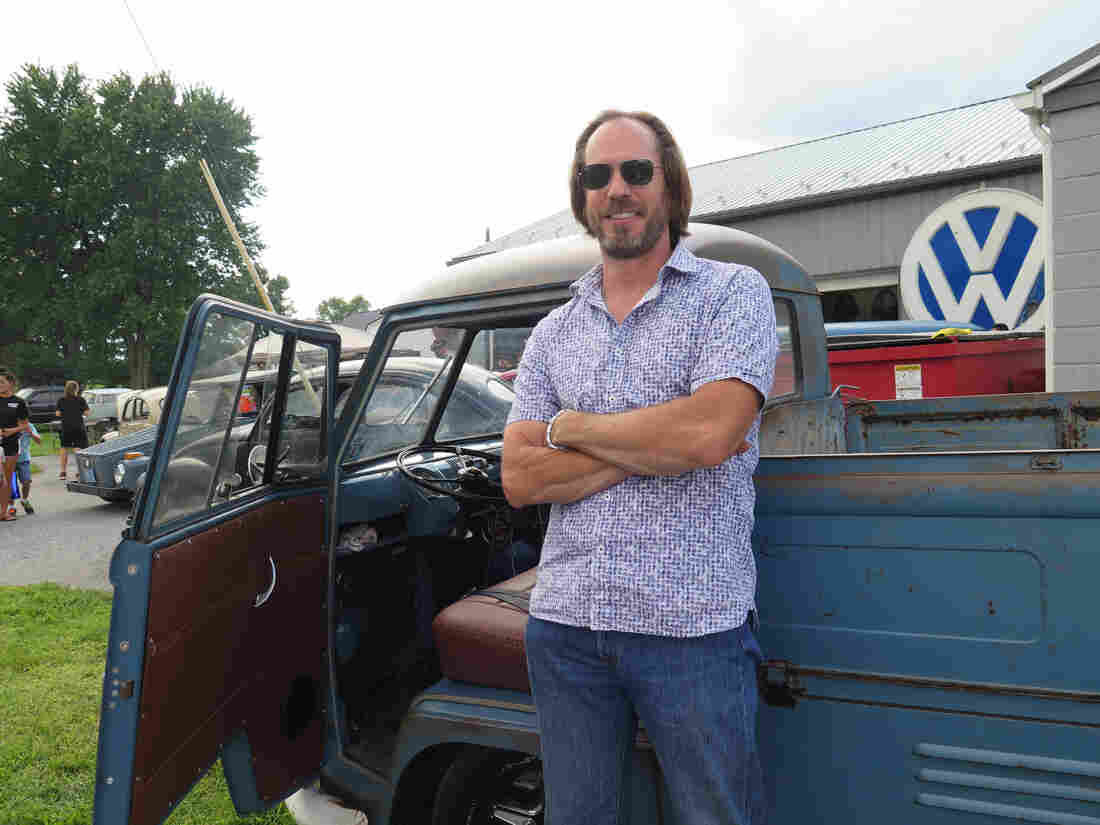
David Abruzzi’s ride is a rare Single Cab. The sides in the back fold down so it can be used as a pickup or a flatbed truck.
Les Cook/NPR
hide caption
toggle caption
Les Cook/NPR
Abruzzi says he has a vivid memory of something that happened one day when the truck was being used to haul sod.
“I thought it would be fun to get up in the bed and throw pieces of sod on [my grandfather’s] back,” Abruzzi says. “He says, ‘If you do that again, you’re going to get a whuppin’. And you know, being a 5-year-old and that’s your grandpa, what do you do? You do it again. I do not remember the spanking, but I remember my grandma making him apologize to me because it’s not the thing a grandpa ever does.”
Cooker’s repaired the rusted spots on the old pickup, matching the original faded blue paint that covers 80 percent of the vehicle. It’s more valuable with the original paint on it. But, for Abruzzi, the truck’s monetary value isn’t the point. What’s priceless for him is his grandfather’s name and address still stenciled on the doors: W.E. Skalicky, Battleview, N.D.

Abruzzi’s 1960 VW Single Cab belonged to his grandfather and has been in his family since about 1965. He says he doesn’t think he could ever part with it. He likes to take it out about once a week. “It just makes people smile,” he says.
Les Cook/NPR
hide caption
toggle caption
Les Cook/NPR
NPR’s Les Cook contributed to this report.
What It Might Take To Stop The Data Breaches

NPR’s Scott Simon talks to technology writer and professor Zeynep Tufekci about what she describes as Equifax’s unaccountability after a massive data breach.
SCOTT SIMON, HOST:
There seems to be a new big breach of personal data every few weeks. But this latest case in which Equifax, the credit reporting agency, was hacked seems especially massive. The Social Security numbers, dates of birth and other personal information of 143 million Americans was potentially exposed. Zeynep Tufekci argues that the underlying problem isn’t a technical failure; it’s political. Zeynep’s a contributing opinion writer for The New York Times. She joins us now from Chapel Hill, N.C.
Thanks so much for being with us.
ZEYNEP TUFEKCI: Thank you for inviting me.
SIMON: Since this hack was revealed, the Federal Trade Commission has announced an investigation. Equifax’s stock price, I guess, has tumbled a bit. And last night, two Equifax executives stepped down. Do you think this means real change is ahead?
TUFEKCI: I would like to know the conditions under which they stepped down. Very often, the step down is riding into the sunset with tens of millions of dollars. When Yahoo had many really huge breaches under the tenure of their CEO Marissa Mayer – and she just stepped down this summer with about $200 million in total compensation. So that doesn’t sound like a punishment to me. I would like to be punished that way.
(LAUGHTER)
TUFEKCI: I mean, I’m a former programmer. I’m pretty sympathetic to the idea that software will have bugs. But every time we hear of these breaches, most of the time, including in this Equifax case, it turns out that it was neglect and underinvestment. The problem that caused the breach was a software update that was available that they just did not implement.
SIMON: U.S. citizens don’t feel that they’ve been dealt with fairly because of this breach.
TUFEKCI: And they have not been. Yeah, they have not been.
SIMON: Well – but what can they do about it? People don’t even really do business, per se, with Equifax.
TUFEKCI: Right – because we are their product. We’re not their consumers. We are not the – they are usurping our data. They’re taking our data, and they’re selling it to others. So they really don’t care about us. And the automotive industry is a good example. They were dragged into regulation, and they were dragged into installing seatbelts and paying attention to car safety. And with much pressure, with much regulation, with much effort from consumers, they did. And it was good for the industry, too. It’s a better industry, healthier industry right now. So this isn’t going to work – I can’t withdraw from Equifax. I didn’t even have that right to do that. So this isn’t going to work without some level of oversight, some level of regulation and some real, genuine accountability.
As I said, if a person – if the little guy makes a tiny mistake with a credit card payment, they suffer severe consequences. We need to have proportionate consequences for the company, for the people who oversee it and for the whole industry. And if those are not in place, the next company knows that they can just keep ignoring the security aspect; they can underinvest. Something happens, it’s a few days of bad press. I talk to you; you talk to me. They go their merry way to their million-dollar retirement – at worst. And that’s the worst that happens to them. I – the incentives are not aligned for them to protect us, and we need to change that.
SIMON: Zeynep Tufekci at the University of North Carolina, thanks so much for being with us.
TUFEKCI: Thank you for inviting me.
Copyright © 2017 NPR. All rights reserved. Visit our website terms of use and permissions pages at www.npr.org for further information.
NPR transcripts are created on a rush deadline by Verb8tm, Inc., an NPR contractor, and produced using a proprietary transcription process developed with NPR. This text may not be in its final form and may be updated or revised in the future. Accuracy and availability may vary. The authoritative record of NPR’s programming is the audio record.
Saturday Sports: Cleveland's Winning Streak Ends
Howard Bryant of ESPN and ESPN the Magazine joins NPR’s Scott Simon to talk about the Cleveland Indians’ winning streak and the imbroglio between ESPN and the White House.
SCOTT SIMON, HOST:
And time now for sports.
(SOUNDBITE OF MUSIC)
SIMON: The Cleveland Indians lost last night, 4-3, to the Kansas City Royals to end their win streak at 22 games, the longest in 101 years. Cleveland came out to the field, and they gave their fans a standing ovation. We’re joined now by Howard Bryant of ESPN and ESPN the Magazine. Howard, thanks so much for being with us.
HOWARD BRYANT: Good morning, Scott.
SIMON: That standing O for the fans is one of the classiest things I’ve ever seen on a baseball field. In a way, are the Indians relieved not to have the streak on their shoulders as they go into the playoffs?
BRYANT: No, I just think all of this is great. I don’t think there’s anything bad about losing this game. I don’t think there’s anything bad about them continuing to win. I think that – the thing that I like most about what Cleveland’s been doing is that they’ve just proven that last year was no fluke. They had – played a great World Series against the Cubs. They came very, very close to winning. And it looks like they are on their way to taking another shot at that championship. If you’re in Cleveland, you’re extremely excited about what this team can do.
SIMON: Giancarlo Stanton of the Miami Marlins has 54 home runs this season. Barry Bonds ostensibly holds the title of 73 – you know, but that’s a steroid record. So Giancarlo Stanton is drawing close to the – Roger Maris’ 61 home runs from 1961.
BRYANT: And with absolutely no fanfare on this, Scott. I think it’s fascinating. One of the things that we’ve talked about is the price for the steroid era. We talked about what was going to happen in terms of how we viewed sports after this or how he viewed baseball specifically after all of the drugs and the suspensions and everything. And I think what you’re finding is, as much as we talk about the Hall of Fame paying a price, you’re also paying a price now because when somebody was going after that record, people cared. And right now, I don’t feel any of the buzz that you felt, whether it was 1961 or whether it was – or 1998. It just isn’t there. It’s nowhere near what it was. And that’s the price. When you mess with the record books in that sport, that’s what matters the most to people.
SIMON: Yeah. I have to ask – your colleague Jemele Hill of “SportsCenter” called President Trump a white supremacist in a series of tweets, so ESPN has been dragged into the news. The White House press secretary called that a fireable offense. President Trump went out after it. And last night, ESPN’s public editor called Jemele Hill’s tweets an error in judgment.
Do you have anything to say you can share with us?
BRYANT: Well, we are not really talking very much about this. But I feel – to me, the – this is the most divided time I’ve ever been in in terms of the country. This is a divided country. And I think that we’re – as sports people, we’re all finding out – for all the terms about the flag and protests and the president and Kaepernick and Jemele and everything else, we’re going to find out right now if these institutions about the flag and the Constitution, whether they mean something or whether it’s just all talk until it’s challenged.
SIMON: Howard Bryant of ESPN, thanks very much for being with us, my friend.
BRYANT: Thank you.
Copyright © 2017 NPR. All rights reserved. Visit our website terms of use and permissions pages at www.npr.org for further information.
NPR transcripts are created on a rush deadline by Verb8tm, Inc., an NPR contractor, and produced using a proprietary transcription process developed with NPR. This text may not be in its final form and may be updated or revised in the future. Accuracy and availability may vary. The authoritative record of NPR’s programming is the audio record.
High-Tech 'Bodega' Falls Short Of The Real Thing

Jesus Martinez (L) works at his bodega grocery store in the Queens borough of New York City in 2007. Tech entrepreneurs got pushback for calling their startup “Bodega.”
Spencer Platt/Getty Images
hide caption
toggle caption
Spencer Platt/Getty Images
A couple of high-tech entrepreneurs thought they’d put a personable name on an impersonal product.
Paul McDonald and Ashwath Rajan, formerly of Google, unveiled a box this week with glass doors, stocked with nonperishable items, that people can unlock with their cellphones while a camera records what they take and charges them.
It’s essentially a tech-connected vending machine. But the entrepreneurs chose a name for their venture that many people found offensive: Bodega.
The name is taken from small neighborhood shops, usually in New York, stocked with products people run out of or suddenly crave: candy, gum, soda, and yes, cigarettes, newspapers, lottery tickets, condoms, tampons and soap.
Many bodegas are in Hispanic neighborhoods, run by Hispanic and Asian shopkeepers. They become a stop for people out to walk their dogs, or take a stroll from their apartments, who decide to linger for a few minutes to buy a magazine or candy bar and talk to other people about how bad the Mets are, how nice the weather is, and kvetch about politicians, landlords and the Number 7 train from Flushing.
Bodegas are often the place sixth-graders stop after school to buy a Coke or a candy bar. The bodega owner knows their name and tells them, “Run home and do your homework.” The bodega owner will often let a good customer just take something they need if they have no money until they get their paycheck.
There is no app for that.
Real bodegas are small, affordable businesses you don’t need a stock offering to open. But if the high-tech-minibar-faux bodega takes off, it could be at the expense of bodegas owned by real people, who keep a cat on the counter and become vital characters in a neighborhood.
“To me it’s like sacrilegious — you wanna take this name and use it to make money off it?” Frank Garcia, who chairs the state Coalition of Hispanic Chambers of Commerce, told the New York Post.
The instant reaction on social media was so sharp that Paul McDonald and Ashwath Rajan had to quickly write on Medium, “We did some homework — speaking to New Yorkers, branding people, and even running some survey work asking about the name and any potential offense it might cause. But it’s clear that we may not have been asking the right questions of the right people.
“Despite our best intentions and our admiration for traditional bodegas, we clearly hit a nerve,” said the entrepreneurs, “we intended only admiration.”
But their statement leaves a question unanswered. Will the name stay?
The Week in Movie News: Here's What You Need to Know
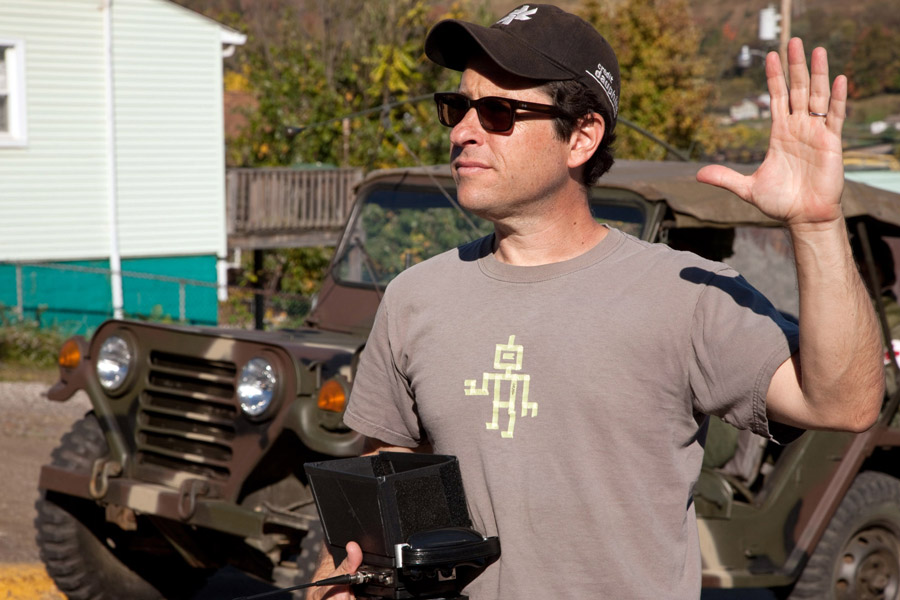
Need a quick recap on the past week in movie news? Here are the highlights:
BIG NEWS
J.J. Abrams will direct Star Wars IX: Following the departure of Colin Trevorrow as the director of Star Wars: Episode IX, Lucasfilm announced the return of The Force Awakens helmer J.J. Abrams. Due to the changeup, they also rescheduled the trilogy-closer to release on December 20, 2019. Read more here.

GREAT NEWS
Patty Jenkins officially signs on for Wonder Woman 2: Everyone presumed Wonder Woman director Patty Jenkins would be back for the sequel, but now it’s not only official but great news that she will receive the highest payday for a woman filmmaker ever. Read more here.

FINE FIRST LOOK
The new Hellboy: We got our first look at David Harbour as the new Hellboy, seen above. Read more on the movie here.
COOL CULTURE
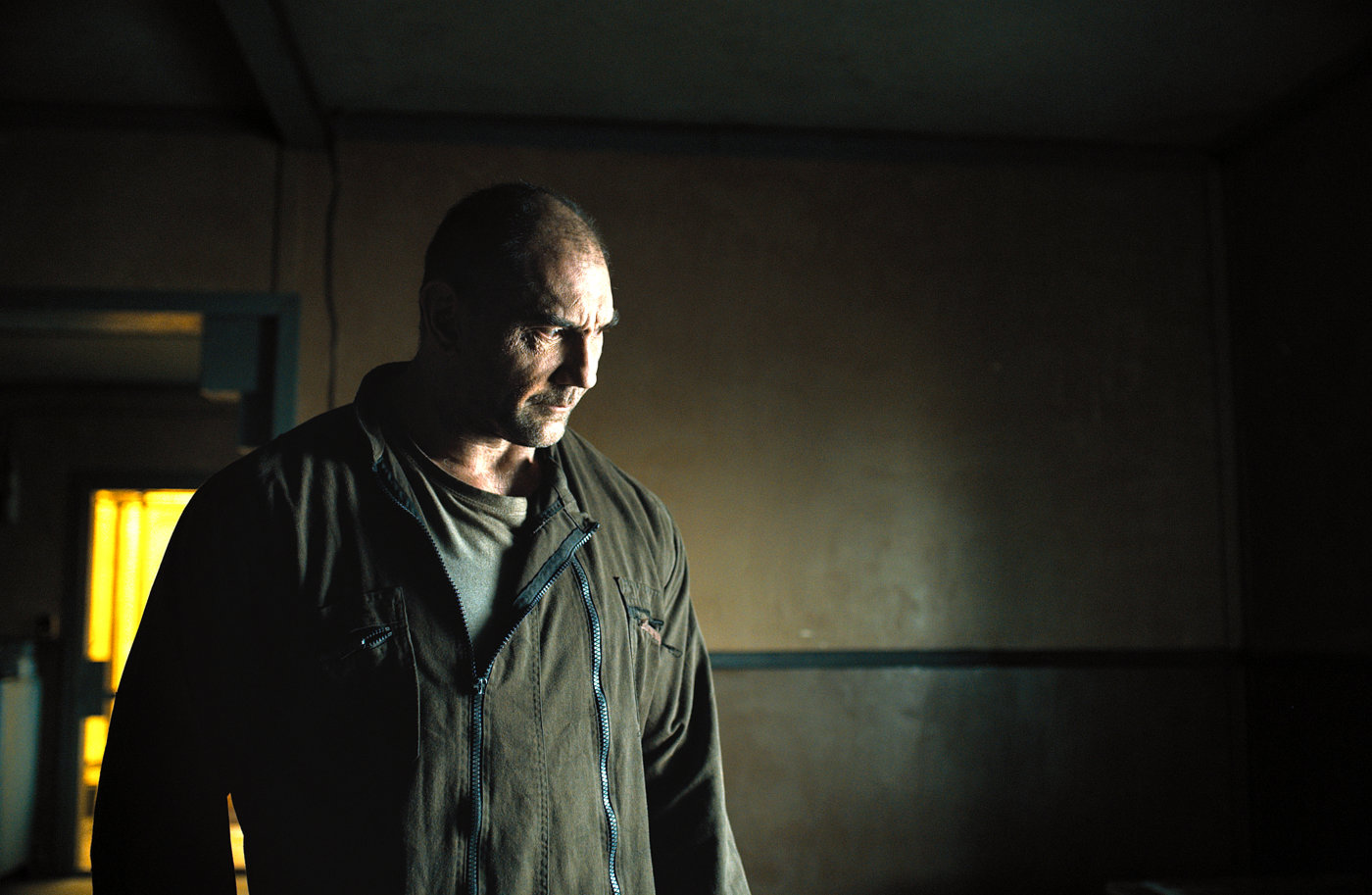
Dave Bautista is a replicant on the run: Speaking of tough guys, Dave Bautista’s new Blade Runner 2049 replicant character is introduced in a new prequel short film. Watch it below.
#BladeRunner2049‘s @DaveBautista is a replicant on the run in this never-before-seen in-world prequel. Watch it now. pic.twitter.com/xGn3WfjATF
— iTunes Trailers (@iTunesTrailers) September 14, 2017
FESTIVAL BUZZ
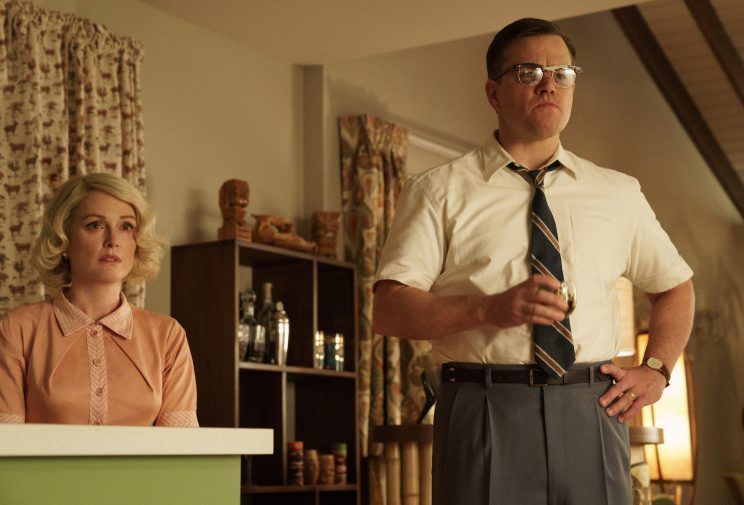
Toronto International Film Festival highlights: We are still at TIFF this week, and we’ve been sharing our own and others’ buzz about big movies from the film festival, including Downsizing and Molly’s Game. Read more here and here.

MUST-WATCH TRAILERS
Coco looks stunning: The new trailer for Pixar’s next animated feature, Coco, teases a movie that’s absolutely gorgeous and pretty funny, too. Watch it below.
[embedded content]

Fifty Shades Freed will see us soon: The first teaser for Fifty Shades Freed, the second sequel to Fifty Shades of Grey, shows a wedding, paradise and danger. Check it out here:
[embedded content]

My Little Pony is rainbow bright: The new trailer for My Little Pony: The Movie highlights its heroes and its guest star voice cast while exploding with rainbowlicious color. Check it out below:
[embedded content]
and
Royals Snap Indians' Winning Streak At 22 Games, Four Short Of Record
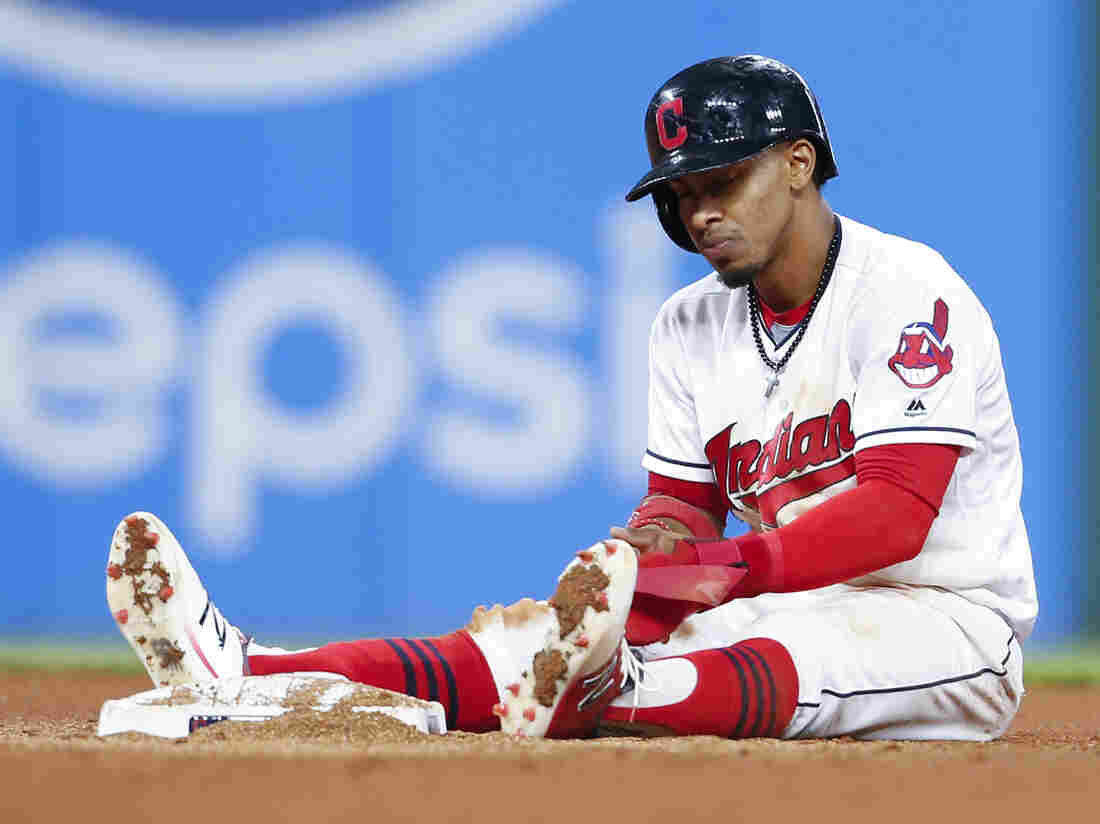
Cheer up, Francisco Lindor — there will be other 22-game winning streaks, right? The Cleveland Indians shortstop was forced out at second base in seventh inning Friday night at Progressive Field in Cleveland.
Ron Schwane/Getty Images
hide caption
toggle caption
Ron Schwane/Getty Images
The Cleveland Indians had mostly breezed through their record-setting 22-game winning streak, needing extra innings for the first time during it when they played the Kansas City Royals on Thursday. But they struggled against the Royals again on Friday and this time couldn’t pull off the comeback, falling 4-3.
The loss leaves them four wins shy of the all-time Major League Baseball record, a 26-game steak by the 1916 New York Giants. The Indians do now hold the record for the longest streak in American League history — and the second-longest streak the MLB ever has seen.
The run of wins also saw Cleveland rise to the top of the American League, with a guaranteed spot in the playoffs, all but clinching their division.
The win represents a surprising turnaround from when Kansas City played Cleveland during the streak in August, getting swept while being outscored 20-0. The biggest difference for the Royals tonight was that the bullpen held, giving up one hit and three walks in four innings.
Outfielder Lorenzo Cain led Kansas City at the plate, going 3-for-4 with a run scored and a run batted in, but every starter outside of catcher Drew Butera got at least one hit — including solo home runs by shortstop Alcides Escobar and designated hitter Brandon Moss.
With 15 games left to play, the Royals remain four games out of the final AL wild card spot.
After Hurricane Katrina, Many People Found New Strength

A Houston resident walks through waist-deep water while evacuating her home after severe flooding following Hurricane Harvey in north Houston.
Win McNamee/Getty Images
hide caption
toggle caption
Win McNamee/Getty Images
Long after the floodwaters recede and the debris is cleared, the mental health impacts of disasters like hurricanes can linger.
Psychologist Jean Rhodes of the University of Massachusetts-Boston has spent more than a decade studying what happens to people years after a natural disaster — in this case, Hurricane Katrina.
She and her team had been studying the health of young parents attending community college in New Orleans starting in 2003. After Katrina hit in 2005, they found themselves with a unique opportunity: they had health data from before and after the natural disaster. The researchers were able to measure Katrina’s mental health impacts in a project called the Resilience in Survivors of Katrina Project (RISK).
Most people fare well in the long term, they found, but some are still struggling years later.
Ailsa Chang, guest host of All Things Considered, spoke with Rhodes about the project and what lesson those people’s experiences may hold for people dealing with Hurricane Harvey and Hurricane Irma. Excerpts of the interview follow, edited for length and clarity.
Interview Highlights
How did going through a major disaster like Katrina affect people’s mental health long term?
Well, here’s some good news. About 60 percent — more than 60 percent if you look at their mental health over time — have returned to where they were prior to the storm. We often hear that there are these long-term consequences. There are, for about 20 percent, we see actually their anxiety and depression went up, and it stayed up. For some there was actually an improvement, they’re actually doing better than before.
They’re doing better?
Yes, so there’s two ways in which they are doing better. Their psychological functioning, about 3 to 5 percent were doing better on indices of anxiety and depression. There’s also this other interesting unexpected finding. That’s something called post traumatic growth; this is really the flip side of post-traumatic stress. They often go hand in hand.
Stress can often precipitate changes in our perspective about life. We begin to appreciate life more and feel a personal sense of strength of having endured the trauma. We see new possibilities. We begin to value relationships over things. And really have a spiritual awakening that psychologists have begun to appreciate comes often hand in hand with post-traumatic stress.
In aftermath of Katrina, some people in the study got access to mental health care for the first time in their lives — that turned out to be crucial for them. Since then, have you see a greater push to get mental health services out to people faster after a natural disaster?
Yes, I’ve seen a much broader, more integrated mental health response to the survivors of Harvey and Irma in ways that I think are going to have long term consequences.
One of the things that we know about exposure to natural disasters is that there’s kind of this critical period where if you’re not exposed to additional stressors and you can begin to process and make sense of what happened, you can begin to heal. It’s almost like a concussion — if you are continuously hit with new stressors after the initial stressor, it makes it much harder to heal.
I think that the responses in Houston and Florida have been much quicker and have really tried to minimize additional stressors that will have long-term implications for survivors’ mental health.
You say pets were a surprisingly big factor. Why is that?
One thing that was different from Katrina is that there was a lot less pet loss. Shelters were much more open to including pets, and people weren’t put in this forced choice between staying with their pets versus evacuating. Because of that, there was less exposure and less trauma.
Five years out of Hurricane Katrina, we saw that the loss of a pet was one of the three biggest predictors of depression and anxiety. Because we didn’t have as much separation between pets and their owners, we probably will be seeing less of that particular stress.
All Things Considered associate producer Selena Simmons-Duffin contributed to this report. Greta Jochem is an intern on NPR’s Science Desk.
