
After Going Shot For Shot, Olympic Athletes From Russia Win Men's Hockey Gold

David Wolf #89 of Germany attempts a shot against Vasili Koshechkin #83 of Olympic Athlete from Russia in the first period during the Men’s Gold Medal Game.
Harry How/Getty Images
hide caption
toggle caption
Harry How/Getty Images
The Olympic Athletes from Russia won 4-3 in a game against Germany where neither team had much to lose.
Germany had defeated hockey powerhouses Sweden and Canada in the semifinals, and the Olympic Athletes from Russia were highly stacked. Neither country had medaled in men’s hockey since 2002, when Russia won bronze.
With 0.5 seconds remaining in the first period, Russian Vyacheslav Voynov scored the first point of the match after an ambitious shot that made it past German goaltender Danny aus den Birken.
Germany brought the score to a tie with 10 minutes left in the second period, after a shot by Felix Schütz bounced off of goalkeeper Vasily Koshechkin and deflected off the body of Russian defenseman Bogdan Kiselevich across the goal line.
After review, we have a good #GER goal
Gold-medal game is now TIED at 1
WATCH: https://t.co/3vGgsIGxqxpic.twitter.com/0f1be8rijz
— CBC Olympics (@CBCOlympics) February 25, 2018
A steady back and forth continued, until Russian Nikita Gusev scored a point with 6:39 left in the third period. But the Russians relaxed — and just 10 seconds later, German frontman Dominik Kahun tied the game right back up, the stakes just as high as before.
With three minutes left in the third period, Jonas Müller broke the tie 3-2 with the cleanest shot of the game after a winning a puck battle against the Russians. This lead didn’t last for long; either: With less than 60 seconds to go, Gusev scored again, and the teams were back to a tie.
About 15 minutes into sudden-death overtime, Gusev scored yet another goal — and the Russians threw off their helmets in celebration of winning gold.
The match was guaranteed to be Germany’s best showing in men’s hockey no matter the outcome: The team had won bronze in 1932, and West Germany won bronze in 1976. Their silver medal is the strongest performance Germany has ever shown in men’s hockey, while Russia won gold in 1992 as the Unified Team.
Canada walked away with the bronze medal by beating the Czech Republic 6-4 after being knocked out for silver and gold by Germany.
The Russian athletes competed in neutral Olympic gear rather than Russian colors. The International Olympic Committee suspended the Russian Olympic Committee in 2017, citing a widespread culture of doping in Russia and alleged state-sponsored system of cheating.
Russian athletes were allowed to compete in the 2018 Winter Games under a neutral Olympic flag and were required to pass rigorous doping tests. Going into Pyeongchang, the IOC said there was a chance Russia’s athletes could march under their country’s colors at the games’ closing ceremony.
After two Russian athletes were disqualified over doping, the IOC voted to uphold the ban, meaning that athletes will once again leave their Russian colors at home in the closing ceremony.
Poll: Where Americans Draw Lines On Workplace Behavior

The #MeToo movement has brought a fresh examination of workplace behavior. A new NPR-Ipsos poll found little tolerance for a broad range of behaviors — from gossip to unwanted touching.
SARAH MCCAMMON, HOST:
People are reconsidering what behaviors are OK in the workplace and which are inappropriate with the Me Too movement taking hold over the last few months. NPR joined up with Ipsos to poll Americans on where they draw the line and what they’ve experienced at work. NPR’s Danielle Kurtzleben has been looking at the results. She joins us now. Hi, Danielle.
DANIELLE KURTZLEBEN, BYLINE: Hello.
MCCAMMON: So there’s been a lot of talk about gray areas in the midst of the Me Too movement. What’s OK, what’s not OK, what’s in between?
KURTZLEBEN: Right.
MCCAMMON: Give me a sense of what this poll found.
KURTZLEBEN: So, we asked people about a dozen workplace behaviors, you know, from unwanted touching to just asking about a co-worker’s social life. And on a lot of these, a majority of people thought that those behaviors were inappropriate on balance. The behaviors that people thought were the most inappropriate were deliberate touching but also some things we don’t hear about in this Me Too cultural moment right now, things like gossiping or speculating about your co-worker’s sexual preference. And meanwhile, at the other end of the spectrum, what the fewest people thought was inappropriate in all of the things that we asked was a co-worker asking a co-worker of equal rank out on a date. But even then, 30 percent of people said that was inappropriate.
MCCAMMON: So how pervasive did people think that these kinds of behaviors are at work?
KURTZLEBEN: On a lot of these, quite pervasive. You know, we asked people if they had seen these things happen in the workplace and even some things that people saw as very inappropriate like telling sexual stories or jokes or calling an adult female in the workplace babe or sweetie or, you know, some iteration of that. A majority of people said they had seen those things at work even though around 8 or 9 in 10 people thought those things were inappropriate. Likewise, about half of people have seen their co-worker discussing each other’s sexual preferences or history. And about a third say they have seen deliberate touching or leaning or cornering or something to that effect.
But on a lot of these behaviors where there’s near consensus that these things are inappropriate and where you have quite a few people saying, yeah, I’ve seen this happening, relatively few people – 1 in 10 or fewer – say they have actually done these things themselves. So, for example, more than half of people have seen someone telling a sexual joke or story at work. Fifteen percent of people say they have done that themselves.
MCCAMMON: It also seems like, especially in this moment, that it would be kind of hard to admit to a pollster that you’ve done any of these things. Am I right?
KURTZLEBEN: Right, yeah. And, you know, that is a concern in a poll like this, so we did this poll online. That should mitigate some of that. But aside from that, you know, there are a few other things to think about with this poll. First is that this is the first time that we have polled on these questions with Ipsos. We do not have anything else to compare this to. This is just a snapshot. So we don’t know if this is a change from people’s behaviors before the Me Too movement.
One other really big question mark with these questions is that the behaviors we asked people about, some of them are pretty ambiguous. And that’s intentionally ambiguous, right? Because one of the big challenges people are confronting in their workplaces right now is those gray areas you started out asking me about. Take commenting on a co-worker’s appearance, for example. Saying to a co-worker, hey, that’s a cool dress you’re wearing, that can be perceived as a very different thing from saying that dress looks great on you.
MCCAMMON: Right.
KURTZLEBEN: Two different things you could say about a co-worker’s appearance and two very different ways to perceive that.
MCCAMMON: Well, thanks, Danielle. Danielle Kurtzleben is a politics reporter with NPR. Good to have you here.
KURTZLEBEN: Yes, thank you.
Copyright © 2018 NPR. All rights reserved. Visit our website terms of use and permissions pages at www.npr.org for further information.
NPR transcripts are created on a rush deadline by Verb8tm, Inc., an NPR contractor, and produced using a proprietary transcription process developed with NPR. This text may not be in its final form and may be updated or revised in the future. Accuracy and availability may vary. The authoritative record of NPR’s programming is the audio record.
Czech Republic's Ester Ledecka Makes History With Golds In Snowboarding And Skiing

Ester Ledecka of the Czech Republic celebrates winning gold in the ladies’ snowboard parallel giant slalom at the Pyeongchang Olympic Games Saturday.
Clive Rose/Getty Images
hide caption
toggle caption
Clive Rose/Getty Images
With a gold medal in the snowboard parallel giant slalom, Ester Ledecka of the Czech Republic has become the first woman in Winter Olympics history to win a gold medal in two different sports at the same Olympic Games.
On Saturday she emerged victorious in the final run against Germany’s Selina Joerg, finishing just 0.46 seconds ahead. Joerg took silver in the event, followed by Ramona Theresia Hofmeister, also of Germany, who took bronze.
A week earlier, Ledecka surprised spectators and herself by taking a gold medal — in skiing. Ledecka finished first in the women’s super-G in Alpine skiing, finishing several spots ahead of the decorated American skier Lindsey Vonn.
But Ledecka is best known and has seen the most success as a snowboarder, where she’s won world titles and competed in the Winter Games in Sochi four years ago.
Ledecka is the third athlete to win gold in two events in the same Winter Games, according to analytics company Gracenote. The last time it happened was in 1928, with Johan Grøttumsbråten taking gold in the Nordic combined and cross-country skiing. Four years earlier, Thorleif Haug achieved the same thing, the company says.
The 22-year-old Ledecka earlier made Olympic history just by being the first woman to compete in both the Alpine skiing and snowboarding events.
She first skied at age 2 and snowboarded at age 5, according to The New York Times, but refused to follow the conventional wisdom of her coaches to give up one sport in order to specialize.
In the men’s snowboarding parallel giant slalom, Nevin Galmarini of Switzerland was the gold medal winner, besting his silver medal he won in Sochi in 2014.
Lee Sang-ho of South Korea finished 0.43 seconds behind to take silver, the country’s first medal in a snowboarding event. Zan Kosir of Slovenia was the bronze winner, beating Sylvain Dufour of France in the “small final,” which determines the contest’s overall third place.
The Week in Movie News: 'Black Panther' Broke Records, Jessica Chastain to Star in 'It' Sequel and More

Need a quick recap on the past week in movie news? Here are the highlights:
BIG NEWS
Black Panther broke a lot of box office records: Marvel’s Black Panther was expected to be another blockbuster, but the movie shot way past expectations to deliver one of the best opening weekends of all time. See all the records it broke here.

GREAT NEWS
Danny Boyle might direct the next Bond movie: For the 25th official James Bond movie, whichi is likely to be Daniel Craig’s last as 007, MGM and EON are hoping to sign Oscar-winning director Danny Boyle. Read more and see visual evidence of why Boyle is a good fit here.

EXPECTED BUT STILL EXCELLENT NEWS
Jessica Chastain will star in It: Chapter Two: Fans have been asking for and assuming the casting of Jessica Chastain as grown-up Beverly in the sequel to the smash hit horror film It, and now it’s actually happening. Read more here.

EXCLUSIVE BUZZ
Ava DuVernay on why the next big Disney movie matters: We talked to Ava DuVernay about her upcoming adaptation of A Wrinkle in Time and why it’s such an important movie. Read the exclusive interview here and our set visit report and character guide here.

COOL CULTURE
The sound design of Star Wars: The Last Jedi: The latest Star Wars movie has been out in theaters a couple months, and now you can relive one of its best elements thanks to a short ABC News documentary on its sound design. Watch it below.

MUST-WATCH TRAILERS
On Chesil Beach delivers a romance in 1960s England: Current Oscar nominee Saoirse Ronan stars alongside Billy Howle in On Chesil Beach, a romantic drama set in 1962 that just dropped its first trailer. Watch it below.
[embedded content]

Where is Kyra showcases the talents of Michelle Pfeiffer: The trailer for Where is Kyra, a character-driven drama starring Michelle Pfeiffer, proves why she’s still one of the greatest living actresses. Watch it here:
[embedded content]

Kings dramatizes the 1992 L.A. riots: The first trailer for the drama Kings, which takes place during the 1992 L.A. riots, features Halle Berry and Daniel Craig as neighbors. Watch it below.
[embedded content]
and
Trump Administration Restricts H-1B Worker Visas Coveted By High Tech
The Trump administration is tightening the rules for companies that contract out high-skilled workers who are in this country on H-1B visas.
The U.S. Citizenship and Immigration Services agency issued a new policy memo on Thursday that requires “detailed statements of work or work orders” about the work that will be performed when an H-1B visa worker is employed at a third-party work site. Employers will have to file more details that support the need for foreign talent.
H-1B visas are controversial. American tech companies use them to hire highly skilled foreign workers, such as engineers, IT specialists, architects among others, in situations in which they say there is a shortage of U.S.-born talent. The visas are good for three years and renewable for another three-year term.
Critics of the visas — 85,000 of which are issued every year — say American workers are aced out of competition with workers who can be paid less.
As CNN reports, “Indian outsourcing firms will be the hardest hit. Indian workers receive more than 70% of all H-1B visas.”
The USCIS memo says that if a visa beneficiary will be placed at one or more third-party worksites, the employer “has specific and non-speculative qualifying assignments in a specialty occupation for the beneficiary for the entire time requested in the petition; and the employer will maintain an employer-employee relationship with the beneficiary for the duration of the requested validity period.”
The memo says USCIS recognizes that visa-holders may wind up earning less money than promised or might perform “non-specialty” jobs when they are contracted out to third-party worksites.
The policy change comes as the Trump administration has signaled its desire to change the visa program with a “Buy American, Hire American” policy outlined in an executive order signed in April 2017. The order promised to root out fraud and abuse in the program.
As the Mercury News reports, the H-1B program has come under intense federal scrutiny.
“A Bay Area News Group report earlier this week found a sharp rise in the number of reviews immigration officials were conducting on H-1B applications. From January to August 2017, the U.S. Citizenship and Immigration Services sent 85,265 requests for evidence in response to H-1B visa applications, a 45 percent increase compared to the same period a year earlier, agency data show. Such requests are made when an application is missing required documents or when the agency determines it needs more proof to decide if a worker is eligible for the visa. Immigration lawyers say the extra enforcement could discourage companies and individuals from seeking an H-1B visa in the first place.”
Experts Say There's Little Connection Between Mental Health And Mass Shootings
President Trump has raised mental health as a key factor in mass shootings, including a call Thursday to create more mental hospitals. But experts say there’s little connection between a person’s mental illness and the likelihood of a mass shooting.
MARY LOUISE KELLY, HOST:
Along with gun control, the link between mental illness and gun violence has been a major focus in the days since the shooting. NRA spokeswoman Dana Loesch put it this way in a CNN town hall this week.
(SOUNDBITE OF ARCHIVED RECORDING)
DANA LOESCH: I don’t believe that this insane monster should have ever been able to obtain a firearm – ever. This individual was nuts.
KELLY: President Trump has repeatedly pointed to mental health as the root of the problem, including yesterday at the White House.
(SOUNDBITE OF ARCHIVED RECORDING)
PRESIDENT DONALD TRUMP: And we’re going to be focusing very strongly on mental health because here’s a case of mental health.
KELLY: President Trump says part of that focus will be keeping guns out of the hands of people with mental illness. Another proposal from the president – opening more mental health institutions. But NPR’s Alison Kodjak reports that doctors and mental health advocates say the link between mental health problems and gun crimes is tenuous.
ALISON KODJAK, BYLINE: The president says the way to stop future school shootings is to identify people with severe mental illness and lock them up.
(SOUNDBITE OF ARCHIVED RECORDING)
TRUMP: So we’re going to be talking seriously about opening mental health institutions again.
KODJAK: And he added…
(SOUNDBITE OF ARCHIVED RECORDING)
TRUMP: We used to have mental institutions. And I said this yesterday. We had a mental institution where you take a sicko like this guy – he was a sick guy – so many signs – and you’d bring him to a mental health institution.
KODJAK: That troubles Bethany Lilly, an attorney with the Bazelon Center for Mental Health Law, because the United States has a dark history of locking people away in psychiatric hospitals.
BETHANY LILLY: We did that for most of American history. And then my organization and civil rights lawyers across the United States and journalists and investigators found out how horrible these snake pits were.
KODJAK: The patients received little mental health care. They were often abused and neglected.
LILLY: Mental health institutions not only imprisoned people who would have what we today call a mental health disability or a mental health diagnosis. They also imprisoned people who simply behaved outside of the norm of society.
KODJAK: So in the 1970s and 1980s, many psychiatric hospitals were closed. The number of patients fell by more than 90 percent. The president isn’t completely alone in suggesting that that went too far. Health policy experts at the University of Pennsylvania wrote in 2015 that there’s a need for more mental asylums, ones that actually provide quality mental health care for people who cannot safely live in the community. But Lilly fears people will once again be locked up not because they pose an actual threat but simply because they carry a diagnosis that others fear.
LILLY: If you talk to any practicing psychiatrist, they will tell you that the risk factors for gun violence are being a young, angry, socially isolated man. Sometimes in the constellation of effects, you will also have people with mental illness.
KODJAK: The Parkland Florida shooter was 19 and by many accounts very isolated. He was referred to police multiple times for violent threats. Matthew Miller is a professor of epidemiology at Northeastern University who has published several papers on the risk factors of gun violence. He says the key ingredient in this mass shooting and others is not mental illness. It’s the guns.
MATTHEW MILLER: The reason for these sort of mass public shootings is not because we have higher rates of mental illness. And it’s not because we have higher rates of violent behavior. We don’t.
KODJAK: The rate of mental health problems in the U.S., he says, is about the same as in Europe. And the same goes for violent crime.
MILLER: But we have much higher rates of violent death because when people try to harm other people, for example, they are much more likely to use guns.
KODJAK: He says if politicians want to reduce mass shootings, they have to deal with the guns. If they want to improve mental health care, they can do that, too.
MILLER: One doesn’t need to invoke homicides in order to say we should be doing a better job trying to treat mental illness and trying to give people access to mental health care. That’s an argument you can make on its own merits.
KODJAK: Alison Kodjak, NPR News.
(SOUNDBITE OF CUL DE SAC’S “BLUES IN E”)
Copyright © 2018 NPR. All rights reserved. Visit our website terms of use and permissions pages at www.npr.org for further information.
NPR transcripts are created on a rush deadline by Verb8tm, Inc., an NPR contractor, and produced using a proprietary transcription process developed with NPR. This text may not be in its final form and may be updated or revised in the future. Accuracy and availability may vary. The authoritative record of NPR’s programming is the audio record.
Today in Movie Culture: Proposing a 'Star Wars'-Inspired Olympic Sport, a Spotlight on Stunt Performers and More
Here are a bunch of little bites to satisfy your hunger for movie culture:
Dream Olympic Sport of the Day:
More people would watch curling at the Winter Olympics if it involved everyone’s everyone Star Wars droid (via io9):
Fan Build of the Day:
[embedded content]
Reworked Trailer of the Day:
Seeing Solo: A Star Wars Story as being like the Star Trek reboot, War Starts at Midnight added The Beastie Boys’ “Sabotage” to the trailer to make it even better (via Geek Tyrant):
[embedded content]
Oscars History of the Day:
Burger Fiction highlights every Academy Award winner for Best Animated Feature in this shorter than most Oscar history supercut:
[embedded content]
Vintage Image of the Day:
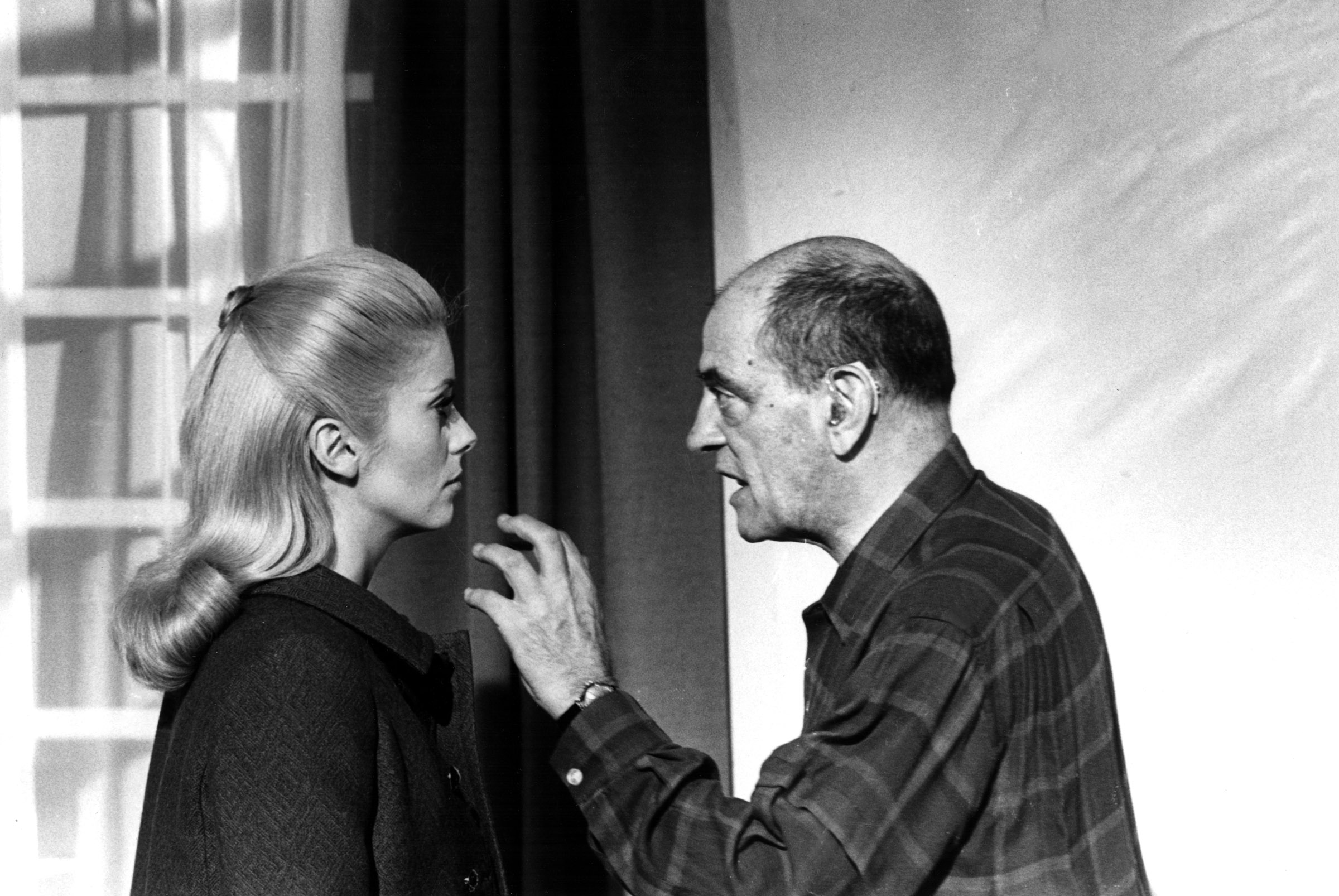
Luis Bunuel, who was born on this day in 1900, directs Catherine Denueve on the set of his 1967 classic Belle de Jour:
Movie Comparison of the Day:
Last year, Rob Stone compared the opening and closing sequences of Citizen Kane and Alfred Hitchcock’s Rebecca. Now Will DiGravio responds with more side-by-side looks at the two classics (via Film School Rejects):
[embedded content]
Movie Science of the Day:
What is the toxin on the lips of Poison Ivy from Batman & Robin? Kyle Hill gives a scientific explanation of her deadly powers:
[embedded content]
Movie Job of the Day:
They don’t get to win Oscars, but Mashable honors stunt people by showcasing what it takes to do their job in this video:
[embedded content]
Inspired Look of the Day:
Filmmaker Ava DuVernay shared this tweet from a fan who is halfway to cosplaying as a character from her upcoming movie A Wrinkle in Time:
#AWrinkleInTime@WrinkleInTime “Mrs. Whatsit” inspired look! @RWitherspoonpic.twitter.com/M2eqLbivnP
— Katy Mae (@KatyMaex) February 21, 2018
Classic Trailer of the Day:
This week is the 15th anniversary of the release of Ron Shelton’s Dark Blue starring Kurt Russell. Watch the original trailer for the classic crime film below.
[embedded content]
and
Zagitova Edges Medvedeva To Win Figure Skating Gold At Pyeongchang Olympics

Alina Zagitova won the first gold medal for the Olympic Athlete from Russia team at the Pyeongchang Winter Olympics.
Harry How/Getty Images
hide caption
toggle caption
Harry How/Getty Images
Update at 12:50 a.m. ET Friday
Alina Zagitova narrowly beat her teammate Evgenia Medvedeva in the women’s singles figure skating competition at the Pyeongchang Winter Olympics, winning the first gold medal for the Olympic Athlete from Russia team.
“I haven’t fully realized yet that I’ve won,” said Zagitova, who is just 15. “I think I need some time to understand that I won the Olympic Games.”
It would begin to sink in, she said, when she gets her medal in tonight’s ceremony in Pyeongchang.
In addition to her jaw-dropping talent, Zagitova has drawn scrutiny for the composition of her program, in which she saves all the most complicated moves for the second half, to maximize their scoring potential.
But Zagitova also uses the first half of the program to show her artistry and dramatic flair. She did that in her free skate here in South Korea – and when it was time to hit her jumps, she nailed them in spinning, smooth precision.
As she finished, the crowd, including a large and vocal Russian contingent, cheered loudly. Coming off the ice, Zagitova was beaming.
Of her score, Zagitova said, “I was surprised and it was a nice surprise. I am glad that I was able to deal with my nervousness, go out there and skate my program calmly.”
She added that she would have given herself “a 4 with a little plus [out of 5] for my performance, because I didn’t do the first jump combination [triple Lutz-triple loop], but I did it later. I proved one more time to myself that I can change my jump elements during the program.”
The three Americans in the field — Mirai Nagasu, Karen Chen, and Bradie Tennell — needed to turn in eye-popping performances today to even approach the podium. None of them had scored above 70 points in their short program, as six other skaters had. In the final rankings, they held onto their spots, all in a group, with Tennell vaulting from 11th, last in the group, to 9th.
An updated version of our original story, recapping the event:
Zagitova’s score in the free program of 156.65 points staked her claim to the gold medal.
“Kaetlyn Osmond brought her A-game to the Olympics.” @kaetlyn_23‘s first individual medal in the #WinterOlympics, and she earned it with a blissful free skate! https://t.co/fmMl0BMYXFpic.twitter.com/Z6YjxstCLU
— NBC Olympics (@NBCOlympics) February 23, 2018
Canada’s Kaetlyn Osmond, 22, followed with a graceful and smooth skate, with elements flowing into one another. One highlight: a triple salchow – double toeloop – double loop combination that drew loud cheers.
For Osmond, there was at least one stumble on a landing. But when she spun into her finish, the packed arena (with many Canadian fans) was already roaring its approval. Osmond put her hands on the ice, smiling and laughing — and clearly trying to catch her breath: These elite skaters only make these routines SEEM easy.
“I was so excited, I was so ready for this program,” Osmond said later. “All day I was terrified, I was so nervous, but it is a program I feel super comfortable with in practice, and I was so ready to show it in competition — that’s exactly what I felt.”
Osmond’s score: 152.15, putting her into second place overall — a bump up from third and assuring her of a medal.
But then it was all up to Medvedeva, skating in the final slot of the day to “Anna Karenina” by Dario Marianelli. The question in the arena was: Would the reigning world champion take gold, or silver?
.@JannyMedvedeva was stunning in the free skate, a performance that earned her silver. #WinterOlympicshttps://t.co/fmMl0BMYXFpic.twitter.com/mZFRNI25mO
— NBC Olympics (@NBCOlympics) February 23, 2018
Medvedeva’s fluid technique and ability to express herself on the ice — while pulling off jumps with technical skill and grace — are captivating. The crowd cheered her dramatic program with appreciation, but it wasn’t the loudest we heard today.
Finishing her program, Medvedeva immediately started weeping on the ice, covering her face with her hands. As she skated off and hugged her coach, she began crying openly.
Medvedeva’s score: 156.65 points — a tie in the free skate with Zagitova, who had come into the final skate leading her by less than two points: 82.92 to 81.06. That sealed the gold medal for Zagitova, with 239.57 total points.
“I felt today in my program really like Anna Karenina in the movie,” Medvedeva said, discussing her performance and likely mortifying Russian literature professors. “I put everything out there that I had, I left everything on the ice. I have no regrets.”
She skated “in a fog,” Medvedeva said, saying she was in the moment and aware that for four minutes she could express herself to the world.
“My soul thrives on that feeling, the body and the brain did their job,” she said.
When Medvedeva left the scoring area, she and Zagitova shared a big and long hug.
Of her bronze medal, Osmond said, “Not long after the last Olympics, I didn’t even know that I would be competing at this one. It means so much, and to know that I fought so hard in the last four years.”
She added, “My main goal was to place higher than 13th, which I did, and I improved that by 10 placements. I am so excited.”
Divine.
There are very few words to describe Alina Zagitova’s short program, so let’s just watch it. #WinterOlympicshttps://t.co/KZ4MBNvQzppic.twitter.com/1QgRsNMdnM
— NBC Olympics (@NBCOlympics) February 21, 2018
Among the U.S. trio, Tennell led the way in this final, after trailing on Wednesday. She and Chen turned in solid, but far from perfect, performances that left them behind Russian athlete Maria Sotskova. Nagasu, who made history earlier in Pyeongchang by landing the first triple axel at an Olympics, pulled out of her jumps today and didn’t seem as steady as she was during the team event. She finished between Tennell and Chen.
“I’m ready to go home,” Nagasu said afterwards, according to NPR’s Tom Goldman.
The start times for the final six women in the free skate on Friday in South Korea (Thursday night in the U.S.) had Medvedeva going last:
Satoko Miyahara (Japan)
Carolina Kostner (Italy)
Kaori Sakamoto (Japan)
Alina Zagitova (OAR)
Kaetlyn Osmond (Canada)
Evgenia Medvedeva (OAR)
Before the highest-ranked skaters from the short program began their programs, Chen and Tennell had come closer to skating the way many had expected them to – and the way they didn’t quite manage to in their short program (for Tennell, it included a fall, something she rarely does).
After Chen earned a 119.75 score, Tennell put down a solid program to get a 128.34 – and 192.35 total points, with nine skaters still to take the ice.
As she finished her skate and awaited her score, Tennell looked relieved, proud, and happy.
There were 24 skaters in the final — but Zagitova and Medvedeva were the only ones to score above 80 points in the short program. Zagitova had the edge with 82.92 points, partly because her program is shaped to maximize scoring: All of her big jumps come in the last section, when they’re worth more.
Medvedeva, 18, is the reigning world champion. She’s competing in South Korea after recovering from a broken foot that she suffered last October.
Zagitova, 15, won this year’s European championship in Moscow. She has risen to the heights of the world’s elite skaters just one year after winning the world junior championship.
With a Russian skater winning gold, it set off a celebration for fans of the Olympic Athletes from Russia team — who are competing under a neutral flag at these Winter Games because of doping punishments. Before today’s event — and with the final weekend of competition looming in Pyeongchang, the team hadn’t managed to win a gold medal, it has now also won five silver and eight bronze medals.
For a brief while earlier this week, Medvedeva owned the Olympic record for the highest-scoring women’s short program in history, after turning in a flawless skate at the Gangneung Ice Arena. But within moments, her score of 81.06 was eclipsed by Zagitova’s 82.92.
Both Medvedeva and Zagitova attend Sambo 70, a large sports center and school in Moscow that was founded in 1970. The school trains Olympic athletes in a variety of winter and summer sports, from judo and swimming to skiing and figure skating. Another product of Sambo 70:Julia Lipnitskaya, who was 15 when she won a gold medal as part of Russia’s figure skating team at the Sochi 2014 Olympics.
Iran May Follow Venezuela In Launching Its Own Cryptocurrency
Iran has announced its intent to establish a national cryptocurrency. In a tweet posted Wednesday, an Iranian official said that a test model for a “cloud-based digital currency” is being developed for submission to the Iranian banking system.
The official, Mohammad-Javad Azari Jahromi, heads Iran’s Ministry of Information and Communications Technology. Jahromi made the announcement after a meeting with the state-owned Post Bank of Iran.
It is not yet clear what role the currency will play in the Iranian banking system. Iran’s central bank has hinted at regulating cryptocurrencies in the past, even suggesting the adoption of an “infrastructure” to integrate digital currencies into the country’s financial system.
But the central bank backpedaled on Wednesday just as news of the state-sponsored digital currency went public. In a statement reported by Iran Front Page news, the Central Bank of Iran highlighted the “highly unreliable and risky” nature of cryptocurrency markets. It warned that Iranians “may lose their financial assets” in a space marked by extreme volatility and “pyramid scheme”-like businesses.
The announcement comes on the heels of Venezuela’s oil-backed “petro” cryptocurrency launch earlier this week. Venezuelan President Nicolas Maduro claims that the cryptocurrency has raised over $700 million for the cash-strapped country. But doubts remain over the currency’s long-term viability, as Venezuela struggles to profit from the oil reserves that are supposed to back it.
There are fears that the rise of state-backed cryptocurrencies could pose a challenge to international efforts to regulate financial transactions and impose sanctions. The countries most interested in the technology – Iran, Venezuela and Russia – are all targeted by U.S. sanctions.
The Treasury Department has warned that U.S. citizens purchasing these currencies may be violating sanctions laws. And just last month, Treasury officials told Congress that rogue states and international criminal organizations are using virtual currencies “to launder their ill-gotten gains.”
Does A Larger Role For Midwives Mean Better Care?

A new study offers a systematic look at what midwives can and can’t do in different states, offering evidence that empowering them could boost maternal and infant health.
Trina Dalziel/Getty Images/Ikon Images
hide caption
toggle caption
Trina Dalziel/Getty Images/Ikon Images
In Great Britain, midwives deliver half of all babies, including Kate Middleton’s first two children, Prince George and Princess Charlotte. In Sweden, Norway and France, midwives oversee most expectant and new mothers, enabling obstetricians to concentrate on high-risk births. In Canada and New Zealand, midwives are so highly valued that they’re brought in to manage complex cases that need special attention.
All of those countries have much lower rates of maternal and infant mortality than the U.S. Here, severe maternal complications have more than doubled in the past 20 years. Shortages of maternity care have reached critical levels: Nearly half of U.S. counties don’t have a single practicing obstetrician-gynecologist, and in rural areas, the number of hospitals offering obstetric services has fallen more than 16 percent since 2004. Nevertheless, thanks in part to opposition from doctors and hospitals, midwives are far less prevalent in the U.S. than in other affluent countries, delivering about 10 percent of babies, and the extent to which they can legally participate in patient care varies widely from one state to the next.
Now a new study, a systematic look at what midwives can and can’t do in the states where they practice, offers new evidence that empowering them could significantly boost maternal and infant health. The five-year effort by researchers in Canada and the U.S., published Wednesday, found that states that have done the most to integrate midwives into their health care systems, including Washington, New Mexico and Oregon, have some of the best outcomes for mothers and babies. Conversely, states with some of the most restrictive midwife laws and practices — including Alabama, Ohio and Mississippi — tend to do significantly worse on key indicators of maternal and neonatal well-being.
“We have been able to establish that midwifery care is strongly associated with lower interventions, cost-effectiveness and improved outcomes,” said lead researcher Saraswathi Vedam, an associate professor of midwifery who heads the Birth Place Lab at the University of British Columbia.
Many of the states characterized by poor health outcomes and hostility to midwives also have large African-American populations, raising the possibility that greater use of midwives could reduce racial disparities in maternity care. African-American mothers are three to four times more likely to die in pregnancy or childbirth than their white counterparts; black babies are 49 percent more likely to be born prematurely and twice as likely to perish before their first birthdays.
“In communities that are most at risk for adverse outcomes, increased access to midwives who can work as part of the health care system may improve both outcomes and the mothers’ experience,” Vedam said.
That’s because of the midwifery model, which emphasizes community-based care, close relationships between providers and patients, prenatal and postpartum wellness, and avoiding unnecessary interventions that can spiral into dangerous complications, said Jennie Joseph, a British-trained midwife who runs Commonsense Childbirth, a Florida birthing center and maternal care nonprofit. “It’s a model that somewhat mitigates the impact of any systemic racial bias. You listen. You’re compassionate. There’s such a depth of racism that’s intermingled with [medical] systems. If you’re practicing in [the midwifery] model you’re mitigating this without even realizing it.”
The study, published in the peer-reviewed journal PLOS ONE, analyzes hundreds of laws and regulations in 50 states and the District of Columbia — things like the settings where midwives are allowed to work, whether they can provide the full scope of pregnancy- and childbirth-related care, how much autonomy they have to make decisions without a doctor’s supervision, and whether they can prescribe medication, receive insurance reimbursement or obtain hospital privileges. Then researchers overlaid state data on nine maternal and infant health indicators, including rates of cesarean sections, premature births, breastfeeding and neonatal deaths. (Maternal deaths and severe complications were not included because data is unreliable).
The differences between state laws can be stark. In Washington, which has some of the highest rankings on measures such as C-sections, premature births, infant mortality and breastfeeding, midwives don’t need nursing degrees to be licensed. They often collaborate closely with ob/gyns, and can generally transfer care to hospitals smoothly when risks to the mother or baby emerge. They sit on the state’s perinatal advisory committee, are actively involved in shaping health policy, and receive Medicaid reimbursement even for home births.
At the other end of the spectrum, North Carolina not only requires midwives to be registered nurses, but it also requires them to have a physician sign off on their application to the state for approval to practice. North Carolina scores considerably worse than Washington on indices such as low-birthweight babies and neonatal deaths.
Neel Shah, an assistant professor at Harvard Medical School and a leader in the movement to reduce unnecessary C-sections, praised the study as “a remarkable paper — novel, ambitious, and provocative.” He said licensed midwives could be used to solve shortages of maternity care that disproportionately affect rural and low-income mothers, many of them women of color. “Growing our workforce, including both midwives and obstetricians, and then ensuring we have a regulatory environment that facilitates integrated, team-based care are key parts of the solution,” he said.
To be sure, many other factors influence maternal and infant outcomes in the states, including access to preventive care and Medicaid; rates of chronic disease such as diabetes and high blood pressure; and prevalence of opioid addiction. And the study doesn’t conclude that more access to midwives directly leads to better outcomes, or vice versa. Indeed, South Dakota, which ranks third from the bottom in terms of midwife-friendliness, scores well on such key indicators as C-sections and preterm births. Even North Carolina is average on C-section rates, breastfeeding, and prematurity.
The findings are unlikely to quell the controversies over home births, which are almost always handled by midwives and comprise a tiny but growing percentage of deliveries in the U.S., or fears among doctors and hospitals that closer collaborations with midwives will raise malpractice insurance rates. In fact, said Ann Geisler, who runs the Florida-based Southern Cross Insurance Solutions, which specializes in insuring midwives, her clients’ premiums tend to be just one-tenth of premiums for an ob/gyn because their model of care eschews unnecessary interventions or technology. Far from being medical renegades, the vast majority of midwives want to be integrated into the medical system, she said.
Generally, licensed midwives only treat low-risk women, Geisler said. If the patients become higher risk, midwives are supposed to transfer them to a doctor’s care. Since many ob/gyns only see midwife patients when a problem emerges, she said, they may develop negative views of midwives’ skills.
You can read a full report from our partner, ProPublica, here.
