
Suzy Whaley, PGA's First Female President, On Bringing Inclusivity To Golf

Golf professional Suzy Whaley is set to become the first female president of the PGA of America.
Traci Edwards/PGA of America/AP
hide caption
toggle caption
Traci Edwards/PGA of America/AP
Growing up in Syracuse, N.Y., Susan Whaley played golf on a boy’s high school team as a Title IX athlete — but because she was a girl, Whaley was barred from competing in the team’s tournaments.
“That just was a sign of the times — it just is how it was,” she says. “And then fast-forward … and I am allowed to play in a PGA Tour event.”
Whaley became the first woman in 58 years to qualify for a PGA tournament when she made the 2003 Greater Hartford Open. The athlete broke her latest barrier this past weekend when she was elected president of PGA of America, the first woman to hold the position in the association’s 102-year history. Just 40 years ago, women couldn’t even be members.
“Obviously the historic nature of it doesn’t go past me,” she says. “I’m so honored and grateful to have that chance, and to have the trust of my 29,000 members and peers.”
For Whaley — who also serves as the PGA director of instruction at the Country Club at Mirasol in Palm Beach Gardens, Fla. — being elected was never about being a trailblazer: “It’s always been about wanting to play the game.”
That said, it doesn’t hurt being an inspiration to women who want to play a sport known for its exclusivity.
“We still need more women playing the game, and to feel welcome at playing the game,” she says. “If young women can see themselves in the business because they see me in the role — as I saw other women before me who opened the doors for me — then in that sense I’m thrilled to be a woman in the job.”
In an interview with NPR’s Ailsa Chang, Whaley expands on the challenges she has faced, and on her visions for the future of professional golf.
This interview includes Web-only excerpts.
Interview Highlights
On the large gender gap in prize money between the PGA and LPGA tours
It is a large disparity. And, you know, the LPGA Tour has become global for many reasons. You know, we have amazing female golfers from all over the world participating now in the game at the highest level. And oftentimes many of their purses overseas sometimes are even higher than they are domestically (not for the U.S. Open and not for the KPMG women’s PGA championship). A lot of it has to do with television dollars and digital-rights dollars and worldwide sponsors.
On how to fix that imbalance
We need more women and more men to watch ladies’ golf. We need them to turn the channel on, we need them to buy into the fact that these are the best athletes in the world. … What I try to share with the people I teach and coach, and the people that I’m around in the industry, is oftentimes the women’s game is much more compatible to that of a really strong club player — and I don’t mean that with disrespect….
A lot of people can relate to their swing speeds. A lot of people can learn from them by watching them play. They have shots around the greens that they have to have, because oftentimes they aren’t hitting short irons in like some of the men are. And oftentimes that’s comparable to people who are playing the game at clubs around the country and at daily fee facilities around the country.
And once somebody goes to an LPGA event, once somebody goes to the KPMG Women’s PGA Championship, they’re hooked! They are hooked on women’s golf.
On how to grow the sport’s diversity
With scholarship opportunities to our PGM universities that we have 19 of around the country. And we’re making strides — it’s not fast enough, but we’re making strides. … I learned from a male golf professional, and I loved that, but there are many people who prefer to be with somebody that looks like them when they first get started in something new. And if we can have that opportunity for more people we will make greater strides.
We have PGA junior league, which is a huge evolving program of 50,000 boys and girls across the country playing PGA junior league golf. They play together — boys and girls from the same tee. … We have close to 35 percent girls playing — we want it to be 50, but we’re getting there — and then we have almost 25 percent of those of color playing.
Gustavo Contreras and Jessica Smith produced this story for broadcast.
A Search For New Ways To Pay For Drugs That Cost A Mint
Katherine Streeter for NPR
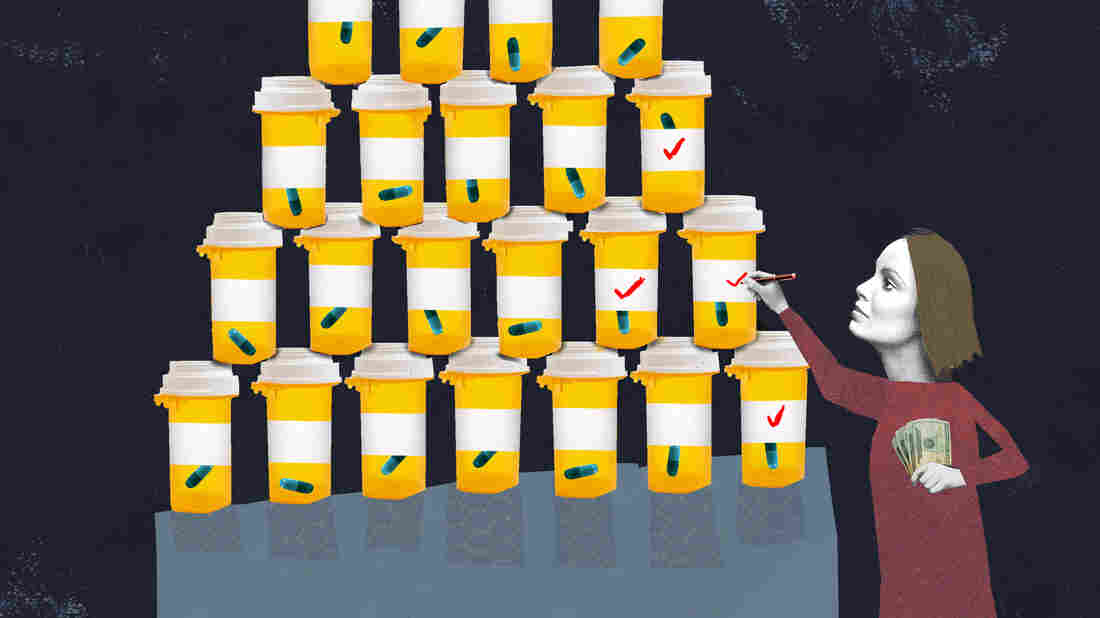
Researchers expect that three dozen new drugs will come on the market over the next few years with astronomical prices — some likely topping a million dollars per patient.
The drugmaker Novartis has told investors it might be able to charge $4 million to $5 million for one of its potential products, a treatment for a rare disease called spinal muscular atrophy.
Hundreds more ultra-expensive therapies are under development. They could drive up the cost of medicine and health insurance for everyone. So researchers have started to develop strategies to address that coming price shock.
These new treatments include gene therapies, which target certain cancers and rare diseases. Take, for example, hemophilia, an inherited disorder that prevents a person’s blood from clotting properly.
“When I was born, treatment did not exist for hemophilia,” says Mark Skinner, one of about 20,000 Americans with the condition. “Within my lifetime — I’m 58 years old — there have been remarkable advances.”
Skinner, an attorney in Washington, D.C., who is past-president of the World Federation of Hemophilia, now gives himself injections of expensive medication most days to prevent the painful and potentially dangerous bleeding episodes.
He says eight or nine companies are now working on gene therapies, which could potentially cure his underlying condition. “I think we could see a gene therapy within the clinics, and available to patients, within a couple of years,” he says.
One infusion of this therapy might be enough to correct the genetic flaw and give him many years, maybe even a lifetime, free from bleeding episodes and daily medication.
Current hemophilia drugs cost many hundreds of thousands of dollars a year. Skinner’s treatment, in particular, can cost $800,000 a year, “so a gene therapy that costs $1 million, or even $2 million — you could see it becoming economically viable over a couple of years,” he says. It could actually save money for his health insurer.
But the new kind of treatment could also be a big shock to the health care system. Gene therapy for every American with hemophilia could cost tens of billions of dollars. One response might be to ration the treatment. That’s essentially what happened when expensive new drugs that could cure hepatitis C came on the market in 2013. Would that happen for hemophilia?
“If a gene therapy came through and was reasonably expensive, it would be terrible if we could only treat a thousand patients a year, and it took us 10 or 15 years to treat all those people,” says Mark Trusheim at MIT’s NEWDIGS program.
That program is trying to dream up better ways to pay for gene therapies for hemophilia as well as dozens of other diseases where long-term treatments are in the works. (NEWDIGS stands for the “New Drug Development ParadIGmS Initiative.”)
Under the current paradigm, we typically pay as we go for drugs, with monthly bills for monthly pills. Trusheim says it’s like paying rent on an apartment.
“But now with these new gene therapies, we get to take the treatment once and it can last for years,” he says. They may even last a lifetime. He says it makes more sense, then, to think of these drugs in terms of paying a mortgage over time – think of a condo, rather than a rental apartment.
That approach could spread out the payments, reducing the potential shock of a new treatment. “Plus we have the option here not just to turn it into a mortgage payment,” he says, “but make that mortgage payment contingent on whether the apartment is really a good apartment or not. If the roof begins to leak, maybe we won’t pay so much on the future payments.”
This strategy has already been put to use to pay for one gene therapy – Luxturna — that treats an inherited form of blindness at the cost of $850,000 per patient. The company that produces the therapy, Spark Therapeutics, has agreed to give payers a refund if a patient’s vision hasn’t improved sufficiently after 2 1/2 years.
New therapies may not work at all, or their effects may wear off over time. There should be some way to reflect the actual long-term value to a patient in the price of treatment, says Trusheim.
He is eager to get funding schemes like this instituted now, because he expects to see another three dozen new expensive therapies coming to the market in just the next four years. Those include immune-system treatments called CAR-T for cancer, which may extend a person’s life but may not be curative. It also includes gene therapies for diseases that up until now have had no treatment at all.
“It could be really exciting,” he says, “but it could also be really expensive as we’re treating conditions we never used to be able to treat.”
Many of these treatments are for rare diseases. There are about 7,000 rare diseases, so there could eventually be many products on the market. And because there aren’t many patients who would benefit from any given therapy, the costs of developing each novel treatment have to be recouped from a small number of patients. That drives up the price.
One biopharmaceutical company, Alnylam, prices its drugs for rare diseases in the range of $250,000 to $650,000, says Yvonne Greenstreet, the company’s chief operating officer. Speaking at a recent meeting organized by the Milken Institute, she said the company has raised about $4 billion to develop the technology behind these medications.
Her company focuses on a method called RNA interference that can block genetic messages. Unlike other forms of gene therapy, RNAi treatments typically need to be given periodically. Among other projects, the company has a novel hemophilia treatment in development.
“I think it’s important to remember that when you are focused on coming up with true innovation, it’s a very capital-intensive, high-risk endeavor,” she says.
Yet in the United States, where drug companies set their prices based on whatever they believe the market can bear, this can potentially be overwhelming.
“If we get a cure for Alzheimer’s priced at $100,000 or $1 million a pop, we’re toast!” said Joe Grogan from the White House Office of Management and Budget, speaking at the Milken meeting. The costs for this one condition could run into the trillions of dollars.
Even if governments and insurers can rein in the price of drugs, therapies are still likely to cost a lot at the outset, and the health care system will need creative ways to manage that.
“At the pace at which gene therapy is coming, I think we have no choice,” says advocate Skinner. “I don’t think the public would tolerate cures sitting on the shelf that people don’t have access to.”
A solution will require not only new ways of thinking, but new rules and regulations that govern how insurance companies and government programs pay for medical care. MIT’s Trusheim says, for example, that refunds for poorly performing drugs can fall afoul of current laws designed to prevent kickbacks.
Skinner says these conversations should also involve patients early on, to make sure that new treatments actually address the health concerns of the patients themselves. Value shouldn’t be measured simply in terms of drug company profits, he says.
“Achieving an early alignment between patients, the drug developers and the payers in how value is going to be measured is going to be an important approach as we go forward,” he says.
You can reach Richard Harris at rharris@npr.org.
Today in Movie Culture: Alternate 'Fantastic Beasts' Endings, 'Detective Pikachu' Easter Eggs and More
Here are a bunch of little bites to satisfy your hunger for movie culture:
Alternate Endings of the Day:
With Fantastic Beasts: The Crimes of Grindelwald out this Friday, here’s an animated look at how Fantastic Beasts and Where to Find Them should have ended:
[embedded content]
Easter Eggs of the Day:
Need a guide to all the Easter eggs and everything else in the new Pokemon: Detective Pikachu trailer? Nerdist has you covered:
[embedded content]
Truthful Marketing of the Day:
Honest Trailers points out they should have sold The Meg as a movie and its sequel rolled into one:
[embedded content]
Film History of the Day:
For Vox, Coleman Lowndes looks at how the Victorian mansion became such a staple of horror media, including movie such as Psycho:
[embedded content]
Composer in Close-Up:
For Fandor, Jacob T. Swinney celebrates the movie music of Ennio Morricone, who scored such movies as The Thing, The Hateful Eight and The Good, the Bad and the Ugly:
[embedded content]
Vintage Image of the Day:
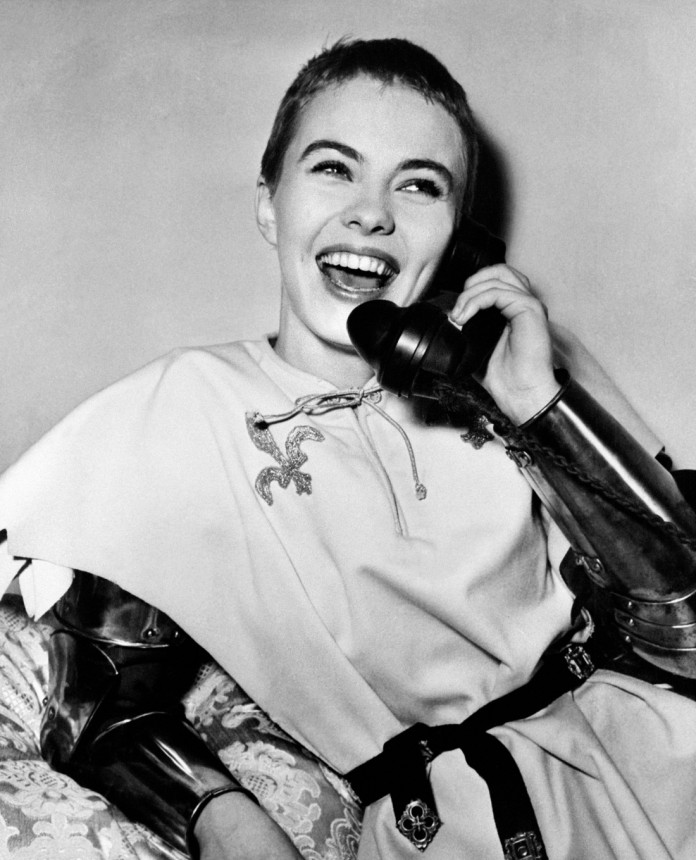
Jean Seberg, who was born on this day in 1938, talks on the phone while in costume on the set of Saint Joan in 1957:
Actor in the Spotlight:
Screen Crush paid tribute to Stan Lee by figuring out how all his cameos were the same role:
[embedded content]
Supercut of the Day:
Speaking of Stan the Man, Dr. Machakil compiled Marvel movie characters saying “thank you” in tribute to their “father.”:
[embedded content]
Cosplay of the Day:
And one more for Stan Lee, here’s a fan cosplaying as the comics legend along with another fan dressed as his most iconic creation:
This is the closest I’ll ever get to “hugging @RealStanLee”, as one of my best pals in cosplay @spiderdangeromo paid homage w/ his exceptional cosplay of The Man at #XmasToyfair2017. @spiderverseph would not have existed w/o you. Thank you and Excelsior.??????#StanLee #RIPStanLee pic.twitter.com/exa1J05xV1
— Timzster (@thetimzster) November 12, 2018
Classic Movie Trailer of the Day:
This week is the 20th anniversary of the release of The Faculty. Watch the original trailer for the classic sci-fi teen horror movie below.
[embedded content]
and
How Amazon's New Headquarters Could Change Communities In New York And Virginia

Amazon announced its expanding footprint, adding some 25,000 jobs in Long Island City in Queens and Arlington, Va. Some in those cities are worried about housing prices and congestion on the roads.
ARI SHAPIRO, HOST:
Amazon conducted a national search for a city to build a new headquarters in, and today the company announced that it will have two more – one in Long Island City, N.Y., the other in the D.C. suburb of Arlington, Va. NPR’s Alina Selyukh reports on the mixed feelings about the company’s expansion.
ALINA SELYUKH, BYLINE: Amazon’s search lasted more than a year and drew 238 bids from across the country. But in the end, the company decided it could not do with just one new headquarters and settled for two. So now Amazon will be based in Seattle as always but also in Queens and in Northern Virginia. Here’s Amazon executive Jay Carney.
JAY CARNEY: Because the driving factor for us was access to existing talent and the ability to refer or lure talent, it would make the most sense to divide HQ2 into HQ2 and HQ3.
SELYUKH: Carney says the company seriously considered all of the bids from across the nation, and going forward, Amazon is likely to continue negotiating for smaller projects in other places, like a new corporate office in Nashville that the company also announced today. But ultimately, Carney says, for a new HQ, Amazon needed a place that would be easy to sell to potential new hires. So now it’s New York and Northern Virginia that are each getting more than 25,000 jobs paying an average of more than $150,000 dollars a year. A note – Amazon is one of NPR’s sponsors.
ANGELOS ANGELOU: We were of the opinion that no city in the U.S. can support this project based on the timeline and the criteria that Amazon set up for it.
SELYUKH: Angelos Angelou is an economic development consultant who helps tech companies find new office locations. He says Amazon wanted 50,000 people ready to go in a matter of 10 to 15 years. And that’s very hard to accomplish with just one location. But in the two locations it chose, six-figure wages that Amazon touts are already common. Plus, traffic and housing prices are already a challenge. All this is prompting a new wave of criticism for the company.
DANA AUSSENBERG: This neighborhood has already really scaled up very quickly.
SELYUKH: Dana Aussenberg lives in Long Island City.
AUSSENBERG: Great for Queens and great for Long Island City. But there’s just a lot of issues that need to be fixed first. And, you know, as someone who’s been living here for seven years, I don’t want to be pushed out.
SELYUKH: And here’s Ron Lafond who works in Crystal City in Arlington.
RON LAFOND: It’s good for the higher-end workforce in terms of options. I obviously have concerns about parking and transit and…
SELYUKH: For Crystal City, there was another surprise in the news today – its own name. The local developer has started calling it National Landing to woo Amazon. The neighborhood has been stagnant with many office towers, so locals here are generally optimistic about the prospect of Amazon jobs even as the company is slated to benefit from half a billion dollars in financial incentives.
In New York, however, city and state politicians are raising major concerns about the incentives. They’re even higher there at $1 1/2 billion. But for most residents, the biggest concerns are housing prices and road congestion.
KATIE CRISTOL: My name is Katie Cristol. I’m the chair of the Arlington County Board.
SELYUKH: Cristol is also a member of the Northern Virginia Transportation Authority, so I didn’t even have to finish my question to her.
Holy cow, 25,000…
CRISTOL: (Laughter) That seems like a lot of cars.
SELYUKH: Cristol says the county plans to invest in roads, better access to the metro, bus routes, more affordable housing. And she says public transit is actually underused in Crystal City.
CRISTOL: I know it can feel counterintuitive. We know Northern Virginia has some of the nation’s worst traffic. But by and large, there’s a transportation or transit infrastructure here in Crystal City that’s hungry for more riders.
SELYUKH: She hopes those new Amazon workers help pay for it all by buying 25,000 metro cards. Alina Salyukh, NPR News, Washington.
Copyright © 2018 NPR. All rights reserved. Visit our website terms of use and permissions pages at www.npr.org for further information.
NPR transcripts are created on a rush deadline by Verb8tm, Inc., an NPR contractor, and produced using a proprietary transcription process developed with NPR. This text may not be in its final form and may be updated or revised in the future. Accuracy and availability may vary. The authoritative record of NPR’s programming is the audio record.
Today in Movie Culture: 'Harry Potter' and 'Fantastic Beasts' Recap, a Tribute to Exposition Scenes and More

Comic book writer, editor and publisher Stan Lee has passed away, according to The Hollywood Reporter and multiple other sources. He was 95 years old.
It would be impossible to understate Lee’s influence upon multiple generations of comic book readers and creators, as well as movie lovers and filmmakers. He has left a lasting mark on popular culture, thanks to the textured and beloved characters he created and/or developed, including Spider-Man, Black Panther, The Fantastic Four, Daredevil, Ant-Man, The Mighty Thor and Iron Man. His characters were often superpowered, yet they were also recognizably human, dealing with issues in the real world and their own personal flaws.
Lee played a lovely role (as himself) in Kevin Smith’s Mallrats (1995), offering dating wisdom:
[embedded content]
He began making regular cameo appearances in superhero films in 2008, when he appeared in Iron Man, the first entry in Marvel’s so-called “Cinematic Universe.” Thereafter, he appeared in every installment in Marvel’s series. He also showed up in other superhero movies not produced by Marvel.
Clearly, he enjoyed his work with director Shane Black on Iron Man 3:
[embedded content]
He was very pleased in make an appearance in Disney’s Big Hero 6:
[embedded content]
In this video, Lee talks about the origins of Black Panther:
[embedded content]
Stocks Start The Week With A Plunge, Dragged Down By Tech Shares

Investors are said to be worried about signs that the global economy may be slowing, even though the U.S. economy is faring well.
Drew Angerer/Getty Images
hide caption
toggle caption
Drew Angerer/Getty Images
Investors worried about a slowdown in global growth helped push stocks sharply lower Monday, with the Dow Jones Industrial Average falling 602 points, or 2.3 percent.
Technology stocks fared especially badly, with Apple down 5 percent, after a report it was cutting orders for iPhone parts. The decline knocked 100 points off the Dow and helped lead to a broader rout. The technology-heavy Nasdaq Composite fell almost 2.8 percent., wiping out its gains for November.
“Apple is a bellwether,” Randy Frederick, vice president of trading and derivatives at Schwab, told the Financial Times. “Whenever Apple appears to be struggling — for whatever reason — there is the perception that it will impact other tech companies as well. It may or may not be true, but that is the perception.”
Shares of banks and financial services companies also fell. Among the big losers was Goldman Sachs, which fell about 7.5 percent amid reports of its involvement in a Malaysian corruption scandal.
Even as the overall U.S. economy is performing well, the stock market has been especially turbulent lately, wiping out its entire gains for the year by the end of October.
Prices have been climbing back since then, but Monday’s big losses represented another big setback.
Investors are said to be concerned about signs that economic growth is slowing in other countries. Among the problems cited are Britain’s failure to agree on a plan to leave the European Union, and Italy’s budget deficits.
Chicago Bears Kicker Misses 4 Attempts, Hits The Uprights Each Time
Cody Parkey just looked puzzled. He had hit the upright four times on field goal and extra point tries. The analysis on Fox: “Boy he can hit those uprights, can’t he?”
DAVID GREENE, HOST:
Good morning. I’m David Greene. The kicker for the Chicago Bears may have had a game for the history books yesterday. I say may because I don’t think this stat is actually kept. Cody Parkey hit the upright four times on field goal and extra point tries. Parkey just looked puzzled. This was the analysis on Fox.
(SOUNDBITE OF ARCHIVED RECORDING)
UNIDENTIFIED ANNOUNCER: And that…
(SOUNDBITE OF METAL CLANGING, CHEERING)
UNIDENTIFIED ANNOUNCER: Boy, he can hit those uprights, can’t he?
GREENE: I mean, should he be playing a game where the point is to hit a smaller target, like maybe pool? It’s MORNING EDITION.
Copyright © 2018 NPR. All rights reserved. Visit our website terms of use and permissions pages at www.npr.org for further information.
NPR transcripts are created on a rush deadline by Verb8tm, Inc., an NPR contractor, and produced using a proprietary transcription process developed with NPR. This text may not be in its final form and may be updated or revised in the future. Accuracy and availability may vary. The authoritative record of NPR’s programming is the audio record.
With Its Primary Opponents Voted Out, What's Next For Labor Unions?
NPR’s Michel Martin speaks with the president of the AFL-CIO, Richard Trumka, about union strategies following the midterm elections.
MICHEL MARTIN, HOST:
We’ve talked a lot about how last Tuesday’s election marked a turning point with the Democrats set to retake control of the House. But we were wondering what it might mean for this country’s labor movement. Now, labor leaders are claiming victory after Wisconsin’s Republican Governor Scott Walker lost his re-election bid after eight years of fighting to strip unions of their powers. And, in Illinois, Governor Bruce Rauner lost his seat as well. He initiated a lawsuit claiming that mandatory membership dues are unconstitutional for public unions, and the Supreme Court agreed with him earlier this year. As we said, both of those governors have now been voted out of the office.
But we were wondering what, if anything, labor can do to recover the ground it has already lost. So we’ve called the president of the AFL-CIO, Mr. Richard Trumka, to talk more about this. Mr. Trumka, welcome. Thanks so much for joining us.
RICHARD TRUMKA: Thanks for having me on.
MARTIN: So we discussed the Scott Walker and Bruce Rauner elections. Were there any other victories that you want to claim? And were there any setbacks?
TRUMKA: (Laughter) The labor movement really did prove to be the driving force throughout much of this cycle. We knocked on over 2 million doors. We passed out 5 million flyers. We had 12 million pieces of direct mail, and I just have to say this, Michel. This is part of something that’s bigger than just politics or the last election. You’re seeing a tremendous upsurge in collective action throughout the United States right now.
MARTIN: I think that a lot of people would agree with you. But if – are you seeing collective action as expressed through union membership? I mean, you certainly know better…
TRUMKA: Yeah.
MARTIN: …Than anybody that membership has been falling in recent years. In part, that’s – what those two initiatives that we discussed in Wisconsin and Illinois did is that they helped sort of weaken the structural foundation of unions by making it harder to collect dues, for example, by depriving certain, you know, groups of workers of the opportunity to be represented by a union. Really, what can you do to address those structural problems?
TRUMKA: Well, first of all, actually, the last two years, union membership has grown. Last year alone, we organized 262,000 new members and three-quarters of them were under the age of 35. We’ve also begun doing strategic partnerships with other progressive groups. All of us have figured out that we’re all better off if we stick together. And so we’re reaching out to those community groups – people of color, any progressive group that’s out there. We’re working together more effectively and, quite frankly, in much more solidarity.
MARTIN: But we’ve seen states that had been reliably union – Democratic states like Michigan, Illinois and Wisconsin – in the prior election supported President Trump. And the working assumption is that that could not have happened if some union members had not voted for President Trump. Why do you think that is? And do you think that you have changed their minds?
TRUMKA: A lot of workers believe that neither the economy nor the political system are working for them. Donald Trump said, I’m going to change the system. I’m going to shake it up from head to toe for you. They believed it. We went into Ohio in this last election. We talked to those people that had voted for Trump, and nearly 50 percent of them had changed their mind and are not going to vote for Trump or with Trump.
MARTIN: But the Republicans still won the governor’s race there over a credible…
TRUMKA: They did.
MARTIN: …Candidate.
TRUMKA: But we won up and down the ballot in Ohio. I mean, Sherrod Brown won a significant race. He’s been one of our biggest supporters. He won because he has a very clear articulated economic message that resonates with working people. They want to know what you’re going to do to help them with their wages, their health care, their pensions, their kids’ education, their ability to live a decent life after they retire. And he talks about that every day and not just talks about it when the polls say it’s – you should talk about it. But that’s part of his core values.
MARTIN: You’re talking about Sherrod Brown…
TRUMKA: Yes.
MARTIN: The Democratic senator won re-election. But Democrats did not succeed in retaking Ohio governor’s seat.
TRUMKA: No, they didn’t, but we made significant progress. And so, every time, we’re making more progress. When you ask about those people that had voted for Trump, they’re coming back across the street. They understand what’s in their best interests.
MARTIN: Overall, what’s your sense of how the country is going? I mean, if you asked that classic polling question, is the country headed in the right direction or on the wrong track, what would you say?
TRUMKA: I would say we’re on the wrong track right now because of the rise of some of the ugly rhetoric out there that is polarizing the country rather than trying to heal some of the wounds that are out, try to bring us closer together. And so we’re going to work to try to bridge that gap, try to heal people, try to solve some problems so that we can, actually, maybe help take the first step towards bridging the gap rather than widening the gap that exists in the country.
MARTIN: That was Richard Trumka, president of the AFL-CIO. We talked to him at his office in Washington, D.C. Mr. Trumka, thanks so much for talking to us today.
TRUMKA: Thank you.
Copyright © 2018 NPR. All rights reserved. Visit our website terms of use and permissions pages at www.npr.org for further information.
NPR transcripts are created on a rush deadline by Verb8tm, Inc., an NPR contractor, and produced using a proprietary transcription process developed with NPR. This text may not be in its final form and may be updated or revised in the future. Accuracy and availability may vary. The authoritative record of NPR’s programming is the audio record.
Saturday Sports: The Start Of The NBA Season And The NFL
NPR’s Scott Simon speaks with ESPN’s Howard Bryant about the start of the NBA season and the lack of breakout teams in the NFL.
SCOTT SIMON, HOST:
And now it’s time for sports.
(SOUNDBITE OF MUSIC)
SIMON: Olympus has fallen – at least slipped a little. The Milwaukee Bucks clobbered the Golden State Warriors in Oakland on Thursday, 134-111. And also, where are all the premier franchises in the NFL? Howard Bryant of ESPN.com and ESPN The Magazine joins us. Howard, thanks so much for being with us.
HOWARD BRYANT, BYLINE: Good morning, Scott. How are you doing?
SIMON: I’m fine. And as they say in Milwaukee, fear the deer.
BRYANT: (Laughter) Fear the deer.
SIMON: Was that a fluke on Thursday? By the way, the Bucks have an absolutely great player – well, more than one, but absolutely great player. He has an unfortunate name that owes to his Greek heritage. And I know you’re a classical Greek scholar, so I’ll leave you to say Giannis’ name.
BRYANT: So you’re going to force me to say Giannis Antetokounmpo? Yes, I did…
SIMON: Way to go, Howard.
BRYANT: …I did it right. That’s two in a row – exactly. He is the Greek Freak. He is a spectacular basketball player who was really passed over by virtually every team because they didn’t think his game was polished enough. And then, boy, he took over and really raised his level of skill. I mean, he’s an unbelievable basketball player.
And what happened the other night in Oakland is not a fluke. Sure, Golden State did not play very well, that’s for certain. But last year, we saw it in the seven-game series between the Boston Celtics and the Milwaukee Bucks, and Milwaukee is knocking on the door. They’re one of those teams that you’re going to have to watch out for because LeBron James isn’t here anymore. He’s in the Western Conference with the Lakers.
And so we like to talk a lot about how the Boston Celtics are the favorites and how this team is supposed to be the one that’s going to match up best with the Warriors, but I really enjoy what’s taking place in the NBA right now, especially in the Eastern Conference because you’ve got Toronto that now has Kawhi Leonard, who got traded over from San Antonio. You’ve got the Celtics, who are a wonderful ensemble cast who haven’t really put it together yet. They got hammered last night in Utah. And you’ve got Milwaukee, who had this fantastic win. They lost in Boston last Thursday. And then they come into Oakland, and they beat the best team in the NBA.
So certainly, there are a lot of teams to look out for. And, believe me, Milwaukee is definitely one. Fear the deer, indeed.
SIMON: Yeah, fear the deer.
Let’s talk football for a moment. We’re past the halfway mark of the NFL season. Maybe the LA Rams, but other than that, not a breakout team, right?
BRYANT: Well, you know, for everything that we talk about with the Golden State Warriors and the Warriors being this team that nobody can beat and that there’s no suspense, there’s plenty of suspense in the NBA. But when it comes to football, Scott, I got to tell you, the NFL has gone out of its way to promote mediocrity.
The league is set up, pretty much, for everyone to go 8-8 this year, and maybe 12-4 next year and then maybe 8-8 the next year. And so it really does take about half a season to find out who’s going to be good. And so we’re starting to reach Thanksgiving. We’re starting to get into that, what I call, separation time, where you’re going to see who’s really good.
The Rams were undefeated; the Saints beat them. I think the Saints may be the best team in football right now. You’ve got the NFL champs, the Philadelphia Eagles – they’re 4-4. The Patriots are still really good. The Chiefs are outstanding; they lost to the Patriots. The Steelers were fantastic the other night…
SIMON: Yeah.
BRYANT: …Against Carolina.
But as of today, nobody’s really that good. But then again, nobody is really that bad either. I’m thinking in about three weeks, after Thanksgiving, you’ll start to see who’s going to emerge. Last year, nobody thought that the Eagles were Super Bowl favorites, and they ended up winning the whole thing.
SIMON: Yeah. Well, we know it’s hard to have – almost impossible – a dynasty these days. But it’s hard, even, to put two championships together, isn’t it?
BRYANT: Well, absolutely. And that’s why what the Patriots have done has been so fantastic.
SIMON: Well, Howard Bryant of ESPN.com and ESPN The Magazine. Thanks so much for being with us, Howard.
BRYANT: No, my pleasure.
(SOUNDBITE OF HUNTERTONES’ “PARUSHA”)
Copyright © 2018 NPR. All rights reserved. Visit our website terms of use and permissions pages at www.npr.org for further information.
NPR transcripts are created on a rush deadline by Verb8tm, Inc., an NPR contractor, and produced using a proprietary transcription process developed with NPR. This text may not be in its final form and may be updated or revised in the future. Accuracy and availability may vary. The authoritative record of NPR’s programming is the audio record.
Childbirth In The Age Of Addiction: New Mom Worries About Maintaining Her Sobriety

Nicole and Ben Veum, with their little boy, Adrian. Nicole was in recovery from opioid addiction when she gave birth to Adrian, and she worried the fentanyl in her epidural would lead to relapse, but it didn’t.
Adam Grossberg/KQED
hide caption
toggle caption
Adam Grossberg/KQED
When she was in her early 20s, Nicole Veum says, she made a lot of mistakes.
“I was really sad and I didn’t want to feel my feelings,” she says. “I turned to the most natural way I could find to cover that all up and I started using drugs: prescription pills; heroin for a little bit of time.”
Veum’s family got her into treatment. She’d been sober for nine years when she and her husband, Ben, decided to have a baby. Motherhood was something she wanted to feel.
If she needed an epidural during labor, Veum told her doctor, she didn’t want any fentanyl in it. She didn’t want to feel high.
“I remembered seeing other friends,” she says. “They’d used it, and they were feeling good and stuff. I didn’t want that to be a part of my story.”
An epidural is a form of regional anesthesia given via an injection of drugs into the space around the spinal cord. It’s usually a mix of two types of medication: a numbing agent, usually from the lidocaine family, and a painkiller, usually fentanyl.
The amount of fentanyl in the mix is limited, and little passes into the bloodstream, anesthesiologists say. But if a woman doesn’t want the fentanyl, it’s easy to formulate an epidural solution without it. Doctors either use a substitute medication or boost the concentration of the numbing agent.
“There’s no medical reason why someone should be forced to be exposed to opioids if they don’t want to,” says Dr. Kelly Pfeifer, a family physician and addiction expert who now works as director of high-value care at the California Health Care Foundation.
Pfeifer says there’s another situation to be aware of: pregnant women who are taking methadone or suboxone to manage opioid addiction. During labor, anesthesiologists often prescribe certain narcotics to help manage pain, but some of those commonly used — like Nubain — can immediately reverse the effects of methadone or suboxone.
“Suddenly, you’re in the middle of labor — which is already painful — and now you’re in the middle of the worst withdrawal of your life,” Pfeifer says.
For Veum, it was the worst wildfire in California’s recorded history that interrupted her birth plan. She and her husband live in Santa Rosa, Calif., and she was in active labor when devastating fires ignited nearby on Oct. 8, 2017. What are now known as the “Wine Country wildfires” burned more than 5,000 homes and killed 44 people.
“There was a ton of smoke in the hospital,” Veum says. “Like you could visibly see it outside — and smell it.”
Nurses told her everybody had to evacuate. Veum was transferred to another hospital, 5 miles away. And the special instructions for her epidural got lost in the chaos.
“Then, when they went to change the drug, I saw the tube said Fentanyl on it,” she remembers. “And by that point I was starting to feel ‘the itchies’ ” — one of the familiar physical signs she would experience when starting to get high.
Most women without a history of addiction wouldn’t experience these sensations when given opioid anesthesia, says Dr. Jennifer Lucero, chief of obstetric anesthesiology at the University of California, San Francisco Medical Center. Anytime a woman who is not in recovery asks for an epidural without fentanyl (usually out of the mom’s concern for the baby), Lucero explains why it’s there.

Adrian Veum plays at home; Nicole Veum says she’s loving being his mom, and feels “reborn.”
Adam Grossberg/KQED
hide caption
toggle caption
Adam Grossberg/KQED
The fentanyl allows the anesthesiologist to balance out the numbing agent in the solution, she says, so women don’t have as much pain from the contractions, but can still feel the pressure and are able to move their legs a bit or shift in bed during labor.
Once she explains the trade-offs, and assures women that the opioid will have no effect on their fetus, most of her patients opt to keep fentanyl in the epidural solution.
But doctors have been trying to cut down on opioids in other ways during labor and delivery, namely in what they prescribe for pain after the birth.
For years, women who had a normal, vaginal birth were sent home with a 30-day supply of Norco, Percocet or another opioid, Lucero says.
“Some people would think they’re supposed to take them all,” Lucero says, while other women “would not use it, and it would just be sitting in the bathroom cabinet.”
While most people who get a bottle of pills when leaving the hospital won’t develop dependence or an addiction, some will. When a patient is prescribed opioids for short-term pain, the risk of chronic use starts to increase as early as the third day of the prescription, according to a 2017 report published by the Centers for Disease Control and Prevention. A 2018 study suggests that every week of opioid use increases the risk of misuse.
As recently as 2017, postpartum women were routinely being prescribed three- to five-day supplies of opioids — even after an uncomplicated vaginal delivery. A study published that year of 164,720 Pennsylvania women on Medicaid who gave birth vaginally found that 12 percent of them filled an opioid prescription after they gave birth — even though most did not have a clear medical need for a painkiller, such as vaginal tearing or an episiotomy.
Now obstetricians are issuing new guidelines to patients, Lucero says, and they’re trying to prescribe limited amounts of opioids, and only post-surgically, to women who have had a C-section.
Nicole Veum ended up being one of those women. After she was transferred to the second hospital during the wildfire evacuation, she spent another 12 hours in the early stages of labor, but it didn’t seem to be progressing much. She agreed to a C-section.
After the birth of her son, doctors sent her home with a bottle of Percocet — another opioid. They told her that if she was worried about being able to maintain her sobriety, she could have her husband or a friend hold on to the bottle and control the dosage.
Pfeifer, the physician and addiction specialist, says that in a situation like that, sending Veum home with just a few Percocet pills, or even suggesting she take just take ibuprofen would have been fine.
“Any parent will tell you there’s nothing more stressful than the first week of being a parent and having a baby and being in sleep deprivation,” Pfeifer says. “And here you have a little bottle of Vicodin that you used to turn to, to make you feel better when you’re stressed.”
First the fires. Then the fentanyl in her epidural. Then the Percocet. It was Veum’s first test in seeing how her sobriety and motherhood would line up.
She called a friend who was also in recovery. They talked it all through, and Veum was fine.
“I was OK. I was OK with it. It was just something that happened,” she says as her baby, Adrian, now a year old, plays with a new toy.
Veum is 32 now. She’s returned to school this fall to work toward her college degree, after a 14-year break. And she is loving being a mom.
“A lot of people, metaphorically, felt it as a baby coming out of the ash — the life coming from the ashes,” she says about her child born in the midst of the 2017 wildfires.
“And I feel that,” Veum says. “I feel like it was a big time for our community — and me personally — to be reborn in some way.”
