
When Nationals Visit The White House, Sports And Politics Will Intersect Once Again

Fans gather in Washington, D.C. on Nov. 2, 2019 as the Washington Nationals hold a parade to celebrate their World Series victory over the Houston Astros.
Stefani Reynolds/Getty Images
hide caption
toggle caption
Stefani Reynolds/Getty Images
Thousands of baseball fans sporting red caps and sweatshirts, emblazoned with the Washington Nationals’ curvy W, lined Constitution Avenue in Washington on Saturday to celebrate the team’s historic World Series victory.
On Wednesday, the Nationals defeated the Houston Astros in Game 7 of the series with a 6-2 comeback, clinching the city’s first baseball championship in 95 years.
Next on the team’s schedule — a visit with President Trump.
The Nationals are scheduled to meet Trump on Monday, continuing a time-honored tradition of championship teams traveling to the White House for a meeting with the president. But in a city where partisan politics has long been the dominant sport, Monday’s visit has itself taken a political turn.
On Friday, Nationals pitcher Sean Doolittle publicly confirmed that he will skip the event. Doolittle has been vocal about his opposition to many of the administration’s policies.
“There’s a lot of things, policies that I disagree with, but at the end of the day, it has more to do with the divisive rhetoric and the enabling of conspiracy theories and widening the divide in this country,” Doolittle told The Washington Post. “At the end of the day, as much as I wanted to be there with my teammates and share that experience with my teammates, I can’t do it.”
Even before Doolittle’s decision, this year’s World Series had delved into politics. During Game 5 of the series, Nationals fans booed Trump during an appearance at the team’s Nationals Park and taunted him with cheers of “lock him up.” During Game 7 in Houston, more than 16,000 Nationals’ fans gathered for a free viewing party back in Washington and again broke into boos when a Trump campaign ad aired during a commercial break.
While the fan response captured headlines, it was hardly the first instance of baseball intersecting with Washington politics.
The first team visit to the White House was in 1865. That summer, Washington, D.C. held a three-team baseball tournament. The Athletic from Philadelphia beat the Washington Nationals to win the tournament, but both teams were invited to visit the White House to meet President Andrew Johnson. As the story goes, the players from both teams attended and then one by one, shook the president’s hand.
Even then, the meeting had a political motivation. According to The Atlantic’s Yoni Appelbaum, this first meeting was arranged by the president of the National club, Arthur Pue Gorman, a white Southerner and Johnson supporter who in the aftermath of the Civil War wanted to maintain racial segregation. He saw baseball — which was then an all-white sport — and the meeting with Johnson as a way to do this.
It wasn’t until the presidency of Ronald Reagan more than a century later that invitations for championship teams from across the sports world became a regular occurrence. So too did the practice of players snubbing those invitations.
In 1991, for example, after the Chicago Bulls won their first NBA title, Michael Jordan decided to play golf rather than meet with President George H.W. Bush.
Golfer Tom Lehman declined a meeting with President Bill Clinton, referring to him as a “draft-dodging baby killer.”
Jake Arrieta of the Chicago Cubs skipped a visit to the Obama White House, as did Boston Bruins goalie Tea Party supporter Tim Thomas.
But under the Trump administration there has been an uptick in the number of players — and in some cases entire teams — rejecting invitations to visit the White House, citing everything from scheduling conflicts to outright objections to the president’s policies.
The uptick, in part, may be due to a shift in public attitudes. Athletes who were once expected to keep their opinions silent are now cheered by some fans for speaking up and othertimes jeered when they choose not to.
When teams have accepted invitations, the decision by some players not to attend has often overshadowed the actual visit. After their victory in last year’s World Series, the Boston Red Sox visited the White House, but when they did, almost every non-white player and coach on the team was noticeably absent.
In 2017, the White House rescinded an invitation altogether after members of the NBA champion Golden State Warriors said that they were considering skipping the event. Trump tweeted the decision, saying, “invitation is withdrawn!” It was considered the first time a president ever pulled back an invite due to a spat with players.
This past summer during the Women’s World Cup, members of the Women’s National Soccer team, including Megan Rapinoe — said that if they won the tournament, they would decline an invitation to the White House. Trump responded, saying Rapinoe “should never disrespect our Country.” The team ultimately won the World Cup, but did not receive an invitation to the White House.
Since Doolittle announced his decision, he told The Washington Post that he has received a flurry of social media messages from those who disagree with his decision, calling it disrespectful.
Trump Takes In UFC Fight In NYC, Days After Tweeting Residency Change To Florida

President Donald Trump speaks to the media before boarding Marine One on the South Lawn of the White House. He’s expected to spend the weekend in New York and take in a UFC fight.
Bloomberg/Bloomberg via Getty Images
hide caption
toggle caption
Bloomberg/Bloomberg via Getty Images
Politics is often described as a rough and tumble business. But President Donald Trump is expected to witness an actual blood sport when he takes in a much-hyped mixed martial arts event on Saturday at Madison Square Garden in New York.
This will be Trump’s second sporting event in the span of a week. On Sunday, he attended Game 5 of the World Series at Nationals Park in Washington, where he was met with boos and chants of “lock him up.”
Trump’s visit to New York comes just two days after announcing he and his family are switching their permanent residency from New York to Florida, a move that was met with cheers from some of several prominent Democrats in the state. Explaining his decision on Twitter, Trump said he lamented being “treated very badly by the political leaders” in New York.
Trump who was born, raised, built his businesses and launched his political campaign in New York, says he “hated” to have to make the decision to leave, but that “few have been treated worse” by the city and state elected officials.
He’s switching his residence to Palm Beach, Fla., where he owns the Mar-a-Lago resort, a place he’s dubbed the “winter White House.” Trump has resisted calls to release his state or federal taxes, but by switching residences, he’d go from a city that taxes top earners a 3.876% tax rate, and a state with a top rate of about 9% to Florida, which has no state income tax.
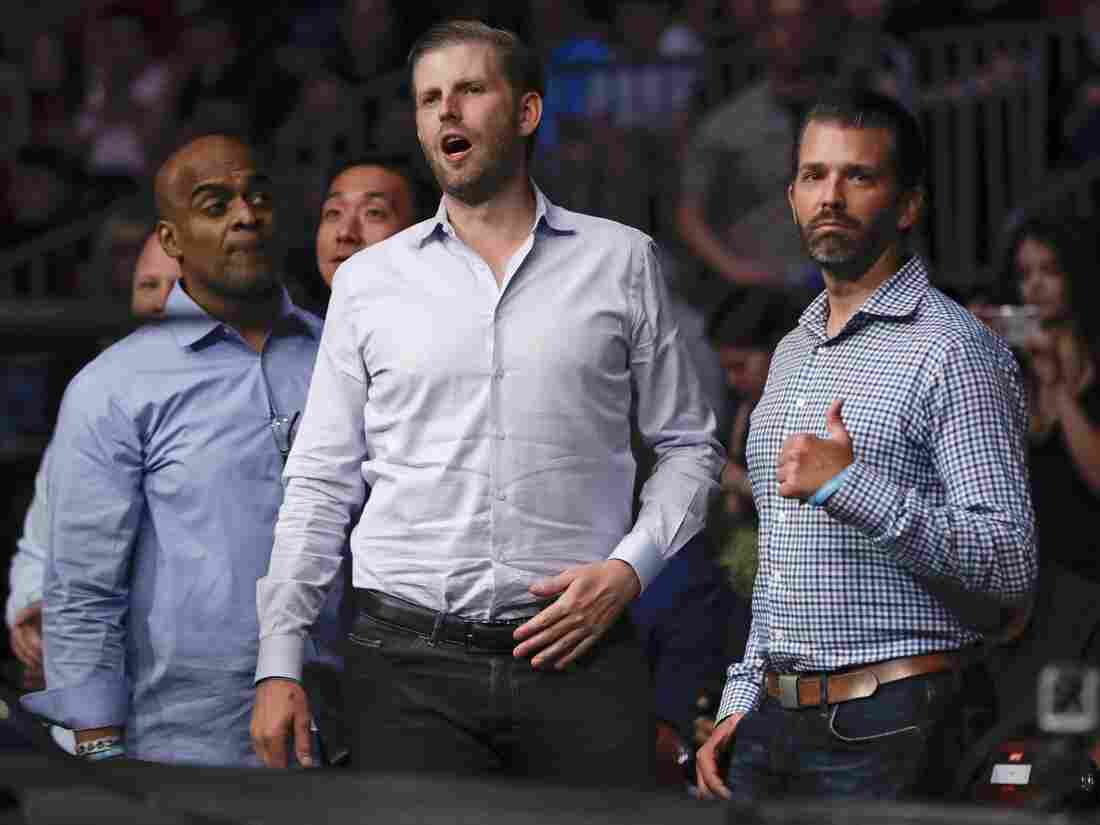
Donald Trump Jr., right, poses for a photo with Eric Trump at UFC Fight Night Saturday, Aug. 3, 2019, in Newark, N.J.
Frank Franklin II/AP
hide caption
toggle caption
Frank Franklin II/AP
Before that paperwork is finalized however, he’s expected to spend much of the weekend in the Big Apple, starting with attending the UFC 244 tournament, headlined by Nate Diaz and Jorge Masvidal. The main event is for a new belt and “title” of BMF, an acronym for “Baddest Motherf*****.”
According to TMZ Sports, the belt cost $50,000 to make and other notables expected to attend include wrestler-turned-actor Dwayne “The Rock” Johnson and New England Patriots owner Robert Kraft.
Trump’s Connection to Mixed Martial Arts
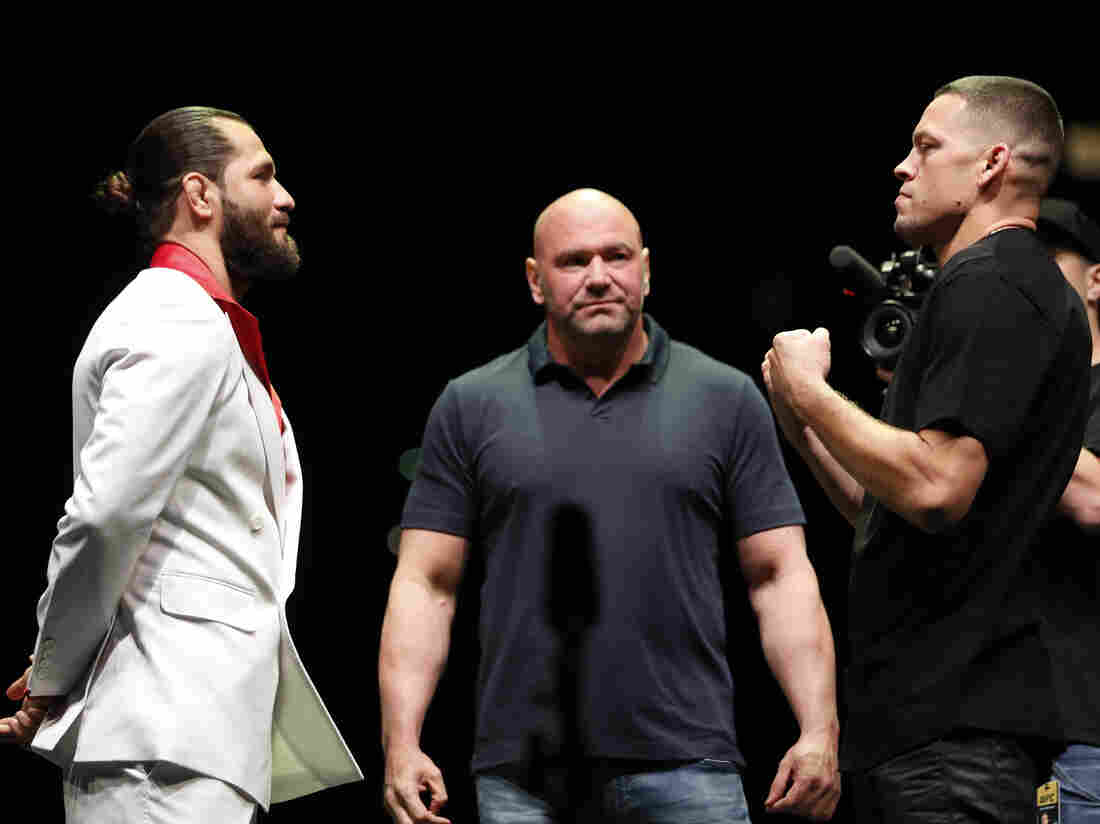
UFC President Dana White, center, at a press conference ahead of UFC 244 scheduled for Saturday in New York City. The main event is between Jorge Masvidal, left, and Nate Diaz.
Michael Owens/Zuffa LLC
hide caption
toggle caption
Michael Owens/Zuffa LLC
While a MMA match may strike some as an unusual place for a commander-in-chief to spend a Saturday night, NPR’s Scott Simon pointed out on Saturday’s Weekend Edition that “the president is a fan and used to book MMA events at his casino in Atlantic City.”
Trump’s dealings with Ultimate Fighting Championship and its President Dana White, go back to 2001 when UFC 30: Battle on the Boardwalk was held at Trump’s Taj Mahal in Atlantic City.
Back then, it was a huge score for the UFC to land a venue like Trump’s. The sport had suffered for years, being banned in several states and disparaged as “human cockfighting” by the late Arizona Sen. John McCain.
In a 2018 interview with The Hill, White spoke about MMA’s “stigma” and that “venues didn’t even want us.”
“I will never say anything negative about Donald Trump,” White said at the time. “He was there when other people weren’t.”
White said he and Trump remain close, even though, for a time, Trump partnered with a rival mixed martial arts outfit called Affliction Entertainment in 2008. Affliction soon tapped out, but the UFC has scrapped its way to being a multi-billion-dollar industry, selling for just over $4 billion in 2016.
“Any good thing that happened to me in my career, Donald Trump was the first to pick up the phone and call and say ‘congratulations, I knew you guys were going to do this,'” White told The Hill.
A month prior to UFC’s sale, White spoke at the 2016 Republican National Convention, something he said he was “blown away and honored” to do.
“Donald championed the UFC before it was popular, before it grew into a successful business,” White said before a crowd gathered in Cleveland.
“I will always be grateful, so grateful to him for standing with us in those early days. So tonight, I stand with Donald Trump.”
Trump is expected to stay overnight at the Trump Tower in New York on Saturday. He is expected to depart on Sunday, and perhaps add to the traffic congestion that’s already anticipated for the New York City Marathon.
YouTube
Voters Weigh In As Elizabeth Warren Takes Health Care Plan On Campaign Trail

Sen. Elizabeth Warren released a plan to pay for “Medicare for All” without raising taxes on the middle class, and now she’s on the campaign trail talking about it.
LEILA FADEL, HOST:
Impeachment aside, health care has emerged as a dominant campaign issue for Democrats this presidential election season. The idea of better, cheaper health care is popular with primary voters. But the idea of eliminating private insurance and replacing it with a government-run system is less popular. Still, that’s what Massachusetts Senator Elizabeth Warren is endorsing. And yesterday, she released her plan explaining how she intends to pay for it. NPR’s Asma Khalid is with Warren on the campaign trail in Iowa.
ASMA KHALID, BYLINE: The first stop of the day for Elizabeth Warren was a rally at a high school in Vinton, a small town with a population around 5,000. Warren did not mention her “Medicare for All” plan in her speech. But the first question she got from the crowd, from Dee Patters, was about health care and specifically what would happen to people like her who depend on unusual lifesaving drugs.
DEE PATTERS: I wholeheartedly support universal health care. But I also worry about the transition and whether or not the continuity of care will be able to be there as we transition to “Medicare for All.”
KHALID: Warren told the crowd that her goal is to improve health care.
ELIZABETH WARREN: No insurance company in the middle to say, sorry, that doctor is out of network. No insurance company in the middle to say, I’m sorry, we don’t authorize that treatment.
KHALID: And her plan, she says, would save middle-class families money.
WARREN: We should be an America where you get the health care that you need and that no one goes broke over it.
KHALID: I caught up with Patters after the rally. She told me she’s not sure who she’s going to caucus for – either Warren or California senator Kamala Harris. She gestured to her partner and explained that they don’t think a public option being offered by some other candidates is enough. But she wants to hear more from Warren about how the country would transition to “Medicare for All.”
PATTERS: We believe in universal health care, but it’s that, you know, nagging, like, am I still going to be able to get everything I have now?
KHALID: Yesterday, Warren laid out an ambitious plan that explains how she would pay for “Medicare for All.” It’s a question she’s been badgered with for months on the campaign trail and on the debate stage. Her plan calls for higher taxes on the wealthy, cuts to defense spending and diverting money to the government that employers already pay to insurance companies.
CHRIS VAN WAUS: I appreciate that she did lay out the information and details. I think that’s good. It wasn’t really necessary for me.
KHALID: That’s Chris Van Waus, who was listening in the front row today with his daughter.
VAN WAUS: In the end, I think it’s really a value judgment more than just purely a money judgment for me. Even if my taxes go up a little bit, I’m still supportive of “Medicare for All” because I think it’s the right policy for America.
KHALID: Warren has insisted her plan will not increase taxes on the middle class. An NPR/PBS NewsHour/Marist poll found that a majority of Americans actually do not support eliminating private insurance in exchange for “Medicare for All,” and that’s what worries Mary O’Hearn.
MARY O’HEARN: I’m all about winning this time around. It’s been a hard two and a half, three years.
KHALID: We met at a Biden rally the other day. She likes Warren. She thinks she’s smart and good at explaining her ideas.
O’HEARN: But there’s one thing about Elizabeth that I – I like if you like your health care, you can keep with that. That’s the thing that I feel strongly about.
KHALID: How strongly could be key. It’s not unusual to find voters who are uncertain about “Medicare for All” but like Warren as a candidate. The question is whether they’ll stick with her.
Asma Khalid, NPR News.
Copyright © 2019 NPR. All rights reserved. Visit our website terms of use and permissions pages at www.npr.org for further information.
NPR transcripts are created on a rush deadline by Verb8tm, Inc., an NPR contractor, and produced using a proprietary transcription process developed with NPR. This text may not be in its final form and may be updated or revised in the future. Accuracy and availability may vary. The authoritative record of NPR’s programming is the audio record.
