Here are a bunch of little bites to satisfy your hunger for movie culture:
Franchise Recap of the Day:
With Transformers: The Last Knight in theaters, Couch Tomato shows us 24 reasons all Transformers movies are the same:
[embedded content]
Commercial of the Day:
Watch Peter Parker (Tom Holland) take his driver’s test in a new Audi ad cross-promoting Spider-Man: Homecoming:
[embedded content]
DIY Prop Build of the Day:
Speaking of Marvel characters, learn how to make your own replica of Thor’s hammer mashed with the look of the xenomorphs from Alien:
[embedded content]
Vintage Image of the Day:
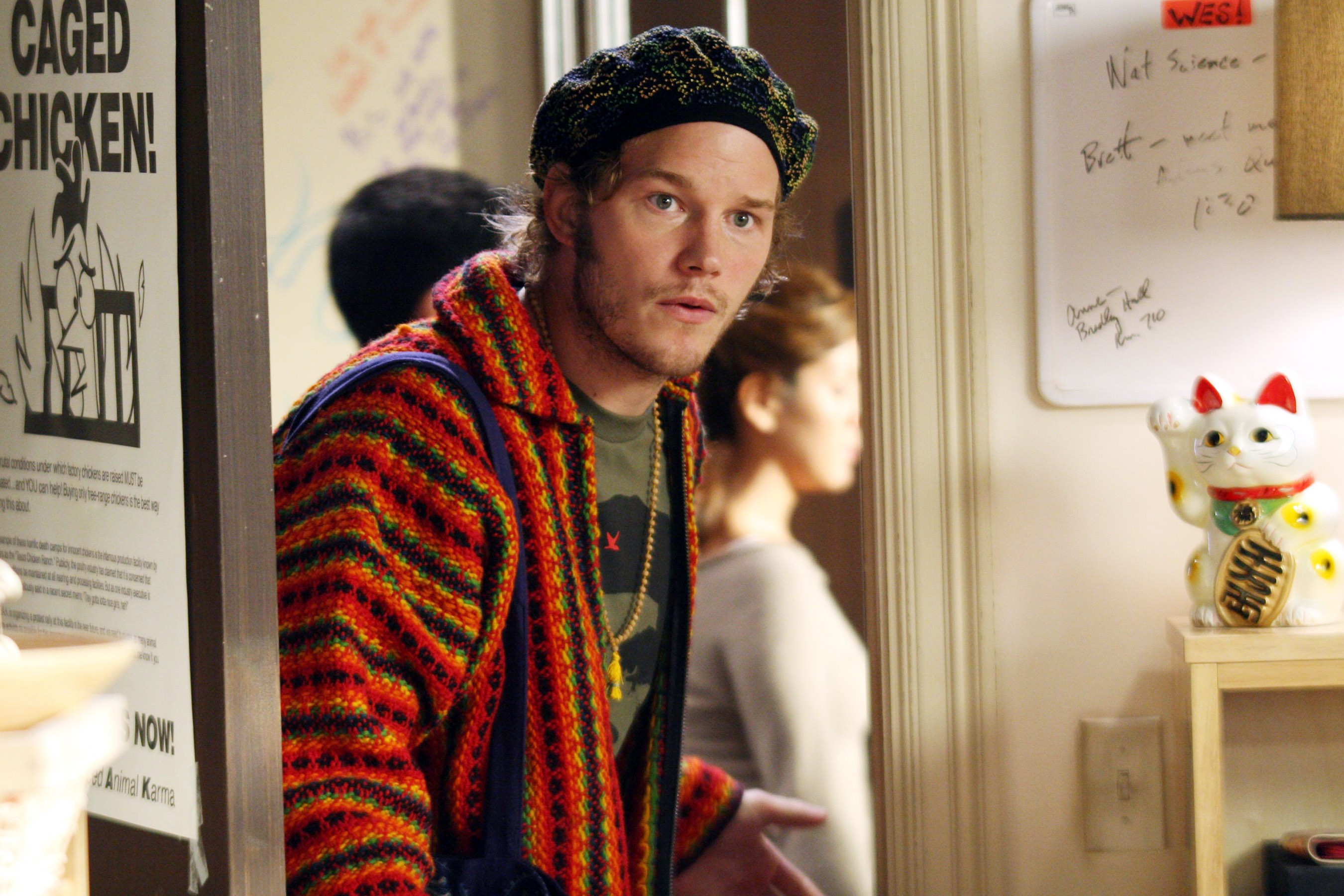
Chris Pratt, who turns 38 today, in his pre-Marvel days in a 2006 episode of The O.C. that just so happens to be titled “The Avengers”:
Reworked Trailer of the Day:
Marvel shouldn’t have all the fun. Here’s a version of the Justice League trailer with Danny Elfman’s Batman music:
[embedded content]
Movie Science of the Day:
Could a lion really live off a diet of bugs alone, as Simba does in The Lion King? MatPat finds out for The Film Theorists:
[embedded content]
Cosplay of the Day:
Also the charitable act of the day, 8-year-old Braeden suits up as a Ghostbusters in this video from For the Win, which granted the bronchomalacia-afflicted child’s greatest wish (via /Film):
[embedded content]
Actor in the Spotlight:
Speaking of Alien and Ghostbusters, here’s an animated Sigourney Weaver in an adaptation of a 2010 Esquire interview:
[embedded content]
Video Essay of the Day:
Signature Views makes the case for movies based on books in this video essay (via /Film):
[embedded content]
Classic Trailer of the Day:
Today is the 40th anniversary of the release of Martin Scorsese’s New York, New York. Watch the original trailer for the classic musical below.
Uber co-founder Travis Kalanick, pictured here at a Vanity Fair summit in October 2016, resigned abruptly this week as the company’s CEO after weeks of scandals about workplace culture.
Mike Windle/Getty Images for Vanity Fair
hide caption
toggle caption
Mike Windle/Getty Images for Vanity Fair
If you think of a company as a sports team — let’s say, basketball — then Uber is at a point where the players are still on the court, but the coaches and general manager are gone, the arena is filled with jeers and the owner’s hair is on fire.
The resignation of co-founder Travis Kalanick as CEO under pressure from investors (instead of the originally announced leave of absence) is only the most dramatic of various dramatic turning points in the disorderly narrative arc of Uber. And though business annals are rife with powerful founders who were forced to leave their companies, such stories typically hinge on poor financial results or wrong business decisions.
Few companies have had such a rapid fallout from such a vast number of crises stemming from the workplace culture perpetuated from the top, while appearing to be at the peak of their success. (Uber is one of the largest privately held companies, valued at nearly $70 billion.)
How long will Kalanick’s shadow be over Uber’s future?
Leadership void
In a statement, Uber’s board of directors said the departure of Kalanick — who was at the helm for more than six years — will give the company “room to fully embrace this new chapter in Uber’s history.”
And the slate is remarkably clean thanks to an exodus of executives in recent weeks as the company shed employees amid the very public airing of stories involving sexist HR practices, sexual harassment of female employees, rampant bro culture and immaturity, shady skirting of regulations, lawsuits by drivers and allegations of intellectual-property theft.
What does history teach about turning around a company in turmoil with an empty executive bench?
“I think that the people who are now in charge — and the question is who is really in charge … — that better get sorted out pretty quickly,” says Rosabeth Moss Kanter, a professor at Harvard Business School and expert on corporate leadership. “That’s the real historic lesson, that you need to move quickly or you’re highly vulnerable. … It’s a perfect time for competitors to start poaching the best executives, for morale to go down, because even staff who have great ideas aren’t sure they can implement them.”
The Uber board had already been searching for a chief operating officer — a more seasoned executive who might tone down the volcanic Kalanick as CEO. This call followed a pledge from Kalanick to “grow up” after a leaked video showed him berating an Uber driver, who complained to him about pay. According to Recode, the board had considered former Disney Chief Operating Officer Tom Staggs, Helena Foulkes from CVS and various executives of media and transportation companies.
Investors are also calling on Uber to hurry up and hire a chief financial officer — a position that’s been vacant since 2015. Uber has also lost executives from its product, engineering, mapping, communications, business, finance and self-driving units.
“Clearly there was a terrible workplace culture … terrible enough for a lot of these people who are highly competent individuals to want to go,” says Valerie Demont, a lawyer at Pepper Hamilton who represents companies undergoing restructuring. In other words, the exodus is also a reflection on Kalanick’s ability to pick and retain talent.
But is he really leaving?
Kalanick is a polarizing figure. He’s come to personify both Uber’s toxic cowboy culture, but also its phenomenal business growth. On Friday, before his abrupt resignation, NPR asked an early Uber investor Jason Calacanis what he thought of the CEO.
“Indefatigable, phenomenal, unlimited upside,” Calacanis said. “I think he has another 20, 30 years ahead of him as founder, and I think the company can grow 10x from here, 20x from here. I think he’s going to wind up being one of the top 10 CEOs that Silicon Valley has ever seen.”
Kalanick’s resignation comes as a surprise to employees and people close to the company. Notably, he and his close allies have majority voting shares in Uber, which means he could have fought it. He’s known for not caving. But here he did cave, under tremendous pressure from large, powerful Silicon Valley investors.
One tricky thing is that technically, Kalanick isn’t leaving for good. His large stake in the company keeps him on Uber’s board of directors — the same board that will search for his and his team’s successors.
“I would like to know who’s heading the search and how much independence they’ll have and how much veto power Travis will have,” Harvard’s Kanter says.
She predicts Kalanick’s successor might be someone unexpected, someone seasoned and, notably, someone with a “calming presence” — again, because Uber’s turnaround will be not financial, but cultural.
Stories of other ousted CEOs include the famous departures of Steve Jobs from Apple or Jack Dorsey from Twitter — both of whom later returned to the companies they helped found. This has spurred speculation of Kalanick doing the same.
But Kanter argues, Uber as a company is not closely tied to its founder at all — in fact, he has come to be the face of Uber’s problems, not of Uber as a company.
“What Uber is to its consumers is … whatever driver they get, Uber is the app on their smartphone,” she says. “Uber is not Travis. In fact, most people can’t even pronounce his name, let alone know who he is.”
Pakistan’s captain, Sarfraz Ahmed, gives a teammate a leaping hug defeating India in the ICC Champions Trophy final in London on Sunday.
Kirsty Wigglesworth/AP
hide caption
toggle caption
Kirsty Wigglesworth/AP
When Pakistan clobbered India in the ICC Champions Trophy final on Sunday — pulling off an upset so shocking, ESPN called it “some diamond-studded, galactic-scale nonsense” — flabbergasted fans took to the streets in several countries to celebrate the national cricket team’s big win.
In India, those celebrations got some fans in deep legal trouble.
“While the entire country was saddened by the defeat, these people were raising slogans in favour of Pakistan and burst crackers on Sunday night, threatening peace in the area,” Sanjay Pathak, a police inspector in Madhya Pradesh, a state where 15 men were arrested, told the newspaper.
“They celebrated with firecrackers, distributing sweets and raising slogans of ‘Long live Pakistan,’ ” another Madhya Pradesh police officer, Ramasray Yadav, told The New York Times. “They expressed hatred toward India and friendship toward Pakistan. They are charged for sedition and criminal conspiracy.”
The Times reports that all the people arrested are Muslims:
“The arrests come as some Muslims in India say they feel a sense of rising alienation. There have been episodes of violence, including by vigilante groups that have staged attacks on Muslims and low-caste Hindus suspected of slaughtering cows, which are considered sacred in Hinduism, the dominant religion in India.”
“These arrests are patently absurd, and the 19 men should be released immediately,” Asmita Basu, program director of Amnesty International India, said in a statement.
“Even if the arrested men had supported Pakistan, as the police claim, that is not a crime,” Basu continued. “Supporting a sporting team is a matter of individual choice, and arresting someone for cheering a rival team clearly violates their right to freedom of expression.”
But Pathak maintains similar situations have caused unrest in the past.
“This has been happening for several years, whenever there is an India-Pakistan match,” he told CNN. “We don’t have any previous cases or official complaints on record but those residing in Mohad have told us that this has happened before.”
As NPR’s Michel Martin reported, the two countries rarely play each other in cricket, partly because of political tensions between them — which made Sunday’s match all the more heavy with consequence.
Osman Samiuddin, senior editor of ESPNCricinfo, told Michel that “450 to 500 million people watched it around the world on TV. … It’s not just a sport. It’s not just a religion. I think it’s become a compulsion.”
Not having concrete information is deeply uncomfortable for a journalist like me.
But for lots of people, like those who work in the insurance industry, not knowing what’s in that bill is a bigger deal. Wednesday is a deadline of sorts for these companies. If they want to sell policies next year in states that use the federal health exchange on Healthcare.gov, they have to let Health and Human Services know their intentions.
How are they dealing?
I reached out to a couple of insurance executives and asked.
Mario Schlosser is CEO of Oscar, the insurance startup that’s betting hard on the Affordable Care Act, also known as Obamacare.
Wednesday morning, Oscar announced it’s going to keep selling individual insurance in New York in 2018, and expanding its offerings in five states – New Jersey, Ohio, California, Florida and Tennessee.
It’s a bold move, considering Congress is right now considering dismantling the Affordable Care Act markets and changing the rules governing health insurance.
“When the dust settles, the individual market will be stable, and we want to be part of getting it there,” Schlosser told me.
He agreed with President Trump that the American Health Care Act, passed by the House in May, is “mean.”
“I think that bill was mean and I think that bill would lead to loss of coverage that would be bad for pretty much everybody in the system,” he said.
Schlosser said it’s crucial for the Trump administration to stabilize the current system in preparation for any changes. That includes enforcing the individual mandate, which penalizes people who don’t buy insurance, and promising to make cost-sharing payments required under the ACA that reimburse insurers for giving extra discounts to the lowest-income customers.
If they don’t, “it would kill the market overnight.” Schlosser said.
“That would be terrible for society, it would be terrible for the whole health care system, and everybody would be worse off,” he said.
I pointed out to Schlosser that his company has a direct line to the White House. His partner and co-founder is Joshua Kushner, the brother of Jared Kushner, Trump’s son-in-law and senior adviser.
Schlosser avoided talking about that relationship and suggested he didn’t know what Trump will do.
Later, I sat down for a cup of coffee at the National Press Club with Dan Hilferty, who runs Independence Blue Cross in Philadelphia and is chairman of the board of the Blue Cross Blue Shield Association. His company sells ACA health plans in the Philadelphia area and southern New Jersey.
“I’m here in DC because of what’s happening in health care,” he said. But acknowledged he doesn’t know what’s in the Senate bill, even though the Blue plans he represents as chairman of the association insure one-third of all Americans.
Hilferty said the ACA has problems, but it did manage to bring insurance coverage to about 20 million people who didn’t have it before. That’s what he’s focused on in meetings with members of Congress.
The Congressional Budget Office says the bill passed by the House would result in 23 million fewer people having insurance coverage in 10 years, compared to current law.
“So I would say let’s build a system that doesn’t that doesn’t push those 20 million people back to uninsured, “Hilferty said.
He says his company is focused on ensuring that whatever lawmakers do, they don’t make it harder for low-income people to get insurance.
“Frankly, we don’t care if it’s the ACA or the AHCA as long as it gives us the ability to cover more people, get them access to care and not lose money,” Hilferty said.
Like Schlosser, Hilferty is worried about what’s going to happen next year. His company has filed to sell ACA plans in the Philadelphia area. But if the Trump administration doesn’t commit to making cost-sharing payments or to enforcing the individual mandate that requires people to have insurance, his rates could go up a lot.
Either way, both companies are operating as if the ACA markets will be alive and functioning in 2018.
“I do think that in the end, reason and compassion will prevail in DC,” Schlosser said.