
April 3, 2017

No Image

North Carolina Tops Gonzaga In Messy NCAA Championship

North Carolina’s Joel Berry II drives around Gonzaga’s Przemek Karnowski during the first half of Monday’s NCAA college basketball tournament title game in Glendale, Ariz.

Mark Humphrey/AP

hide caption

toggle caption

Mark Humphrey/AP

Monday night’s national title game was expected to be a fast-paced, competitive showcase for North Carolina forward Justin Jackson and Gonzaga point guard Nigel Williams-Goss, two of the best players in college this season.

It was certainly competitive, but with both teams’ tough defenses locking up the main offensive options, the game turned into a foul-laden slog rather than a shootout. The Tar Heels were able to pin their opponent in the end, 71-65, winning the school’s sixth national title.

Fittingly it was empty possessions by Gonzaga in the final minute that put the game away, as North Carolina ended the game on a 9-2 run.

With Jackson struggling — he shot 6-19 and missed nine three-pointers — junior point guard Joel Berry II stepped up, scoring 22 and hitting the UNC’s only four three-point shots, and was named the tourney’s most outstanding player. Forward Isaiah Hicks added 13 points and 10 rebounds.

For North Carolina, it was a title to make up for a near-miss against Villanova in 2016, in which the Wildcats answered a last-second prayer with one of their own to win.

Tar Heels coach Roy Williams, who collected his third title in the 100th tournament game of his long career, said his players wanted redemption and were tough enough to take it. North Carolina had far more points in the paint than Gonzaga.

“Both teams played extremely hard,” Williams said. “I don’t think either team played very well.”

The Tar Heels got their first win this season while being out-rebounded, thanks to 14 turnovers by the Bulldogs. The two teams combined to shoot less than 35 percent from the field.

Gonzaga guard Josh Perkins drives past North Carolina guard Joel Berry II, right, Monday during the first half in the NCAA college basketball tournament finals in Glendale, Ariz.

David J. Phillip/AP

hide caption

toggle caption

David J. Phillip/AP

Gonzaga, hampered by both Williams-Goss’ 5-17 shooting and serious front-line foul trouble — wonder freshman Zach Collins fouled out with more than five minutes to go — the Bulldogs got an unexpected contribution from guard Josh Perkins, who scored 13 (all in the first half) after averaging five points in his earlier five tourney games.

Williams-Goss did get nine rebounds and six assists. Center Przemek Karnowski and forward Killian Tillie — pressed into service because of the foul trouble — both grabbed nine rebounds as well. The Bulldogs shot worse than their opponent for the first time all season, and went more than eight straight minutes in the second half without making a field goal.

For most of the first half of Monday’s game, Gonzaga — making the school’s first appearance in the Final Four — seemed to be playing to their strengths — and North Carolina’s.

The country’s best defensive team wasn’t just cutting off the Tar Heels’ fast break and forcing them into bad shots, they were also grabbing more rebounds than one of the best rebounding teams in the country. North Carolina had lost all three games in which they were out-rebounded this season.
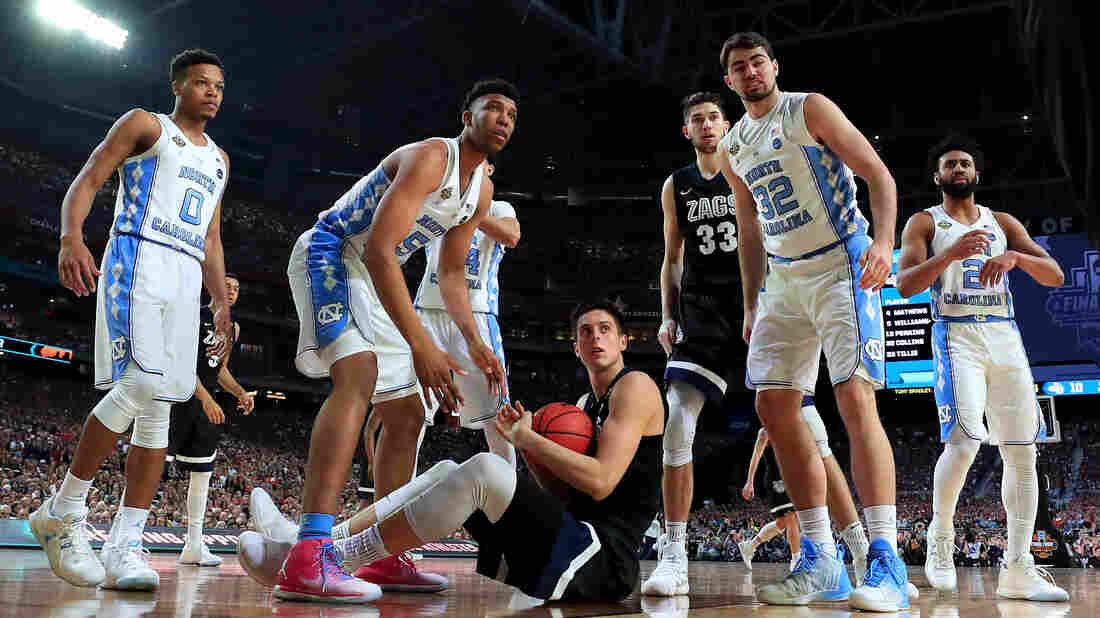
Forward Zach Collins the Gonzaga Bulldogs looks for a call from the referees first half during of the NCAA National Championship game. The freshman blocked three shots and got seven rebounds in the game, but also turned the ball over four times and fouled out with more than five minutes left to play.

Tom Pennington/Getty Images

hide caption

toggle caption

Tom Pennington/Getty Images

But in the last four minutes of the half, North Carolina evened out both the rebound margin and the score, cutting Gonzaga’s game-high seven-point lead to three at the half. Good three-point shooting by the Bulldogs (5-9, vs. 2-12 for the Tar Heels) helped give them the lead, but turnovers kept them from getting away.

As halftime ended, North Carolina coach Williams said his players weren’t moving enough on offense, and were settling for the shots Gonzaga wanted them to take. The Tar Heels drove the ball inside far more in the second half, getting easier shots, building up the fouls on Gonzaga and gaining an edge they needed to win.

Let’s block ads! (Why?)


No Image

Change To President Trump's Trust Lets Him Tap Business Profits

At a Jan. 11 news conference at Trump Tower on in New York City, President-elect Trump gestures at a stack of folders that he said contained documentation separating him from his businesses. That revocable trust was modified about a month later to let Trump withdraw from it at any time, ProPublica reports.

Spencer Platt/Getty Images

hide caption

toggle caption

Spencer Platt/Getty Images

With an oversized check for $78,333, written to the National Park Service, White House press secretary Sean Spicer on Monday took the first step in fulfilling President Trump’s pledge to give away his presidential salary.

Spicer said that the sum equaled Trump’s salary for the first quarter of 2017, and that similar charitable contributions will be made each quarter.

But a five-figure check is pocket change compared to the wealth of Trump’s business empire — businesses now held by the Donald J. Trump Revocable Trust, and a newly released document opens new holes in the ethics wall between the president and that wealth.

Trump lawyer Sheri Dillon said, at a January press conference, that the revocable trust would prevent conflicts of interest.

“President Trump wants there to be no doubt in the minds of the American public that he is completely isolating himself from his business interests,” she said.

This afternoon, however, after Spicer brought out the big check, he had to fend off questions as to just how isolated from the Trump empire the president is.

He said he didn’t know of any changes in the trust since January. “I’m not aware there was any change,” he said. “Just because a left-wing blog makes the point of something changing doesn’t mean it actually happened.”

It wasn’t a left-wing blog, but rather Pro Publica — a nonpartisan, nonprofit investigative journalism outfit — that first reported the change. A document dated Feb. 17 lets Trump draw out profits and principal from his businesses.

It says the trustees “shall distribute” funds to Trump at his request. It also requires them to send him money when appropriate and for “his maintenance, support or uninsured medical expenses.”

Essentially, the president can take money from his businesses whenever he wants.

Spicer dismissed a question of whether Trump already has done so, saying, “The idea that the president is withdrawing money at some point is exactly the purpose of why the trust — a trust — is set up regardless of the individual.”

But the purpose of presidential trusts has been to avoid conflicts of interest.

The new document also sheds new light on how the trust works. It’s run by two trustees, Donald Trump Jr. and an executive of the Trump Organization, who cannot give the president reports on the trust’s finances. But Trump’s second son, Eric, can do that as chair of the trust’s advisory board, and told Forbes magazine last month that he plans to give his father big-picture financial briefings every quarter or so.

Before Trump, recent presidents sold their assets or put them into a blind trust
when they took office.

“This is a ploy, okay?” said Kathleen Clark, a professor of law and ethics at Washington University in St Louis. “It’s a public relations ploy to give people the impression that Trump has done something meaningful about the massive conflicts of interest he faces.”

Those conflicts center mainly around his hotels and brands overseas, U.S. environmental laws that affect his golf courses, and his Washington, D.C., hotel.

Let’s block ads! (Why?)


No Image

Kishori Amonkar, Leading Indian Classical Vocalist, Dies At Age 84

The Indian vocalist Kishori Amonkar and tabla player Zakir Hussain posing at an awards ceremony in Mumbai, India in February 2016. Amonkar died on April 3, 2017 at age 84.

STRDEL/AFP/Getty Images

hide caption

toggle caption

STRDEL/AFP/Getty Images

One of India’s foremost classical singers, Kishori Amonkar, has died; she was one of the primary representatives of the Hindustani (North Indian) vocal tradition. The Times of Indiareported Amonkar died today at home in Mumbai after a brief illness, at age 84.

Kishori Amonkar was a musicians’ musician. In a 2011 documentary about the singer, Bhinna Shadja(a film commissioned by India’s Ministry of External Affairs), the internationally renowned tabla virtuoso Zakir Hussain placed her among the greatest Hindustani vocalists of all time, saying of her music: “It’s a painting that embodies every detail of someone’s life. In that, there is great happiness, great sadness, great anger, great frustration, desperation. Everything comes into focus in this one, concentrated little piece.” Using her nickname, “Tai,” Hussain continued: “That journey you can take in the world of art with so few. Kishoritai is one of those people.”

Along with her brilliant and deeply emotional improvisations in the khyal classical song style, in performances of single ragas that could last well over an hour, Amonkar — who usually sang cradling a small swaramandal zither to accompany herself — was particularly noted for her work in two other, more compact song genres: the “semi-classical” thumri style, and in bhajans, a kind of Hindu religious devotional song. In the recording below, Amonkar interprets a Meera bhajan, a song in honor of the god Krishna attributed to the 16th-century mystic and poet Meera (also known as Mira, Meerabai or Mirabai).

[embedded content]
YouTube

Born April 10, 1932, Amonkar trained with her mother, singer Mogubai Kurdikar, in the Jaipur Atrauli gharana (school, or tradition) founded by the 19th-century artist Ustad [Master] Alladiya Khan. In an interview with The Indian Express originally published in December, Amonkar recalled her mother as a stern taskmaster: “She would sing and I would repeat,” she said. “I would copy her without asking her anything. Aai [Mother] was so strict that she would sing the sthayi [refrain] and antara [stanza] only twice and not a third time. I had to get every contour of the piece in those two instances. That taught me concentration.” Later, she would accompany her mother onstage, playing the stringed tanpura drone as her mother sang.

After her professional career began to develop in her early twenties, Amonkar reportedly lost her voice totally. She said that she found no cure in Western-style doctors or physical therapy. Instead, she credited the return of her abilities — a process that took two years — to a holy person who aided her with Ayurveda. According to Amonkar, that two-year break from singing helped her find her own voice — and her own approach into the tradition. She finally felt free enough to locate her own connection to the music she was singing, rather than simply mimic what she had been taught.

Amonkar received two of the Indian government’s highest civilian awards: the third-highest, the Padma Bushan, in 1987 and the second-highest, the Padma Vibhushan, in 2002. Even so, she was less of a celebrity figure than some of her contemporaries, rarely performing internationally and loathe to give interviews.

She was also famously prone to chastising audiences and presenters for what she perceived as less-than-perfect attention to her performances. Amonkar attributed that acerbity to her need to service the music. “I want to get involved and focus on the abstract … For that I need my audiences’s help, not their interruptions,” she told The Indian Express. “People have to understand that music isn’t entertainment. It is not to be sung to attract the audience, which is why I never play to the gallery.”

[embedded content]
YouTube

Let’s block ads! (Why?)