
November 6, 2016

No Image

Keitany And McFadden Extend Winning Streaks In NYC Marathon

Mary Keitany of Kenya crosses the finish line first in the women’s division of the 2016 New York City Marathon on Sunday, Nov. 6. Seth Wenig/AP hide caption

toggle caption

Seth Wenig/AP

Mary Keitany of Kenya won her third consecutive New York City Marathon on Sunday, finishing in 2 hours, 24 minutes, 26 seconds, and leaving her closest competitors in the dust.

Keitany pulled away from the elite women’s pack less than halfway into the race and ran most of the race alone, her No. 1 spot uncontested over more than a dozen miles.

The men’s race was more conventional, with a pack of elite runners sticking together for more than half of the 26.2 mile course before 20-year-old Eritrean runner Ghirmay Ghebreslassie pulled away. He crossed the finish line in 2 hours, 7 minutes, 51 seconds, becoming the youngest man ever to win.

Ghirmay Ghebreslassie of Eritrea (center) Lucas Rotich of Kenya (left) and Lelisa Desisa of Ethiopia, during the New York City Marathon. Jason DeCrow/AP hide caption

toggle caption

Jason DeCrow/AP

Lucas Rotich of Kenya finished second in the men’s field. Abdi Abdirahman, an American, finished third.

Ghebreslassie finished fourth at the Olympics in Rio de Janeiro over the summer. But Keitany was cut from Kenya’s Olympic team — despite being the second fastest female marathoner ever. According to the International Association of Athletics Federations, only Paula Radcliffe has ever run a faster time than Keitany’s 2012 London marathon time of 2 hours 18 minutes 37 seconds.

Article continues after sponsorship

Sunday was Keitany’s triumphant return, showing that she could not only win, but do so without the luxury of fellow elite runners to pace her throughout the race. Sally Kipyego of Kenya took second place in the women’s race with a time more than three minutes slower than Keitany’s. Molly Huddle of the United States was third.

In the women’s wheelchair race, the American Tatyana McFadden won her fourth New York City Marathon title in a row, and her fifth overall, according to the official race press release.

McFadden has dominated wheelchair racing since 2004, when she won her first Paralympic Games medal as a 15-year-old. In 2012, she described how she won the right to compete as a young athlete at Atholton High in Howard County, Md.

Tatyana McFadden of the United States celebrates winning the Professional Women’s Wheelchair Division for the fourth consecutive time during the 2016 New York City Marathon. Elsa/Getty Images hide caption

toggle caption

Elsa/Getty Images

NPR’s Joseph Shapiro reported:

“[McFadden] wanted to be part of the high school track team. But on the eve of the first track meet, the coach refused to give her a uniform. She wouldn’t be allowed to compete.

“After her mother complained, Tatyana was allowed to race, but not side-by-side with her teammates. At her first meet, her teammates and other competitors in the 400-meter race ran first. Then the track meet stopped and Tatyana was allowed to race — going around the track in her wheelchair, racing against no one. ‘That was the most humiliating, embarrassing thing I’ve ever done, ever,’ she says.

“She didn’t want to be the girl in the wheelchair; even then, she wanted to be seen as a top athlete. ‘People look at you and in their minds [they] see, ‘Oh, the girl with a disability in a wheelchair is running for a high school team. Congratulations.’ And for me as an elite athlete, it’s not what you want as an elite athlete.'”

On the men’s side, Marcel Hug of Switzerland narrowly won the wheelchair event, edging out Kurt Fearnley by six hundredths of a second, according to race regulators.

Marcel Hug of Switzerland, right, crosses the finish line first, just ahead of Kurt Fearnley of Australia, in the men’s wheelchair division of the 2016 New York City Marathon on Sunday. Seth Wenig/AP hide caption

toggle caption

Seth Wenig/AP

Here are full race results for the overall women, overall men and the men’s and women’s wheelchair races.
Let’s block ads! (Why?)


No Image

VW Chairman Now Included In German Prosecutor's Volkswagen Emissions Probe

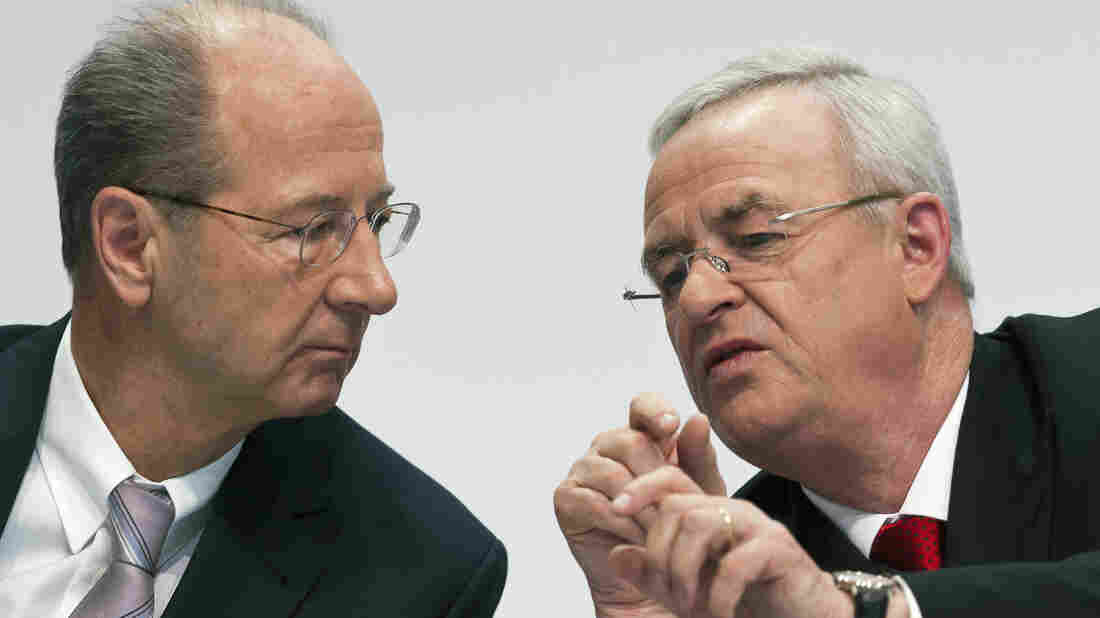
VW Chairman Hans Dieter Pötsch, left, seen here with his predecessor Martin Winterkorn, has been at Volkswagen since 2003. ullstein bild/ullstein bild via Getty Images hide caption

toggle caption

ullstein bild/ullstein bild via Getty Images

The public prosecutor’s office looking into Volkswagen’s diesel emissions scandal in Germany has widened the investigation to include Chairman Hans Dieter Pötsch, who was VW’s chief financial officer when its cars were built to fool emissions tests.

The news comes more than one year after Pötsch was named chairman; last December, he acknowledged that the emissions cheating had stemmed from a “chain of errors” in the company rather than from the actions of a group of rogue engineers.

Pötsch was Volkswagen’s chief financial officer from 2003 to 2015 — a period that encapsulates the company’s development of cheating devices that could fool U.S. emissions tests on diesel engines. The Environmental Protection Agency’s list of affected model years runs from 2009 to 2015.

Volkswagen announced the new development Sunday, saying that despite the Braunschweig public prosecutor’s move, the company “reaffirms its belief that the Volkswagen Board of Management duly fulfilled its disclosure obligation under German capital markets law.”

NPR thanks our sponsors

Let’s block ads! (Why?)


No Image

Middle-Class Americans Face Biggest Strain Under Rising Obamacare Costs

Last month, officials announced health care costs under the Affordable Care Act are expected to rise 22 percent. Rachel Martin speaks with Lindsay Travnicek, an Arizona woman who may forgo coverage.

UNIDENTIFIED WOMAN #1: I think most people hate to think of themselves as middle class.

UNIDENTIFIED WOMAN #2: You have what you need but maybe not everything you want.

UNIDENTIFIED MAN #1: We have a car, but we live in an apartment. That’s middle class.

UNIDENTIFIED MAN #2: If you add a boat, then you’re not middle class anymore. That’s what changes it right there.

UNIDENTIFIED MAN #3: The middle class are families who are earning six figures.

UNIDENTIFIED MAN #4: Thirty thousand, $35,000 probably.

UNIDENTIFIED MAN #5: That means me (laughter). And that means I’m in trouble (laughter).

RACHEL MARTIN, HOST:

It’s time now for our series Hanging On, where we look at some of the economic pressures of American life. Open enrollment for insurance under Obamacare began this past week. That’s after the administration announced that the cost of health care under the Affordable Care Act is expected to rise an average of 22 percent in 2017. Most people won’t actually pay that much more since federal subsidies will also go up. But those who don’t qualify for those subsidies could see a huge increase in their monthly insurance premiums.

Lindsay Travnicek is one of those people. She’s a self-employed dietitian, and she lives in Arizona. She joins us on the line now.

Lindsay, thanks for being with us.

LINDSAY TRAVNICEK: Thank you.

MARTIN: So tell me about the health insurance that you have now. What are your premiums, and what does it cover?

TRAVNICEK: So this year, I was insured through United Health Care over the exchange. And my plan was $255 a month. And I had a $2,000 deductible. So this year – my most recent research on the healthcare.gov – the lowest priced plan that I can get is $430. And the deductible is $4,200 now. And so that is the same plan that I had last year. So the deductible, it went up, you know, $2,200. And the monthly premium went up, you know, a little – you know, $210 or so.

MARTIN: So what does that mean to you? I mean, first of all – let me just ask – are you going to get a subsidy? We hear that subsidies are going to help people who are stretching to make this kind of payment.

TRAVNICEK: Yeah, I do not qualify for a subsidy. And also – I should also say I am a very healthy person. I have no chronic diseases. I take, you know, very good care of myself. And I don’t – you know, I feel that, you know – for me to pay for $430, which is a sizable chunk of disposable income, you know, for basically, sort of, just insuring that something doesn’t go wrong, I mean, that is – I guess I’m at a point now where that is a risk that I am willing to take.

I voted for Obama. And I voted for what I hoped would be a change in, you know, these insurance companies, you know, taking advantage of people and refusing to pay for care that people needed. And we are just getting – I feel like I’m getting the short end of the stick. You know, I’ve paid into the system a long time as a healthy person. And I just am choosing not to pay in any more.

MARTIN: So you’re not going to renew your health insurance for next year?

TRAVNICEK: No, I’m not.

MARTIN: Does that scare you a little bit to think about not having health care?

TRAVNICEK: Oh, my God, it’s terrifying. I come from a family of doctors and people in the medical field. And to us, you know, to go without health care is just – again, it is very risky. But I mean, this is just – I feel like, maybe I could just pay out of pocket and probably still come out ahead, even after paying the penalty for not having any coverage.

MARTIN: The presidential election is Tuesday. Arizona, where you live, is in play in a way it hasn’t been in the past. It’s a battleground state. Is this something you and your friends and family are talking about as a deciding factor when it comes to who you’re going to vote for?

TRAVNICEK: I have been in many discussions with my family, like I said, who’s in the health care field. And I’m really disappointed that neither candidate really touched on this topic in a more broad, deep way during the debates. They didn’t come up with solutions, what they would do. It was, you know, it was just, sort of, general talk about, we understand it’s not affordable. We need to change it. We need to fix it.

And so, you know, I voted for Hillary. And I don’t rescind that. But it is very – it’s very disheartening to me that neither candidate really touched on this in a – you know, a very tangible way as to what their solution was going to be.

MARTIN: Lindsay Travnicek on the line from Tempe, Ariz. We’ve been talking about the Affordable Care Act.

Lindsay, thank you so much.

TRAVNICEK: You’re very welcome. Thank you.

Copyright © 2016 NPR. All rights reserved. Visit our website terms of use and permissions pages at www.npr.org for further information.

NPR transcripts are created on a rush deadline by Verb8tm, Inc., an NPR contractor, and produced using a proprietary transcription process developed with NPR. This text may not be in its final form and may be updated or revised in the future. Accuracy and availability may vary. The authoritative record of NPR’s programming is the audio record.

Let’s block ads! (Why?)