
August 21, 2016

No Image

Rio Dances: Closing Ceremony For The 2016 Summer Olympics
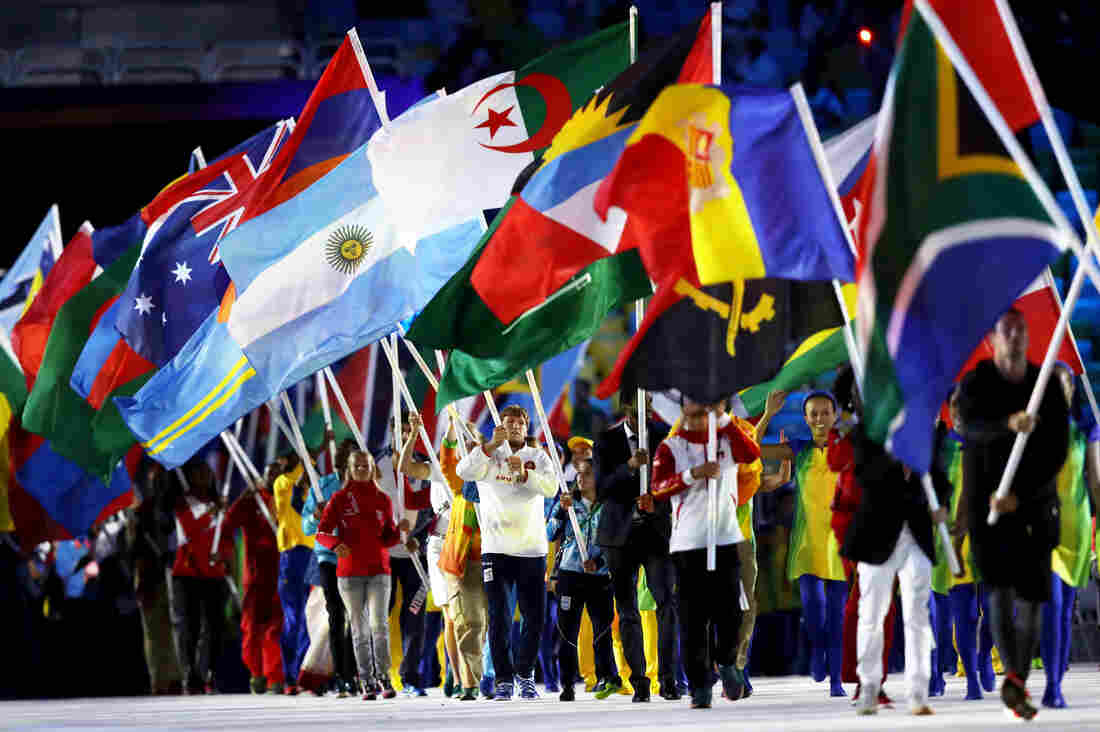
Athletes walk during the "Heroes of the Games" segment during the Closing Ceremony of the Rio 2016 Olympic Games at Maracana Stadium on Sunday in Rio de Janeiro, Brazil.

Athletes walk during the “Heroes of the Games” segment during the Closing Ceremony of the Rio 2016 Olympic Games at Maracana Stadium on Sunday in Rio de Janeiro, Brazil. Ezra Shaw/Getty Images hide caption

toggle caption Ezra Shaw/Getty Images

Rio 2016 organizers are dropping the curtain on the Summer Games, Sunday after hosting the world’s elite athletes who’ve competed for 306 medals over the past 19 days here in Rio de Janeiro.

The closing ceremony starts at 8 p.m. local time, which is one hour ahead of Eastern Time. Because of NBC’s time delay, it’s airing at 8 p.m. ET and progressively later across the U.S.

We’re updating this post with scenes from the event, so please refresh to see what’s happening in Rio. We got a late start due to technical issues, so we’re filling in some blanks from the official guide to the ceremony.

The opening ceremony began with a countdown, similar to the one we saw in the opening ceremony. After that, performers evoked the colors we’ve seen all during these games — inflections on Brazil’s blue, green, and yellow flag — to form a welcoming array of Rio landmarks.

The Games have been criticized for empty seats, but the stadium is packed on Sunday night.

The Games have been criticized for empty seats, but the stadium is packed on Sunday night. Ed Jones/AFP/Getty Images hide caption

toggle caption Ed Jones/AFP/Getty Images

Later in the show, a segment evoked the expanse of time that the opening show also got at, with cave-paintings displayed on Maracana Stadium’s floor in a a meditation on archeology.

The effect was very pretty — but the crowd loved what came in the show’s second half. One segment, cartoon characters such as Mario ran around — and then, inexplicably and yet wondrously, shot a drill bit through the Earth and out the other side. They created a tunnel that links Tokyo (hosts of the 2020 Games) and Rio, with a green pipe-like entrance protruding from Rio.

And here in Rio, the tunnel’s green entrance the magically appeared on the floor of Maracana — and out popped Japan’s Prime Minister Shinzo Abe. Or at least that’s what we’re told. It’s one of those “Wait, what… I love it!” moments that Olympic ceremonies pull off at their best.

Japan's Prime Minister Shinzo Abe appears during the closing ceremony.

Japan’s Prime Minister Shinzo Abe appears during the closing ceremony. David Ramos/Getty Images hide caption

toggle caption David Ramos/Getty Images

Another winning segment came earlier, when Grupo Corpo, a contemporary dance troupe from the Brazilian state of Minas Gerais, put on part of “Parabelo,” one of its shows, at the ceremony. But then the dancers gave way to “clay people,” and the performance drew roars of approval as the crowd bopped along to Luiz Gonzaga’s forró song “Asa Branca.”

The closing ceremonies must always include speeches, and that happened often tonight. There were also national anthems — of Brazil, of Greece, of Japan, and of Kenya (during a medal ceremony for marathon).

Dancers wave flags ushering in excitement for the 2020 Summer Olympics which will be held in Tokyo.

Dancers wave flags ushering in excitement for the 2020 Summer Olympics which will be held in Tokyo. Martin Bernetti/AFP/Getty Images hide caption

toggle caption Martin Bernetti/AFP/Getty Images

At the end of the show came a tribute to a personal favorite of ours: the genius landscape designer and artist Roberto Burle Marx, famous for his organic, wavy shapes (he created Copacabana’s iconic sidewalk tile pattern). Trained in Europe, Marx was a champion of Brazil’s native plants and its rainforests. In this segment, the music is “Chovendo na Roseira,” in a version by Tom Jobim.

The flame was then extinguished, in a graceful official end to these games.

And then, after a thoughtful pause — and because Rio knows how to party — the drums kicked in, and six six samba singers belted out “Cidade Maravilhosa” (Marvelous City) — a Carnival march that is Rio’s anthem. In the stadium, row upon row of people stood and danced, singing along.

Dancers pay tribute to landscape designer and artist Roberto Burle Marx, who created Copacabana's iconic sidewalk tile pattern.

Dancers pay tribute to landscape designer and artist Roberto Burle Marx, who created Copacabana’s iconic sidewalk tile pattern. Cameron Spencer/Getty Images hide caption

toggle caption Cameron Spencer/Getty Images

Was it then over? Not yet: A sound truck appeared, along with 12 carnival queens, and athletes who competed in these games poured out of

While these games have been criticized for not having full seats, Maracana was packed last night with people who watched Brazil’s men’s soccer team win gold. And tonight, it’s full of people who came out to enjoy the unique spectacle the Olympics brings.

Music — seen by many as the backbone of Brazil’s culture — is woven throughout this ceremony, from old classics and traditional music to new pop sounds from around the country. The audience clearly agrees with the choices the show’s music programmers have made. Brazilian music has many anthems, standards that everyone can sing, and tonight we’re hearing strains of familiar music reworked in new ways.

Singer Mariene de Castro performs in front of the Olympic flame before it was extinguished.

Singer Mariene de Castro performs in front of the Olympic flame before it was extinguished. Alexander Hassenstein/Getty Images hide caption

toggle caption Alexander Hassenstein/Getty Images

At the start of the show, a choir of 27 children entered, looking like little twinkling stars. With singers representing Brazil’s 26 states (and the Federal District), they performed Brazil’s national anthem.

We’ll note that after a travel delay, we arrived at Maracana Stadium later than we wanted — it’s a rainy, dreary evening in Rio. But the show must go on — even in an open-air stadium. Tonight, Maracana’s halls are darkened to highlight the light show and the Olympic flame.

Confetti falls as singers and dancers perform during the closing ceremony on Sunday.

Confetti falls as singers and dancers perform during the closing ceremony on Sunday. David Ramos/Getty Images hide caption

toggle caption David Ramos/Getty Images

At the end of an Olympics, talk always turns to their legacy – and instead of one, these games could be said to have many: First and foremost, there’s the drama, grace, and excellence displayed by more than 11,000 athletes.

Then there are the games’ effects on Rio – its people, its infrastructure, and it standing. What will become of the buildings erected to host this global event? And will the Paralympic Games, which have faced huge budget problems here in Rio, go smoothly?

Spectators dance as fireworks light up the sky during the closing ceremony of the Rio 2016 Olympic Games on Sunday.

Spectators dance as fireworks light up the sky during the closing ceremony of the Rio 2016 Olympic Games on Sunday. Fabrice Coffrini/AFP/Getty Images hide caption

toggle caption Fabrice Coffrini/AFP/Getty Images

The impact of the Olympics on the city’s future is tied to its impact on Brazil – whose economy was bustling when Rio won the right to host these games eight years ago but which was continually forced to rebalance its budget for the Olympics and Paralympics, making cuts that sometimes gave a ramshackle air to the proceedings.

And then, we come to the members of the U.S. swim team who failed to distinguish themselves repeatedly in an episode that eventually led U.S. Olympic Committee President Scott Blackmun to apologize “to our hosts in Rio and the people of Brazil for this distracting ordeal.”

Let’s block ads! (Why?)


No Image

The 'Young Invincibles': A Huge Hurdle For Obamacare

Young, healthy people referred to as “young invincibles” pose a serious challenge to the success of President Obama’s expanded health care coverage, the Affordable Care Act. Kaiser Health’s Julie Rovner explains more about this group of uninsured Americans.

Transcript

FARAI CHIDEYA, HOST:

Now it’s time for our regular segment Words You’ll Hear, where we try to understand what’s happening in the news by parsing some of the words associated with it. This week, our words are young invincibles. We’re talking about healthy young people who don’t have health insurance. They’re not being covered at work, and they’re choosing to bypass health care coverage available through the Affordable Care Act. They could be the downfall of the long-term success of President Obama’s legacy expanded health care coverage.

Joining us to help explain more about them is Julie Rovner from Kaiser Health News. Hi, Julie.

JULIE ROVNER: Hi. How are you?

CHIDEYA: I’m great. So first of all what are the characteristics of young invincibles? How young are we talking about and what’s keeping them from buying health insurance?

ROVNER: Well, originally young invincibles were males in their 20s. That was how they were always thought of, you know – young guys who felt like they were invincible, so they didn’t need health insurance. They would never get sick. They would never have an accident. More recently, the term has come to describe, I think, what most of us think of as millennials, both young men and young women. But the idea is still the same. They feel like they don’t need health insurance because they’re not going to get sick.

CHIDEYA: So why is it a problem for insurers and especially for the Affordable Care Act if these folks don’t buy insurance?

ROVNER: Well, the Affordable Care Act made individual insurance available to people who were older and sicker, and they jumped at the chance to buy it. The hope was that younger people would buy it because they were required to and their lower expenses would help balance out the risk pool, helping them basically subsidize older, sicker people on the theory that someday they’ll become older, sicker people and young people will subsidize them.

CHIDEYA: Last week, Aetna at first said that they would be pulling back on coverage in the Affordable Care Act exchanges, saying they were losing money in large part due to these young invincibles, but then another story emerged. So can you walk us through Aetna’s move?

ROVNER: They’re pulling out of most of the places where they are – have been selling insurance. And, you know, they said it was due to losses, and I don’t think anybody doubts they have been losing money. But what came out shortly after that announcement was a letter from Aetna to the Justice Department saying that if the Justice Department didn’t approve Aetna’s merger with Humana, they would therefore have to start pulling out, which is exactly what they did.

So some people saw that as kind of a threat that, you know, if you don’t do what we want, then we’re not going to participate anymore, but others point out that, you know, Aetna has an obligation to its shareholders. And even though it makes lots and lots and lots of money in general, it was, in fact, losing money in the exchange markets. Pretty much every insurer is complaining that this has not worked exactly as they had wanted, and it’s not just the lack of young people. There are unhealthy young people, and there are healthy older people. But basically they don’t have the mix that they had hoped for.

CHIDEYA: So what can policymakers and/or insurers do to convince the young invincibles to actually buy into the coverage?

ROVNER: Well, one problem that a lot of insurers have talked about – it’s been too easy to buy insurance outside the open enrollment period, which means that you can wait until you get sick to buy insurance. And that’s been a problem.

This year is the first year that the penalty actually goes up to its full amount for not having insurance. So now depending on how much they earn, young people could be responsible for fines that go up to about $2,500. So that could convince some of them that maybe they would like to spend that money on insurance instead. And then, of course, depending on who’s elected president and who’s elected to control Congress next year, there could be some more changes to try to smooth out some of the bumps that have been seen in the implementation of the law.

CHIDEYA: Julie Rovner covers health policy issues for Kaiser Health News. Thanks for joining us, Julie.

ROVNER: Thank you.

Copyright © 2016 NPR. All rights reserved. Visit our website terms of use and permissions pages at www.npr.org for further information.

NPR transcripts are created on a rush deadline by Verb8tm, Inc., an NPR contractor, and produced using a proprietary transcription process developed with NPR. This text may not be in its final form and may be updated or revised in the future. Accuracy and availability may vary. The authoritative record of NPR’s programming is the audio record.

Let’s block ads! (Why?)


No Image

George Curry, Legendary Political And Civil Rights Journalist, Dies At 69

In a 2005 photo, George Curry sits in a classroom at Howard University in Washington.

In a 2005 photo, George Curry sits in a classroom at Howard University in Washington. Kevin Wolf/AP hide caption

toggle caption Kevin Wolf/AP

George Curry, the legendary columnist, commentator and champion of black journalists, died of sudden heart failure on Saturday. He was 69.

Curry grew up in Tuscaloosa, Ala., where he was childhood friends with Bernard Lafayette, the current chairman of the Southern Christian Leadership Conference. “This is a tragic loss to the movement because George Curry was a journalist who paid special attention to civil rights because he lived it and loved it,” Lafayette told Trice Edney News Wire.

Curry began his career as reporter for Sports Illustrated and The St. Louis Dispatch. In the 1990s, he was the editor of Emerge, an edgy political and cultural publication with the tag line “Black America’s Newsmagazine.” In 1993, the cover depicted Supreme Court nominee Clarence Thomas wearing an Aunt Jemima-style handkerchief next to the word “BETRAYED.”

Curry was the first African-American to be elected president of the American Society of Magazine Editors.

After Emerge folded in 2000, Curry led the news service for the National Newspaper Publishers Association for nine years. He wrote a syndicated column that was published in black newspapers all over the country, and he frequently appeared as a commentator on television and radio news programs.

NPR’s Karen Grigsby Bates interviewed Curry on numerous occasions. In 2012, she spoke to him about how the media approached the murder of Trayvon Martin, an unarmed black teenager who was shot to death by a white man in Florida.

Bates reported:

“Syndicated columnist George Curry says the black media have a long history of highlighting anti-black violence, which mainstream media often picks up on later.

” ‘The black press plays a unique role, because they know right away and can recognize these kinds of stories and the value of them,’ Curry says.

Curry thinks part of the lag between when black and mainstream media began covering the Martin shooting can be accounted for by the communities’ different interaction with law enforcement.

‘I think that stems from the fact that whites have a different experience with the police than blacks and Latinos,” he says. “To whites, he’s Mr. Friendly. To blacks and Latinos, he’s Mr. Unfriendly.’ “

In 2014, Curry told Bates “there is no event in my life that has been more transforming than the murder of Emmett Till,” adding that another major black magazine, Jet, had been crucial to his understanding of the murder as a young man.

In an obituary, the current editors of Jet wrote, “Curry was largely thought of as an unapologetic steward and champion for the Black press and frequently expressed the need for it in the civil rights narrative.”

Let’s block ads! (Why?)