December 12, 2015

No Image

Alabama Running Back Derrick Henry Wins Heisman Trophy

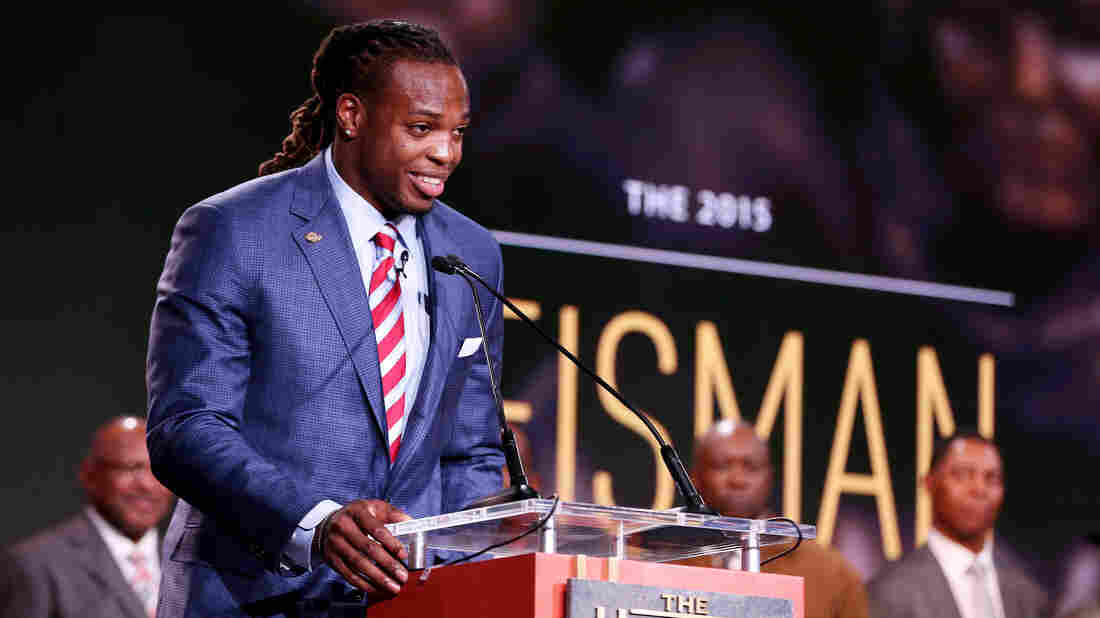
Running back Derrick Henry of the Alabama Crimson Tide speaks after being named the 81st Heisman Memorial Trophy Award winner Saturday in New York City.

Running back Derrick Henry of the Alabama Crimson Tide speaks after being named the 81st Heisman Memorial Trophy Award winner Saturday in New York City. Kelly Kline/Getty Images hide caption

toggle caption Kelly Kline/Getty Images

Alabama running back Derrick Henry has taken home this year’s Heisman Trophy.

Henry led the nation in rushing yards and rushing attempts, among other noteworthy stats, the Heisman Web site notes:

“The 6-3, 242-pounder from Yulee, Fla., set an SEC single-season-record in 2015 with 1,986 rushing yards. He also tied the conference mark for rushing touchdowns with 23.”

In one game against Auburn, Henry notched 46 carries for 271 yards — a career best in both, the Heisman site says.

The award site shared a video of Henry’s highlights from that game:

[embedded content]
YouTube

Although Alabama is a college football powerhouse, Henry is only the second Crimson Tide player to win a Heisman. The first was Mark Ingram, in 2009; Ingram was also the most recent running back to win the trophy.

Henry’s margin of victory was narrower than recent Heisman winners’, the Associated Press notes, but the contest wasn’t quite a squeaker. The Crimson Tide star had 1,892 points — 293 more points than second-place finisher Christian McCaffrey, a Stanford running back with the NCAA record for all-purpose yards in a season.

Clemson quarterback Deshaun Watson came in third.

This entry passed through the Full-Text RSS service – if this is your content and you’re reading it on someone else’s site, please read the FAQ at fivefilters.org/content-only/faq.php#publishers.


No Image

Today in Movie Culture: 'Star Wars: Episode V – The Empire Strikes Back' Edition

Here are a bunch of little bites to satisfy your hunger for Star Wars movie culture:

We’re counting down the days to the release of Star Wars: The Force Awakens by devoting a week’s worth of movie culture roundups to the seven live-action installments of the Star Wars Saga, continuing today with the second episode, The Empire Strikes Back, and further in release order through next Thursday.

See More Star Wars Movie Culture:

Star Wars: Episode IV – A New Hope

Classic Trailer of the Day:

The first trailer for The Empire Strikes Back arrived in 1979, promoting a sequel that would hit theaters the following summer. Watch it below.

[embedded content]

Movie Remake of the Day:

With approval of Lucasfilm, 480 fans got to contribute to this shot-for-shot remake of The Empire Strikes Back, each taking on a different scene in a different style:

[embedded content]

Sweded Scene of the Day:

Watch a homemade re-creation of the Hoth battle from The Empire Strikes Back, complete with a capella score:

[embedded content]

Alternative Movie Poster of the Day:

Some of the most well-known Mondo posters for any movie are Olly Moss’s Star Wars triptych. Below is the design for The Empire Strikes Back, which cleverly uses Cloud City to form part of Boba Fett’s helmet. See the other two here.

Movie Parody of the Day:

How It Should Have Ended took on The Empire Strikes Back five years ago, focusing on the iconic reveal that Darth Vader is Luke Skywalker’s father:

[embedded content]

Movie Scene Remix:

This re-edit of a brief moment from The Empire Strikes Back turns Darth Vader into an even bigger jerk:

[embedded content]

Cosplay of the Day:

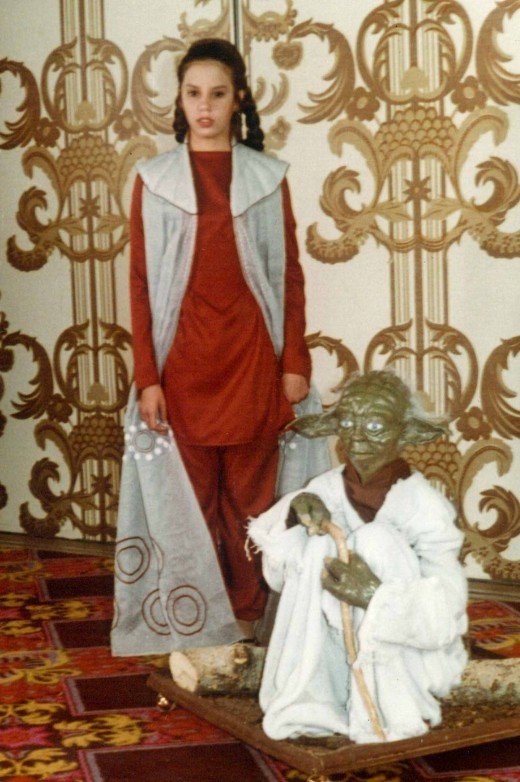
By the time The Empire Strikes Back rolled into theaters, fans were already attending conventions in costume. But this duo dressed as Princess Leia (Bespin outfit) and Yoda must have seen the sequel before attending Westercon in the summer of 1980.

Movie Trivia of the Day:

Think you’re a master of Star Wars trivia? Then knew everything in the following video of The Empire Strikes Back facts you did:

[embedded content]

Vintage Image of the Day:

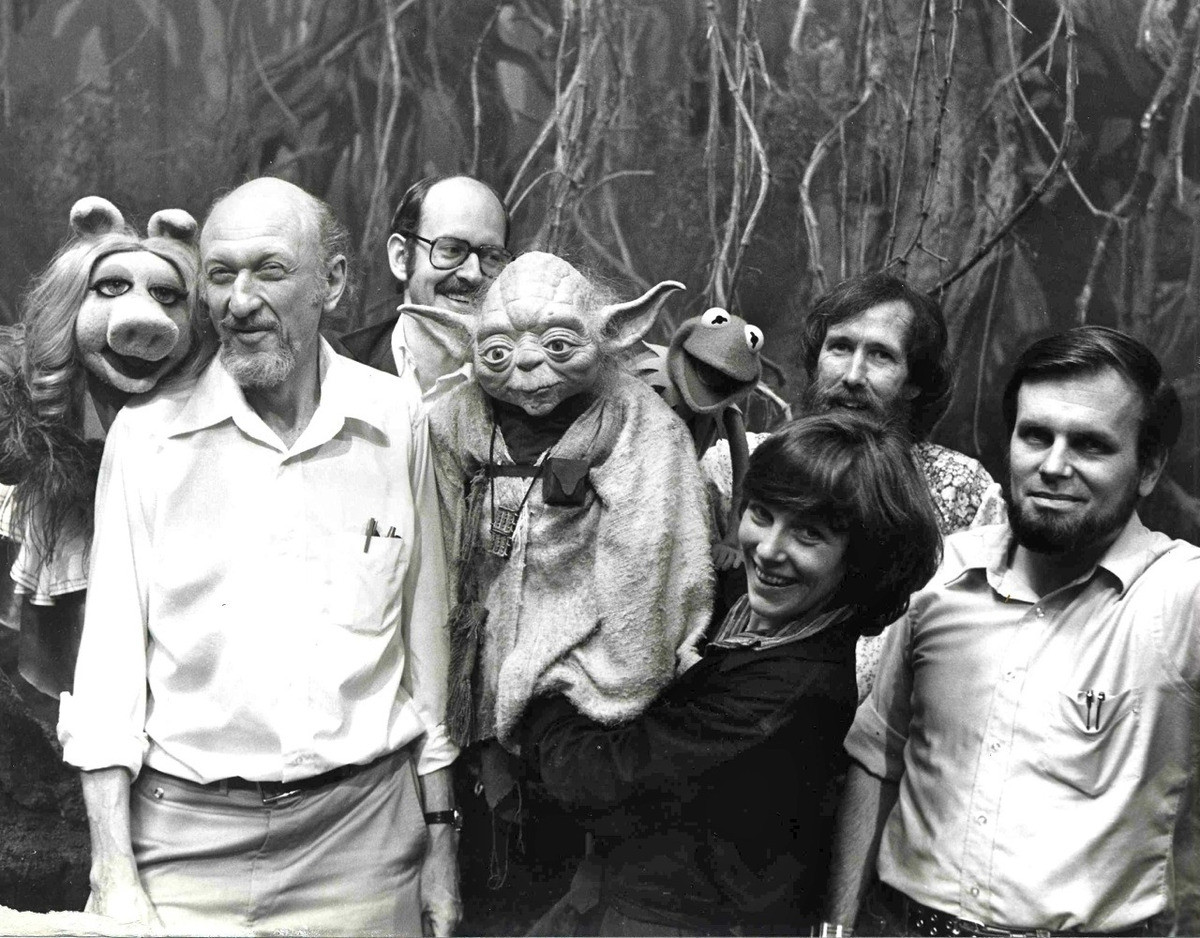
Kermit the Frog and Miss Piggy visit the set of The Empire Strikes Back in 1979 to meet their new Muppet friend, Yoda. Also in the photo are Yoda puppeteers Frank Oz and Kathryn Mullen, Muppets creator Jim Henson, Empire director Irvin Kershner and producer Gary Kurtz.

Movie Takedown of the Day:

Everyone thinks The Empire Strikes Back is not only the greatest Star Wars movie but one of the best movies of all time. So, here’s CinemaSins with everything wrong with the sequel:

[embedded content]

and

This entry passed through the Full-Text RSS service – if this is your content and you’re reading it on someone else’s site, please read the FAQ at fivefilters.org/content-only/faq.php#publishers.


No Image

Post-Bankruptcy, A Booming Detroit Is Still Fragile

Detroit, after having billions of dollars of debt erased through bankruptcy, has emerged with a razor-thin financial cushion.
3:57

Download

Detroit, after having billions of dollars of debt erased through bankruptcy, has emerged with a razor-thin financial cushion. Laura McDermott/Bloomberg via Getty Images hide caption

toggle caption Laura McDermott/Bloomberg via Getty Images

It’s been a year since Detroit emerged from the nation’s largest-ever municipal bankruptcy. The city has made strides in improving services, is enjoying a construction boom and, unencumbered by the billions of dollars of debt erased through bankruptcy, just gave the underpaid police force a raise before their contract is up.

“I want to get the bankruptcy behind us. We have to move this forward. It’s no longer the Motor City like it used to be. It’s no longer Motown. But we can write a new history,” said Mark Young, head of one of the city’s police unions, at a recent news conference about the police force raise.

Nevertheless, Detroit is walking a financial tightrope.

Detroit emerged from bankruptcy with a razor-thin financial cushion, where even being a few million dollars off in its billion-dollar general fund budget could trigger another fiscal collapse. Detroit Mayor Mike Duggan says even with the state having final say, the city is still making substantial progress.

“We have almost 90 percent of the lights in this city replaced. We have a full contingent of buses and the ambulances are arriving within eight or nine minutes, which is the national standard.”

But some financial analysts say Detroit’s bankruptcy has made the national bond markets leery of loaning money to any municipality.

Stephen Spencer represented Detroit’s major bondholders. He testified at a recent U.S. Senate hearing that the bankruptcy court allowed Detroit to pay far more of what it owed to city retirees than to bondholders.

“Detroit wasn’t a bankruptcy. It was a stick up,” Spencer said.

Yet even those who Spencer claims received preferential treatment say they don’t feel favored at all.

Fear Of Two Cities

Some city retirees lost a portion of their monthly pension payments, all the savings the city had invested for them and their health care benefits. Now retirees like Sheila Baker say they’re paying five times more for health insurance while the city’s downtown is booming with new construction.

“All of a sudden you got money in your pocket? They knew what they were doing,” she says. “You know, it’s all just a racket — literally — and they waited till we were older to do this to us? It is just unbelievable to me.”

New development is erupting downtown. There’s a new hockey arena complex and a new light rail line.

Construction continues on Orleans Landing, a housing development along the Detroit riverfront. A year after its exit from bankruptcy, new development is booming downtown.

Construction continues on Orleans Landing, a housing development along the Detroit riverfront. A year after its exit from bankruptcy, new development is booming downtown. Carlos Osorio/AP hide caption

toggle caption Carlos Osorio/AP

Trying to walk through a maze of construction at a downtown park, Detroiter Paul Garrison calls the efforts a godsend.

“Bankruptcy, in my perspective and opinion, was 10 years overdue. But fortunately it did finally take place,” he says, “and so the money the city is bringing in will not have to all go to debt.”

But only a few blocks away, at Detroit’s major transit center, bus rider James Jordan says he’s yet to see the new development touch the city’s outer-lying neighborhoods.

“OK, they’re opening a Nike shop. But you never hear about a new housing development or a new grocery store being built in the heart of the neighborhood.”

For their part, business leaders say Detroit cannot survive by becoming, in essence, two cities: one of haves and one of have nots.

Detroit-based businessman and auto racing legend Roger Penske is helping redevelop the city’s downtown. He says Detroit’s success depends on making it a city people want to live in.

“I’m gonna be sure it’s not two cities,” Penske says.

City officials are tearing down tens of thousands of blighted buildings and offering cut-rate prices to those who will move in and fix up salvageable homes. But Detroit still needs more jobs and a better school system.

If efforts to make those improvements fail, Detroit’s fragile financial forecast could again falter.

This entry passed through the Full-Text RSS service – if this is your content and you’re reading it on someone else’s site, please read the FAQ at fivefilters.org/content-only/faq.php#publishers.