
September 27, 2015

No Image

For Jukebox Salesman, Collecting Records Isn't Just A Job: It's A Hobby, Too
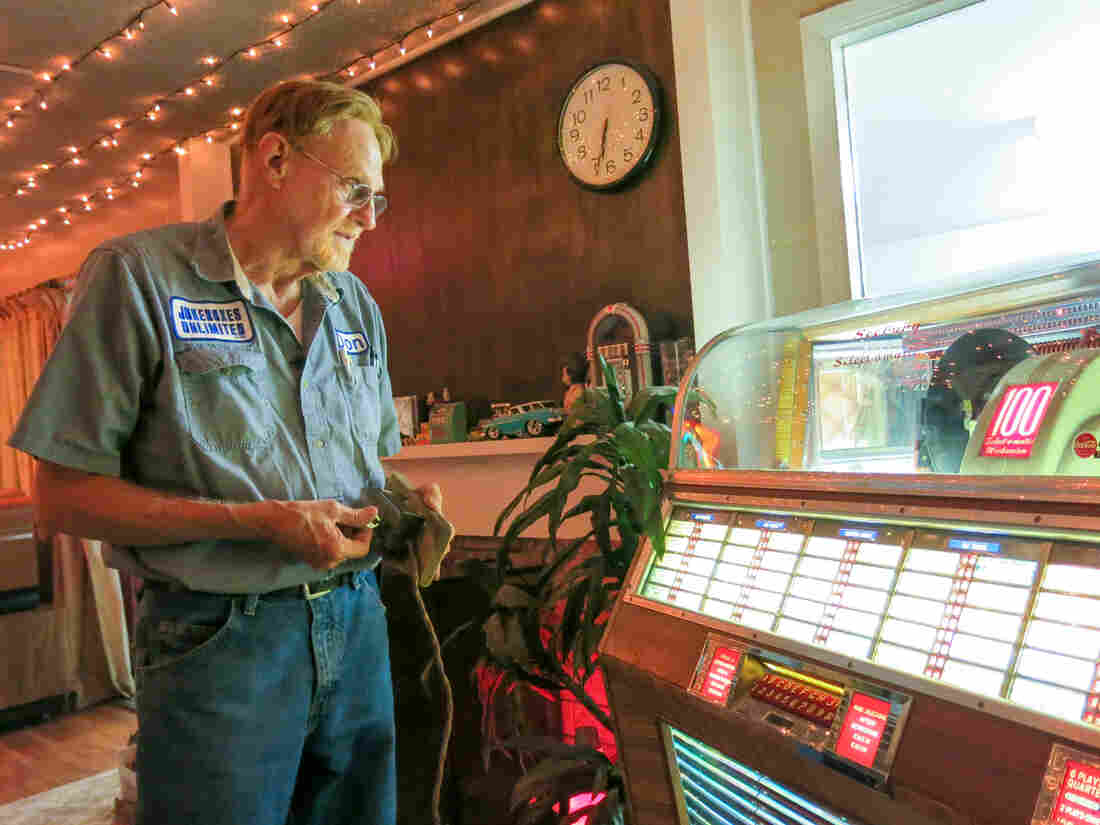
Don Muller says his favorite jukebox is his 1948 Seeburg M100A, which he keeps in the corner of his living room.
5:21

Download

Don Muller says his favorite jukebox is his 1948 Seeburg M100A, which he keeps in the corner of his living room. Carla Javier/NPR hide caption

itoggle caption Carla Javier/NPR

Don Muller has so many jukeboxes in his house, he doesn’t even know how many there are.

“I’ve never done this, walk around and count them,” Muller says, as he begins counting a row of jukeboxes tucked under a shelf of records.

He walks through the add-on garage, porch, living room and foyer. So far, he’s counted 62 jukeboxes, just in his own house — plus 40 in stock at his store, and plenty more in storage elsewhere.

“I’ve been telling people we have over a hundred,” Muller says. “Now, I know it’s even way more than that.”

Most of these jukeboxes are part of his company, Jukeboxes Unlimited, which he’s owned since 1971. He guts many of them to salvage their parts for assisting with repairs. Others, he fixes up to sell, while still others — the nicer looking ones, especially those that light up — he rents for parties and dances.

And some, Muller simply falls in love with and keeps for himself, like his 1948 Seeburg M100A. It sits in the corner of his living room at home.

“This machine is 100 percent original, every single aspect of it: the original cartridge, the original needle and original old 78 rpm records,” he says before playing Frankie Lymon’s “Goody Goody.”
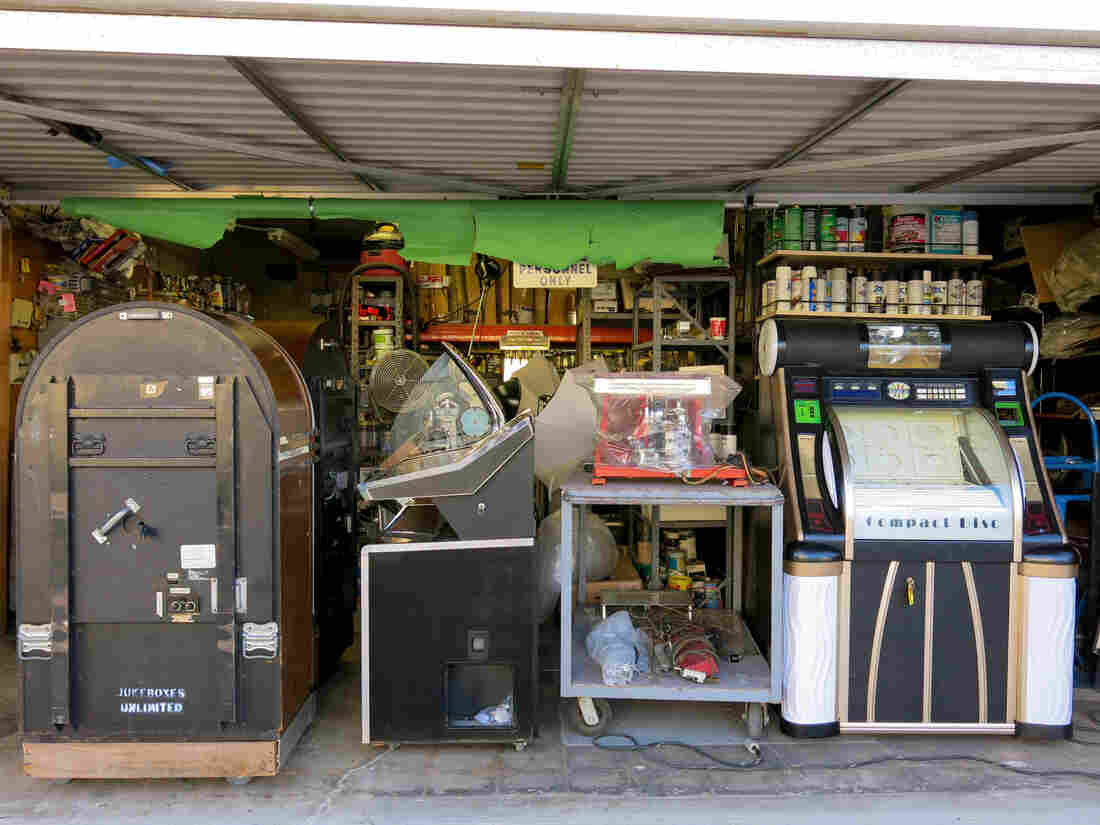
Muller's Jukeboxes Unlimited buys, repairs, rents and sells jukeboxes. He's owned it since 1971.

Muller’s Jukeboxes Unlimited buys, repairs, rents and sells jukeboxes. He’s owned it since 1971. Carla Javier/NPR hide caption

itoggle caption Carla Javier/NPR

Back when he got his start in the 1970s in Los Angeles, there were a lot of guys like him in the jukebox business — but he set himself apart by selling to the stars. His famous clients include Steve Martin and Mick Fleetwood, and their notes and copies of checks still fill books and albums of his. He even used to go to the Playboy Mansion to repair a jukebox owned by Hugh Hefner.

Muller, now 72, has seen many of his competitors go away. The business has gotten less glamorous, but he keeps busy through his online store.

“I get so many emails. I get ’em from all over the world, and it’s the same thing. It’s like, ‘Can you tell me what gear goes with this gear?’ And you know, for me to just get back to them and say, ‘What jukebox are you even talking about?’ I just don’t have time,” he explains.

He drives 50 miles to visit one of those people who contacted him online — Aline DeGroote, in Anaheim, Calif. She has promised to give him some records if he can take her jukebox off her hands.

Muller doesn’t need more records. The add-on to his house is full of them; he has hundreds and thousands already. Many are duplicates, and most aren’t worth that much — but he’s excited about the records DeGroote is offering anyway.

“I don’t collect records: I amass records,” he explains as he drives to DeGroote’s home. “I don’t even know what we’re getting today. I’m sure I already have 20 copies of what she’s got, but it’s an addiction.”

DeGroote’s jukebox is from the early ’60s, and she’s had some trouble selling it. She tried Craigslist and thrift stores.

“When I first tried to sell the jukebox, people were like, ‘Well, does it play CDs?'” DeGroote says.

Muller keeps his collection of records in what he calls "banana boxes." He says each box holds 400 45-rpm records.

Muller keeps his collection of records in what he calls “banana boxes.” He says each box holds 400 45-rpm records. Carla Javier/NPR hide caption

itoggle caption Carla Javier/NPR

Her dad, who died five years ago, used to keep the jukebox in the pool room. She grew up listening to it. But now it’s broken, and she’s selling it to Muller for $75.

“I wanted it to go to someone who would appreciate it for what it is,” she explains. “It’s a jukebox that plays old music.”

When she pulls out seven boxes of records, Muller’s face lights up. There are at least 2,000. He sorts through the records, putting them in other boxes he brought himself — “banana boxes,” he calls them, since he picked them up at the local grocery store.

“A packed banana box is 400 records,” he explains. “Four hundred 45s in a banana box.”

As he sorts through them, he gets excited when he sees a record by The Fleetwoods. He begins to sing “Come Softly To Me,” and DeGroote joins in.

Muller says he could make decent money if he sold his collection of over 400,000 records. But he doesn’t plan to unless someone comes along with a huge offer, because the records aren’t for his business.

They’re for his collection. And eventually, he’ll give them to his son.

This entry passed through the Full-Text RSS service – if this is your content and you’re reading it on someone else’s site, please read the FAQ at fivefilters.org/content-only/faq.php#publishers.


No Image

Fantasy Sports Push The Boundaries Of Legal Gambling

3:36

Download

More Americans than ever are signing up for fantasy sports leagues. NPR’s Rachel Martin speaks with Mike Pesca, host of The Gist podcast, about fantasy leagues and gambling.

Transcript

RACHEL MARTIN, HOST:

It’s time now for sports.

(SOUNDBITE OF MUSIC)

MARTIN: Today, we’re diving into the world of fantasy football. More Americans than ever are signing up for these leagues where you are the coach, the general manager and you decide who will be on your team. In the past few weeks, gaming sites have launched huge ad campaigns to try to cash in on what has become very big business. Mike Pesca is the host of Slate’s “The Gist” podcast. He’s here to tell us more. Hey, Mike.

MIKE PESCA: Hi, and isn’t it sad how they’ve defined fantasy down? What if I told you 30 years ago you’d be living out your fantasy. And I’d say yeah, but then they’d say, yeah it’s drafting Davante Adams in the third round.

MARTIN: (Laughter) Somehow seems insufficient, yeah. All right, so…

PESCA: That’s right.

MARTIN: …Remind us how this whole thing works.

PESCA: Well, the big trend now is the daily fantasy league. DraftKings and FanDuel are the two most prominent ones. The people who track ads say that DraftKings took out more ads than any other company in America like McDonald’s or GM…

MARTIN: Wow.

PESCA: …I have to name all the companies. I have a podcast. They do a couple podcasts where advertisers support it. Guess who advertises sometimes on my show? These guys. You can’t get away from it. So how they work is you pick different players. Depending on how the players do, you get points and then maybe you win your contest. You could make the weekend interesting for a wager of $5. You could wager $500 and lose the kids’ savings if you are so inclined.

MARTIN: Wow, OK, so DraftKings, Fanduel, have been really aggressive with their advertising, obviously. But how is it legal to gamble on sports this way when you’re not allowed to do the same thing in real life?

PESCA: Well, you’re not allowed to bet on the outcome of a game. So Chargers against the Bengals, you can’t bet on that. But if I wanted to bet on Philip Rivers, the quarterback of the Chargers, I mean, I would be betting on him. And the answer is the yearly fantasy leagues have existed for a while. They’re sometimes not even played for money or that much money. But you want to say camel’s nose under the tent, you want to say slippery slope, there was a loophole in the law. This loophole was exploited. The only state that bans it is Montana, but federally, it seems fine.

MARTIN: OK, so if this is getting so popular, though, is it likely to open any other doors? Is it likely to loosen the rules about betting on real-life football or other sports, for that matter?

PESCA: I think it will. And there are a few things going on. First of all, both of these companies, if you look at how much was invested, they’re both worth a billion dollars, and they both have partnered with the big sports league, with Major League Baseball, with the NHL, with the NBA. And, in fact, baseball and the NBA, they each own a part of some of the leagues. That’s part of their agreement. And the other big thing is that Adam Silver, the Commissioner of the NBA, he has said that he wants an avenue towards gambling to be legal. So I think rather than these fantasy leagues becoming illegal, what’s going to happen is that regular betting on the outcome of a game, a legal bet on the Super Bowl, will eventually be allowed to happen. But my one hope is that all the advertising – I know I’ve been the beneficiary to some extent – just simmers down a little bit. You can’t change a channel without someone telling you to try out FanDuel. Give it a break. This is fantasy gone awry.

MARTIN: (Laughter) Mike Pesca’s the host of “The Gist” on Slate. Thanks so much for talking with us.

PESCA: You’re welcome.

Copyright © 2015 NPR. All rights reserved. Visit our website terms of use and permissions pages at www.npr.org for further information.

NPR transcripts are created on a rush deadline by a contractor for NPR, and accuracy and availability may vary. This text may not be in its final form and may be updated or revised in the future. Please be aware that the authoritative record of NPR’s programming is the audio.

This entry passed through the Full-Text RSS service – if this is your content and you’re reading it on someone else’s site, please read the FAQ at fivefilters.org/content-only/faq.php#publishers.