
June 6, 2015

No Image

After 37 Years, A Triple Crown Winner At Last: American Pharoah Sweeps The Races

It took nearly four decades, but a horse has once again attained the honor that some call the most difficult achievement in sports: American Pharoah, after winning the Kentucky Derby and the Preakness Stakes, ran to victory in the Belmont Stakes as well.

He’s the first Triple Crown winner since 1978. With his win, a total of 12 horses have now achieved the feat.

American Pharoah took the lead early in the race, with Materiality close on his tail: at the halfway point, they were separated by three-quarters of a length.

But then the favorite kicked away, opening up a two-length lead at the top of the final stretch, as Frosted moved into second. American Pharoah and jockey Victor Espinoza opened up even more distance as they made their way to triumph across the finish line.

In that emphatic win, American Pharoah overcame a marked disadvantage: he was the only horse running in the Belmont Stakes who also ran in both the Derby and the Preakness. That means he was racing against better-rested horses.

Over the years, as NPR’s Joel Rose reports, that disparity has led to grumbling from horse-racing fans and professionals — and some skepticism that any horse, under those rules, could again win the Triple Crown:

“I’m 61 years old, and I’ll never see, in my lifetime, I will never see another Triple Crown winner, because [of] the way they do this,” said California Chrome’s owner, Steve Coburn, after the race.

The winner at last year’s Belmont was Tonalist. He didn’t run in the Kentucky Derby or the Preakness, so he had plenty of time to rest before the Belmont. Coburn said that should not be allowed.

“It’s all or nothing,” Coburn said last year. “Because this is not fair to these horses that have been running their guts out for these people, and for the people who believe in them. This is a coward’s way out in my opinion. This is a coward’s way out.”

Coburn later apologized. But he put his finger on something real. Of the seven horses challenging American Pharoah in this year’s Belmont, only one raced in the Preakness three weeks ago, meaning the other horses have had at least two extra weeks to rest.

But calls for a rule change might die down for a while, now that American Pharoah beat his well-rested opponents.

The resounding win is a triumph not only for the horse, but for owner Ahmed Zayat and Hall of Fame trainer Bob Baffert.

And it may feel particularly sweet to Espinoza, who has fallen just short of the Triple Crown twice before: In 2002, he rode War Emblem as the Triple Crown contender came in 8th in the Belmont; last year, he rode California Chrome to 4th.

On Saturday, before a roaring crowd, he rode American Pharoah into the history books.

This entry passed through the Full-Text RSS service – if this is your content and you’re reading it on someone else’s site, please read the FAQ at fivefilters.org/content-only/faq.php#publishers.

No Image

Once Feared, Now Celebrated, Hudson River Cleanup Nears Its End

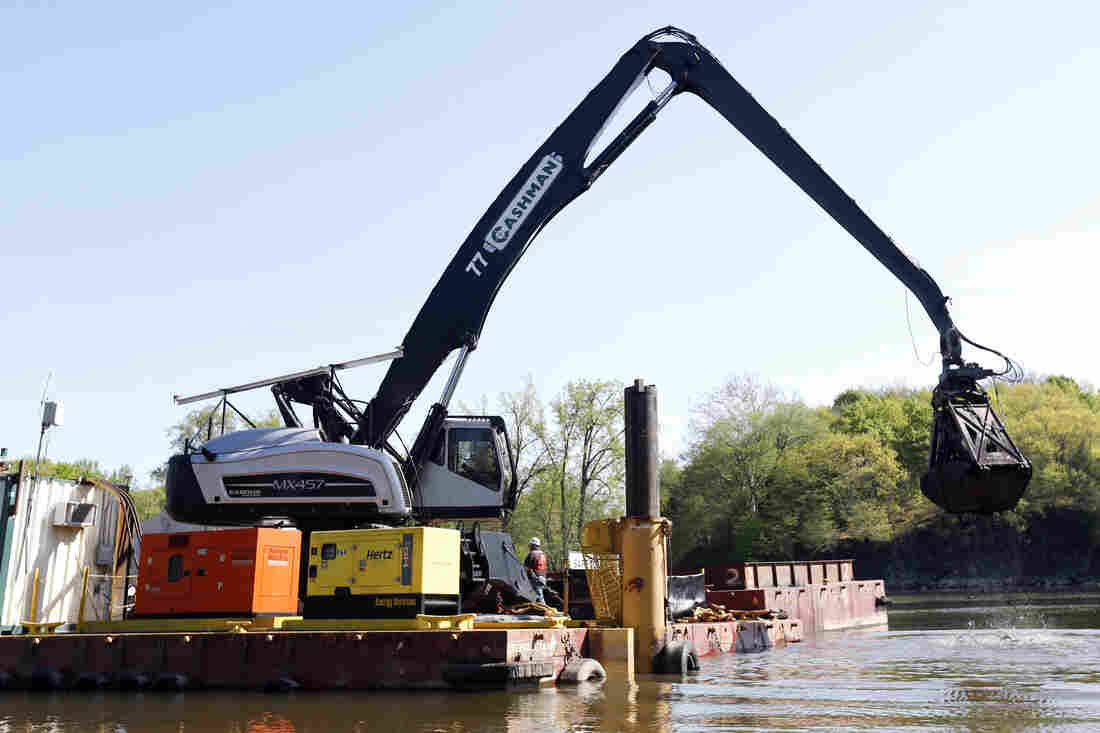
Crews perform dredging work along the upper Hudson River in Waterford, N.Y. General Electric's cleanup of PCBs discharged into the river decades ago will end this year.

Crews perform dredging work along the upper Hudson River in Waterford, N.Y. General Electric’s cleanup of PCBs discharged into the river decades ago will end this year. Mike Groll/AP hide caption

itoggle caption Mike Groll/AP

For half a decade, General Electric has been paying for a massive dredging operation on the upper Hudson River in New York.

The billion-dollar cleanup, designed to remove toxic PCBs, sparked fierce controversy when it was proposed. But as the project enters its final summer, it’s been so successful that even some of the cleanup’s most vocal critics want it expanded.

A Symbol For Sick Rivers

Just offshore in Mechanicville, three hours north of New York City, barges shuttle back and forth across the Champlain Canal, a waterway linked to the Hudson River. A backhoe is digging up great gobs of PCB-contaminated muck.

“The good news is we’re finishing the dredging and then we anticipate [that] over a decade or decades, that the fish advisories will begin to be reduced,” says Gary Klawinski, director of the Environmental Protection Agency’s Hudson River field office.

PCBs were once a key ingredient in GE’s manufacturing of electrical components, but the substance has been linked to cancer in animals and studies have shown severe impacts on wildlife. PCBs were banned in the 1970s, but not before GE poured tons of it into these waterways from two plants along the river.

As a result, people were warned against swimming and eating the fish. The Hudson became a symbol for sick and polluted rivers nationwide.

Still, when the cleanup was first proposed, it was surprisingly controversial. With advertising, GE convinced a lot of locals in places like Mechanicville that dredging would do more harm than good.

“These wonderful moments on one of the richest rivers on Earth could be interrupted for the next 20 years, if the EPA orders the Hudson dredged,” read one ad.

Those ads scared a lot of people. Ernest Martin, then mayor of the nearby town of Stillwater, N.Y., captured the mood when he spoke at a public hearing in 2001.

“I am definitely against dredging in the Hudson River,” Martin said. “It will take too many years to clean it under the dredging proposal by EPA. Our future for tourism, employment, new business will be lost forever.”

A National Model For Dredging

But the EPA pushed forward, requiring that GE remove roughly two-thirds of the PCBs. It was described as the largest, most complex Superfund site in U.S. history.

With active dredging now its sixth year, even the project’s early critics say it’s been a huge success.

“We did have reservations about this project, as did many others,” says Mark Behan, a spokesman for GE. “Because at the time that it was conceived, no project of this size or complexity had ever been attempted before.”

Behan says the company is now proud of its work here, developing new techniques to remove toxic silt from a vast river that changes from season to season.

“We assembled a world-class team of dredging, environmental and engineering experts, we adapted technology to the task and we’ve produced a project that EPA now calls a national model,” Behan says.

Now towns along New York’s upper Hudson have begun revitalizing these old industrial waterfronts, thinking about a future where kids can swim and play along the shore without fear of contamination.

“I remember when this all started the predictions were it was going to have a major impact on all communities,” says Mark Sever, who works for the city of Mechanicville. “So I guess, we’re pleasantly surprised.”

Calls For An Expansion

The dredging has gone so well that a lot of local leaders here have pivoted completely. More than 50 towns and counties are now calling on GE to keep working until all of the PCBs are scooped up.

EPA officials haven’t endorsed that idea. They say they’re satisfied that enough PCBs have been removed that the Hudson can begin healing. GE’s Behan says the company has done enough.

“For years, there have been voices who have said they wanted a different project, a larger project, a smaller project, but EPA is the decision-maker,” he says. “EPA ordered the dredging project, and GE executed that project, and I think did so exceptionally well.”

But a separate coalition of state and federal agencies — not including the EPA — has been studying the impact of PCBs on Hudson River wildlife. They’ve signaled that they may push GE to dredge contaminated sites not included on the EPA’s list.

This entry passed through the Full-Text RSS service – if this is your content and you’re reading it on someone else’s site, please read the FAQ at fivefilters.org/content-only/faq.php#publishers.

No Image

Forty Years Ago, NBA Finals Featured A Surprise: The Warriors

The last time the Golden State Warriors were in the NBA Championship, their berth was such a surprise that they had to schedule games around an ice entertainment show at the Oakland Coliseum.

This entry passed through the Full-Text RSS service – if this is your content and you’re reading it on someone else’s site, please read the FAQ at fivefilters.org/content-only/faq.php#publishers.


No Image

Serena Williams Wins French Open For 20th Grand Slam Title

Serena Williams of the U.S. reacts as she plays Lucie Safarova of the Czech Republic during their final match of the French Open tennis tournament at the Roland Garros stadium on Saturday.

Serena Williams of the U.S. reacts as she plays Lucie Safarova of the Czech Republic during their final match of the French Open tennis tournament at the Roland Garros stadium on Saturday. Francois Mori/AP hide caption

itoggle caption Francois Mori/AP

Overcoming a mid-match lull and a third-set deficit, Serena Williams won her third French Open title and 20th major singles trophy by beating 13th-seeded Lucie Safarova of the Czech Republic 6-3, 6-7 (2), 6-2 on Saturday.

The top-ranked Williams took the last six games and added to her championships on the red clay of Roland Garros in 2002 and 2013.

She stretched her Grand Slam winning streak to 21 matches, following titles at the U.S. Open last September and Australian Open in January.

Only two women in the century-plus history of Grand Slam tennis have won more than the 33-year-old American: Margaret Smith Court with 24 titles, and Steffi Graf with 22.

This one, though, did not come easily for Williams, who double-faulted 11 times.

This entry passed through the Full-Text RSS service – if this is your content and you’re reading it on someone else’s site, please read the FAQ at fivefilters.org/content-only/faq.php#publishers.


No Image

American Pharoah Makes A Run At History

Kentucky Derby and Preakness Stakes winner American Pharoah plays with hot walker Juan Ramirez during a bath Friday at Belmont Park.

Kentucky Derby and Preakness Stakes winner American Pharoah plays with hot walker Juan Ramirez during a bath Friday at Belmont Park. Julie Jacobson/AP hide caption

itoggle caption Julie Jacobson/AP

The Triple Crown is one of the most difficult tests in sports: Three horse races over the course of just five weeks, culminating with the Belmont Stakes Saturday in Elmont, N.Y.

American Pharoah is favored to win, which would make him the first horse to capture the Triple Crown in 37 years. But his rivals have a key advantage: They’ve had extra time to rest, and that’s led to some grumbling inside the sport.

Since 1978, a dozen horses have won the Kentucky Derby and the Preakness — only to come up short on the mile-and-a-half dirt track at Belmont Park. That total includes last year’s Belmont favorite, California Chrome, who finished a disappointing fourth.

“I’m 61 years old, and I’ll never see, in my lifetime, I will never see another Triple Crown winner, because [of] the way they do this,” said California Chrome’s owner, Steve Coburn, after the race.

The winner at last year’s Belmont was Tonalist. He didn’t run in the Kentucky Derby or the Preakness, so he had plenty of time to rest before the Belmont. Coburn said that should not be allowed.

“It’s all or nothing,” Coburn said last year. “Because this is not fair to these horses that have been running their guts out for these people, and for the people who believe in them. This is a coward’s way out in my opinion. This is a coward’s way out.”

Coburn later apologized. But he put his finger on something real. Of the seven horses challenging American Pharoah in this year’s Belmont, only one raced in the Preakness three weeks ago, meaning the other horses have had at least two extra weeks to rest.

That’s led some to propose extending the Triple Crown season, so that all the horses might be on more equal footing going into the final race. But the owner of American Pharoah rejects that idea.

“The good ones find a way to win,” said Ahmed Zayat. “My horse is coming in with zero excuse.”

At a press conference this week, Zayat said tradition is important. “What makes this game special is its history,” Zayat said. “I want to be compared, if my horse achieves something, to Seattle Slew and Secretariat. Once you try to play with what happened before, it’s something you don’t want to do.”

The last horse to win the Triple Crown was Affirmed, in 1978, ridden by an 18-year-old jockey named Steve Cauthen.

“I remember right after I won it that people were starting to say the Triple Crown is getting too easy, they’re gonna have to make it tougher,” Cauthen says. “Because people were getting bored when three horses won it in one decade.”

Those winners in the 1970s also included Secretariat and Seattle Slew. Cauthen says there’s a reason the Triple Crown schedule is grueling.

“That’s what proves that a Triple Crown horse is so special, is that he takes on all comers at all times,” Cauthen says. “There’s no question that he’s far and away the best horse.”

If American Pharoah wins at Belmont, he’ll join that very select group of Triple Crown champions. If he doesn’t, you can bet that calls to change the rules will continue.

This entry passed through the Full-Text RSS service – if this is your content and you’re reading it on someone else’s site, please read the FAQ at fivefilters.org/content-only/faq.php#publishers.


No Image

Triple Championships: The Weekend In Sports

It’s a championship weekend in sports: the NBA Finals, the Stanley Cup, and perhaps a Triple Crown? NPR’s Scott Simon talks with NPR’s Tom Goldman about the upcoming sporting events.

This entry passed through the Full-Text RSS service – if this is your content and you’re reading it on someone else’s site, please read the FAQ at fivefilters.org/content-only/faq.php#publishers.


No Image

For New Mexico's Chiles, The Enemy Isn't Just Drought But Salt, Too

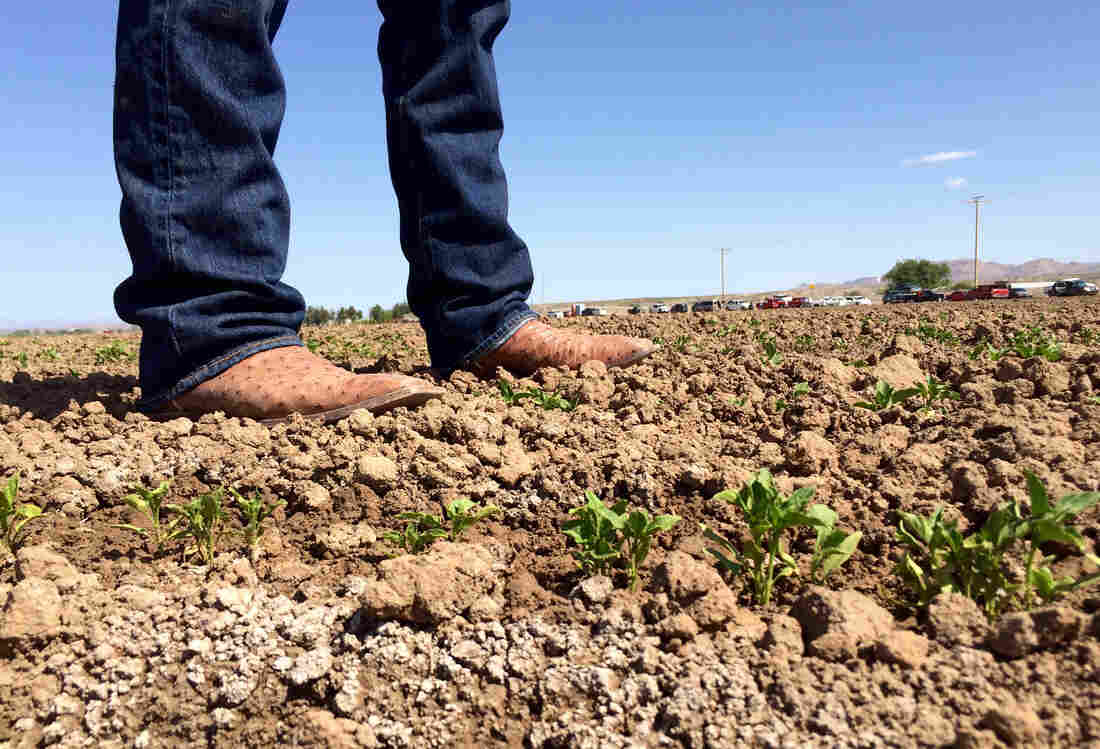
Salt appears in white clumps in a newly sprouted chile field in Garfield, N.M.

Salt appears in white clumps in a newly sprouted chile field in Garfield, N.M. Mónica Ortiz Uribe/KJZZ hide caption

itoggle caption Mónica Ortiz Uribe/KJZZ

For some people, too much salt is bad for health. Too much salt is also bad for growing most crops.

Salty soil is a common problem for farmers in the arid West and it’s gotten worse because of the ongoing drought. Water is necessary to flush salts out; without it, salt builds up over time.

In New Mexico, one crop that’s suffering is the state’s beloved chile pepper.

Chile is not just a crop in New Mexico — it’s an identity. Whether red or green, the long leathery pepper with its unmistakable aroma is the reigning ingredient in local cuisine. It’s posted on road signs, arranged in vertical wreaths for decoration and protected by state law from impostors. But lately the state’s chile crop has been declining.

Joe Paul Lack is a farmer who married into New Mexico’s chile dynasty. His wife’s family is credited with commercializing a mild green pepper known as Big Jim.

Dried red chile pods for sale in Hatch, New Mexico's chile capital.

Dried red chile pods for sale in Hatch, New Mexico’s chile capital. Susan Montoya Bryan/AP hide caption

itoggle caption Susan Montoya Bryan/AP

“This is the third year that I have not had one acre of chile,” he says. “I’ve been farming since the ’70s, so yeah, that hurts.”

Lack farms in southern New Mexico, near Hatch, the state’s chile capital. Foreign competition and labor shortages are partly to blame for the shrinking chile acreage. But so is drought.

Dry weather forces farmers to pump from underground aquifers. The water spills into irrigation canals that flow onto fields, making up for a short supply in the neighboring Rio Grande. But while groundwater can be a blessing, it’s also a curse.

“The aquifers tend to be salty,” said Stephanie Walker, a vegetable specialist at New Mexico State University.

Salt is part of a geologic legacy beneath the desert, leftover from ancient oceans that once covered the West. The shallow aquifer under New Mexico’s chile fields concentrates the salt. Experts estimate salt content there has quadrupled in the last four years.

“The longer growers have to pump water … the more detriment to the vegetables that they are trying to grow,” Walker says.

The detriment comes in the form of root damage, which weakens certain crops, like chile. In New Mexico, production is down 40 percent from record highs a decade ago. That’s despite better farming techniques that allow farmers to grow seven times more chile per acre than they did back in the 1990s.

In the absence of water from the neighboring Rio Grande, farmers have taken to pumping from underground aquifers. The salt content in groundwater builds up on the soil and harms certain kinds of crops, like chile.

In the absence of water from the neighboring Rio Grande, farmers have taken to pumping from underground aquifers. The salt content in groundwater builds up on the soil and harms certain kinds of crops, like chile. Mónica Ortiz Uribe/KJZZ hide caption

itoggle caption Mónica Ortiz Uribe/KJZZ

“What we need is a couple of monster snow seasons,” says Phil King, a civil engineer and consultant for the Elephant Butte Irrigation District.

Like the Colorado River, the Rio Grande depends on snowmelt. The more water in the river, the more water to flush away the salts. But as global temperatures rise, scientists predict there will be less snow to feed rivers. One federal study says the Rio Grande could lose a third of its flow by the end of the century.

“Our whole system is predicated on having a supply of fresh river water from the north, and if we don’t we are simply not sustainable,” says King.

The battle against salt is happening across the West. It’s fallowed more than 100,000 acres in California’s San Joaquin Valley. Salty runoff from farms in the Colorado River basin was what prompted the federal government to build a desalination plant in Yuma, Ariz., after years of complaints from Mexican farmers downstream.

“We have a tendency to utilize our resources to their fullest capacity and then go through painful downsizing when necessary,” King says.

The Elephant Butte Irrigation District, which covers 90,640 acres in southern New Mexico, is making an effort to combat its salt problem in an era of little water. Farmers are installing drip irrigation, which uses less water and pushes salt away from a crop’s root zone. The district is also looking into creating systems that capture storm water.

No matter the challenges, farmers pledge to not let their state’s beloved chile pepper die. Those who have stuck it out say they’ll continue until nature forces them out.

This entry passed through the Full-Text RSS service – if this is your content and you’re reading it on someone else’s site, please read the FAQ at fivefilters.org/content-only/faq.php#publishers.


No Image

FIFA Arrests Unlikely To Tarnish The Women's World Cup

The Women’s World Cup kicks off Saturday in Canada. Twenty-four teams will compete in six cities. NPR’s Scott Simon talks to NPR’s Shereen Marisol Meraji about the largest sporting event for women.

This entry passed through the Full-Text RSS service – if this is your content and you’re reading it on someone else’s site, please read the FAQ at fivefilters.org/content-only/faq.php#publishers.